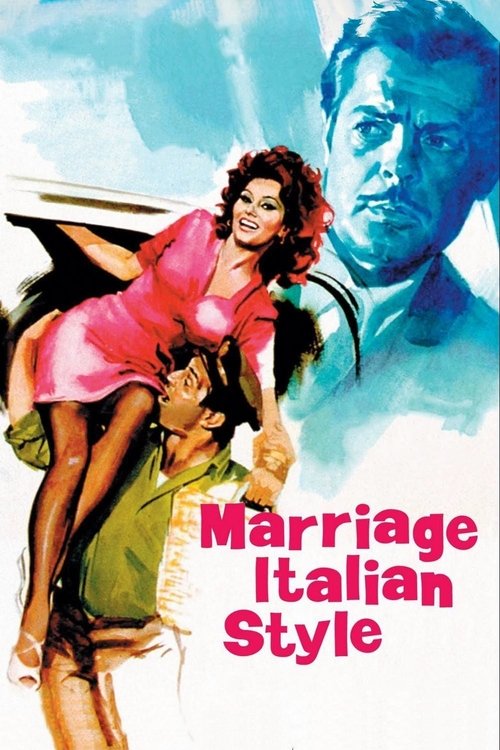
Marriage Italian Style
A fiery Neapolitan tragicomedy where love is a battlefield of deceit and devotion. Against the sun-drenched chaos of post-war Italy, a determined woman uses her wits to turn a selfish playboy into a father, proving that tears are the ultimate weapon of the heart.
Marriage Italian Style

Marriage Italian Style

Matrimonio all'italiana

"You have never seen it before! A New torrent of emotions! A New Triumph of Film-Making from Embassy Pictures who brought you "Divorce Italian Style" and "Yesterday, Today and Tomorrow" now brings you..."

18 December 1964 Italy 102 min ⭐ 7.7 (535)
Director: Vittorio De Sica
Cast: Sophia Loren, Marcello Mastroianni, Aldo Puglisi, Tecla Scarano, Marilù Tolo
Drama Comedy Romance
The Sanctity of Motherhood Patriarchy vs. Female Agency Social Class and Dignity Forgiveness and Redemption
Box Office: $12,800,000

Overview

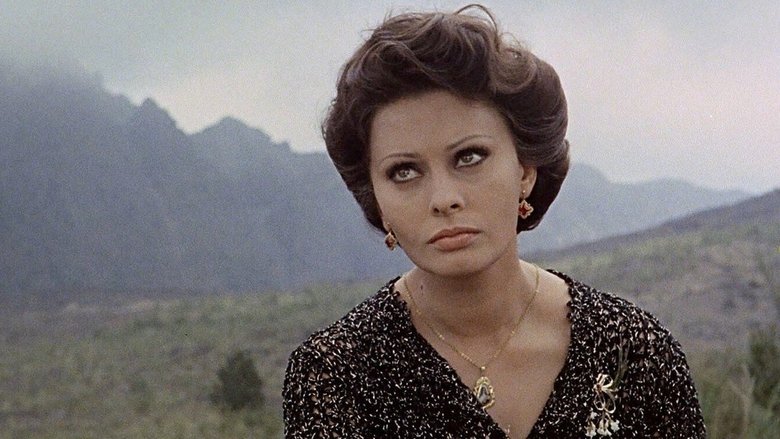
In the bustling, chaotic streets of Naples, Filumena Marturano (Sophia Loren), a former prostitute, has spent twenty years as the mistress and servant of Domenico Soriano (Marcello Mastroianni), a wealthy and narcissistic businessman. Tired of being marginalized and treated like a piece of furniture, Filumena hatches a desperate plan: she feigns a mortal illness on her deathbed to trick Domenico into marrying her. Terrified of her impending death and feeling a flicker of guilt, Domenico agrees, only to be enraged when Filumena miraculously 'recovers' immediately after the ceremony.

As Domenico fights to annul the marriage, the film delves into their shared past through flashbacks, revealing their first meeting during a WWII bombing and the decades of Filumena's silent devotion. However, Filumena holds a trump card that changes everything: she reveals she has three grown sons, secretly raised on Domenico's money. One of them is his biological child, but she refuses to say which one, declaring that 'children are children, and they are all equal.' Domenico is forced to confront his own selfishness and the true meaning of family as he tries to uncover the truth.
Core Meaning

At its heart, Marriage Italian Style is a testament to the ferocious resilience of women in a patriarchal society. Director Vittorio De Sica explores the idea that family is defined not by biological certainty or legal contracts, but by love, sacrifice, and commitment. The film deconstructs the male ego, showing how a woman's unwavering moral force can redeem a self-absorbed man and transform a hollow arrangement into a genuine bond.

Thematic DNA

The Sanctity of Motherhood 35%
Patriarchy vs. Female Agency 25%
Social Class and Dignity 20%
Forgiveness and Redemption 20%

The Sanctity of Motherhood

Filumena's entire existence is driven by her devotion to her illegitimate sons. She endures humiliation and servitude solely to provide for them. The film posits motherhood as a sacred, equalizing force that supersedes social stigma and the law.

Patriarchy vs. Female Agency

Domenico represents the entitled Italian male who views women as commodities. Filumena subverts this power dynamic not through force, but through superior emotional intelligence and strategic manipulation, effectively dismantling his control.

Social Class and Dignity

The conflict is also one of class: the illiterate, slum-born Filumena versus the wealthy, bourgeois Domenico. Filumena's struggle is a fight for dignity and respectability (the name 'Soriano') for her children, challenging the rigidity of social stratification.

Forgiveness and Redemption

Despite decades of mistreatment, Filumena offers Domenico a chance at redemption. The film suggests that true maturity comes from accepting responsibility, allowing Domenico to evolve from a 'boss' into a father.

Character Analysis

Filumena Marturano

Sophia Loren

Archetype: The Mother / The Survivor
Key Trait: Ferocious Tenacity

Motivation

To secure a legitimate name and future for her three secret sons.

Character Arc

Starts as a vulnerable 17-year-old prostitute, hardens into a stoic mistress, and finally triumphs as a respected matriarch. Her journey is one of gaining agency and reclaiming her dignity.

Domenico Soriano

Marcello Mastroianni

Archetype: The Rogue / The Reformable Patriarch
Key Trait: Narcissism

Motivation

Initially, to maintain his freedom and pleasure; later, to discover which boy is his blood son.

Character Arc

Begins as a narcissistic playboy who treats Filumena as property. Through the shock of her deception and the revelation of his son, he is humbled and learns to value emotional connection over control.

Alfredo

Aldo Puglisi

Archetype: The Loyal Fool
Key Trait: Subservience

Motivation

To serve Domenico while secretly sympathizing with Filumena.

Character Arc

Serves as the comic relief and Domenico's sidekick, often caught in the crossfire of the couple's domestic wars.

Symbols & Motifs

The 100 Lire Bill

Meaning:

Symbolizes the transactional nature of their early relationship transformed into a bond of blood. It marks the date of the son's conception, turning a payment for sex into a token of paternity.

Context:

Filumena tears the corner off a bill Domenico gave her years ago and keeps it in a locket. She gives it back to him as a clue to his son's identity.

Filumena's Tears

Meaning:

Represent her suppressed humanity and vulnerability. For years, she refused to cry to survive her harsh life; her ability to finally weep signifies her safety and happiness.

Context:

In the final scene, after securing her family's future, she cries for the first time, telling Domenico, 'How good it is to cry.'

The Cupboard

Meaning:

Symbolizes Filumena's entrapment and Domenico's indifference to her fear.

Context:

During their first meeting in the brothel during an air raid, a young Filumena hides in a cupboard, trembling, while Domenico remains casual and detached.

Memorable Quotes

I figli so' ffigli e so' tutti eguali.

— Filumena Marturano

Context:

Filumena delivers this line when Domenico demands to know which of the three boys is his, establishing her moral superiority.

Meaning:

'Children are children, and they are all equal.' This is the moral spine of the film. Filumena refuses to identify the biological son because she knows Domenico would favor him and neglect the others. She forces him to love them all or none.

Sto chiagnenno... Quant'è bello chiagnere.

— Filumena Marturano

Context:

Spoken in the final moments of the film after she and Domenico are legally married and the family is united.

Meaning:

'I am crying... How good it is to cry.' Marks the completion of her arc from a hardened survivor to a woman allowed to feel emotion.

The more the world changes, the more it stays the same.

— Domenico Soriano

Context:

Domenico musing on the modernization of the city while his personal life remains stuck in old patterns.

Meaning:

Reflects his cynical, somewhat oblivious worldview, contrasting with the massive changes happening in his own household.

Philosophical Questions

Does biology determine parenthood?

The film argues that shared history and conscious commitment make a parent, not just DNA. Domenico is only forced to become a father to all three boys because he cannot distinguish the one who shares his blood, teaching him that love should not be conditional on genetics.

Is deception justified in the face of oppression?

Filumena lies about her illness and hides her children for decades. The film frames these lies as necessary survival tactics in a world where honest women of her class have no power, asking if morality is a luxury of the privileged.

Alternative Interpretations

While traditionally viewed as a romantic triumph, some modern critics offer a cynical reading: Domenico never truly changes; he is simply outmaneuvered. He marries Filumena not out of love, but because he is trapped by his own curiosity about his son and his aging ego. In this view, the 'happy ending' is actually a victory of pragmatism over romance—Filumena gets security, and Domenico gets heirs, but the marriage is built on a foundation of a 20-year lie.

Cultural Impact

Marriage Italian Style solidified the global image of the Commedia all'italiana genre—films that blended boisterous humor with biting social critique and melancholy. It cemented Sophia Loren and Marcello Mastroianni as the definitive symbols of Italian cinema: him as the charming but flawed Latin Lover, and her as the earthy, unbreakable Mother figure.

Culturally, the film brought the specific vibrancy and dialect of Naples to a worldwide audience, moving Italian cinema away from the stark grimness of early Neorealism toward a more colorful, commercially viable, yet still socially conscious style. It remains a touchstone for feminist film analysis, with Filumena celebrated as a subversive heroine who weaponizes patriarchal rules to defeat them.

Audience Reception

The film is almost universally beloved, holding high ratings (often 7.5+ on IMDB and high percentages on Rotten Tomatoes). Praised aspects include the explosive chemistry between Loren and Mastroianni, the vibrant Technicolor cinematography, and the emotional depth of the script. Criticisms, though rare, sometimes focus on the dated gender dynamics, with some viewers finding Domenico's behavior too abusive to forgive, making the 'romantic' resolution feel unearned to modern sensibilities.

Interesting Facts

  • The film is based on the famous Neapolitan play Filumena Marturano by Eduardo De Filippo, who actually wrote the role for his sister, Titina.
  • Anna Magnani was originally cast as Filumena, but director Vittorio De Sica replaced her with Sophia Loren to capitalize on the chemistry she shared with Mastroianni in Yesterday, Today and Tomorrow.
  • Sophia Loren was only 30 years old during filming but had to play Filumena at ages 17, 30, and 48. She used intricate makeup and body language to age convincingly.
  • The film was nominated for Best Foreign Language Film at the Academy Awards, and Sophia Loren received a Best Actress nomination, a rare feat for a non-English performance at the time.
  • In the final scene, Sophia Loren's voice initially came out in a strange 'baritone' due to her intense emotion; De Sica had to gently coach her to use a lighter tone for the take.
  • Marcello Mastroianni and Sophia Loren starred in over a dozen films together, but this is widely considered the pinnacle of their dramatic collaboration.

Easter Eggs

Mastroianni's Mouth Twitch

Domenico often checks his appearance in mirrors and adjusts his mouth. This is likely a subtle nod (or recycled mannerism) to Mastroianni's character in Divorce Italian Style (1961), linking the two iconic 'Italian Style' films through his performance.

The 'Soriano' Pastry Shop

The family business is a pastry shop, which is a nod to the traditional Neapolitan bourgeois status. The specific location used was near the Castel Nuovo, embedding the film deeply in real Neapolitan geography.

⚠️ Spoiler Analysis

Click to reveal detailed analysis with spoilers

Frequently Asked Questions

Explore More About This Movie

Dive deeper into specific aspects of the movie with our detailed analysis pages

Comments (0)

Leave a comment

No comments yet. Be the first to share your thoughts!