
Ali: Fear Eats the Soul
A quiet, devastating melodrama about an impossible romance between an elderly German widow and a young Moroccan mechanic. Amidst a yellow sea of empty chairs and cold stares, their tender love exposes the cruel hypocrisies of a society consumed by prejudice.
Ali: Fear Eats the Soul

Ali: Fear Eats the Soul

Angst essen Seele auf

05 March 1974 Germany 93 min ⭐ 7.7 (441)
Director: Rainer Werner Fassbinder
Cast: Brigitte Mira, El Hedi ben Salem, Irm Hermann, Barbara Valentin, Elma Karlowa
Drama Romance
Xenophobia and Racism Social Exclusion and Conformity Exploitation vs. Utility Ageism and Loneliness
Budget: $130,000
Box Office: $186,757

Overview

In 1970s Munich, Emmi Kurowski, a lonely 60-year-old widow and cleaning woman, ducks into a bar frequented by immigrant workers to escape the rain. There she meets Ali, a Moroccan mechanic in his late thirties. A dance, initiated as a joke by other patrons, leads to a genuine connection. Despite their age and cultural differences, and the language barrier, Ali moves in with Emmi, and they impulsively get married. Their union, however, triggers a vicious campaign of social ostracism from everyone in Emmi's life: her adult children, her neighbors, her coworkers, and the local shopkeeper.

As the external pressure mounts, the couple's resilience is tested. They take a vacation to escape the hostility, but upon their return, they face a more insidious challenge: the community's hatred shifts into exploitative tolerance. Emmi, eager to be reintegrated into her social circle, begins to adopt the very attitudes that once victimized her, treating Ali more like a trophy or servant than a husband. The internal strain proves more damaging than the external hate, leading to Ali's infidelity and physical collapse, culminating in a bittersweet and ambiguous hospital conclusion.


Core Meaning

Fassbinder uses the framework of a classic melodrama to deliver a biting social critique of West Germany's "economic miracle." The film argues that social oppression is not just a force that crushes people from the outside, but a toxin that infects their souls and relationships from the inside. It reveals how fear—of the other, of loneliness, of social judgment—destroys human connection. Ultimately, it suggests that society tolerates the "outsider" only when they can be useful or exploited, and that love requires constant vigilance against the corrosive effects of social conformity.

Thematic DNA

Xenophobia and Racism 30%
Social Exclusion and Conformity 25%
Exploitation vs. Utility 25%
Ageism and Loneliness 20%

Xenophobia and Racism

The film unflinchingly portrays the casual and systemic racism of postwar Germany. Ali is constantly dehumanized, referred to as a "swine" or "foreign dog," and viewed solely as a sexual object or a source of labor. Emmi's association with him leads to her own "social death," exposing how racism functions as a tool of social control.

Social Exclusion and Conformity

Fassbinder explores how groups police their boundaries. The neighbors, coworkers, and family form a "Greek chorus" of judgment. The theme highlights that the desire to belong is so powerful that victims (like Emmi) will readily become victimizers to regain their social standing.

Exploitation vs. Utility

In the second half, the community's attitude shifts from hostility to acceptance, but only because they find uses for the couple. The grocer needs Emmi's money; the neighbors need Ali's strength for moving furniture; the son needs Emmi to babysit. Tolerance is shown as merely a pragmatic form of exploitation.

Ageism and Loneliness

Emmi is marginalized not just for her choices, but for her age and class. The film validates the sexual and romantic needs of an older woman, which society deems invisible or grotesque. Their relationship begins primarily as a refuge from profound shared loneliness.

Character Analysis

Emmi Kurowski

Brigitte Mira

Archetype: The Lonely Outcast / The Tragic Lover
Key Trait: Naive resilience

Motivation

To escape loneliness and find human warmth and validation.

Character Arc

Starts as a lonely, invisible widow who finds courage through love. She bravely defies social norms to marry Ali but eventually succumbs to the pressure to conform, inadvertently adopting the oppressor's role within her own marriage before a tragic reconciliation.

Ali (El Hedi ben Salem)

El Hedi ben Salem

Archetype: The Stranger / The Stoic Victim
Key Trait: Silent endurance

Motivation

To find a sense of home and belonging in a hostile land.

Character Arc

Ali begins as a passive observer seeking connection. He endures racism with stoicism but cracks under the pressure of Emmi's objectification of him, seeking refuge in infidelity and gambling before his body physically gives out.

Barbara

Barbara Valentin

Archetype: The Temptress / The Pragmatist
Key Trait: Cynical warmth

Motivation

Business and casual companionship without social pretense.

Character Arc

The owner of the bar frequented by Arab workers. She offers Ali a sexual and culinary refuge (couscous) when Emmi rejects him, representing a transactional but honest form of acceptance.

Symbols & Motifs

Doorways and Frames

Meaning:

Visual entrapment and social constriction.

Context:

Characters are constantly shot through doorframes, window panes, and banisters. This "framing within a frame" technique visually isolates them, emphasizing that they are trapped by their environment and social roles.

The Yellow Chairs

Meaning:

Artificiality, desolation, and the vast distance between people.

Context:

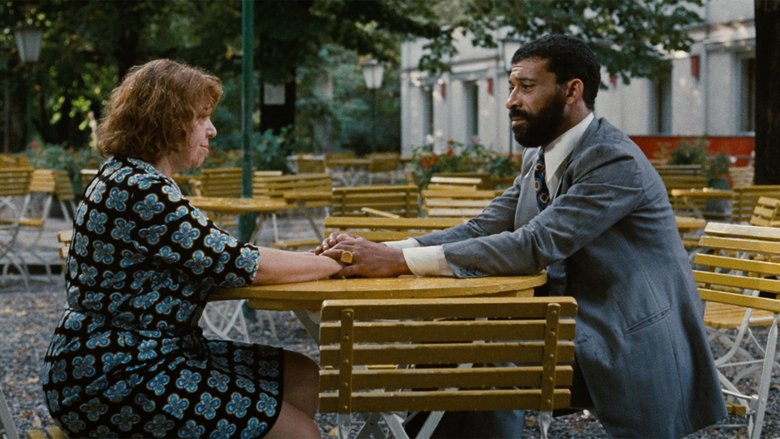
In the iconic scene at the outdoor café, Emmi and Ali sit alone in a sea of bright yellow plastic tables and chairs. The unnatural color and emptiness symbolize their isolation from the rest of the world.

Stomach Ulcer

Meaning:

The physical manifestation of internalized social trauma and the immigrant experience.

Context:

Ali collapses from a burst ulcer. The doctor explains it is common among "guest workers" due to stress and alienation. It literally represents the title: fear eating the soul (and body).

Couscous

Meaning:

Cultural identity and the fluctuating power dynamic in the marriage.

Context:

Ali loves couscous, but Emmi eventually refuses to cook it, telling him to eat German food. Later, Ali seeks comfort with Barbara, who cooks it for him. It becomes a barometer for Emmi's acceptance of his identity.

The Broken Television

Meaning:

Violent disconnection and the destruction of bourgeois comfort.

Context:

Emmi's son kicks in her TV screen in a rage after hearing of her marriage. It is a direct visual reference to Sirk's All That Heaven Allows, symbolizing the shattering of family peace.

Memorable Quotes

Angst essen Seele auf.

— Ali

Context:

Spoken by Ali to Emmi in the bedroom as they discuss their fears and the hostility they face.

Meaning:

The titular line (grammatically broken German for "Fear eats the soul") encapsulates the film's central thesis: that the constant anxiety of living as an outcast destroys one's essence.

Think much, cry much.

— Ali

Context:

Ali's response when Emmi asks him about his family and his past.

Meaning:

A fatalistic worldview that suggests introspection leads to misery for those in their position.

I know that I'm old and that you could have any young girl.

— Emmi

Context:

Emmi to Ali, acknowledging the unlikelihood of their pairing.

Meaning:

Highlights Emmi's insecurity and the transgressive nature of their age gap.

Because I'm so happy, and so full of fear, too.

— Emmi

Context:

Emmi explaining her tears to Ali.

Meaning:

Expresses the duality of their relationship—it brings immense joy but triggers terrifying consequences.

Philosophical Questions

Can personal happiness exist within a corrupt society?

The film suggests that "happiness is not always fun" and that personal love is besieged by social structures. It asks if two people can truly create a world apart, or if the "outside" will inevitably rot the "inside."

Is tolerance just a mask for exploitation?

The neighbors eventually accept Ali, but only because he can carry heavy things. The grocer accepts Emmi because he needs her business. Fassbinder questions if true acceptance exists or if all social relations are transactional.

Alternative Interpretations

Critics debate the nature of Emmi's character. While she is the victim of prejudice, some readings emphasize her complicity in the Third Reich (hinted at by her Hitler anecdote) and her later colonialist attitude toward Ali (showing off his muscles to friends). This suggests the film is not just about "love vs. hate," but about how the victimized can easily become oppressors.

The Ending: Some view the ending as a reconciliation, but a more cynical reading suggests Ali's return to Emmi is only due to his physical incapacitation (the ulcer), and Emmi's care is a form of maternal control. The relationship survives, but the power dynamic remains permanently unbalanced.

Cultural Impact

Ali: Fear Eats the Soul is widely considered the masterpiece of New German Cinema and Fassbinder's most accessible yet profound work. It won two awards at the 1974 Cannes Film Festival.

  • Historical Context: It was groundbreaking in its humanization of the Gastarbeiter (guest worker), a demographic largely ignored or reviled in German culture at the time.
  • Cinematic Influence: It demonstrated how Hollywood melodrama techniques (specifically Douglas Sirk's) could be applied to European art house cinema to create politically charged social critiques. It paved the way for future filmmakers like Todd Haynes (Far From Heaven) to explore similar themes.
  • Legacy: The film remains a staple in film studies for its masterclass in "Brechtian" acting and framing. It is frequently cited as one of the greatest films ever made about racism and love.

Audience Reception

The film is universally acclaimed by critics and cinephiles, holding extremely high ratings (often 100% on Rotten Tomatoes). Praised for: Its emotional rawness, the performances of Mira and Salem, and its stunning visual composition. Criticism: Some casual viewers initially find the acting style "stiff" or "theatrical," not realizing this is a deliberate Brechtian distancing technique intended to make the audience think rather than just feel.

Interesting Facts

  • The film was shot in just roughly two weeks (some sources say 15 days) as an exercise to fill time between two other productions.
  • El Hedi ben Salem, who played Ali, was Fassbinder's real-life partner at the time. He tragically committed suicide in prison a few years later.
  • The original German title 'Angst essen Seele auf' is grammatically incorrect immigrant German (it should be 'Angst isst die Seele auf'), reflecting Ali's speech patterns.
  • Fassbinder himself has a cameo as Eugen, Emmi's unsympathetic and racist son-in-law.
  • Brigitte Mira was a veteran cabaret, operetta, and TV actress; this role revitalized her career and made her a star of New German Cinema.
  • The film is a loose remake/homage to Douglas Sirk's 1955 Hollywood melodrama 'All That Heaven Allows'.
  • Emmi mentions eating at a restaurant because 'Hitler used to eat there,' a subtle detail Fassbinder included to show how the Nazi past lingers in the 'ordinary' German generation.

Easter Eggs

The American Soldier Connection

The story of Emmi and Ali was actually told as an anecdote by a character (a cleaning lady) in Fassbinder's earlier film The American Soldier (1970), essentially making this film a cinematic expansion of that brief story.

The Kicked Television

When Emmi's son kicks in the TV screen, it is a direct visual homage to Douglas Sirk's All That Heaven Allows, where the TV symbolizes the sterile life society tries to force upon the widow.

Munich Massacre Reference

Ali mentions that Germans haven't been good to Arabs "since the Olympics," a direct reference to the 1972 Munich massacre, grounding the film in the specific political tension of its time.

⚠️ Spoiler Analysis

Click to reveal detailed analysis with spoilers

Frequently Asked Questions

Explore More About This Movie

Dive deeper into specific aspects of the movie with our detailed analysis pages

Comments (0)

Leave a comment

No comments yet. Be the first to share your thoughts!