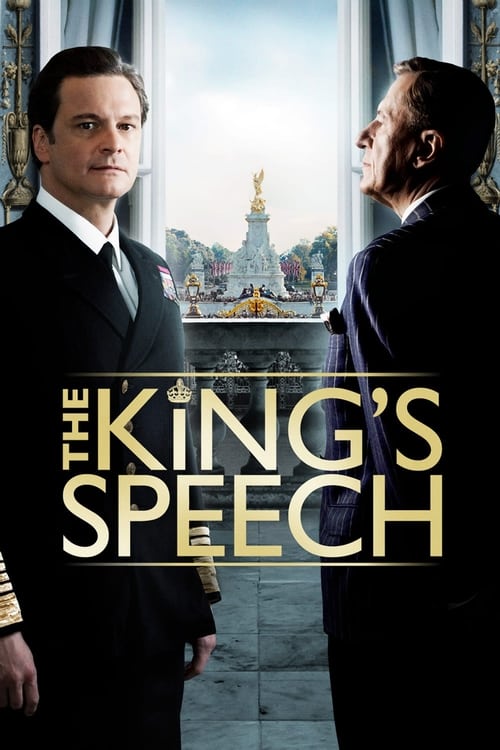
The King's Speech
In the claustrophobic shadow of a looming world war, a reluctant monarch battles his own voice. A visual symphony of wide lenses and stifled silence where a microphone becomes a terrifying instrument of torture and, ultimately, liberation.
The King's Speech

The King's Speech

"Find your voice."

26 November 2010 United Kingdom 118 min ⭐ 7.7 (9,127)
Director: Tom Hooper
Cast: Colin Firth, Geoffrey Rush, Helena Bonham Carter, Guy Pearce, Timothy Spall
Drama History
Voice and Communication Friendship and Equality Duty vs. Fear
Budget: $15,000,000
Box Office: $414,211,549

Overview

Prince Albert, the Duke of York (Colin Firth), suffers from a debilitating stammer that humiliates him during public appearances. After years of failed treatments by traditional doctors, his wife Elizabeth (Helena Bonham Carter) persuades him to visit Lionel Logue (Geoffrey Rush), an eccentric Australian speech therapist with unorthodox methods. Logue insists on total equality and intimacy in his sessions, challenging the Prince's royal reserve and digging into the psychological roots of his speech impediment.

When King George V dies and Albert's brother, Edward VIII, abdicates the throne to marry Wallis Simpson, Albert is thrust into the role of King George VI. With Britain on the brink of war with Nazi Germany, the new King must overcome his fear and find his voice to unite the nation. The film culminates in his first wartime radio broadcast, a high-stakes moment where his friendship with Logue is put to the ultimate test.
Core Meaning

At its heart, The King's Speech is a story about the humanization of authority and the courage to overcome personal demons for the greater good. It suggests that true leadership is not about innate perfection but about the resilience to persevere through vulnerability. The film posits that every voice has value and deserves to be heard, deconstructing the class barriers between a King and a commoner to reveal the shared human struggle for connection and dignity.

Thematic DNA

Voice and Communication 40%
Friendship and Equality 30%
Duty vs. Fear 30%

Voice and Communication

The central theme explores voice not just as the ability to speak, but as an assertion of self-worth. Bertie's stammer symbolizes his internal repression and lack of confidence. Regaining his voice is synonymous with reclaiming his identity and his right to lead.

Friendship and Equality

The relationship between Bertie and Logue transcends rigid British class structures. The film illustrates that true healing requires a level playing field, as seen when Logue insists on calling the Prince 'Bertie' and sitting as equals. Their friendship becomes the emotional anchor of the King's success.

Duty vs. Fear

Bertie is the 'Reluctant Hero' who never wanted the throne. The film contrasts his overwhelming personal terror of public speaking with his profound sense of duty to his people, highlighting bravery as action taken despite fear.

Character Analysis

King George VI (Bertie)

Colin Firth

Archetype: The Reluctant Hero
Key Trait: Resilience

Motivation

To cure his stammer not for vanity, but to fulfill his duties without humiliating himself or his family, and later, to provide a strong voice for a nation at war.

Character Arc

Starts as a frustrated, silenced man crushed by his father's shadow and his disability. Through his work with Logue, he processes his childhood trauma and emerges as a confident leader who accepts his burden.

Lionel Logue

Geoffrey Rush

Archetype: The Mentor / The Maverick
Key Trait: Empathy

Motivation

To help his patient find his voice, driven by a genuine belief in the potential of every human being and a disregard for stuffy protocol.

Character Arc

He begins as a failed actor and uncredentialed therapist who believes in his methods. He gains the trust of the King, validating his own life's work and proving that his lack of formal credentials does not diminish his ability to heal.

Queen Elizabeth

Helena Bonham Carter

Archetype: The Caregiver / The Rock
Key Trait: Devotion

Motivation

Love for her husband and a fierce desire to protect him and the monarchy's dignity.

Character Arc

She is the constant, unwavering support system. While she does not undergo a drastic change, her persistence is the catalyst for the entire plot, as she refuses to give up on finding help for her husband.

Symbols & Motifs

The Microphone

Meaning:

It represents the terrifying judgment of the public and the modern era of mass media where a King must be an actor/performer. It is initially a weapon of torture, but transforms into a tool of connection.

Context:

The film opens with a distorted, looming shot of a microphone that resembles a gallows. In the climax, the microphone is the focal point of the small room where the King faces his fear.

St. Edward's Chair

Meaning:

Symbolizes the weight of tradition, divine right, and the intimidating expectations of the monarchy that Bertie feels unworthy of.

Context:

In a key scene before the coronation, Logue sits in the chair, provoking Bertie's anger. This act of 'desecration' forces Bertie to assert his authority and claim his right to be King.

The Open Window

Meaning:

Represents liberation from the stifling constraints of royal protocol and the physical manifestation of 'letting go'.

Context:

During the final speech, Logue opens the window (a detail from real diaries) to make the stuffy broadcasting room feel less like a prison, allowing the King to breathe metaphorically and physically.

Memorable Quotes

I have a voice!

— King George VI

Context:

During an argument in Westminster Abbey when Logue sits in St. Edward's Chair, mocking the King's lack of confidence.

Meaning:

The pivotal moment of self-actualization where Bertie finally claims his worth as a human being and a King, asserting his existence against Logue's provocations.

The nation believes that when I speak, I speak for them. But I can't speak.

— King George VI

Context:

A moment of vulnerability where Bertie confesses the depth of his despair to Logue.

Meaning:

Encapsulates the central conflict: the crushing gap between the public expectation of the monarch's role and his private inability to perform it.

I am speechless.

— Lionel Logue

Context:

After the final wartime broadcast, when the King asks how he did.

Meaning:

A witty, ironic double-entendre that serves as the highest praise for the King's successful delivery of the war speech.

Philosophical Questions

Does the office make the man, or does the man make the office?

The film explores whether royal authority is inherent in the title or if it must be earned through personal strength. Bertie feels like a fraud until he masters the skill to perform the role, suggesting that authority is performative and requires personal substance to be valid.

What is the role of a monarch in a modern democracy?

George V tells Bertie, 'We've become actors.' The film questions the function of royalty when they no longer govern but must embody the nation's spirit via mass media (radio). It posits that their power now lies solely in their ability to communicate and inspire.

Alternative Interpretations

While largely straightforward, some critics view the film as an 'Anti-Pygmalion' story. Unlike Pygmalion (or My Fair Lady), where a lower-class subject is taught to speak 'properly' to fit into high society, here a high-status monarch must learn to loosen up and speak like a 'common man' to connect with his people. Another reading suggests the film is less about speech mechanics and more about psychotherapy, with Logue acting as a proto-Freudian analyst unlocking the King's childhood trauma (abusive nanny, corrective splints) rather than just treating the physical symptoms.

Cultural Impact

The King's Speech was a massive critical and commercial success, winning four Academy Awards including Best Picture, Best Director, Best Actor, and Best Original Screenplay. Culturally, it sparked a significant global conversation about stuttering and speech therapy, reducing stigma and highlighting the emotional toll of communication disorders. It also revived interest in the history of the House of Windsor and King George VI, though it faced criticism from historians for 'whitewashing' Winston Churchill's views on the abdication crisis (he actually supported Edward VIII). The film remains a benchmark for 'prestige' historical dramas.

Audience Reception

The film received an overwhelmingly positive reception, earning a rare 'A+' CinemaScore. Audiences praised the emotional resonance of the friendship and Colin Firth's vulnerable performance. Critics were nearly unanimous in acclaim, though some found the direction 'safe' or 'Oscar-bait.' A minority criticized the historical inaccuracies regarding Churchill and the Abidcation crisis. Overall, it is regarded as a crowd-pleasing, uplifting masterpiece of the genre.

Interesting Facts

  • The screenwriter, David Seidler, stammered as a child and found inspiration in George VI's wartime speeches, but the Queen Mother asked him not to write the film during her lifetime because the memories were too painful.
  • Colin Firth developed headaches and a numbness in his left arm from the physical strain of simulating the stammer during filming.
  • Lionel Logue's grandson discovered his grandfather's diaries in an attic just nine weeks before filming began, providing crucial authentic details like the 'open window' during the speech.
  • The 'F-word' scene where the King swears to relieve tension was originally going to earn the film an R rating, leading to a public debate about ratings and context.
  • Paul Bettany was the director's first choice for the role of King George VI, but he turned it down to spend time with his family.
  • Geoffrey Rush's laugh when the King swears is genuine 'corpsing' (breaking character); he found Firth's delivery so funny that he couldn't help himself, and the director kept it in.

Easter Eggs

Jennifer Ehle as Myrtle Logue

Jennifer Ehle, who plays Lionel's wife, famously played Elizabeth Bennet opposite Colin Firth's Mr. Darcy in the 1995 Pride and Prejudice. Their reunion is a meta-nod to their iconic status as a romantic screen couple.

Authentic Logue Dialogue

Lines like 'You still stammered on the W' and the King's reply 'I had to throw in a few so they knew it was me' were taken verbatim from Lionel Logue's real diaries found just before production.

The Wallpaper in Logue's Office

The distressed, peeling wall in Logue's office was not a set design choice but the actual condition of the location. The director chose to keep it to symbolize the imperfections and 'rough edges' of the characters.

⚠️ Spoiler Analysis

Click to reveal detailed analysis with spoilers

Frequently Asked Questions

Explore More About This Movie

Dive deeper into specific aspects of the movie with our detailed analysis pages

Comments (0)

Leave a comment

No comments yet. Be the first to share your thoughts!