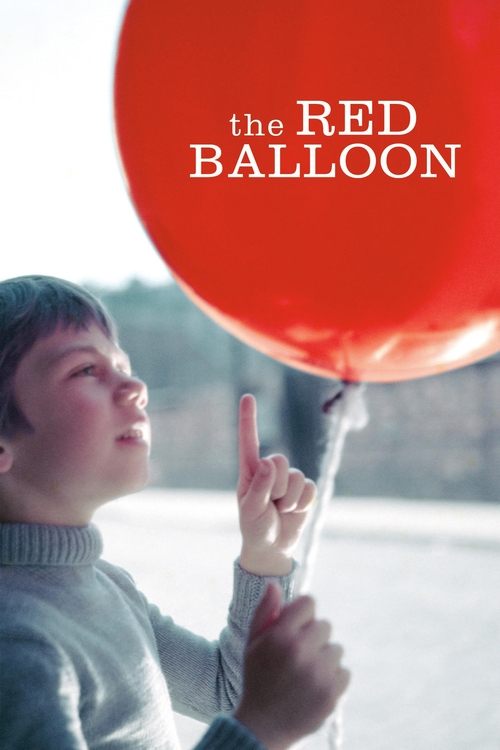
The Red Balloon
Le Ballon rouge
"Something to uplift your spirit."
Overview
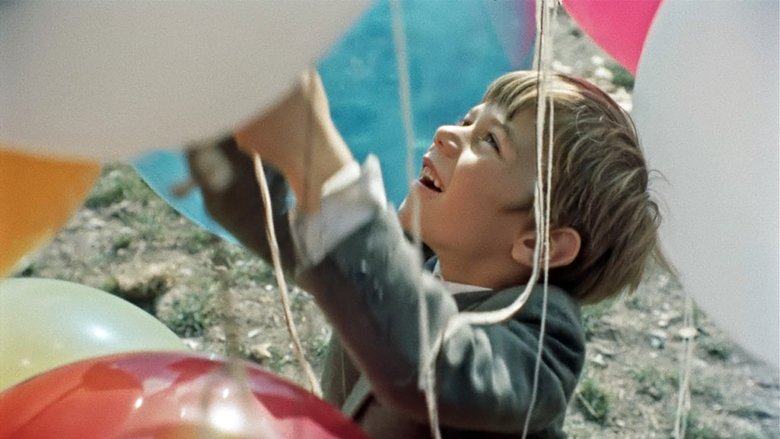
In the monochromatic Ménilmontant neighborhood of 1950s Paris, a young boy named Pascal discovers a large, bright red balloon tied to a lamppost. After rescuing it, he discovers the balloon has a mind of its own. A wordless bond forms between them as the balloon playfully follows Pascal through the streets, waiting for him outside his school window and accompanying him to church, much to the annoyance of adults who see it as a nuisance.
As their friendship deepens, the balloon displays a distinct personality—teasing Pascal, playing hide-and-seek, and offering companionship in a lonely world. However, their joy attracts the envy of a gang of local bullies. The film culminates in a dramatic chase through narrow alleys as the bullies attempt to capture and destroy the magical object. The story ends with a poignant and surreal sequence that transforms a moment of cruelty into a triumphant, uplifting ascension.

Core Meaning
At its heart, The Red Balloon is a tender allegory about the fragility of innocence and the inevitable harshness of the adult world. Director Albert Lamorisse contrasts the pure, colorful connection of childhood friendship with the grey, rigid conformity of society. The film suggests that while innocence (the balloon) may be destroyed by cynicism (the bullies), the spirit of imagination and hope is immortal and can lift us above the mundane sorrows of reality.
Thematic DNA
Innocence vs. Cynicism
The film visually pits the vibrant, playful innocence of Pascal and his balloon against the drab, grey, and often hostile world of adults and bullies. The balloon represents a purity that the cynical world tries to suppress or destroy.
Friendship and Loyalty
Without a single word of dialogue between them, Pascal and the balloon demonstrate profound loyalty. The balloon waits for Pascal and follows him, while Pascal protects the balloon from rain and attackers, illustrating a bond that transcends language.
Freedom and Conformity
The balloon moves with a fluid, floating freedom that defies the rigid, linear movement of the city's inhabitants. Adults (the principal, the church beadle) constantly try to restrain or expel this symbol of freedom, enforcing strict social conformity.
Spirituality and Transcendence
The balloon's death and the subsequent 'resurrection'—where all the balloons in Paris rise up to save Pascal—carry strong spiritual undertones, suggesting that the spirit cannot be truly killed, only transformed.
Character Analysis
Pascal
Pascal Lamorisse
Motivation
To protect his only friend (the balloon) and find companionship in a world that ignores or rejects him.
Character Arc
Pascal starts as a lonely, isolated figure. Through his bond with the balloon, he experiences joy and companionship, eventually facing loss and being literally uplifted by a collective miracle.
The Balloon
N/A (Special Effects)
Motivation
To be with Pascal and play; it exhibits a childlike desire for fun and attachment.
Character Arc
The balloon acts with agency, choosing Pascal, playing with him, and ultimately sacrificing itself, which triggers a miraculous response from all other balloons.
The Girl with the Blue Balloon
Sabine Lamorisse
Motivation
To walk her own path with her own companion.
Character Arc
A brief appearance that suggests Pascal is not unique; there are other kindred spirits with their own magical companions.
Symbols & Motifs
The Red Balloon
It symbolizes the spirit of childhood, magic, unconditional love, and perhaps a Christ-like figure of sacrifice. Its vivid color represents life and passion in a deadened world.
It stands out in every frame against the grey background, acting as the only source of warmth and 'personality' in the environment.
The Grey City (Paris)
Represents the post-war depression, the dullness of adulthood, and a reality devoid of magic. It is the antagonist to the balloon's color.
The crumbling walls, cobblestone streets, and drab clothing of the adults create a visual prison from which Pascal ultimately escapes.
Mirrors and Glass
Used to suggest self-awareness and the magical nature of the balloon. It allows the object to 'see' itself, affirming its sentience.
In a key scene, the balloon encounters a mirror in a flea market and seems to recognize its own reflection, a moment that humanizes it completely.
Memorable Quotes
Pascal!
— Pascal's Mother (Renée Marion)
Context:
Shouted from a window, emphasizing the vertical distance between the adult world (high up, controlling) and the child's world on the street.
Meaning:
One of the very few spoken lines in the film. It represents the voice of authority and the adult world calling the child back to reality and order.
(Silence / Visual)
— The Balloon
Context:
Throughout the film, such as when the balloon waits outside the school or follows Pascal without a string.
Meaning:
The film is famous for its lack of dialogue. The balloon communicates entirely through movement—bobbing, waiting, and nudging—establishing a 'language' of pure emotion.
People with dogs walk. People with packages take taxis. People with balloons leave them behind.
— Narrator (English Version)
Context:
Commentary on why the bus conductor refuses to let Pascal board with the balloon.
Meaning:
(Note: This quote appears in the English narrated version/book adaptation, not the original silent French film). It highlights the rigid social rules that the balloon disrupts.
Philosophical Questions
Does inanimate matter have a 'spirit'?
The film challenges our perception of the material world. By giving the balloon agency, loyalty, and the capacity to die, it asks if love can animate the lifeless, or if the 'life' we see is merely a projection of our own need for connection.
Is innocence a weakness or a strength?
Pascal's innocence makes him a target for the bullies (weakness), yet it is this same purity that attracts the balloons of Paris to save him (strength). The film suggests that while innocence is vulnerable in the physical world, it possesses a metaphysical power.
How do we cope with the loss of the things we love?
The destruction of the balloon is a traumatic event. The film explores whether the correct response to loss is to accept reality (the balloon is dead) or to embrace a higher hope (the balloon spirit lives on).
Alternative Interpretations
The Religious Allegory: Many critics view the film as a retelling of the Christ story. The balloon (divinity) comes down to earth, is loved by a faithful follower (Pascal), is persecuted by a mob (the bullies), is 'killed' (popped/stoned), and then is 'resurrected' in a glorious ascension, taking the boy to heaven/safety.
The Loss of Childhood: A psychological reading suggests the balloon represents the transitional object of childhood (like a security blanket). Its destruction forces the boy to detach from his infantile fantasy, but the ending (flying away) represents a retreat into total fantasy—a refusal to grow up, or perhaps a psychotic break from a traumatic reality.
Truffaut's Critique: François Truffaut argued the film was 'false' because it imposed human psychology onto an object, betraying the 'reality' of the balloon. He saw it as manipulative sentimentality rather than true poetry.
Cultural Impact
The Red Balloon is considered one of the most influential short films ever made. Historical Context: Released in 1956, it provided a splash of Technicolor hope in a post-war France that was still rebuilding and psychologically recovering. Cinema Influence: Its visual storytelling influenced directors like Damien Chazelle (La La Land) and Pete Docter (Pixar's Up). The final shot of the house lifting off in Up is a direct homage to the balloon-lifting scene. Reception: It won the Palme d'Or for Short Film at Cannes and the Oscar for Best Original Screenplay. It became a staple in elementary schools worldwide for decades as an tool for teaching visual literacy and empathy. Pop Culture: The image of the red balloon has become a universal shorthand for childhood innocence and has been referenced in music videos and advertisements globally.
Audience Reception
Praised: Audiences universally adore the film's visual beauty, the simplicity of its storytelling, and its emotional resonance. It is often described as 'magic' and a 'masterpiece' that captures the essence of childhood. The lack of dialogue is seen as a strength, making it universally accessible.
Criticized: Some modern viewers finds the ending too fantastical or the pacing slow. A minority (echoing Truffaut) find it overly sentimental or 'saccharine'.
Verdict: It remains a beloved classic, holding a rare 100% rating on Rotten Tomatoes and maintaining its status as an essential piece of family cinema.
Interesting Facts
- The film won the Academy Award for Best Original Screenplay in 1956, which is extraordinary because the film has almost no dialogue.
- Albert Lamorisse used his own children, Pascal and Sabine, as the main actors.
- The special effect of the balloon following Pascal was achieved using a thin, invisible thread, but for some shots, a 'double balloon' (a yellow one inside a red one) was used to make it opaque and extra shiny.
- The film was shot in the Ménilmontant neighborhood of Paris, an area that was heavily run-down and was largely demolished for redevelopment shortly after filming.
- French singer Renaud (Renaud Séchan) makes a cameo as one of the twin brothers in red coats near the end of the film.
- Legendary filmmaker François Truffaut notoriously disliked the film, criticizing it for 'humanizing' an inanimate object in a 'Disney-fied' way.
- The film is the only short film in history to win the Oscar for Best Original Screenplay (not Short Film, but the writing category itself).
Easter Eggs
Renaud Séchan Cameo
The famous French singer Renaud appears as a child extra (one of the twins in red coats) in the final sequence. This is a delightful detail for French pop culture fans.
The Blue Balloon
The brief appearance of a girl with a blue balloon mirrors Pascal's situation, suggesting a hidden world of magical connections between children that adults cannot see.
The Painting of the Girl
In the flea market, Pascal looks at a painting of a young girl. The balloon stops and looks at itself in a mirror next to it. This parallels the boy looking at a representation of a child, while the balloon looks at a representation of itself, deepening the theme of self-identity.
⚠️ Spoiler Analysis
Click to reveal detailed analysis with spoilers
Frequently Asked Questions
Explore More About This Movie
Dive deeper into specific aspects of the movie with our detailed analysis pages
Comments (0)
No comments yet. Be the first to share your thoughts!