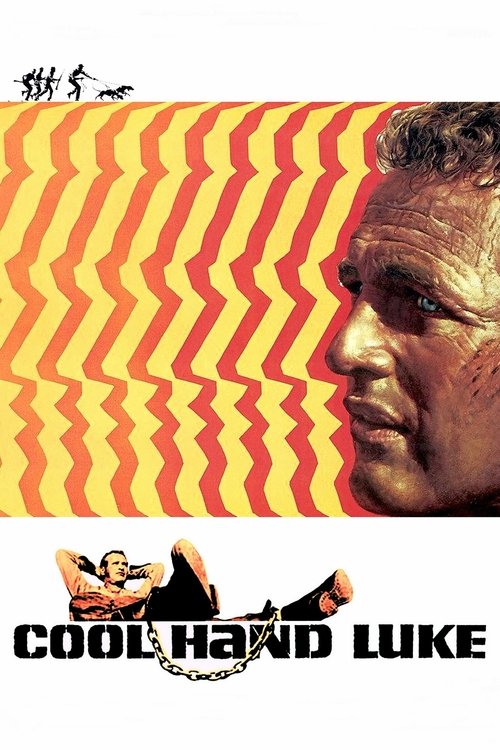
Cool Hand Luke
Southern Prison Drama/Atmospheric. A searing, sun-drenched allegory where an existential rebel battles a soulless system. The heat of the Florida sun mirrors the oppression of the spirit, culminating in a tragic, Christ-like sacrifice that immortalizes the refusal to submit.
Cool Hand Luke

Cool Hand Luke

"The man... and the motion picture that simply do not conform."

01 November 1967 United States of America 127 min ⭐ 7.7 (1,557)
Director: Stuart Rosenberg
Cast: Paul Newman, George Kennedy, Luke Askew, Morgan Woodward, Harry Dean Stanton
Drama Crime
Rebellion and Anti-Authoritarianism Christian Allegory and Sacrifice Existentialism and Meaninglessness Failure to Communicate
Budget: $3,200,000
Box Office: $16,217,773

Overview

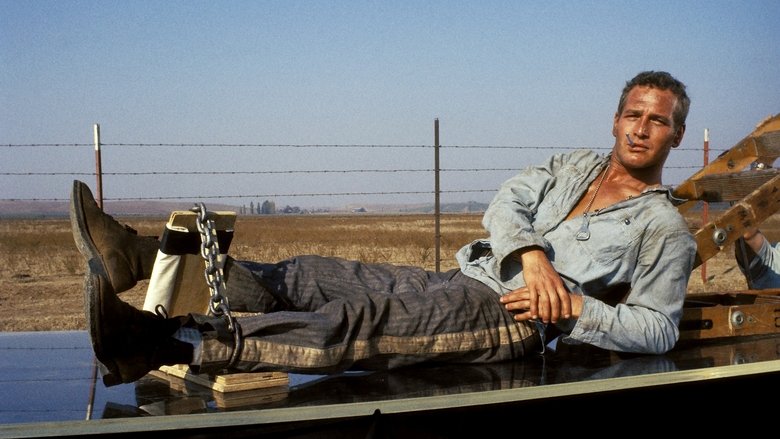
Lucas "Cool Hand" Luke Jackson (Paul Newman), a decorated World War II veteran with a disdain for authority, is sentenced to two years in a Florida prison camp for drunkenly decapitating parking meters. In the sweltering heat, he joins a chain gang ruled by a sadistic Captain and silent, rifle-toting guards. Luke initially clashes with the prisoners' leader, Dragline (George Kennedy), but wins their respect through his sheer refusal to stay down during a boxing match and an audacious poker bluff.

Luke becomes a legend among the inmates, performing "miracles" like eating 50 hard-boiled eggs in an hour and energizing the men to complete a road-paving job in record time. However, the prison authority, threatened by his spirit, seeks to break him. After his mother dies and he is subjected to the "box" and brutal beatings, Luke attempts multiple escapes, each more desperate than the last, leading to a final, inevitable confrontation with the system he cannot defeat but refuses to obey.
Core Meaning

At its heart, Cool Hand Luke is an examination of the individual spirit versus institutional oppression. It explores the existential necessity of rebellion even when defeat is certain. Director Stuart Rosenberg and the writers use heavy Christian allegory to present Luke as a modern messiah who takes on the suffering of his "disciples" (the inmates) and is ultimately sacrificed by the establishment, suggesting that while the man can be broken, the legend of his non-conformity lives on.

Thematic DNA

Rebellion and Anti-Authoritarianism 35%
Christian Allegory and Sacrifice 30%
Existentialism and Meaninglessness 20%
Failure to Communicate 15%

Rebellion and Anti-Authoritarianism

Luke represents the unstoppable force of individuality crashing against the immovable object of the System. His rebellion isn't for a cause, but for his own nature; he simply cannot submit. The film argues that this spirit is both heroic and self-destructive.

Christian Allegory and Sacrifice

The film is saturated with religious symbolism. Luke is a Christ figure: he has "disciples" (the inmates), performs "miracles" (the 50 eggs), experiences a "Gethsemane" moment (prayer in the rain/church), and is sacrificed. Dragline acts as a Judas/Peter figure who both betrays and canonizes him.

Existentialism and Meaninglessness

Luke's initial crime (cutting parking meters) is committed out of boredom, highlighting the absurdity of his world. He constantly seeks meaning from God ("the Old Man") but receives only silence, forcing him to create his own meaning through resistance.

Failure to Communicate

The Captain's famous line underscores the disconnect between the ruling class and the individual. It highlights the impossibility of understanding between those who demand conformity and those who demand freedom.

Character Analysis

Lucas 'Luke' Jackson

Paul Newman

Archetype: Existential Anti-Hero / Christ Figure
Key Trait: Indomitable Will

Motivation

To live on his own terms; a refusal to be "fixed" or owned by anyone. He seeks answers from God but ultimately decides he must find his own way.

Character Arc

Starts as a bored, petty vandal. Through his time in prison, he inadvertently becomes a savior figure for the other men. He is broken by the system but finds a final moment of defiance before his death, cementing his legacy.

Dragline

George Kennedy

Archetype: The Disciple / The Convert
Key Trait: Loyalty

Motivation

To maintain his status, then to support and idolize Luke.

Character Arc

Initially the prison bully and leader. He fights Luke, but Luke's resilience wins him over. He becomes Luke's biggest promoter (apostle), helps him escape, and ultimately delivers his eulogy.

The Captain

Strother Martin

Archetype: The Tyrant / Pontius Pilate
Key Trait: Sadism masked as paternalism

Motivation

To maintain order and break anyone who challenges his absolute authority.

Character Arc

Static character representing the establishment. He tries benevolent paternalism first, then switches to brutality when Luke refuses to conform.

Godfrey (The Man With No Eyes)

Morgan Woodward

Archetype: The Executioner / The Devil
Key Trait: Silent Lethality

Motivation

Duty and enforcement.

Character Arc

A silent, looming threat throughout the film. He never speaks, only watches and shoots. He is the physical instrument of Luke's destruction.

Symbols & Motifs

Mirrored Sunglasses

Meaning:

They represent the faceless, soulless authority of the law. They reflect the prisoners' suffering back at them and hide the humanity (or lack thereof) of the guard, Godfrey ("The Man With No Eyes").

Context:

Godfrey wears these constantly, never showing his eyes until after Luke's death (or remaining hidden, emphasizing his role as a blind executioner). They create an intimidating, non-human presence.

The Box

Meaning:

A symbol of containment, psychological torture, and the tomb. It represents the system's ultimate tool to force conformity by stripping away physical freedom and sensory input.

Context:

Luke is thrown into the box after his mother's death not for something he did, but for what he might do (run away to the funeral), illustrating the system's preemptive cruelty.

The Road and Chains

Meaning:

The endless road represents the futility of life and the circular nature of their imprisonment. The chains are the physical manifestation of their bondage to society's rules.

Context:

The chain gang works on the road daily, paving the way for others' freedom while they remain bound. The road also forms a visual cross in the final shot.

Plastic Jesus

Meaning:

Represents commercialized, hollow faith versus the real, gritty suffering Luke experiences. It contrasts the easy comfort of religion with the harsh reality of the prison.

Context:

Luke sings this song while playing the banjo after his mother's death, mocking the idea that a plastic idol can save him from his pain.

Traffic Lights

Meaning:

The shift from Green to Red symbolizes the transition from life/hope to death/stop. It marks the end of Luke's journey.

Context:

In the final sequence as the dying Luke is driven away, the traffic light in the background shifts from green to red. (Trivia note: the green is famously on top in this shot, a possible error or specific local detail).

Memorable Quotes

What we've got here is failure to communicate.

— The Captain

Context:

Spoken by the Captain after Luke is beaten for an escape attempt. Luke later mocks this line back to the Captain at the end.

Meaning:

The film's most iconic line. It epitomizes the gap between the individual and authority. The Captain believes the failure is Luke's refusal to listen, while the audience sees the failure is the Captain's refusal to understand.

Sometimes nothin' can be a real cool hand.

— Luke

Context:

Said after he wins a poker hand with nothing but a bluff, earning him the name "Cool Hand Luke."

Meaning:

Explains his nickname and life philosophy: playing a bad hand with such confidence that you win anyway. It signifies making something out of the nothingness of existence.

I can eat fifty eggs.

— Luke

Context:

Said casually during a bunkhouse conversation, leading to the famous betting scene.

Meaning:

An absurd, impossible boast that becomes a "miracle." It represents Luke's ability to transcend human limits and the inmates' desperate need for a hero.

Calling it your job don't make it right, Boss.

— Luke

Context:

Said to a guard who apologizes for putting him in the box, claiming he's just doing his job.

Meaning:

A moral indictment of the "Nuremberg Defense" (just following orders). It challenges the individual responsibility of the enforcers.

Philosophical Questions

Does resistance have meaning if it ends in defeat?

The film asks if Luke's suffering was worth it. He dies, and the system remains. However, the film suggests that the act of resistance itself creates meaning and inspires others (Dragline and the inmates), proving that the human spirit cannot be fully commodified or controlled.

Is total non-conformity compatible with life?

Luke cannot function in society (cutting meters) or in prison (escaping). The film explores the tragedy of the 'wild spirit'—that in a world of rules and 'failure to communicate,' the truly free individual has no place to exist and must inevitably be destroyed.

Alternative Interpretations

Luke as a Suicidal Nihilist: Some critics argue Luke isn't a hero but a man with a death wish. His rebellion is irrational and self-destructive, driven not by a desire for freedom but by an inability to exist in any structure. In this view, his death is a form of 'suicide by cop'.

The Holy Fool: Instead of a direct Christ figure, Luke can be seen as a 'Holy Fool'—a character who reveals the truth through apparent madness or nonsense (eating 50 eggs, digging futile ditches). He exposes the absurdity of the rules simply by refusing to take them seriously.

Cultural Impact

Cool Hand Luke arrived in 1967, perfectly synchronized with the rising counter-culture movement and anti-Vietnam War sentiment. Luke became an instant icon for a generation disillusioned with authority. The line "What we've got here is failure to communicate" entered the global lexicon, used by everyone from political protesters to parents. The film cemented Paul Newman's status as a top-tier superstar and the ultimate "cool" anti-hero. It redefined the prison genre, moving away from simple escape thrillers to deep character studies, influencing later films like One Flew Over the Cuckoo's Nest (1975) and The Shawshank Redemption (1994).

Audience Reception

Praised: Upon release, audiences and critics hailed Paul Newman's charismatic performance and the film's gritty realism. The anti-establishment message resonated deeply with 1960s youth. George Kennedy's performance was universally acclaimed.

Criticized: Some contemporary critics felt the Christian symbolism was too heavy-handed (the cross imagery, the Gethsemane prayer). Others felt the first half (the chain gang life) was stronger than the second half (the repeated escapes).

Verdict: It is now considered a classic of American cinema, with a 100% rating on Rotten Tomatoes, celebrated for its script, cinematography, and timeless themes.

Interesting Facts

  • Paul Newman insisted on learning to play the banjo himself for the 'Plastic Jesus' scene. The filming was delayed while he learned, and in the final cut, you can hear him speed up the tempo to cover a mistake he made.
  • The famous 'traffic light' shot at the end features a rare oddity: the green light is on top and the red on the bottom. This is either a continuity error or a reference to the upside-down traffic light in Tipperary Hill, Syracuse, NY.
  • The 'road tarring' scene was shot in actual sweltering heat, and the actors really paved a stretch of road for the county.
  • Luke's prison number is 37, which is widely believed to reference Luke 1:37 in the Bible: 'For with God nothing shall be impossible.'
  • George Kennedy (Dragline) won the Academy Award for Best Supporting Actor for his role.
  • To film the egg-eating scene, Paul Newman did not actually eat 50 eggs. He spat them out after cuts, and essentially 'swallowed' zero whole eggs during the takes to avoid illness.
  • The fictional prison location is in Florida, but the movie was actually filmed in the San Joaquin River Delta near Stockton, California. Spanish moss was imported and hung on trees to mimic the Deep South.
  • The line 'What we've got here is failure to communicate' was ranked #11 on the AFI's 100 Years...100 Movie Quotes list.

Easter Eggs

Luke's Prisoner Number 37

References the Bible verse Luke 1:37: "For with God nothing shall be impossible." This reinforces the Christ-figure allegory and foreshadows his impossible feats (like the egg eating).

Violation

When Luke cuts the heads off the parking meters in the opening scene, the word "VIOLATION" appears on the meter. This sets the theme for his entire existence: a violation of social order.

The Final Cross

In the final overhead zoom-out shot, the intersecting roads form the shape of a cross, and the torn photograph of Luke is superimposed over it, completing the visual canonization of Luke as a martyr.

Green-on-Top Traffic Light

In the ambulance scene, the traffic light shows green on top. While potentially a goof, it mirrors the famous upside-down light in Syracuse's Tipperary Hill, a symbol of Irish rebellion against British (Red) authority.

⚠️ Spoiler Analysis

Click to reveal detailed analysis with spoilers

Frequently Asked Questions

Explore More About This Movie

Dive deeper into specific aspects of the movie with our detailed analysis pages

Comments (0)

Leave a comment

No comments yet. Be the first to share your thoughts!