Skip to content
Alice in Wonderland
A gothic-tinged fantasy of overgrown gardens and crooked grins, tender and unsettling at once, in which a young woman at a crossroads tumbles down a rabbit hole like a girl falling back into her own unspoken self.
Alice in Wonderland

Alice in Wonderland

"You're invited to a very important date."

03 March 2010 United States of America 108 min 6.6 (15,155)

Director: Tim Burton

Cast: Mia Wasikowska, Johnny Depp, Anne Hathaway, Helena Bonham Carter, Crispin Glover

Family Fantasy Adventure Self-Discovery and Identity Defying social expectation and gender roles Imagination versus reality Madness and nonconformity Power, tyranny and sisterly rivalry
Budget: $200,000,000
Box Office: $1,025,467,110

Overview

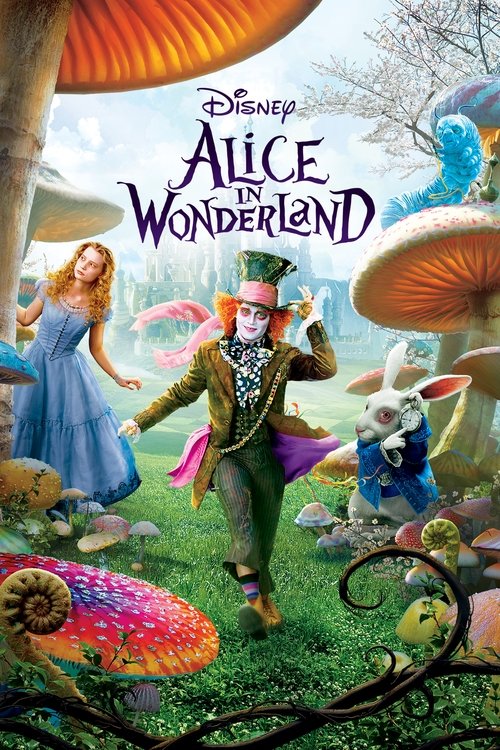
Nineteen-year-old Alice Kingsleigh is about to be publicly engaged to a dull aristocrat at a Victorian garden party. She is a dreamer in a society that wants her to conform. She has been haunted for years by a recurring dream of a strange place. She spots a waistcoated White Rabbit, follows it, and falls into the world she half-remembers.

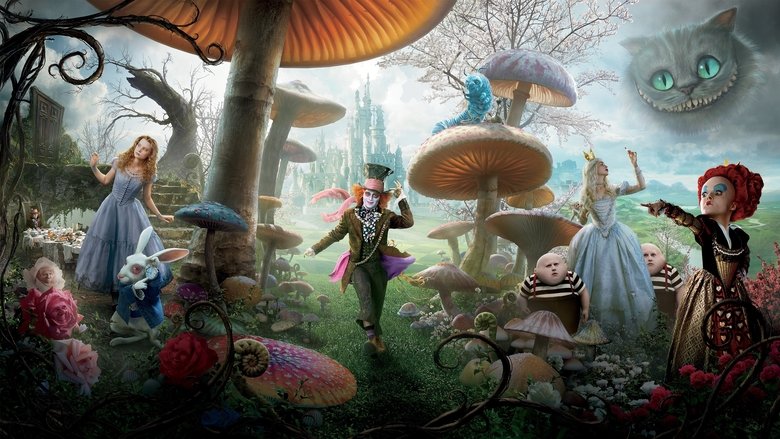
That world is called Underland, not Wonderland. Its talking creatures include the Mad Hatter, the Cheshire Cat, the Dormouse, the twins Tweedledee and Tweedledum, and the White Rabbit. They debate whether she is the "right" Alice. The tyrannical Red Queen rules from her heart-shaped castle, and her sister the White Queen is in exile. A prophecy says a champion will slay the Jabberwocky on Frabjous Day.

Tim Burton and screenwriter Linda Woolverton treat the film as a sequel-like reimagining of Lewis Carroll's two books rather than a straight retelling. It is a quest story about a young woman deciding who she is. It is staged as a lavish, CGI-heavy 3D spectacle.
Core Meaning

The film argues that identity is not handed to you by family, class or prophecy. You claim it by choosing. Alice is told repeatedly what she must be: a bride, a savior, a girl who has "lost her muchness". She only becomes herself when she decides for herself. The White Queen tells her she must choose, and no one can choose for her.

The Mad Hatter's line "Only if you believe it is" sums up the message. Imagination and belief are practical tools for acting in the real world. Alice brings the courage she finds in Underland back to Victorian England, where she refuses a conventional marriage and takes up a career in trade.

Thematic DNA

Self-discovery and identity 30%
Defying social expectation and gender roles 25%
Imagination versus reality 20%
Madness and nonconformity 15%
Power, tyranny and sisterly rivalry 10%

Self-discovery and identity

Alice's central question is whether she is the "right" Alice. The creatures doubt her, and she doubts herself. She settles it by choosing to fight, not by accepting the role the prophecy assigns her. The film's slogan-like idea of "muchness" stands for a sense of self.

Defying social expectation and gender roles

Victorian society pushes Alice toward an arranged marriage and a narrow life. Critics read her as a feminist heroine who saves herself and Underland and does not wait to be rescued. Others found the framing marriage plot too tidy.

Imagination versus reality

The line between dream and memory blurs. Alice's "recurring dream" turns out to be a real childhood visit. Believing impossible things is presented as a skill, not escapism.

Madness and nonconformity

The Hatter and the other "mad" characters are loyal and caring. Alice says the best people are mad, a nod toward those the world dismisses. The truly cruel figures are the supposedly sane tyrants.

Power, tyranny and sisterly rivalry

The Red Queen rules by fear and beheadings. The White Queen's gentler rule is its opposite, and she chooses banishment over execution. The sisters mirror each other, as chess pieces and playing cards do.

Character Analysis

Alice Kingsleigh

Mia Wasikowska

Archetype: Reluctant hero / chosen one Key Trait: Curious and independent

Motivation

To escape a predetermined life and to protect the friends who believe in her.

Character Arc

She starts as a polite, doubting young woman cornered by a proposal. In Underland she learns that she is the only one who can decide who she is. She slays the Jabberwocky, returns home and refuses the marriage. She then sets out on a trading venture.

The Mad Hatter (Tarrant Hightopp)

Johnny Depp

Archetype: Mentor and loyal friend Key Trait: Eccentric yet loyal

Motivation

To restore Underland and to help Alice find her muchness.

Character Arc

He is first broken by the Red Queen's tyranny. As Alice finds her courage he recovers his own, and the two share a bittersweet farewell.

All 5 characters and cast

Symbols & Motifs

Muchness

Meaning:

Vitality, self-belief and the spark of one's authentic self.

Context:

The Hatter says Alice has lost her muchness, and he points to her heart as its source. She declares she has regained it in the climax.

Growing and shrinking

Meaning:

Alice's awkward, shifting sense of self and the struggle to find a size that fits.

Context:

She nibbles and sips her way through doors. Critics have read this as a metaphor for how a young person finds a confidence that fits.

The Vorpal Sword and the Jabberwocky

Meaning:

The external trial that must be faced in order to claim one's destiny. The monster is also a fear to be overcome.

Context:

Alice dons armor, takes up the sword and slays the dragon on Frabjous Day. That ends the Red Queen's reign.

The Red and White Queens

Meaning:

Opposing models of rule and of femininity: fear and excess against gentleness and restraint.

Context:

They are sisters. The White Queen holds her hands gracefully at shoulder height, and her army wears chess-inspired white armor. The Red Queen's army is built from cards.

The blue dress

Meaning:

The classic Alice image, adapted for a young woman. It stands for her identity under the pressure of conformity.

Context:

Burton keeps Alice in a blue dress but makes her a young woman rather than a child.

The rabbit hole

Meaning:

A descent into the unconscious and into memory.

Context:

Alice falls into Underland to escape a proposal. She learns she has been here before.

Memorable Quotes

You used to be much more... "muchier." You've lost your muchness.
— The Mad Hatter

Context

He says it to Alice during her journey, doubting that she is the same girl he knew.

Meaning

The film's emotional core: Alice has lost touch with her own spirit.

This is impossible.
— Alice Kingsleigh

Context

She says it as she faces the incredible events of Underland. The Hatter answers with "Only if you believe it is."

Meaning

Alice's initial skepticism, which the film sets up for the Hatter to answer.

All 6 quotes

Philosophical Questions

Who decides who you are?

The creatures debate whether Alice is the real Alice, and the prophecy casts her as a champion. She shows that identity is chosen rather than assigned.

Is the impossible only a matter of belief?

The Hatter and Alice's father both insist that belief opens the way to action. The film treats imagination as a practical skill.

What separates madness from sanity?

The "mad" characters are warm and loyal, while the authority figures are cruel. The film values eccentricity over conventional sanity.

Is it dream or memory?

Alice's recurring dream proves to be a real childhood visit, which blurs the line between imagination and the past.

How It Ends

Alternative Interpretations

Feminist fable: many read Alice as a woman rejecting a Victorian marriage market and choosing a career. Others find the marriage plot at the start and its tidy dodge at the end too simplistic.

Full ending explanation

Cultural Impact

The film arrived at the height of the 2010 3D craze and made over $1 billion. One report credits it with kickstarting Disney's live-action remake era and with giving Burton his first $1 billion film. Its cultural footprint is debated: one critical retrospective says it did not leave a lasting cultural impact and is not remembered as one of Burton's or Disney's best.

Critics were divided. Rotten Tomatoes sits at around 51%, with a consensus calling it an undeniable visual treat that sacrifices narrative coherence and heart. Metacritic gave it 53/100. Roger Ebert gave three of four stars and said it plays better as an adult hallucination until a pointless third act. Michael Rechtshaffen of The Hollywood Reporter called it a subversively witty dazzler. Audiences polled by CinemaScore gave it an A-. Danny Elfman's score was singled out for praise.

The feminist reading of Alice drew academic and popular attention, and Anne Hathaway herself described the film as a feminist take that follows Alice's return to self.

Audience Reception

Audiences were warmer than critics. CinemaScore gave an A-, and the film was a huge commercial hit. Viewers praised the cast, especially Depp, Bonham Carter and Hathaway, the imaginative designs and Elfman's score. Some praised Alice as a strong, capable female lead.

Criticism centered on a conventional chosen-one plot that lacks Carroll's nonsense, heavy CGI and a third act that turns into a standard battle. Some wrote that it lacked the whimsy of the book and other adaptations, and one outlet called the audience reception tepid. Overall verdict: a visually rich but uneven reimagining that divides viewers.

Interesting Facts

  • The film was directed by Tim Burton from a screenplay by Linda Woolverton and was produced by Richard D. Zanuck, Joe Roth, Suzanne Todd and Jennifer Todd.
  • Danny Elfman composed the score, Dariusz Wolski was the cinematographer, and Chris Lebenzon edited.
  • The film premiered at the Odeon Leicester Square in London on February 25, 2010, and opened in the US on March 5, 2010.
  • Its running time is 108 minutes and its budget is reported as $150–$200 million.
  • It grossed about $1.025 billion worldwide, becoming the second-highest-grossing film of 2010 behind Toy Story 3 and Burton's highest-grossing film.
  • It broke the IMAX opening-weekend record with $12.2 million on 188 IMAX screens, and a record for opening-weekend 3D grosses that was later topped by The Avengers.
  • Before release, several major UK cinema chains planned a boycott over Disney shortening the gap between cinema and DVD release from 17 weeks to 12.
  • It received three nominations at the 68th Golden Globe Awards, including Best Motion Picture – Musical or Comedy.

Easter Eggs

The six impossible things before breakfast

This is lifted from the White Queen in Carroll's Through the Looking-Glass. The film turns it into a recurring motif and a closing exchange between Alice and the Hatter.

"Muchness" and the Dormouse

The word comes from the Dormouse's story in Carroll's tea party, where the sisters draw things beginning with "M", including muchness. The film turns a nonsense word into its central idea.

Chess and cards

The White Queen's soldiers wear armor inspired by chess pieces, and the Red Queen's armor is made to resemble cards. This combines Carroll's two books into one conflict.

Frequently Asked Questions

Explore More About This Movie

Dive deeper into specific aspects of the movie with our detailed analysis pages

Comments (0)

Leave a comment

No comments yet. Be the first to share your thoughts!

Similar Movies