Skip to content
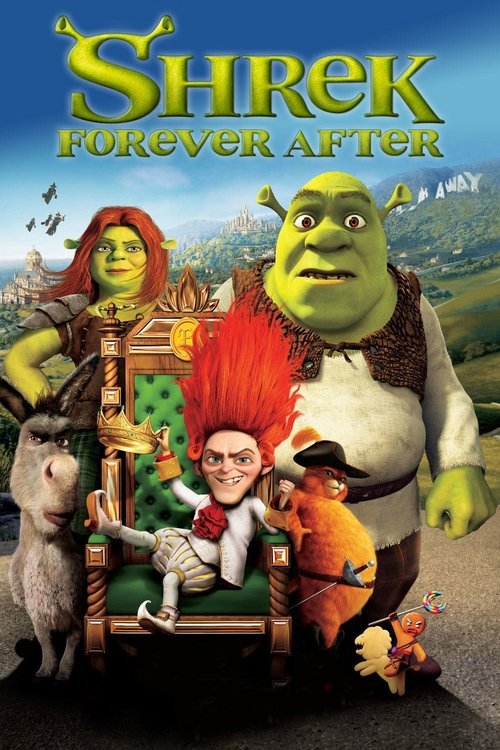
Shrek Forever After
A warm, mischievous fairy-tale comedy tinged with midlife ache, where a swamp-green hearth flickers beside a darker, ogre-ruled world, and one careless wish unravels the cozy life it longed to escape.
Shrek Forever After

Shrek Forever After

"It ain't ogre... til it's ogre."

16 May 2010 United States of America 93 min 6.4 (8,185)

Director: Mike Mitchell

Cast: Mike Myers, Eddie Murphy, Cameron Diaz, Antonio Banderas, Walt Dohrn

Animation Family Fantasy Comedy Adventure Gratitude and the value of ordinary life Midlife restlessness and lost identity Consequences of deals and wishes Love and sacrifice Friendship and loyalty
Budget: $165,000,000
Box Office: $752,600,867

Overview

Shrek Forever After, directed by Mike Mitchell, is the fourth film in the Shrek series. It finds the ogre as a family man in Far Far Away. He is a husband and a father to three babies. His days have settled into a loop of diapers, birthday parties and villagers asking him to perform his old roar.

Restless and nostalgic for the time when he was feared, Shrek meets the scheming deal-maker Rumpelstiltskin. Rumpelstiltskin offers him a magical contract that promises a single day of being a "real ogre" again. Shrek signs, and the fine print puts the world he knows at risk.

Mike Myers, Eddie Murphy, Cameron Diaz and Antonio Banderas return as Shrek, Donkey, Fiona and Puss in Boots. The film keeps the franchise's mix of fairy-tale parody, pop-culture gags and sentiment. This time it frames them around a "what if I'd never existed" story.
Core Meaning

The film argues that contentment is often invisible to the person living it. Shrek wants freedom and excitement, but the life he resents is the one that gave him love, friendship and purpose. The story is a fairy-tale take on the "It's a Wonderful Life" idea. Seeing what is lost makes ordinary domestic happiness feel heroic.

It also warns against shortcuts and bargains made out of impulse and self-pity. Wishing for a day of the past costs more than it appears to.

Thematic DNA

Gratitude and the value of ordinary life 30%
Midlife restlessness and lost identity 25%
Consequences of deals and wishes 20%
Love and sacrifice 15%
Friendship and loyalty 10%

Gratitude and the value of ordinary life

Shrek's routine of family and friends feels like a trap until it is taken away. The alternate world shows him how much he had.

Midlife restlessness and lost identity

Shrek misses being feared and feeling like himself. He is reduced to a performer who roars on demand for party guests, so his fatherhood feels like a loss of selfhood.

Consequences of deals and wishes

Rumpelstiltskin's contract works through loopholes and fine print. Shrek acts on impulse and pays for it, as in the old folktales the film parodies.

Love and sacrifice

Shrek's attempt to win Fiona's love again, and his willingness to give himself up for others, turn the story from comedy into a romance about choosing someone.

Friendship and loyalty

Donkey and Puss in Boots are changed by the altered timeline, yet they still gravitate towards Shrek. This shows that bonds can survive a reset of the world.

Character Analysis

Shrek

Mike Myers

Archetype: Reluctant hero Key Trait: Gruff but sentimental

Motivation

He wants to feel like himself again, then to restore Fiona's love and save his friends.

Character Arc

He starts bored and resentful, makes a rash wish, and finds out what he had. He ends by choosing his family with full appreciation.

Donkey

Eddie Murphy

Archetype: Loyal sidekick Key Trait: Chatty, comic loyalty

Motivation

He wants friendship and a place to belong.

Character Arc

In the altered world he does not know Shrek, but he is gradually pulled back to him. His loyalty is a constant.

All 5 characters and cast

Symbols & Motifs

The magical contract

Meaning:

The cost of impulsive choices and the fine print of fantasy.

Context:

Rumpelstiltskin tricks Shrek into signing it. The deal takes a day from Shrek's past, and Shrek does not see what it will cost.

The ogre roar

Meaning:

Shrek's authentic self, turned into a commodity.

Context:

Villagers ask him to perform it, which is why he feels like a mascot. Later it becomes meaningful again.

The birthday party

Meaning:

The repetitive, overwhelming side of domestic life.

Context:

The chaotic party for Shrek's children pushes him toward the wish.

Waffles

Meaning:

Temptation and lures that look innocent.

Context:

Donkey is drawn to waffles in the forest, and Shrek is suspicious about waffles appearing in the middle of nowhere.

The crown

Meaning:

Power taken by trickery and the self that exists apart from title.

Context:

Rumpelstiltskin takes the throne in the altered world and discards the crown he has won.

Memorable Quotes

Sometimes I wish I had just one day to feel like a real ogre again.
— Shrek

Context

He says it to Rumpelstiltskin, who immediately offers a magical transaction.

Meaning

It states the film's central wish and the mistake that causes the plot.

Magical transactions are my specialty!
— Rumpelstiltskin

Context

His reply to Shrek's wish for one day as a real ogre.

Meaning

It shows the villain's opportunism.

All 5 quotes

Philosophical Questions

Would life be better without certain responsibilities?

Shrek has to live without his family to see what they mean to him. The film suggests that what feels like a burden can be the source of meaning.

What is a person's identity worth without relationships?

In the alternate world Shrek has the freedom he wanted but no connection to anyone. He learns that identity is partly made of the people who know you.

Can a bargain ever be truly free?

Rumpelstiltskin's contract looks like a free choice, but it exploits Shrek's dissatisfaction. The film questions consent given in a moment of weakness.

How It Ends

Alternative Interpretations

Some viewers read the film as a midlife-crisis allegory about fatherhood and lost youth. Others see a story about depression and nostalgia, in which Shrek has to learn gratitude. A more cynical reading treats the film as a franchise "return to basics" that resets the series to its original status quo.

Full ending explanation

Cultural Impact

The film was released in 2010 as the fourth Shrek installment. It was marketed as the franchise's final chapter, and it shifted toward a more sentimental, family-centered tone. Its "world without me" structure draws on the tradition of It's a Wonderful Life, and its villain comes from the Brothers Grimm folktale about Rumpelstiltskin. The franchise's wider influence on fairy-tale parody in animation is substantial, though I did not verify specific critical or box-office figures for this film.

Frequently Asked Questions

Explore More About This Movie

Dive deeper into specific aspects of the movie with our detailed analysis pages

Comments (0)

Leave a comment

No comments yet. Be the first to share your thoughts!

Similar Movies