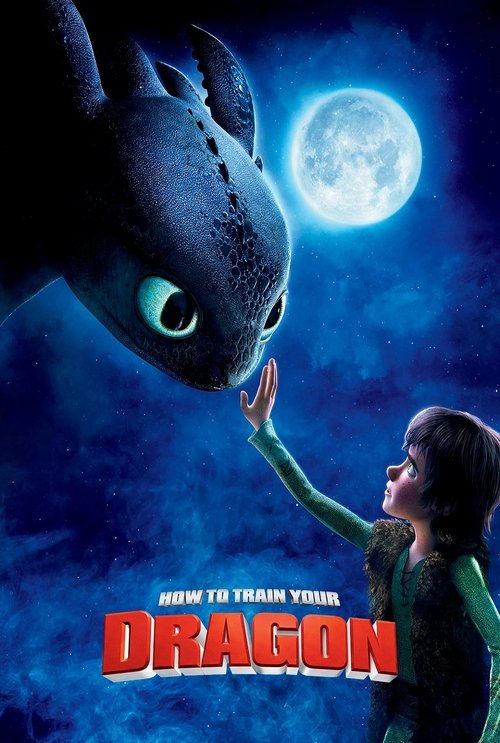
How to Train Your Dragon
"One adventure will change two worlds."
Overview
In the mythical Viking village of Berk, life is a constant battle against raiding dragons. Hiccup, the awkward and undersized teenage son of the village chieftain, Stoick the Vast, is a misfit who prefers invention to brute force. During a dragon attack, Hiccup uses one of his contraptions to shoot down a mysterious Night Fury, the most feared and elusive of all dragons, though no one believes him.
Venturing into the forest, Hiccup finds the injured dragon but finds he cannot bring himself to kill it. Instead, he sets it free and begins a secret, tentative friendship, naming the dragon 'Toothless'. As he nurses Toothless back to health, designing a prosthetic fin to help him fly again, Hiccup discovers that everything his tribe believes about dragons is wrong. He must now find a way to reconcile his newfound understanding with his village's deeply ingrained hatred, a challenge that will change the fate of both Vikings and dragons forever.
Core Meaning
The core meaning of How to Train Your Dragon revolves around the power of empathy and understanding to overcome prejudice and generational conflict. The film posits that true strength lies not in conforming to societal expectations of aggression and violence, but in compassion, intelligence, and the courage to challenge the status quo. Director Dean DeBlois and his team wanted to tell a story where the bond between a boy and a dragon could end an age-old war, showcasing that fear is often born from misunderstanding. Hiccup's journey is a message that leadership can be defined by compassion rather than dominance, and that accepting those who are different can lead to a more harmonious world.
Thematic DNA
Overcoming Prejudice and Fear
The central theme is the conflict between the Vikings and dragons, rooted in mutual fear and ignorance. For generations, the Vikings of Berk have seen dragons only as monstrous pests to be killed. Hiccup's journey with Toothless forces him to see beyond this ingrained prejudice. He learns that dragons are not inherently evil but are acting out of fear and coercion from a larger threat. The film serves as an allegory for overcoming prejudice, showing that understanding and empathy can dismantle long-standing hatred. As Hiccup says, "Everything we know about you guys is wrong," which becomes the emotional thesis of the movie.
Father-Son Relationships and Expectations
The dynamic between Hiccup and his father, Stoick, is a powerful emotional core of the film. Stoick, the epitome of a stoic Viking chief, is disappointed in his son's physical weakness and inventive, non-conformist nature. Their conflict represents a clash between tradition and a new way of thinking. Stoick's journey is one of learning to see his son for who he is, not who he expects him to be. His eventual apology and declaration of pride signifies a profound reconciliation and acceptance, highlighting the theme of bridging generational divides.
Finding Your True Self
Hiccup is an outcast who feels he must change to be accepted. Gobber even tells him to stop being "all of this," gesturing to his entire being. However, Hiccup's greatest strengths are the very qualities that make him different: his intelligence, creativity, and compassion. By befriending Toothless, he doesn't become a traditional Viking; he redefines what it means to be one. The film champions the idea of being true to oneself, suggesting that individuality and a different perspective can be sources of immense strength and positive change.
Cooperation and Mutual Dependence
The relationship between Hiccup and Toothless is built on mutual need and trust. Toothless cannot fly without the prosthetic tail fin Hiccup builds and controls, and Hiccup cannot achieve his potential without Toothless. This physical interdependence is a metaphor for their emotional bond. The film's climax, where Hiccup loses his leg, creates a powerful symmetry: both boy and dragon are now disabled and rely on prosthetics, solidifying their connection as equals who are stronger together. This theme extends to the village, which learns that coexisting with dragons is more beneficial than fighting them.
Character Analysis
Hiccup Horrendous Haddock III
Jay Baruchel
Motivation
Initially, his motivation is to kill a dragon to prove his worth as a Viking and gain his father's acceptance. This shifts to protecting Toothless and, ultimately, to bridging the gap between humans and dragons to create a world of peace and coexistence.
Character Arc
Hiccup begins as an insecure outcast, desperate for the approval of his father and tribe by conforming to their dragon-killing ways. His inability to kill Toothless sparks a journey of self-discovery. Through his bond with the dragon, he learns that his perceived weaknesses—empathy, intelligence, and sensitivity—are actually his greatest strengths. He transitions from a boy trying to fit in to a confident young leader who forges a new path for his entire culture, proving that true strength lies in understanding, not violence.
Stoick the Vast
Gerard Butler
Motivation
His primary motivation is to protect his village from the dragon threat, a duty he pursues relentlessly. He is also driven by a deep, if poorly expressed, love for Hiccup and a desire for his son to become a strong Viking like himself.
Character Arc
Stoick starts as a stubborn, traditional Viking leader who embodies his village's prejudice against dragons and is frustrated by his son's failure to meet his expectations. He is initially blind to Hiccup's true talents. His arc is one of transformation, driven by his son's actions. He eventually witnesses the truth about dragons and Hiccup's courage, leading him to shed his prejudice, apologize to his son, and embrace a new era of peace. His proud declaration, "He is my son!", marks the completion of his arc from a rigid traditionalist to a proud, accepting father.
Astrid Hofferson
America Ferrera
Motivation
Her initial motivation is to be the best dragon-slayer of her generation and uphold Viking traditions. This changes to helping Hiccup protect Toothless and convince the village that dragons are not their enemies after she learns the truth.
Character Arc
Astrid is initially the model young Viking: strong, skilled, and competitive, embodying all the values Hiccup lacks. She is skeptical and jealous of Hiccup's sudden success in dragon training. Her arc begins when she discovers Toothless. After a terrifying but ultimately breathtaking flight, her fear turns to wonder and acceptance. She becomes Hiccup's first and most crucial ally, supporting his cause and helping him stand against tradition. Her journey is from a staunch traditionalist to a forward-thinking partner.
Toothless
Randy Thom (vocal effects)
Motivation
His initial motivation is survival. After bonding with Hiccup, his motivation becomes protecting his new friend at all costs and, by extension, helping bridge the divide between their two species.
Character Arc
Toothless begins as a feared, almost mythical creature—the deadly Night Fury. Injured and trapped, he is initially hostile and mistrustful of Hiccup. Through Hiccup's patience and kindness, Toothless's character unfolds, revealing him to be intelligent, playful, and fiercely loyal, much like a cat or a dog. His arc is one of learning to trust a human, forming a bond so powerful it shatters centuries of conflict. He becomes the ultimate symbol of the dragons' true nature, shifting from a feared monster to a beloved friend.
Symbols & Motifs
Toothless's Injured Tail Fin
The damaged tail fin symbolizes vulnerability and the need for connection and trust. It represents Toothless's initial helplessness and Hiccup's capacity for empathy and ingenuity. Their ability to fly together, with Hiccup operating the prosthetic, is a powerful visual metaphor for their symbiotic relationship and mutual dependence.
Toothless's tail is injured when Hiccup shoots him down. Hiccup later crafts a prosthetic fin and harness, which he must actively control for them to fly. This device is central to their bonding, particularly in the iconic "Test Drive" sequence.
Hiccup's Prosthetic Leg
Hiccup's lost leg at the end of the film is a profound symbol of sacrifice and the cost of change. It creates a physical parallel between him and Toothless, forever linking them through their shared disability. This shared vulnerability reinforces their equality and the depth of their bond, showing that scars do not weaken but can represent strength and connection.
In the final battle against the Red Death, Hiccup is knocked off Toothless and loses his lower left leg. He wakes up in the film's epilogue with a metal prosthetic forged by Gobber, mirroring the prosthetic fin he made for his dragon.
The Dragon's Nest / The Red Death
The dragons' nest and its tyrannical ruler, the Red Death, symbolize a larger, oppressive system that forces individuals to commit harmful acts against their nature. The smaller dragons don't attack Berk out of malice, but to feed the giant queen to avoid being eaten themselves. This reveals that the perceived "enemy" is often a victim of circumstances, challenging the Vikings' black-and-white view of the conflict. The Red Death embodies the true source of fear and violence that must be confronted.
Hiccup and Astrid discover the nest during their first long flight on Toothless. They witness the colossal Red Death dragon consuming the other dragons' offerings. This discovery is the key to understanding the dragons' motivation for raiding the village.
Memorable Quotes
This is Berk. It snows nine months of the year, and hails the other three. [...] The only upsides are the pets. While other places have ponies or parrots… we have… dragons.
— Hiccup
Context:
This is part of Hiccup's opening narration at the very beginning of the film, as the camera flies over the village of Berk during a chaotic dragon raid.
Meaning:
This opening line masterfully establishes the film's setting, tone, and central conflict in a few concise, witty sentences. It immediately frames the harsh, unforgiving world of the Vikings and introduces the core problem—their "pest" issue is dragons—setting the stage for the entire narrative.
I wouldn't kill him because he looked as frightened as I was. I looked at him and I saw myself.
— Hiccup
Context:
Hiccup says this to Astrid when trying to explain why he couldn't kill Toothless, justifying his radical choice to befriend a dragon.
Meaning:
This quote encapsulates the film's central theme of empathy. It is the turning point for Hiccup's character and the moment the story's core message is articulated: the perceived enemy is not a monster, but a being capable of fear and vulnerability, just like oneself. This realization is the foundation of their friendship and the eventual peace.
Thank you for nothing, you useless reptile.
— Hiccup
Context:
Hiccup shouts this in frustration after Toothless pins him down, roars in his face, and then flies away, leaving Hiccup shaken but alive in the forest ravine.
Meaning:
This quote is delivered with biting sarcasm but marks the beginning of Hiccup's and Toothless's relationship. It's the moment after Hiccup cuts Toothless free and the dragon spares his life in return. The line is full of irony, as Toothless will prove to be the most useful and important thing in Hiccup's life.
You just gestured to all of me!
— Hiccup
Context:
This exchange happens in the blacksmith shop when Gobber is trying to give Hiccup advice on how to fit in and become a dragon fighter, just before Stoick arrives to talk to Hiccup.
Meaning:
This quote humorously highlights Hiccup's feeling of being a complete disappointment to the Viking ideal. When Gobber tells him he needs to "stop all... this" to be a real Viking, Hiccup's response underscores the theme of identity and the pressure to conform. The film ultimately proves that "all of him" is exactly what was needed.
Philosophical Questions
Is tradition always worth upholding?
The film deeply explores the conflict between tradition and progress. Berk's tradition is a 300-year war with dragons, a custom passed down through generations without question. Hiccup is the first to challenge this tradition, not out of rebellion, but through discovery and experience. The film suggests that while traditions can provide identity and structure, they should be re-examined and even discarded when they are based on fear, ignorance, or prejudice. It poses the question of whether loyalty to one's culture requires blind adherence to its past or the courage to guide it toward a better future.
What is the nature of an 'enemy'?
How to Train Your Dragon philosophically deconstructs the concept of an enemy. The Vikings see dragons as monolithic, evil beasts. However, Hiccup learns they are complex individuals with their own fears and motivations. The discovery of the Red Death reveals that the dragons are not raiding out of malice but are themselves victims of an oppressive force. The film argues that what we perceive as an enemy is often a product of misunderstanding and that seeking to understand our adversaries can reveal a common ground, or a common enemy, transforming conflict into cooperation.
Alternative Interpretations
While the film is widely seen as a coming-of-age story about empathy, some analyses offer different lenses for interpretation. One perspective reads the story through a queer lens, where Hiccup's feeling of being an outsider and his need to hide a fundamental part of himself (his friendship with Toothless) from a society that would not understand mirrors the experience of many LGBTQ+ individuals. His struggle to get his father to accept him for who he truly is, rather than trying to force him to conform, resonates with this interpretation.
Another interpretation views the film as a subtle critique of toxic masculinity. The Viking society of Berk prizes brute strength, aggression, and stoicism—traits Hiccup lacks. His ultimate victory comes not from adopting these traits but by succeeding through intelligence, empathy, and cooperation. He redefines what it means to be a strong man and a leader, suggesting that compassion is a more powerful tool than violence.
Cultural Impact
Released in 2010, How to Train Your Dragon was a massive critical and commercial success for DreamWorks Animation, grossing nearly $500 million worldwide and earning two Academy Award nominations. It was widely praised for its emotional depth, stunning animation, and exhilarating 3D flight sequences, setting a new benchmark for the studio. The film's heartfelt story of friendship and acceptance resonated deeply with audiences, distinguishing it from many of its more comedy-focused animated contemporaries.
The movie's success launched a major multimedia franchise, including two critically acclaimed sequels, How to Train Your Dragon 2 (2014) and How to Train Your Dragon: The Hidden World (2019), several television series, short films, and video games. The franchise is notable for allowing its main character, Hiccup, to grow up and mature across the films, a rarity in animated series. The first film, in particular, has had a lasting influence, inspiring a generation of young animators and storytellers. Its themes of embracing differences, challenging toxic masculinity through a hero who succeeds with intelligence and compassion, and advocating for empathy have made it a timeless classic that continues to be celebrated by fans of all ages.
Audience Reception
How to Train Your Dragon was met with overwhelmingly positive audience reception, and it is widely considered one of DreamWorks' best films. Audiences consistently praise the emotional depth of the relationship between Hiccup and Toothless, often citing the wordless "Forbidden Friendship" scene as a masterpiece of animated storytelling. The exhilarating flight sequences, especially in 3D, were a major highlight for many viewers, along with John Powell's soaring musical score. The film's heartfelt themes of acceptance, friendship, and overcoming prejudice resonated strongly with families and adults alike. It holds a 91% audience score on Rotten Tomatoes, indicating widespread and lasting affection from the public. Criticism is minimal, generally focusing on some conventional plot elements, but the execution, heart, and visual splendor of the film typically overshadow these critiques.
Interesting Facts
- The film is loosely based on the British children's book series of the same name by Cressida Cowell, but the filmmakers made significant changes, such as making Toothless a rare Night Fury and large enough to be ridden.
- Famed cinematographer Roger Deakins, known for his work on live-action films like 'The Shawshank Redemption' and 'No Country for Old Men', served as a visual consultant. He helped create a more realistic, cinematic feel with the film's lighting and composition.
- The vocal effects for Toothless were created by sound designer Randy Thom using a mix of sounds, including his own voice, elephants, horses, and tigers.
- The animators studied the movements of various real-life animals to create Toothless's behavior; he is largely based on cats (especially his mannerisms), bats (his flight), and salamanders.
- During recording sessions, many of the actors in the supporting cast were brought together to allow for improvisation, adding to the natural comedic timing of their interactions.
- In early drafts, which were more faithful to the book, the dragons were already domesticated creatures living alongside the Vikings. Directors Chris Sanders and Dean DeBlois changed this to a story about ending a war between the two species.
- The musical score, composed by John Powell, is highly acclaimed and features a blend of orchestral themes with Celtic and Scottish influences, which perfectly complements the Viking setting.
Easter Eggs
In the opening DreamWorks Animation logo sequence, the shadow of Toothless can be seen flying past the moon just before the title card.
This is a subtle visual nod that immediately introduces the film's main non-human character. It's an easy-to-miss detail that rewards attentive viewers from the very first seconds of the movie.
⚠️ Spoiler Analysis
Click to reveal detailed analysis with spoilers
Frequently Asked Questions
Explore More About This Movie
Dive deeper into specific aspects of the movie with our detailed analysis pages
Comments (0)
No comments yet. Be the first to share your thoughts!