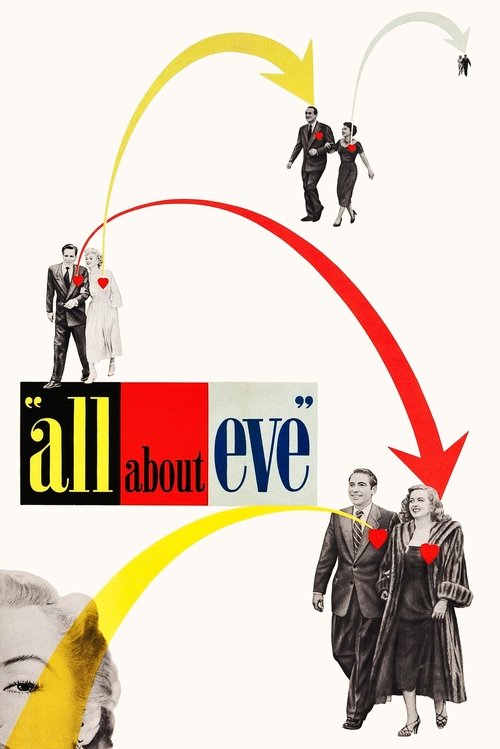
All About Eve
"It's all about women... and their men!"
Overview
"All About Eve" chronicles the calculated ascent of Eve Harrington (Anne Baxter), a seemingly devoted and demure fan of the legendary, yet aging, Broadway star Margo Channing (Bette Davis). Taken under Margo's wing, Eve quickly ingratiates herself into the lives of Margo's closest circle, including her director boyfriend Bill Sampson (Gary Merrill), her playwright Lloyd Richards (Hugh Marlowe), and his wife Karen (Celeste Holm).
Eve's initial humility and tragic backstory charm everyone, except for Margo's sharp-witted maid, Birdie (Thelma Ritter), who remains suspicious. As Eve's presence becomes more ingrained, her ambition begins to surface. She subtly manipulates situations to her advantage, positioning herself as Margo's understudy and seizing opportunities to undermine the star. The narrative, framed by the cynical narration of theatre critic Addison DeWitt (George Sanders), peels back the layers of theatrical society to expose the raw ambition, jealousy, and duplicity that lie beneath the glamorous facade.
Core Meaning
At its heart, "All About Eve" is a searing examination of ambition, identity, and the ephemeral nature of fame. Director Joseph L. Mankiewicz uses the cutthroat world of Broadway theatre as a microcosm to explore the lengths to which individuals will go for success and the personal cost of such ambition. The film poses a fundamental question about authenticity: in a world built on performance, where does the character end and the real person begin? It suggests that the relentless pursuit of stardom can lead to a hollow victory, where one gains the world but loses their soul and genuine human connection. Margo ultimately finds happiness by embracing her identity beyond the stage, while Eve achieves her dream only to find herself trapped in a new cycle of rivalry and controlled by the cynical men who enabled her rise.
Thematic DNA
Ambition and Betrayal
This is the central theme, embodied by Eve Harrington. Her journey from an adoring fan to a ruthless star is a case study in Machiavellian ambition. She systematically betrays the trust of everyone who helps her, most notably Margo and Karen, using their kindness and vulnerabilities as stepping stones. The film portrays ambition as a destructive force that sacrifices loyalty and genuine relationships for personal gain, suggesting a cyclical nature where the ambitious eventually become targets themselves.
Aging and Identity in Show Business
Margo Channing's character arc explores the anxieties of an aging actress in a world that worships youth. She grapples with the fear of being replaced by a younger version of herself, blurring the lines between her on-stage persona and her off-stage identity. The film critically examines how a woman's value in the entertainment industry is often tied to her age and appearance, a struggle Margo must navigate to find her true self beyond the footlights.
Artifice and Deception
The film constantly plays with the idea of performance versus reality. The theatre world is depicted as a place of illusion, but the real deception happens offstage. Eve's entire persona is a carefully constructed act of humility and innocence designed to manipulate those around her. The film suggests that while artifice is celebrated on stage, its use in real life is a corrosive force that destroys trust and authenticity. Critic Addison DeWitt is the master observer and manipulator who sees through everyone's performances.
The Nature of Womanhood
The film, a product of its time, presents a complex and somewhat traditional view of womanhood. It contrasts Margo, the career-driven woman who eventually finds fulfillment in a domestic role, with Eve, whose ambition is portrayed as unnatural and ultimately unfulfilling. Margo delivers a key monologue about the sacrifices a woman makes in her career and how, ultimately, being a woman is a career in itself that requires a partner. The film explores the societal pressure on women to choose between a career and a traditional domestic life.
Character Analysis
Margo Channing
Bette Davis
Motivation
Margo is motivated by a desire to hold onto her stardom and her relationship with Bill. Her primary conflict is her insecurity about her age and the fear of being replaced, which fuels her volatile behavior. Ultimately, her motivation shifts to finding genuine happiness and fulfillment as a woman, not just as an actress.
Character Arc
Initially, Margo is a celebrated but deeply insecure and temperamental Broadway queen, terrified of aging and losing her career and younger boyfriend. Her journey is one of self-realization. Provoked by Eve's threat, she is forced to confront her own identity apart from her stage persona. She ultimately chooses personal happiness and the role of a wife over the relentless demands of stardom, finding peace and a more authentic version of herself.
Eve Harrington
Anne Baxter
Motivation
Eve's singular motivation is the acquisition of fame at any cost. She desires not just to be an actress, but to become Margo Channing, taking over her career, her friends, and her life. She is driven by a deep-seated egotism and a relentless need for the adoration that comes with stardom.
Character Arc
Eve begins as the picture of innocence and adoration, a humble fan with a tragic past. This facade quickly crumbles to reveal a ruthlessly ambitious and manipulative woman. Her arc is a meteoric rise to fame built on a foundation of lies and betrayals. By the end, she has achieved stardom but is emotionally hollow, isolated, and now controlled by Addison DeWitt, only to see her own potential usurper, Phoebe, appear in her life.
Addison DeWitt
George Sanders
Motivation
Addison is motivated by power, control, and a disdain for the sentimentality he sees around him. He enjoys observing and orchestrating the drama of the theatre world. His interest in Eve stems from recognizing her as a fellow manipulator, but one he can ultimately dominate.
Character Arc
Addison DeWitt remains largely unchanged throughout the film, serving as its cynical, all-knowing narrator and manipulator. He is initially amused by Eve's machinations, helping her career for his own benefit. His arc culminates in him asserting complete control over Eve, exposing her lies not for moral reasons, but to make her his possession, revealing the true depth of his own manipulative and proprietary nature.
Karen Richards
Celeste Holm
Motivation
Karen is motivated by a desire to be kind and to perhaps gently humble her friend Margo, whom she feels is being unfair to Eve. Her actions are born from a sense of pity and a failure to see through Eve's deception until it is too late.
Character Arc
Karen starts as Margo's loyal best friend and a well-meaning, if somewhat naive, society wife. She is initially charmed by Eve and becomes her biggest advocate, even betraying Margo by helping Eve perform in her place. Her arc involves a painful disillusionment as she discovers Eve's true nature. She is blackmailed by Eve, forcing her to confront the consequences of her misplaced sympathy.
Symbols & Motifs
Mirrors and Reflections
Mirrors symbolize self-reflection, identity, and the deceptive nature of appearances. They represent the division between the public persona and the private self. For Margo, the mirror is a place to confront her aging and the blurring line between the actress and the woman. For Eve, and later Phoebe, mirrors reflect their ambition and the multiple, fractured identities they assume to achieve their goals.
Mirrors are used throughout the film, most notably in dressing rooms. The opening scene shows Margo at her dressing room mirror, removing her stage persona. The final, iconic scene shows Phoebe, Eve's own aspiring successor, holding Eve's award and practicing her acceptance speech in front of a three-way mirror, her reflection multiplying infinitely, symbolizing the endless cycle of ambition and the many faces of deception.
The Sarah Siddons Award
The award is a tangible symbol of the ultimate theatrical achievement and the goal of Eve's ambition. However, it also represents a hollow victory. It is an award for acting—for deception—which mirrors Eve's off-stage life. For Eve, possessing the award does not bring happiness or love, but isolation.
The film is framed by the Sarah Siddons Award ceremony. It opens with Eve about to receive the award and flashes back to show how she got there. At the end, after achieving her goal, Eve treats the award with indifference, leaving it in a taxi. Margo quips that Eve can "put that award where your heart ought to be." The award ultimately becomes a prop for the next aspirant, Phoebe, continuing the cycle.
Cigarettes
Cigarettes often symbolize sophistication, anxiety, and a certain jaded worldliness within the theatrical setting. For Eve, her adoption of smoking marks her transition from a seemingly innocent fan to a hardened, calculating player in the Broadway scene, signifying her loss of innocence and growing cynicism.
Characters are frequently seen smoking during moments of stress, contemplation, or cynical conversation. Margo is often enveloped in a haze of smoke, reflecting her identity crisis. Eve's smoking becomes more prominent as her true nature is revealed, aligning her with the cynical worldview of characters like Addison DeWitt.
Memorable Quotes
Fasten your seatbelts. It's going to be a bumpy night.
— Margo Channing
Context:
Spoken at the birthday party Margo is throwing for Bill Sampson. Feeling insecure and increasingly irritated by Eve's machinations and Bill's attention to her, Margo has been drinking heavily. As she heads upstairs, she delivers this line with relish, signaling her intent to make the rest of the evening a dramatic and confrontational affair.
Meaning:
This iconic line signifies Margo's declaration of war. Knowing the evening will be filled with tension and conflict, especially concerning Eve, she dramatically warns her party guests that she intends to cause turbulence. It perfectly encapsulates her theatrical personality and her refusal to go down without a fight.
Funny business, a woman's career. The things you drop on your way up the ladder so you can move faster. You forget you'll need them again when you get back to being a woman.
— Margo Channing
Context:
Margo says this to Karen in a moment of vulnerability after a fight with Bill. She has realized that her identity has become consumed by "Margo Channing, the star," and she fears it has cost her the chance at a happy personal life with the man she loves.
Meaning:
This quote is the heart of Margo's epiphany about her life and priorities. She reflects on the sacrifices she's made for her career and realizes that in her pursuit of stardom, she has neglected her identity as a woman who needs love and partnership. It speaks to the film's broader theme of the perceived conflict between professional ambition and domestic fulfillment for women in that era.
You can always put that award where your heart ought to be.
— Margo Channing
Context:
This line is said after the Sarah Siddons Award ceremony. Eve gives a gracious-sounding acceptance speech, thanking Margo and the others she has used. Later, Margo encounters Eve and delivers this devastating assessment, letting Eve know that despite her public triumph, her true, heartless nature is clear to those she betrayed.
Meaning:
A sharp, final barb from Margo to Eve, delivered with cutting sincerity. It implies that Eve has achieved her goal but has sacrificed her humanity and capacity for love in the process. The award is a cold substitute for the genuine human connection that Eve has destroyed on her path to success.
I'll admit I may have seen better days, but I'm still not to be had for the price of a cocktail, like a salted peanut.
— Margo Channing
Context:
Margo directs this remark at Eve during Bill's birthday party. She feels that Eve, the producer Max Fabian, and others are treating her as if she's already washed up and are plotting behind her back. The line is a direct challenge to their assumptions and a reassertion of her status.
Meaning:
This line is a fiery assertion of Margo's self-worth and refusal to be dismissed or taken for granted. Despite her anxieties about aging, she retains her pride and demands respect. It showcases her wit and her fighting spirit, reminding everyone that she is still a formidable presence.
Philosophical Questions
What is the true cost of unbridled ambition?
The film relentlessly explores this question through the character of Eve. She achieves the pinnacle of success—fame, awards, and stardom—but the cost is her authenticity and any chance at genuine human relationships. She is left isolated, emotionally hollow, and under the control of the cynical Addison DeWitt. The film contrasts her trajectory with Margo's, who chooses personal fulfillment over professional supremacy and finds happiness. It posits that ambition devoid of morality leads to a victory that is ultimately empty and self-destructive.
Where does performance end and identity begin?
Set in the world of theatre, the film constantly blurs the line between acting on stage and acting in life. Margo's central crisis is her inability to separate "Margo the actress" from "Margo the woman." Eve's entire existence is a performance, a carefully crafted role of an ingénue that masks her true self. The film suggests that identity can be fluid and, in a world that values appearances, easily lost. It asks whether a person can become so consumed by the roles they play that their true self ceases to exist.
Is the cycle of rivalry and usurpation inevitable in the pursuit of fame?
The film's ending strongly suggests that this cycle is inescapable. Just as Eve has replaced Margo, a new, younger aspirant named Phoebe appears, ready to do the same to Eve. The final shot of Phoebe multiplied in mirrors implies an endless succession of Eves waiting in the wings. This suggests a cynical view of fame: that it is a temporary state, and there will always be someone younger and more ruthless ready to take your place. The system itself perpetuates this cycle of ambition and betrayal.
Alternative Interpretations
While the primary reading of "All About Eve" sees Eve Harrington as a straightforward, sociopathic opportunist, some interpretations offer more nuanced perspectives on her character and motivations. One view suggests that Eve is not just a 'type' but a complex character who may genuinely admire Margo's talent, even as she seeks to supplant her. Her ambition could be seen as a product of a society that offers women limited paths to power, forcing them into manipulative roles. Her villainy is a reflection of the brutal, competitive system of stardom itself.
Another interpretation focuses on the ending. The arrival of Phoebe creates a cyclical narrative, suggesting that this story of ambition and betrayal is timeless and inherent to the nature of fame. However, the original short story, "The Wisdom of Eve," ended with Eve successfully stealing the playwright Lloyd Richards and heading to Hollywood, with no comeuppance. The film's ending, where Eve is trapped by Addison and faces her own usurper, can be interpreted as a moralistic addition required by the Hollywood Production Code of the era, which dictated that villainy must be punished. This suggests that Mankiewicz's ending is not just a comment on the cyclical nature of fame, but also a concession to the cinematic conventions of the time.
Cultural Impact
"All About Eve" was released to immense critical acclaim in 1950 and has since been cemented as one of the greatest films in American cinema. Its screenplay, written and directed by Joseph L. Mankiewicz, is considered one of the sharpest and most literate in Hollywood history, celebrated for its biting wit and unforgettable dialogue. The film's record-setting 14 Oscar nominations and six wins, including Best Picture, solidified its place in the cinematic canon.
Its influence on cinema is profound. The narrative of the ambitious ingénue who usurps a powerful figure has become a classic archetype, referenced and parodied in countless films and television shows. The film's cynical exploration of celebrity, ambition, and the backstage machinations of show business was groundbreaking and has remained remarkably relevant. Bette Davis's portrayal of Margo Channing is considered a pinnacle of her career and one of the most iconic performances in film history, resurrecting her from a career slump and forever associating her with the role.
The film's lines, particularly "Fasten your seatbelts. It's going to be a bumpy night," have become ingrained in popular culture, frequently quoted and often misquoted. Furthermore, the fictional Sarah Siddons Society in the movie inspired the creation of a real-life organization in Chicago, which continues to present an award to distinguished actors, a testament to the film's lasting impact beyond the screen. In 1990, "All About Eve" was selected for preservation in the United States National Film Registry by the Library of Congress for being "culturally, historically, or aesthetically significant."
Audience Reception
Upon its release, "All About Eve" was met with widespread critical acclaim and was a box office success. Critics lauded Joseph L. Mankiewicz's brilliant, witty screenplay and masterful direction. The performances were universally praised, especially that of Bette Davis, which was hailed as a triumphant comeback and one of her greatest roles. George Sanders won an Academy Award for his portrayal of the acid-tongued Addison DeWitt.
Audiences were captivated by the film's sharp dialogue, sophisticated drama, and its juicy, behind-the-curtain look at the world of show business. While the film's cynical take on ambition and fame was a key point of discussion, its core emotional story, particularly Margo's struggle with aging and identity, resonated deeply with viewers. Over the decades, its reputation has only grown, and it is now universally regarded by critics and audiences as one of the best films ever made, praised for its timeless themes and enduring relevance.
Interesting Facts
- The film holds the record for the most Academy Award nominations for a single film (14), a feat only later matched by "Titanic" (1997) and "La La Land" (2016).
- It is the only film in Oscar history to receive four female acting nominations: Bette Davis and Anne Baxter for Best Actress, and Celeste Holm and Thelma Ritter for Best Supporting Actress.
- The role of Margo Channing was originally intended for Claudette Colbert, who had to drop out due to a back injury. Bette Davis was cast as a replacement, and the role revitalized her career, which had been in a slump.
- The film is based on a 1946 short story called "The Wisdom of Eve" by Mary Orr, which itself was based on a real-life anecdote told by actress Elisabeth Bergner about a manipulative young fan.
- Bette Davis and her co-star Gary Merrill, who played her on-screen love interest Bill Sampson, fell in love during filming and were married shortly after production wrapped. They even adopted a daughter whom they named Margot.
- The prestigious-sounding "Sarah Siddons Award" was fictional, created for the film. However, in 1952, a real Sarah Siddons Society was established in Chicago and began giving out a genuine award, inspired by the movie.
- A young Marilyn Monroe has an early, memorable role as Miss Casswell, an aspiring actress described by Addison DeWitt as a "graduate of the Copacabana School of Dramatic Arts."
- The character of Birdie Coonan was written specifically for actress Thelma Ritter by director Joseph L. Mankiewicz.
- The film was adapted into a successful Broadway musical called "Applause" in 1970, which won the Tony Award for Best Musical. Lauren Bacall originated the role of Margo Channing.
⚠️ Spoiler Analysis
Click to reveal detailed analysis with spoilers
Frequently Asked Questions
Explore More About This Movie
Dive deeper into specific aspects of the movie with our detailed analysis pages
Comments (0)
No comments yet. Be the first to share your thoughts!