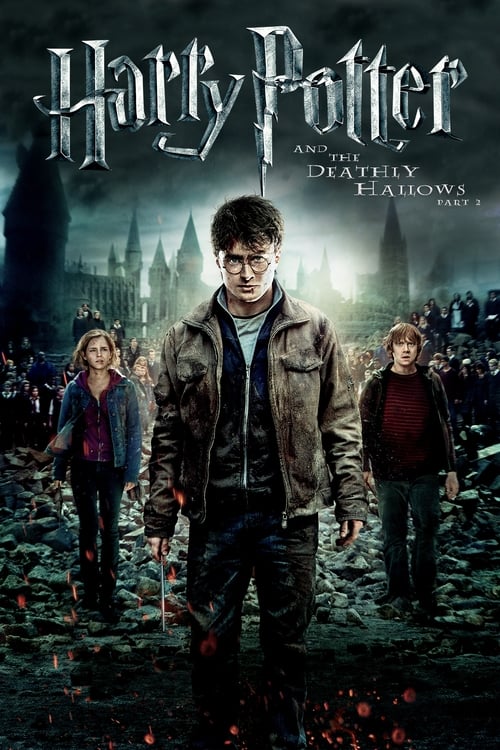
Harry Potter and the Deathly Hallows: Part 2
A dark fantasy finale erupting with operatic battles and emotional sacrifices, painting a hauntingly beautiful tapestry of courage against overwhelming darkness.
Harry Potter and the Deathly Hallows: Part 2

Harry Potter and the Deathly Hallows: Part 2

"It all ends."

12 July 2011 United Kingdom 130 min ⭐ 8.1 (21,323)
Director: David Yates
Cast: Daniel Radcliffe, Emma Watson, Rupert Grint, Ralph Fiennes, Alan Rickman
Fantasy Adventure
Death and Mortality Good vs. Evil Love and Sacrifice Courage
Budget: $125,000,000
Box Office: $1,341,511,219

Overview

"Harry Potter and the Deathly Hallows: Part 2" picks up immediately where the first part left off, with Harry, Ron, and Hermione continuing their perilous quest to find and destroy Lord Voldemort's remaining Horcruxes. Their journey takes them from the goblin-run Gringotts Wizarding Bank, where they perform a daring heist, to the hallowed halls of Hogwarts School of Witchcraft and Wizardry, which has become a battleground for the future of the wizarding world.

As the forces of good and evil converge for a final, cataclysmic showdown, Harry must confront his own destiny and make the ultimate sacrifice. The film is a culmination of years of friendship, loss, and bravery, bringing the epic saga to a powerful and emotionally resonant conclusion. It is a story of the enduring power of love, the importance of friendship, and the difficult choices that define a hero.
Core Meaning

The core meaning of "Harry Potter and the Deathly Hallows: Part 2" revolves around the themes of mortality, sacrifice, and the triumph of love over evil. Director David Yates sought to convey that true power lies not in immortality or dominance, but in the courage to face death and the willingness to sacrifice oneself for the greater good. The film posits that it is our choices, especially in the face of adversity, that truly define us. Ultimately, the message is that love, in its purest form—familial, platonic, and selfless—is the most potent magic of all, capable of conquering even the darkest of forces.

Thematic DNA

Death and Mortality 35%
Good vs. Evil 30%
Love and Sacrifice 25%
Courage 10%

Death and Mortality

The theme of death is central to the film, as characters are constantly confronted with their own mortality and the loss of loved ones. Harry's journey forces him to accept his own potential demise as a necessary sacrifice to defeat Voldemort. The film explores the idea that fearing death, as Voldemort does, leads to a life devoid of love and true meaning. In contrast, accepting death as a natural part of life is portrayed as a source of immense courage and strength. Dumbledore's wisdom, "Do not pity the dead, Harry. Pity the living, and, above all, those who live without love," encapsulates this theme perfectly.

Good vs. Evil

The classic struggle between good and evil reaches its epic conclusion in this film. The Battle of Hogwarts serves as the ultimate stage for this conflict, with Harry and his allies representing hope, love, and selflessness, while Voldemort and the Death Eaters embody hatred, fear, and a lust for power. The film emphasizes that the line between good and evil is not always clear-cut, as seen through the complex character of Severus Snape, but ultimately, it is the choices individuals make that place them on one side or the other.

Love and Sacrifice

Love is depicted as the most powerful form of magic, capable of protecting and ultimately defeating evil. Lily Potter's sacrificial love for Harry created a lingering protection that Voldemort could not overcome. This theme is echoed in Harry's own willingness to sacrifice himself for his friends and the wizarding world. The film is filled with acts of love and sacrifice from numerous characters, highlighting that these actions are the true measure of a hero.

Courage

Courage is a prominent theme, demonstrated not only by the main trio but also by supporting characters like Neville Longbottom, who transforms from a timid boy into a defiant leader. The film showcases different forms of courage, from the bravery of facing a dark wizard in battle to the quiet strength required to endure loss and continue fighting for what is right. Harry's ultimate act of courage is his willing walk into the Forbidden Forest to face Voldemort, accepting his fate for the sake of others.

Character Analysis

Harry Potter

Daniel Radcliffe

Archetype: The Chosen One/Hero
Key Trait: Selflessness

Motivation

Harry is motivated by a deep sense of love for his friends and the wizarding world, and a desire to avenge his parents' deaths and put an end to Voldemort's reign of terror. He is driven by a strong moral compass and a commitment to doing what is right, even at great personal cost.

Character Arc

Harry's arc culminates in his transformation from a boy burdened by prophecy to a man who chooses his own destiny. He fully embraces his role as a leader and makes the ultimate sacrifice, willingly walking to his death to save others. His journey is one of coming to terms with loss, understanding the true nature of courage, and realizing that love is the most powerful magic. His resurrection and final victory over Voldemort solidify his status as a true hero.

Severus Snape

Alan Rickman

Archetype: Anti-hero/Tragic Hero
Key Trait: Enigmatic

Motivation

Snape's primary motivation is his enduring love for Lily Potter and his desire to protect her son, Harry. This love compels him to make immense sacrifices and risk his life to aid in the fight against Voldemort, all while maintaining a facade of loyalty to the Dark Lord.

Character Arc

Snape's character arc is one of the most complex and pivotal in the series, and it is fully revealed in this film. Through his memories, we learn that his seemingly villainous actions were driven by his unrequited love for Lily Potter. He has been acting as a double agent, protecting Harry in secret while appearing to serve Voldemort. His arc is one of redemption, showcasing the profound impact of love and the capacity for good to exist even in the most outwardly dark individuals.

Lord Voldemort

Ralph Fiennes

Archetype: The Villain/Shadow
Key Trait: Power-hungry

Motivation

Voldemort is driven by an insatiable lust for power and a pathological fear of death. He seeks to control the wizarding world and achieve immortality at any cost, believing that this will make him the most powerful wizard of all time.

Character Arc

Voldemort's arc is one of escalating obsession and ultimate self-destruction. His relentless pursuit of immortality and power leads him to commit heinous acts, but it also reveals his profound weaknesses. As his Horcruxes are destroyed, he becomes more vulnerable and erratic. His inability to understand love and his fear of death are his ultimate undoing, leading to his final defeat at the hands of Harry.

Neville Longbottom

Matthew Lewis

Archetype: The Unlikely Hero
Key Trait: Resilience

Motivation

Neville is motivated by a fierce loyalty to his friends and a deep-seated desire to fight against the injustice and cruelty of Voldemort and the Death Eaters. The memory of his parents, who were tortured into insanity by Bellatrix Lestrange, fuels his determination to see them defeated.

Character Arc

Neville's arc is a powerful story of growth and bravery. He transforms from a clumsy, insecure boy into a courageous and defiant leader of the resistance at Hogwarts. His defining moment comes when he stands up to Voldemort, refusing to surrender even when all seems lost. By destroying the final Horcrux, he plays a crucial role in Voldemort's defeat, proving himself to be a true Gryffindor and a hero in his own right.

Symbols & Motifs

The Deathly Hallows

Meaning:

The three Deathly Hallows—the Elder Wand, the Resurrection Stone, and the Cloak of Invisibility—symbolize the human desire to conquer death. However, the film suggests that true mastery of death comes not from possessing these powerful objects, but from accepting mortality. Harry, who possesses all three Hallows at one point, ultimately chooses to reject the power they offer, demonstrating his wisdom and true strength.

Context:

The Hallows are central to the plot, with Voldemort seeking the Elder Wand for its power. Harry uses the Resurrection Stone to find strength from his deceased loved ones before facing Voldemort, and the Cloak of Invisibility has protected him throughout his journey. His decision to break the Elder Wand at the end of the film symbolizes his rejection of ultimate power.

Horcruxes

Meaning:

The Horcruxes, objects containing fragments of Voldemort's soul, symbolize his desperate and unnatural fear of death. They represent his corruption and his willingness to sacrifice his humanity for immortality. The destruction of each Horcrux signifies the chipping away of Voldemort's power and his forced confrontation with his own mortality.

Context:

The film revolves around Harry, Ron, and Hermione's quest to find and destroy the remaining Horcruxes, which include Hufflepuff's cup, Ravenclaw's diadem, and Nagini the snake. Harry himself is revealed to be an unintentional Horcrux, which necessitates his sacrifice.

The Sword of Gryffindor

Meaning:

The Sword of Gryffindor symbolizes true courage and worthiness. It appears to those who demonstrate bravery in times of need. The sword is one of the few objects capable of destroying Horcruxes, representing the power of good to vanquish evil.

Context:

The sword is used to destroy several Horcruxes throughout the series. In this film, Neville Longbottom pulls the sword from the Sorting Hat during a moment of profound courage, using it to kill Nagini, the final Horcrux, which is a pivotal moment in Voldemort's defeat.

Memorable Quotes

Always.

— Severus Snape

Context:

This line is spoken in a flashback sequence, as Dumbledore questions Snape about his feelings for Lily after all this time. Snape's Patronus, a doe (the same as Lily's), is a testament to the enduring nature of his love.

Meaning:

This single word encapsulates the depth of Snape's unwavering love for Lily Potter, which has motivated his actions throughout the entire series. It is a poignant and powerful revelation that redefines his character and reveals his true loyalties.

Not my daughter, you bitch!

— Molly Weasley

Context:

Molly Weasley shouts this line at Bellatrix Lestrange during the Battle of Hogwarts, just before she engages Bellatrix in a duel to the death for threatening her daughter, Ginny.

Meaning:

This quote is a powerful expression of maternal love and ferocity. It showcases Molly Weasley's immense strength and her unwavering determination to protect her children. It's a moment of fierce, righteous anger from a character often seen as nurturing and domestic.

Do not pity the dead, Harry. Pity the living, and above all, those who live without love.

— Albus Dumbledore

Context:

Dumbledore speaks these words to Harry in the ethereal King's Cross-like setting after Harry has been "killed" by Voldemort. It is a moment of profound wisdom and comfort for Harry as he grapples with the concepts of life, death, and sacrifice.

Meaning:

This quote encapsulates one of the central themes of the series: that a life without love is a fate worse than death. It highlights the core difference between Harry and Voldemort and serves as a guiding principle for Harry's journey.

It is our choices, Harry, that show what we truly are, far more than our abilities.

— Albus Dumbledore

Context:

This idea is central to the film's climax, as Harry chooses to sacrifice himself and ultimately to reject the power of the Deathly Hallows. It is a guiding principle that has shaped Harry's character throughout his adventures.

Meaning:

Though not originally from this film, this sentiment is a core message of the entire series and is particularly relevant to the final installment. It emphasizes that one's character is defined by the choices they make, not by their inherent talents or circumstances. This is a recurring theme that resonates throughout Harry's journey.

Philosophical Questions

What is the nature of death, and how should we confront our own mortality?

The film explores this question through the stark contrast between Harry and Voldemort. Voldemort's obsessive fear of death leads him to mutilate his own soul in a desperate bid for immortality, ultimately living a tormented and loveless existence. Harry, on the other hand, learns to accept death as a natural part of life and is willing to sacrifice himself for a greater purpose. The film suggests that true mastery over death is not about avoiding it, but about living a life filled with love and courage, so that when death comes, it can be faced without fear.

Are our destinies predetermined, or do our choices shape our lives?

This classic philosophical debate is at the heart of Harry's journey. While he is burdened by a prophecy that seems to dictate his fate as "the Chosen One," it is ultimately his choices that define him as a hero. He consistently chooses love over hate, friendship over isolation, and self-sacrifice over self-preservation. The film argues that even in the face of prophecy and seemingly insurmountable odds, it is the power of free will and the moral compass of one's choices that truly shape one's destiny.

Alternative Interpretations

While the film presents a clear narrative of good triumphing over evil, some alternative interpretations have emerged among critics and audiences. One perspective is a religious allegory, with Harry as a Christ-like figure who willingly sacrifices himself and is resurrected to save humanity. Another interpretation focuses on the political undertones of the story, with Voldemort's pure-blood ideology mirroring fascist regimes and the Ministry of Magic's corruption serving as a critique of governmental overreach. Some have also analyzed the story through a psychological lens, viewing the Horcruxes as representations of trauma that must be confronted and destroyed for healing to occur. The ending itself has been subject to different readings; while it is presented as a happy conclusion, some viewers find the "19 years later" epilogue to be overly sentimental and a departure from the darker tone of the rest of the film.

Cultural Impact

"Harry Potter and the Deathly Hallows: Part 2" was more than just a film; it was a cultural event that marked the end of an era for a generation of fans who had grown up with the books and movies. Its release was met with unprecedented anticipation and emotional farewells from a dedicated global fanbase. Critically, it was hailed as a powerful and satisfying conclusion to the series, with many considering it the best film in the franchise. It was a massive box office success, becoming the highest-grossing film of 2011 and, at the time, the third highest-grossing film of all time. The film's influence on cinema can be seen in the trend of splitting the final book of a popular series into two films, a model that other franchises would later adopt. It solidified the fantasy genre as a major box office draw and demonstrated the power of long-form storytelling in film. The movie's themes of love, loss, and the struggle against tyranny resonated with audiences worldwide, cementing Harry Potter's place as a timeless and beloved cultural phenomenon.

Audience Reception

Audience reception for "Harry Potter and the Deathly Hallows: Part 2" was overwhelmingly positive. Fans praised it as a deeply satisfying and emotionally powerful conclusion to the series they had grown up with. The performances of the cast, particularly Alan Rickman as Severus Snape, were widely acclaimed. The epic scale of the Battle of Hogwarts, the stunning visual effects, and the masterful score by Alexandre Desplat were also major points of praise. The main points of criticism, though minor, were often directed at the film's pacing, with some feeling that certain plot points were resolved too quickly. The epilogue, set 19 years later, was a point of contention for some viewers, who found it overly sentimental or tonally inconsistent with the rest of the film. Overall, however, the audience verdict was that it was a fitting and triumphant end to a beloved cinematic saga.

Interesting Facts

  • This is the shortest film in the Harry Potter series, with a running time of 130 minutes.
  • J.K. Rowling is a producer on this film, making it the second time she held that role in the series, the first being "Harry Potter and the Deathly Hallows: Part 1".
  • Daniel Radcliffe reportedly went through 160 pairs of glasses and broke around 80 wands by the end of the entire film series.
  • The hug between Voldemort and Draco Malfoy was improvised by actor Ralph Fiennes, and Tom Felton's awkward reaction was genuine.
  • The battle scenes featured the largest number of cast and extras in the entire series, with 400 Death Eaters and Snatchers and 400 students and teachers present for filming.
  • For the Gringotts vault scene, the props department created over 210,000 gold coins.
  • In the movie, Harry snaps the Elder Wand in half. In the book, he uses it to repair his own wand before returning it to Dumbledore's tomb.

Easter Eggs

In the epilogue, Draco Malfoy's wife, Astoria Greengrass, is played by Tom Felton's real-life girlfriend at the time, Jade Olivia Gordon.

This is a fun, meta-casting choice that adds a touch of realism to the scene. Tom Felton himself suggested his girlfriend for the role.

During the final scene on Platform 9¾, a Chocolate Frog can be seen hopping on the window of the Hogwarts Express, just as it did in the first film.

This is a nostalgic callback to the very beginning of Harry's journey, bringing the series full circle and symbolizing the start of a new generation's magical adventures.

The music that plays during the final scene is titled "Leaving Hogwarts," which is the same piece of music used at the end of the first film, "Harry Potter and the Sorcerer's Stone."

This musical choice creates a powerful sense of nostalgia and finality, bookending the entire cinematic saga and tying the conclusion back to its origins.

⚠️ Spoiler Analysis

Click to reveal detailed analysis with spoilers

Frequently Asked Questions

Explore More About This Movie

Dive deeper into specific aspects of the movie with our detailed analysis pages

Comments (0)

Leave a comment

No comments yet. Be the first to share your thoughts!