Skip to content
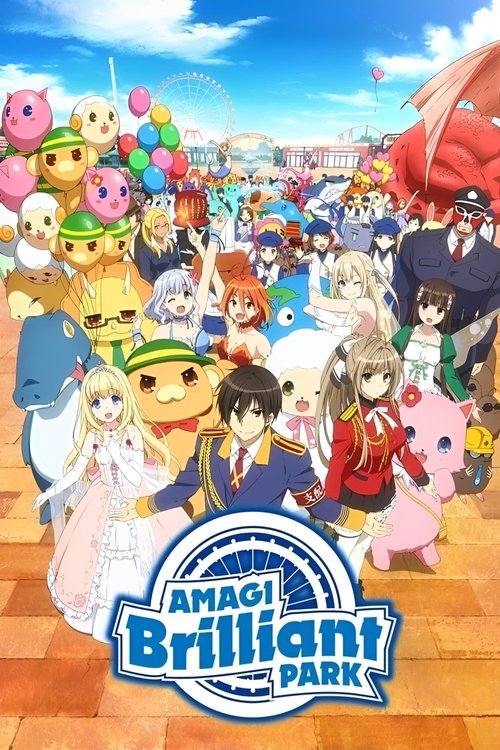
Amagi Brilliant Park
A magical amusement park on the brink of closing, where mascots bleed real tears and every visitor's smile is literal fuel — a sparkling comedy about saving something dying.
Amagi Brilliant Park

Amagi Brilliant Park

甘城ブリリアントパーク

07 October 2014 — 26 December 2014 Japan 1 season 13 episode Ended 7.2 (129)

Cast: Koki Uchiyama, Ai Kakuma, Yukiyo Fujii, Ayako Kawasumi, Ryoko Shiraishi

Drama Animation Sci-Fi & Fantasy Comedy Joy as a Renewable Resource Leadership, Competence and the Dignity of Work Masks, Mascots and Authentic Feeling Deadlines, Mortality and Borrowed Time Found Family Among Misfits

Overview

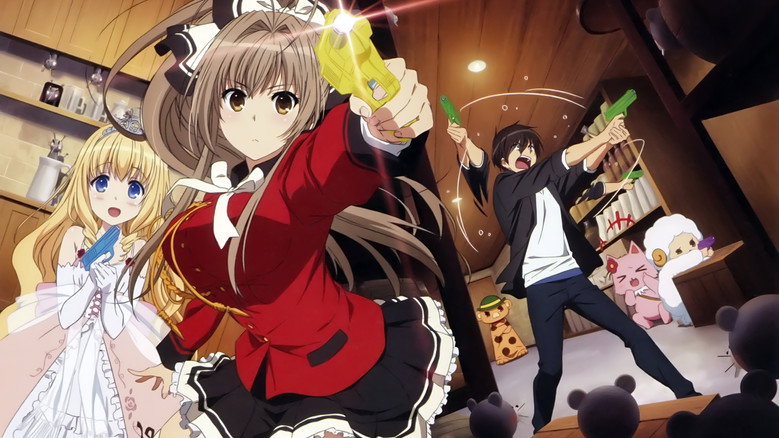
Amagi Brilliant Park adapts Shoji Gatoh's light novel series (illustrated by Yuka Nakajima, published by Fujimi Shobo's Fujimi Fantasia Bunko imprint since February 2013) into a thirteen-episode television anime produced by Kyoto Animation, which aired in Japan between October 6 and December 25, 2014. Its premise is disarmingly simple and quietly desperate: Seiya Kanie, a brilliant and monumentally narcissistic high school student, is approached by a girl carrying a firearm under her skirt and invited on a "date" — which turns out to be a recruitment pitch. The destination is a shabby, failing amusement park whose staff are not costumed employees but genuine magical beings from another world.

The park has three months to attract enough guests or be sold off for land redevelopment. That deadline supplies the series with its unusual engine: rather than a monster-of-the-week or a romance-of-the-week, Amaburi runs on management. Seiya audits the books, studies queue flow, fires and rehires, rebrands attractions, and drags a workforce of fairies, mascots and magical creatures into something resembling professionalism. Alongside him is Isuzu Sento, the stoic musket-carrying aide whose flat affect conceals enormous loyalty, and Latifa Fleuranza, the gentle princess who owns the park and whose own fate is bound to it.

What keeps the series from being a dry workplace comedy is the fantastical stakes underneath the spreadsheets. The park is not merely a business; it is a life-support system for an entire displaced people, and the attendance target is not just a financial goal. The show alternates between broad slapstick — mascot-suit brawls, chaotic auditions, disastrous new attractions — and moments of startling sincerity, building toward a finale in which the accumulated joy of ordinary visitors becomes the only thing that can save someone.
Core Meaning

At its heart, Amagi Brilliant Park argues that joy is labor — and that the labor is worth it. The series takes the most artificial, commercial form of happiness imaginable, the theme park, and insists that something real and sustaining passes between the person having fun and the person working to create that fun. In the show's cosmology this is made literal: the enjoyment of guests is harvested as Animus, the energy that keeps the beings of Maple Land alive. Delight is not decoration; it is nourishment.

From that premise the creators build a quietly humane thesis about work and dignity. The park's employees are lazy, resentful, badly managed and easy to mock — and the story's answer is not to replace them but to lead them: to give them structure, standards, and a reason to care. Seiya's arrogance, which in most stories would be the flaw to be cured, is repurposed as an asset, because someone has to believe the impossible target is achievable. Meanwhile his self-absorption is slowly sanded down by the discovery that other people's happiness has become the metric by which he measures himself.

Finally, the series is about saving something that the world has already written off. A run-down park scheduled for redevelopment, a cursed girl told her condition is hopeless, a staff told they are worthless — the show's repeated gesture is to refuse the verdict and do the unglamorous daily work of proving it wrong.

Thematic DNA

Joy as a Renewable Resource 25%
Leadership, Competence and the Dignity of Work 22%
Masks, Mascots and Authentic Feeling 20%
Deadlines, Mortality and Borrowed Time 18%
Found Family Among Misfits 15%

Joy as a Renewable Resource

The series literalizes a metaphor: the fun that guests experience is converted into Animus, the energy sustaining the people of Maple Land. This transforms every gag about attendance figures into a matter of survival. Early episodes treat the attendance target as a comic business problem; by the back half, each ticket sold carries emotional weight, and the finale reveals that three months of accumulated enjoyment has literally blossomed into salvation.

The theme evolves from quantity to quality — the park does not merely need bodies through the gate, it needs people who genuinely leave happier than they arrived.

Leadership, Competence and the Dignity of Work

Seiya arrives as a manager, not a hero, and the show is unusually interested in the mechanics of turning a dysfunctional workplace around: cost-cutting, staffing, customer flow, marketing, service standards. Episodes are structured like case studies — a broken department, a diagnosis, a painful intervention, a measurable result.

Across the run, the theme deepens from 'the boss fixes things' to 'the team fixes things.' The mid-series episodes hand problems to the staff themselves, most notably the Elementario fairies' forced cooperation in Not Enough Teamwork, so that by the climax the park's success belongs to everyone rather than to one clever outsider.

Masks, Mascots and Authentic Feeling

Everything in the park wears a costume — except the costumes are real bodies. Moffle and the other mascots are actual magical creatures, so the usual gag of 'the person inside the suit' is inverted: there is no person inside, the cuteness is the truth and the violence and bitterness are equally true.

This runs parallel to the human characters: Seiya's performative arrogance masks genuine investment, Isuzu's expressionless delivery masks deep feeling, and Latifa's serene sweetness masks a grim situation. The series steadily strips these masks, and the comedy of the early episodes becomes the pathos of the later ones.

Deadlines, Mortality and Borrowed Time

The three-month countdown to redevelopment is doubled by a personal countdown attached to Latifa's curse. The series is therefore structured around time running out on two scales at once — commercial and mortal — and its comedy is played against a ticking clock.

What begins as sitcom urgency ('we need more customers this weekend') resolves into something closer to a meditation on whether effort can outrun fate. The answer the finale gives is characteristically generous: the work done for ordinary reasons turns out to have been saving a life all along.

Found Family Among Misfits

The park's staff are refugees — displaced beings with nowhere else to go, squabbling and underperforming in a rundown attraction in a foreign world. The series rarely states this directly, preferring to show it through petty workplace friction, but the exile subtext gives the slapstick an undertow.

Over thirteen episodes the group moves from a collection of grudges to something like a household, with Seiya, the ultimate outsider and the only one with no stake in Maple Land, ending up as its improbable center.

Character Analysis

Seiya Kanie

Koki Uchiyama

Archetype: Arrogant genius / reluctant leader (antihero-adjacent protagonist) Key Trait: Unshakeable self-confidence backed by genuine ability

Motivation

Initially self-interest and the simple refusal to be beaten by a problem. This shifts toward protecting Latifa and the staff, until the attendance quota stops being a puzzle and becomes a promise.

Character Arc

He begins as a smart and extremely narcissistic high school student, coerced into managing a failing park he has no reason to care about. His early tenure is pure technocracy: he diagnoses the park's failures with contempt and imposes solutions by force of will.

Across the thirteen episodes his competence stays constant while his motive quietly changes. The turning point is not a humbling but a redirection — his vanity attaches itself to the park's success, and then to the wellbeing of the people in it. By the final arc he is working for reasons he would never admit aloud, and his narcissism has become a kind of stubborn faith that the impossible target is achievable.

Isuzu Sento

Ai Kakuma

Archetype: Stoic retainer / deadpan foil Key Trait: Flat, literal-minded seriousness concealing intense loyalty

Motivation

Absolute devotion to Latifa and to Maple Land, which over the run grows to include a devotion to Seiya himself that she is conspicuously unequipped to articulate.

Character Arc

She enters the series as a weapon pointed at the protagonist — recruiting Seiya at musket-point under the guise of a date — and functions at first as an unreadable enforcer of Latifa's interests.

Her development is one of gradual thawing rendered almost entirely in micro-expressions and inappropriate literalism. As she works alongside Seiya she moves from servant of the princess to partner in the project, and her feelings become the series' most conspicuous unresolved thread: the final episodes leave her romance with Seiya suspended in an almost-confession that reviewers explicitly compared to the famous near-miss in Kyoto Animation's Hyouka.

All 5 characters and cast

Symbols & Motifs

Animus

Meaning:

The energy generated by human enjoyment and harvested to sustain the people of Maple Land. It is the series' central symbol: a made-literal claim that happiness given away is not lost but transferred, and that entertainers are genuinely fed by the audiences they serve.

Context:

Introduced as the explanation for why attendance matters, Animus reframes every commercial decision as an act of care. Its accumulation over the park's three-month campaign becomes the mechanism of the finale's rescue.

The Tree

Meaning:

The park's collection point for Animus — a living meter of how much joy the place has produced. Its flowering is the show's image of cumulative small kindnesses reaching critical mass.

Context:

Present throughout as scenery, the tree pays off in the climax: having come into full bloom from three months of accumulated enjoyment, it supplies enough Animus to negate Latifa's curse — the visual proof that unremarkable daily effort was never wasted.

Isuzu's Musket

Meaning:

An antique firearm carried under a skirt: the series' emblem of anachronistic devotion and of feelings that can only be expressed as force. It marks Isuzu as a bodyguard rather than a love interest, and its absurdity is inseparable from her sincerity.

Context:

It appears in the very first scene, when Isuzu recruits Seiya at gunpoint under the pretense of a date, and recurs as a running gag whose comedy never quite conceals the loyalty behind it.

The Mascot Suit

Meaning:

A symbol of the gap between the face an institution shows the public and the exhausted reality behind it — except here the suit is the body, collapsing the distinction and suggesting that performed cheer and true self can be the same thing.

Context:

Embodied by Moffle and the other mascot characters, whose adorable designs coexist with foul tempers and physical violence, generating both the show's biggest laughs and its argument about authenticity.

The Attendance Counter

Meaning:

A number standing in for a life. The quota reduces an existential question to a metric, satirizing corporate targets while acknowledging that measurable goals are what let people act at all.

Context:

Tracked obsessively across the run, it turns box-office arithmetic into suspense and makes the audience complicit in caring about a statistic.

The Redevelopment Plan

Meaning:

The bulldozer waiting offscreen: modernity's indifference to unprofitable wonder. It represents the world's verdict that magic is not worth the land it stands on.

Context:

The threat of the park being sold for land redevelopment frames the entire season and gives the comedy its edge of genuine precarity.

Episode Highlights

Episode 1 — Seiya's recruitment

S1E1

The series' inciting premise arrives fully formed: Seiya Kanie is approached by Isuzu Sento, who has a rifle hidden under her skirt, and is asked on a 'date' that turns out to be a coerced job interview. He learns the park is magical, that its staff are real creatures, and that he has three months to save it from being sold for land redevelopment.

Significance:

Establishes the countdown that structures the entire season and the tonal formula — absurd comedy resting on real stakes — that the show sustains to the finale.

Episode 2 — The audit

S1E2

Seiya begins treating the park as a business rather than a fantasy, confronting its dismal finances, indifferent staff and hostile mascots. The conflict with Moffle crystallizes as the new manager's authority collides with entrenched resentment.

Significance:

Sets up the series' distinctive engine: problems are solved by management, not magic, and the antagonist for much of the first half is workplace dysfunction itself.

Episode 3 — Building the machine

S1E3

The reform program begins in earnest — service standards, restructuring, and the first measurable improvements in attendance. The staff's individual quirks start being repurposed as assets rather than liabilities.

Significance:

Converts the premise into a repeatable format and proves to the audience that the impossible quota might actually be reachable.

Episode 5 — Latifa and the weight beneath the comedy

S1E5

The series begins deepening Latifa's role, moving her from ornamental princess to the person whose situation gives the countdown its emotional charge, and hinting that the park's survival and her own are connected.

Significance:

The first serious tonal pivot, retroactively recoloring earlier gags and signaling that the show intends to land an emotional ending.

Not Enough Teamwork

S1E9

The Elementario fairies are invited to dinner with Latifa and unwittingly trigger the castle's automatic defense system — Latifa points out a big red button and tells them not to press it, and they press it by accident. Trapped inside, they must reinitialize the system from within by passing a series of trials that can only be cleared through genuine cooperation.

Significance:

The clearest statement of the series' central management thesis, moved from Seiya to the staff themselves: the group must learn to function without the manager, which is the precondition for the final push.

Episode 10 — The final push begins

S1E10

With the deadline closing in, the campaign to hit the attendance target escalates and the cost of failure becomes explicit rather than implied.

Significance:

Shifts the series from episodic problem-solving into a continuous climax, tightening the countdown into genuine suspense.

Episode 11 — Reaching the goal

S1E11

The culmination of the attendance drive, in which three months of accumulated work is put to the test. Several reviewers argue the story effectively reaches its dramatic conclusion here, in the second-to-last episode.

Significance:

The payoff of the season's structural promise; everything before it has been building toward this single number.

Episode 12 — The curse broken

S1E12

The emotional climax. Takaya Kurisu is revealed as the wizard who placed the spell on Latifa, and he claims that even sufficient guests cannot save her. Moffle and Isuzu say their goodbyes and wait for midnight — but the tree, the collection center for Animus, has come into full bloom from three months of accumulated fun, supplying enough energy to negate the curse. Latifa awakens and remembers everything.

Significance:

Retroactively justifies the entire series: every attendance gag and management gimmick was the mechanism of a rescue. The show's thesis — that joy given to strangers is a life-sustaining force — is made literal and complete.

Episode 13 — Epilogue

S1E13

A quieter closing chapter following the resolution. Reviewers widely noted that it functions as a coda rather than a climax, and that the Seiya–Isuzu romance is deliberately left unresolved in an almost-confession.

Significance:

Leaves the park's future open and the central relationship suspended — a choice critics compared to the celebrated near-confession in Kyoto Animation's Hyouka.

Philosophical Questions

Can happiness that is manufactured commercially still be genuine?

The park sells joy on a schedule, with mascots on shift and attractions engineered to produce delight — and the series' conceit is that this artificial happiness generates Animus, an energy real enough to sustain lives. The show refuses the easy cynicism that paid entertainment is hollow, arguing instead that what passes between performer and audience is authentic regardless of the transaction framing it. Yet it keeps the tension alive by making the staff's cynicism, exhaustion and resentment fully visible.

Is a life worth saving reducible to a number?

The entire season hangs on an attendance quota that stands in for Latifa's survival and Maple Land's future. The series plays this for suspense while quietly satirizing the corporate logic that turns human outcomes into metrics. The finale's resolution — the tree blooming from accumulated joy rather than from the quota's arithmetic alone — suggests the number was always a proxy for something that cannot be counted.

Does effort have any power against a fate declared irreversible?

Takaya Kurisu, the wizard who cast the spell, states plainly that even a full park could not lift Latifa's curse. The series' answer is not defiance through heroics but through persistence: three months of unglamorous daily work accumulate into exactly the force required. The ending's quiet radicalism is that the authority on the curse was simply mistaken about its limits.

Can arrogance be a virtue?

Seiya's narcissism would be the flaw to be corrected in most narratives. Here it is the resource that makes an impossible target thinkable — someone has to refuse to accept the obvious conclusion. The series never fully humbles him; it redirects him, asking whether the trait matters less than what it is aimed at.

What do we owe the people who entertain us?

By making the park's workers literally dependent on their guests' enjoyment, the show inverts the usual hierarchy of service. The audience is not a passive consumer but a participant in someone else's survival, and the series invites viewers — sitting in front of a screen made by an animation studio — to notice the position they occupy.

Alternative Interpretations

The optimistic reading. The most straightforward interpretation takes the finale at face value: the tree blooms, the accumulated Animus from three months of genuine fun negates Latifa's curse, and the message is that sustained collective effort can overturn a fate declared unchangeable. Takaya Kurisu's assertion that guests could never save her is simply and satisfyingly wrong, and the series is a fable about the redemptive power of work done for others.

Full ending explanation

Cultural Impact

Amagi Brilliant Park arrived in the fall 2014 season as a Kyoto Animation production at a moment when the studio was strongly associated with school-club slice-of-life and high-gloss adaptations. Its choice of an amusement park as a setting was noted at the time as unusual — commentary described it as one of the first prominent anime built around such a location — and its structure as a workplace-turnaround comedy set it apart from its contemporaries.

Its most durable cultural position is as a node in a specific creative lineage. The reunion of author Shoji Gatoh, director Yasuhiro Takemoto and writer Fumihiko Shimo — the team behind Full Metal Panic? Fumoffu — meant the series was received partly as a spiritual successor to that comedy, carrying forward its brand of absurd physical humor grafted onto a straight-faced premise. For many viewers it is remembered as 'the other Gatoh/Takemoto comedy,' and Takemoto's own body of work (Full Metal Panic!, Lucky Star, Hyouka, Amagi Brilliant Park) is frequently discussed as a single authorial run.

The franchise's reach extended beyond the anime: eight light novel volumes from Fujimi Shobo and three separate manga adaptations from Fujimi Shobo and Kadokawa, with the anime licensed for North American release by Sentai Filmworks. Within fandom, the series' legacy rests largely on its mascot characters, the Elementario fairies, and the enduring image of a girl producing a musket from under her skirt — imagery that circulated well beyond people who watched the show.

Audience Reception

Reception was broadly warm, with critics and viewers converging on a similar verdict: a well-crafted, unusually structured comedy that does not quite reach the top tier of its studio's output. The most consistent praise went to the originality of the setting — reviewers described the amusement park as an unconventional premise with a genuinely original plot, and as a near-perfect playground for character interaction, since any character can be thrown into any situation the park requires.

A frequently cited strength was the show's restraint. Despite a premise loaded with fanservice potential and a cast of fairies and mascots, reviewers specifically noted that it avoids falling into stereotypical ecchi tropes by having an actual plot — the fanservice exists but never displaces the story. Viewers also responded to the underlying themes of perseverance and hard work, which several reviews identified as the show's real subject beneath the comedy, and to the appeal of watching competence applied to a failing organization.

Criticism clustered around pacing and structure. A common complaint is that some episodes feel like filler, with random occurrences that do not advance the central arc, and that the final episode adds little because the story effectively concludes in the second-to-last one. The other recurring point of contention is the unresolved romance between Kanie and Sento, which ends in an almost-confession; reviewers drew the comparison to the equivalent scene in Kyoto Animation's Hyouka, and audiences divided between those who found this a frustrating loose end and those who read it as an intentional, characteristic choice.

Opinion over the run followed a recognizable curve: an enthusiastic reception to the striking opening episodes, a dip during the mid-season episodic stretch that some found unfocused, and a strong recovery through the climactic curse-breaking episode, which is widely regarded as the series' high point. The overall consensus is a confident, funny, good-looking series with a genuinely moving payoff and a soft landing.

Interesting Facts

  • The series is based on the light novels by Shoji Gatoh, creator of Full Metal Panic!, with illustrations by Yuka Nakajima; Fujimi Shobo published eight volumes under its Fujimi Fantasia Bunko imprint beginning February 20, 2013.
  • The thirteen-episode anime was produced by Kyoto Animation and aired in Japan from October 6 to December 25, 2014.
  • Yasuhiro Takemoto directed, with series composition by Fumihiko Shimo — the same director-writer pairing behind Full Metal Panic? Fumoffu, another Shoji Gatoh adaptation.
  • Takemoto's prior credits at Kyoto Animation included Full Metal Panic!, Lucky Star and Hyouka before he was commissioned to direct Amagi Brilliant Park in 2014.
  • Character designs were handled by Miku Kadowaki, who had previously designed for Beyond the Boundary.
  • The music was composed by Shinkichi Mitsumune.
  • Crunchyroll reported Takemoto's attachment as director in March 2014, and Anime News Network reported the fall 2014 broadcast slot in April 2014.
  • The leads were announced early as Koki Uchiyama (Seiya Kanie) and Ai Kakuma (Isuzu Sento).
  • Sentai Filmworks licensed the series for North American release.
  • Three separate manga adaptations of the franchise have been published by Fujimi Shobo and Kadokawa.
  • Contemporary commentary noted that it was one of the first prominent anime built around an amusement park setting.

Easter Eggs

The violent mascot comedy echoes Full Metal Panic? Fumoffu

Director Yasuhiro Takemoto, series composer Fumihiko Shimo and original author Shoji Gatoh had previously collaborated on Full Metal Panic? Fumoffu, famous for its brawling mascot costume. Moffle's adorable-but-belligerent physicality reads as a deliberate continuation of that team's signature gag, and viewers familiar with Fumoffu catch the lineage immediately.

The unresolved almost-confession mirrors Hyouka

Reviewers drew an explicit parallel between the Seiya–Isuzu non-confession and the equivalent scene in Kyoto Animation's Hyouka, which Takemoto also directed. It functions as a studio-and-director signature: the romance that is allowed to remain a hair's breadth from resolution.

The theme park as a meta-commentary on the entertainment industry

The park's staff are performers whose survival depends on an audience showing up — a transparent mirror of an anime studio, where the 'Animus' generated by delighted viewers sustains the people making the show. The workplace-comedy framing lets the series joke about its own economics.

Frequently Asked Questions

Explore More About This Movie

Dive deeper into specific aspects of the movie with our detailed analysis pages

Comments (0)

Leave a comment

No comments yet. Be the first to share your thoughts!

Similar Movies