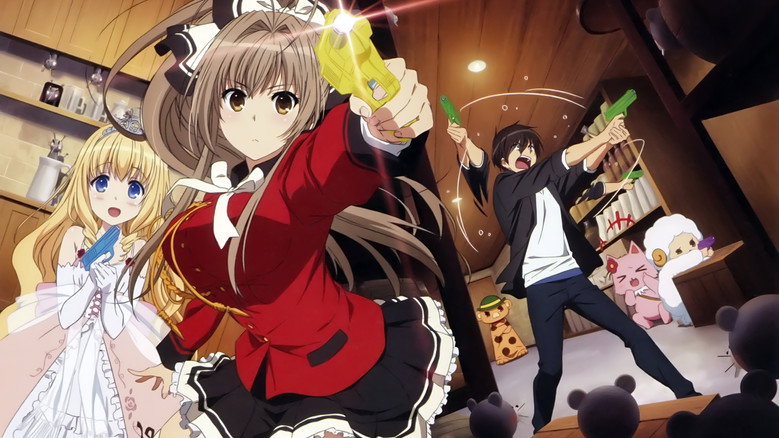

Full spoilers for the entire thirteen-episode series follow.
The setup and its hidden stakes. Seiya Kanie is recruited at gunpoint — Isuzu Sento approaches him with a rifle hidden under her skirt and frames it as a date — to manage Amagi Brilliant Park, a failing amusement park facing sale for land redevelopment. He has three months to raise attendance. The first concealed layer is that the park's mascots and staff are not employees in costume but genuine magical beings from Maple Land, living in exile. The second and deeper layer is the nature of the park's economy: the enjoyment of guests is harvested as Animus, the energy that keeps the people of Maple Land alive. The attendance quota is therefore never merely commercial — every ticket is a unit of life support.
The middle stretch. The episodic body of the series functions as a management case study, with Seiya reforming departments one at a time. Its thematic turning point is episode 9, Not Enough Teamwork: the Elementario fairies are invited to dinner with Latifa, and when she points out a large red button and warns them not to press it, they press it by accident, activating the castle's automatic defense system. Trapped inside, they must reinitialize the system from within by passing trials that require genuine cooperation. The episode deliberately removes Seiya from the equation, proving the staff can now function on their own — the precondition for the climax.
The curse and the antagonist. Latifa Fleuranza, the park's owner and princess of Maple Land, is under a spell. The wizard responsible is revealed to be Takaya Kurisu. His crucial claim — the series' final obstacle — is that even if the park hits its guest target, this cannot save her from the curse. This assertion is what the ending exists to refute.
The climax (episode 12). With the deadline approaching, Moffle and Isuzu say their goodbyes to Latifa and wait for midnight, when the curse's effects would take hold. The rescue comes from a source planted in plain sight throughout the series: the tree is the collection center for Animus, and after three months of the park's revival and all the fun that has been had there, it has come into full bloom. The accumulated Animus is enough to negate the curse. Latifa awakens — and, crucially, remembers everything, restoring the continuity of self that the spell had taken from her. Kurisu's claim of impossibility is simply proven false.
What this retroactively reveals. The series' comic premise turns out to have been its emotional mechanism all along. Every attendance gag, every marketing gimmick, every reluctant shift worked by a foul-tempered mascot was literally accumulating the force that saves a life. The show's structure is a long setup for a single reframing: the mundane work was the miracle.
The finale (episode 13). The closing episode functions as an epilogue rather than a climax — a point reviewers noted critically, observing that the story effectively ends in episode 12 and that the finale adds relatively little. Its most discussed element is what it withholds: the romance between Kanie and Sento is left unresolved, ending in an almost-confession that critics explicitly likened to the famous near-miss in Kyoto Animation's Hyouka. The park survives, the people of Maple Land have a future, Latifa is whole and remembering — and the one thing left deliberately unfinished is the feeling between the two people who did the most to save it.