Skip to content
American Dad!
Suburban absurdism painted in neon paranoia, this surreal animated comedy blends chaotic family affection with unhinged existential madness, operating like a fever-dream carnival hidden behind a white picket fence.
American Dad!

American Dad!

"From the creator of "Family Guy" comes a man who will stop at nothing to protect his country."

06 February 2005 — 21 June 2026 United States of America 22 season 401 episode Returning Series 7.0 (2,420)

Cast: Seth MacFarlane, Wendy Schaal, Rachael MacFarlane, Scott Grimes, Dee Bradley Baker

Animation Comedy Performative Patriotism & Ideological Dogma Fluid Identity, Persona & Escapism Family Codependency & Unconditional Acceptance Subversion of the American Dream & Suburban Life Masculinity, Fragility & Maturation

Overview

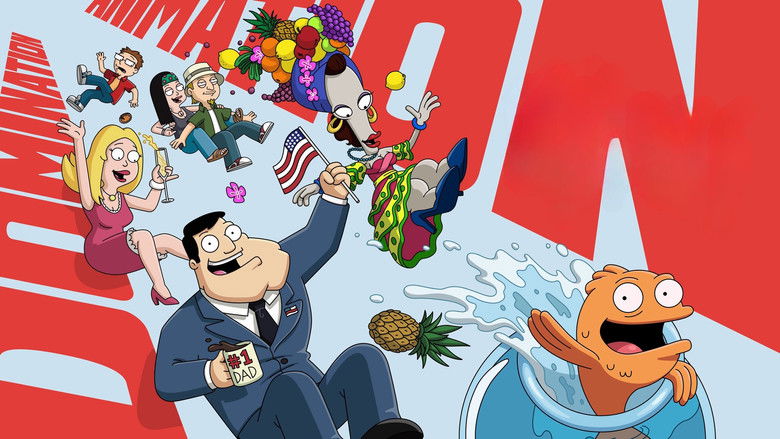
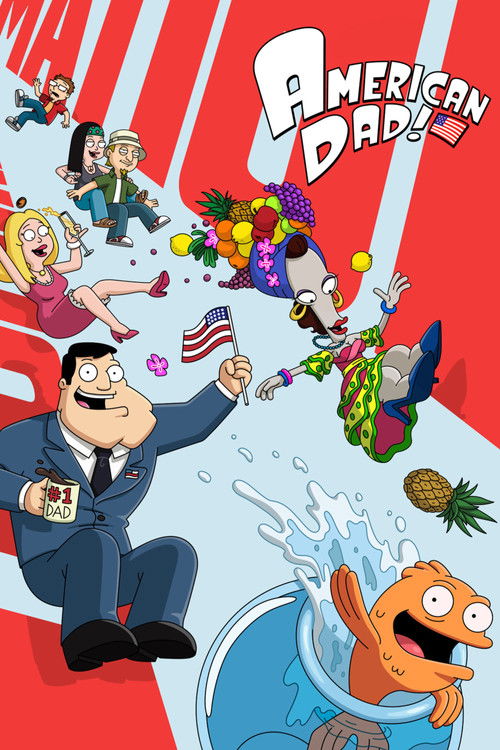
American Dad! is an animated sitcom created by Seth MacFarlane, Mike Barker, and Matt Weitzman that debuted on Fox in February 2005 before transitioning to TBS in 2014. Set in the fictional suburban town of Langley Falls, Virginia, the series revolves around the Smith household, headed by Stan Smith—a hyper-patriotic, gun-toting CIA officer—and his wife Francine, a former party girl turned loyal homemaker. They share their home with two children: Hayley, an outspoken left-wing activist, and Steve, an emotionally sensitive, geeky high school student searching for confidence.

The family dynamic is radically altered by two non-human housemates. Klaus Heissler is an East German Olympic ski jumper whose brain was forcibly transplanted into a goldfish by the CIA during the 1988 Winter Olympics. Roger is a pansexual, alcohol-loving alien who escaped Area 51 after saving Stan's life, forced to reside in the attic while adopting thousands of wildly inventive alter-egos to navigate human society without being captured. Over the course of 22 seasons and more than 400 episodes, Hayley's gentle stoner husband Jeff Fischer also joins the permanent household.

While early seasons focused heavily on political satire during the George W. Bush administration—juxtaposing Stan's conservative paranoia with Hayley's liberal idealism—the series rapidly evolved into a high-concept, character-driven absurdist comedy. Unlike Family Guy, American Dad! eschews frequent cutaway gags in favor of tight narrative arcs, surreal escalation, genre parodies, sci-fi elements, and dark humor grounded in the absurd loyalty of a deeply flawed family.
Core Meaning

The core message of American Dad! revolves around the absurdity of absolute ideological dogma and the ultimate triumph of radical family acceptance over rigid societal ideals. Through Stan's ultra-conservative, hyper-masculine worldview, the series initially set out to dismantle post-9/11 fearmongering and performative American nationalism. However, as the show matured, its central thesis expanded: no matter how broken, hypocritical, or completely insane individuals may be, human connection and unshakeable family commitment offer the only true anchor in a chaotic universe.

The creators demonstrate that rigid authority and moral purity are illusions. Every character represents extreme flaws—Stan's overbearing control, Roger's amoral hedonism, Francine's suppressed criminality, Steve's desperate insecurity, and Hayley's performative activism. Yet, across all seasons, the Smiths continuously choose each other, proving that love and solidarity thrive not despite human eccentricity, but through the willingness to embrace it completely.

Thematic DNA

Performative Patriotism & Ideological Dogma 25%
Fluid Identity, Persona & Escapism 25%
Family Codependency & Unconditional Acceptance 25%
Subversion of the American Dream & Suburban Life 15%
Masculinity, Fragility & Maturation 10%

Performative Patriotism & Ideological Dogma

Initially the show's primary engine, this theme skewers American hyper-nationalism, government paranoia, and political tribalism. Stan's belief that safety requires extreme authoritarianism is repeatedly subverted as his own paranoia creates the very chaos he fears. Over time, political polarization yields to a broader commentary on how dogmatic thinking of any kind hinders personal growth.

Fluid Identity, Persona & Escapism

Centralized in Roger's thousands of elaborate alter-egos, the show examines how people construct disguises to escape boredom, process trauma, or reinvent themselves. Roger's personas—ranging from corrupt cops to sociopathic con artists—often take on lives of their own, suggesting that identity is a performative costume. The rest of the Smith family also adopts alternate personas, reflecting a universal longing for reinvention.

Family Codependency & Unconditional Acceptance

Despite shooting, betraying, gaslighting, and ruining each other's lives on a daily basis, the Smiths remain fiercely loyal. The show continually explores how a dysfunctional family survives external monsters, alien incursions, and internal madness through an unspoken commitment to never abandon one another.

Subversion of the American Dream & Suburban Life

The pristine, nuclear suburban home in Langley Falls is a façade hiding extreme corruption, CIA torture chambers, alien attics, and dark magical artifacts. The show continually deconstructs the post-WWII sitcom mythos, proving that beneath quiet suburban streets lies unhinged absurdity.

Masculinity, Fragility & Maturation

Explored through Stan and Steve's father-son dynamic, Stan's toxic expectations of physical strength and dominance constantly clash with Steve's emotional sensitivity, nerd culture, and artistic passions. Stan is forced to learn that true strength requires emotional vulnerability.

Character Analysis

Stan Smith

Seth MacFarlane

Archetype: Authoritarian Antihero / Rigid Patriarch Key Trait: Hyper-masculine confidence masking deep insecurity

Motivation

Protecting his family and nation while maintaining absolute control, evolving into a desire for genuine emotional harmony.

Character Arc

Begins as a xenophobic, rigid CIA agent who views the world in black-and-white political terms. Over 22 seasons, Stan softens considerably, learning to accept his family's bizarre choices, value Steve's non-traditional talents, and embrace emotional vulnerability.

Francine Smith

Wendy Schaal

Archetype: Subversive Homemaker / Wild Card Matriarch Key Trait: Sweet suburban warmth mixed with savage street smarts

Motivation

Keeping her family happy and unified while secretly satisfying her own appetite for excitement and danger.

Character Arc

Transcends the traditional 1950s housewife archetype to reveal a wild past as a former groupie, street fighter, and criminal. She grows into the ultimate grounding force who effortlessly handles the family's insanity with unflappable calm.

All 5 characters and cast

Symbols & Motifs

The Golden Turd (Golden Poop)

Meaning:

A recurring subplot saga where a jewel-encrusted golden turd defecated by Roger acts as a cursed MacGuffin. It symbolizes pure greed, corruption, and the destructive dark desires hidden within ordinary humans who lay eyes upon it.

Context:

Originates in Season 1 and passes through various hands across multiple seasons, causing madness and death wherever it goes until culminating in Episode 300.

Roger's Personas & Disguises

Meaning:

Roger's vast wardrobe represents identity fragmentation and ultimate escapism. The running gag where family members randomly fail to see through specific disguises underscores the power of human self-deception.

Context:

Used continuously throughout the series as Roger adopts alter-egos to navigate human society, take on jobs, or orchestrate elaborate schemes.

Klaus's Goldfish Body

Meaning:

Symbolizes lost human potential, former athletic glory, and inescapable alienation. Represents the fear of being forgotten by one's peers.

Context:

Klaus is an East German ski jumper whose brain was transplanted into a goldfish; he is constantly sidelined, mocked, and trapped in a tiny bowl in the Smith house.

The CIA Flagpole & "Good Morning USA" Intro

Meaning:

Represents the rigid, repetitive ritual of patriotic duty—a routine constantly disrupted by domestic chaos.

Context:

Featured in the opening sequence where Stan sings while driving to work and hitting the CIA flagpole.

Santa Claus & Christmas Battles

Meaning:

Subverts wholesome American holiday traditions into violent survival horror.

Context:

A recurring holiday motif where Santa Claus becomes a vengeful villain waging war on the Smith family.

Memorable Quotes

We're at terror alert orange! Which means something could go down somewhere in some way at some point in time, so look sharp!
— Stan Smith

Context

Season 1, Episode 1 ("Pilot")—Stan warning his family at the breakfast table.

Meaning

Encapsulates the post-9/11 fearmongering and posturing of early-season Stan.

Boil water. What, am I a chemist?
— Stan Smith

Context

Season 2, Episode 10 ("Bush Comes to Dinner") / Season 3—Stan attempting to cook pasta by himself.

Meaning

Highlights Stan's complete incompetence with basic domestic tasks outside his rigid CIA skill set.

All 5 quotes

Episode Highlights

Pilot

S1E1

Establishes the core premise, political satire framework, and original character dynamics of the Smith household.

Significance:

Launches the series and lays down the foundational relationships between Stan, his family, and housemates.

In Country... Club

S5E1

Steve takes part in a Vietnam War reenactment for golf caddies.

Significance:

Acclaimed for its cinematic parody of Platoon and Apocalypse Now, highlighting the show's high-concept narrative versatility.

Rapture's Delight

S5E9

A post-apocalyptic Christmas special where Stan and Jesus fight the Antichrist.

Significance:

Consistently ranked as one of the best animated episodes in TV history for its dark scale and ambitious storytelling.

Bully for Steve

S6E16

Stan bullies Steve to "toughen him up," leading Steve to hire Stan's old childhood bully, Stelio Kontos.

Significance:

Subverts parenting tropes and introduces the iconic recurring character Stelio Kontos.

Hot Water

S7E1

A dark musical episode guest-starring CeeLo Green as a demoniacally possessed hot tub that kills Stan.

Significance:

Showcases bold non-canon narrative experimentation and musical creativity.

Ricky Spanish

S7E17

Debuts Roger's most infamous, irredeemable sociopathic alter-ego.

Significance:

Establishes persona-driven narratives as a primary comedic strength of the series.

Lost in Space

S8E18

Follows Jeff Fischer enslaved on an alien mall spaceship after being marooned by Roger.

Significance:

The 150th milestone episode, praised for its emotional depth and Wax Fang soundtrack.

Rabbit Ears

S14E4

Stan gets trapped inside an eerie 1960s jazz lounge TV show after buying a vintage television set.

Significance:

A haunting, Twilight Zone-inspired horror episode demonstrating the show's capacity for psychological surrealism.

300

S15E23

The milestone 300th episode that concludes the decade-spanning Golden Turd saga and explores the apocalyptic collapse of the family.

Significance:

Resolves the series' longest-running continuity storyline through catastrophic scale and time travel.

Philosophical Questions

What constitutes personal identity?

Explored through Roger's endless personas—when a disguise gains its own bank account, personality, and social life, where does the fake persona end and true identity begin?

Can love exist without moral agreement?

Explored through Stan and Hayley's diametrically opposed ideological views, questioning whether familial affection transcends political dogma.

Is human nature inherently corruptible?

Explored through the Golden Turd saga, which examines how ordinary, decent citizens instantly succumb to murder and greed when presented with absolute wealth.

Alternative Interpretations

The "Stan's Heaven" / Simulation Theory: Following the climax of "Rapture's Delight" (S5E9), where Stan dies in the post-apocalyptic battle and enters his personal Heaven—which is presented as his normal house with his family—some fans and critics interpret every subsequent episode as taking place inside Stan's personal paradise simulation.

Full ending explanation

Cultural Impact

Debuting during the height of the Iraq War and post-9/11 political anxiety, American Dad! initially offered a direct skewering of conservative Bush-era policies. However, as American political discourse transformed, the series wisely pivoted away from topical political satire to avoid feeling dated, embracing timeless, surreal character comedy.

Early reviews dismissed American Dad! as a cheap, inferior clone of Family Guy. However, over two decades, critical and audience opinion shifted dramatically. Television critics came to praise the show for superior character development, tight narrative structure, artistic risk-taking, and inventive world-building. It is now widely considered one of the finest adult animated series of the 21st century, possessing a massive, loyal cult fanbase.

Audience Reception

Critical acclaim shifted drastically over time across distinct eras:

  • Fox Era (Seasons 1-3): Rated at approximately 65%, early seasons were initially dismissed by critics as a Family Guy clone.
  • Fox Era (Seasons 4-10): Climaxed at a 92% approval rating, celebrated as a Golden Era of character surrealism.
  • TBS Era (Seasons 11-22): Maintains an 85% approval level, holding experimental, cult-classic status.

Praised Aspects: Viewers express unanimous praise for Roger's persona antics, Scott Grimes' musical vocal performances as Steve, high-concept parody episodes ("Rabbit Ears", "Rapture's Delight"), and dark, unexpected narrative escalations.

Main Points of Criticism: Mixed reactions target early Season 1 political heavy-handedness, occasional reliance on extreme gross-out humor in later seasons, and non-canon character deaths that reset continuity.

Overall Verdict: Revered as a rare animated comedy that improved significantly after its early seasons, building a unique identity distinct from MacFarlane's other works.

Interesting Facts

  • Although Seth MacFarlane co-created the show, he largely stepped back after writing the pilot to focus on Family Guy and films, leaving Mike Barker and Matt Weitzman as primary showrunners.
  • The pilot premiered on February 6, 2005, directly after Super Bowl XXXIX on Fox, drawing over 15 million viewers.
  • After Fox canceled the series in 2014, TBS picked up the show starting in Season 11, giving writers broader creative freedom for surrealism, profanity, and high-concept serialized storylines.
  • The character Jeff Fischer is named after and voiced by Seth MacFarlane's actual real-life friend, actor Jeff Fischer.
  • Unlike many animated shows where the cast table-reads together, the American Dad! cast records their dialogue individually because their real-life camaraderie led to non-stop off-topic conversations that delayed production.
  • Voice actor Dee Bradley Baker originally auditioned using a French accent for a character concept, but switched to an East German accent, prompting writers to re-craft Klaus into a former East German skier.

Easter Eggs

The Golden Turd in the Intro

In later seasons, observant viewers can spot the Golden Turd sitting inconspicuously near a parking meter in the background of the opening intro sequence.

Roger's Changing Costume Gag

Beginning in Season 4, the opening sequence replaces the classic newspaper headline gag with Roger appearing in a different persona costume every single episode.

"Wheels and the Legman"

A recurring meta-fictional detective agency run by Steve ("Wheels"—a paraplegic detective) and Roger ("The Legman"), complete with its own 1970s TV intro theme.

Sir Patrick Stewart as Avery Bullock

Shakespearean actor Sir Patrick Stewart voices Stan's CIA boss, Avery Bullock, bringing highbrow theatrical gravitas to absurdly degenerate storylines.

Buffy Crossover Homage

In "Virtual In-Stanity," guest stars Sarah Michelle Gellar and Alyson Hannigan (who played Buffy and Willow in Buffy the Vampire Slayer) voice high school girls interacting with Steve.

Frequently Asked Questions

Explore More About This Movie

Dive deeper into specific aspects of the movie with our detailed analysis pages

Comments (0)

Leave a comment

No comments yet. Be the first to share your thoughts!

Similar Movies