I Am Not an Animal
A darkly comedic satire where pampered, anthropomorphic naivety collides with the harsh, bewildering reality of the human world, framed by a unique photo-collage animation style.
I Am Not an Animal

I Am Not an Animal

10 May 2004 — 19 October 2004 1 season 6 episode Ended ⭐ 8.6 (785)
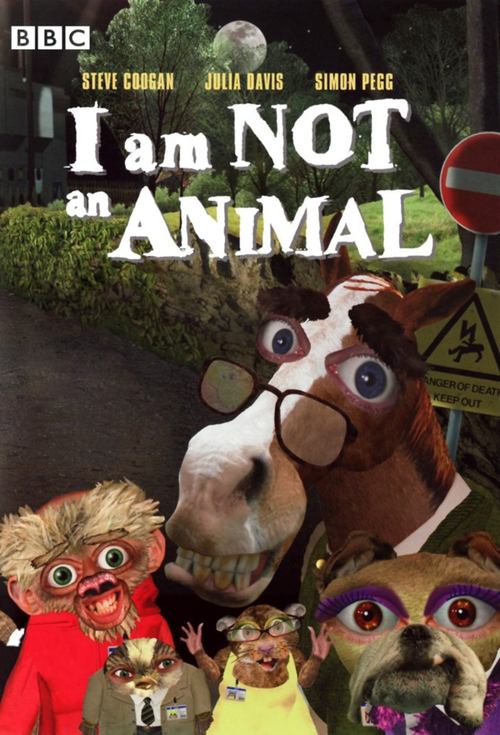
Cast: Steve Coogan, Julia Davis, Simon Pegg, Kevin Eldon, Amelia Bullmore
Animation Comedy
Nature vs. Nurture Satire of Class and Intellectualism The Ambiguity of Freedom Critique of Media and Celebrity Culture

Overview

I Am Not an Animal is a six-part animated black comedy series created by Peter Baynham. It follows the absurd journey of six highly intelligent, talking animals who have lived their entire lives in blissful ignorance within a luxurious, four-star hotel-like vivisection unit called Vivi-Sec UK. Believing they are sophisticated, cultured beings, they spend their days eating gourmet food, drinking fine wine, and engaging in pseudo-intellectual conversations, unaware they are part of 'Project S', an experiment to create talking animals.

Their cosseted existence is shattered when a group of well-meaning but incompetent animal rights activists liberates them. Thrust into the bewildering and often cruel human world, the animals must navigate a reality for which they are completely unprepared. They initially conclude they have been transported to an alternate dimension where only humans can speak and other animals are enslaved, a nod to Planet of the Apes. The series chronicles their misadventures as they grapple with concepts like money, fame, and their own animal instincts, all while being hunted by their creators.
Core Meaning

The core meaning of I Am Not an Animal is a satirical critique of human arrogance, class pretension, and the absurdities of modern society. The series uses the 'fish-out-of-water' premise to expose the foolishness of the animals' cultivated, upper-class sensibilities, which prove useless in the real world. It simultaneously satirizes both the cold, corporate nature of scientific research and the misguided zeal of animal rights activism.

Ultimately, the show explores themes of identity and belonging. The animals are caught between a human world they can't fully join and an animal kingdom they no longer understand. Their journey is a tragicomic search for a place to call home, questioning what it means to be 'civilized' and whether their manufactured intelligence is a gift or a curse.

Thematic DNA

Nature vs. Nurture 35%
Satire of Class and Intellectualism 30%
The Ambiguity of Freedom 20%
Critique of Media and Celebrity Culture 15%

Nature vs. Nurture

The series is a stark exploration of this theme. The animals are biologically creatures of instinct, yet they have been nurtured in a completely artificial, human-centric environment. Throughout the six episodes, this conflict creates both comedy and pathos. Their attempts to maintain their sophisticated, 'human' personas often clash ridiculously with their underlying animal natures, such as Philip the horse struggling with clothing or Hugh the monkey's baser instincts emerging at inopportune moments. The finale, where they find they have been replaced by more 'successful' versions, solidifies the idea that their nurtured identity is fragile and perhaps unattainable, forcing them to accept a hybrid existence.

Satire of Class and Intellectualism

The animals speak in pretentious, pseudo-intellectual jargon and are obsessed with the trappings of a sophisticated, upper-middle-class lifestyle, like fine wines and board games. When thrust into the real world, their intellectualism is shown to be utterly impractical. They look down on the 'working class' people they meet, viewing them as simpletons, yet they are the ones who cannot function. This satirizes how academic and high-culture knowledge can be divorced from practical reality, and how class prejudice is often based on superficial markers of refinement.

The Ambiguity of Freedom

The series questions whether the animals' 'liberation' is a genuine act of kindness or simply a transfer from one form of captivity to another. In the lab, they were safe and pampered, albeit ignorant prisoners. In the outside world, they are free but also vulnerable, hunted, and alienated. Their journey is fraught with danger and misunderstanding, leading them to ultimately seek refuge and confinement once more in an old woman's house. The show suggests that freedom without the means or understanding to navigate it is its own kind of prison.

Critique of Media and Celebrity Culture

In the episode "A Star is Hatched", the animals have a brush with media fame. Their unique ability to talk makes them a novelty, and they are quickly exploited for entertainment. The experience highlights the vapid and sensationalist nature of celebrity culture, where their intelligence and individuality are less important than their value as a spectacle. This theme critiques how media consumes and discards novelties, stripping them of their intrinsic worth for public consumption.

Character Analysis

Philip Masterson-Bowie

Steve Coogan

Archetype: The Pretentious Leader
Key Trait: Arrogant

Motivation

Philip is motivated by a desire to maintain the sophisticated, orderly lifestyle he believes is his birthright. He seeks to understand the new world through the lens of his academic knowledge, which consistently fails him, forcing him to confront the uselessness of his cultivated identity.

Character Arc

Philip, a thoroughbred horse, begins as the de facto leader of the group, embodying their pompous and out-of-touch intellectualism. His arc is one of disillusionment. Initially confident in his superior intellect, he is repeatedly humbled by the real world's indifference to his knowledge of fine arts and literature. He never fully sheds his arrogance, but by the end of the series, his certainty is shattered, replaced by a weary resignation as he accepts a quiet, meaningless existence over a struggle he cannot win.

Mark Andrews

Steve Coogan

Archetype: The Cynic
Key Trait: Cynical

Motivation

Mark is motivated by base desires and a pragmatic, if selfish, approach to survival. He is less concerned with maintaining their former lifestyle and more focused on immediate gratification and pointing out the flaws in everyone else's plans.

Character Arc

Mark, a sparrow, is the most cynical and world-weary of the group, often mocking Philip's pomposity and the absurdity of their situation. He is the first to grasp the grimness of their new reality. His arc is less about transformation and more about the hardening of his pre-existing cynicism. While the others struggle with disillusionment, Mark is already there. His journey is about finding small, selfish ways to survive in a world he already despises.

Winona Matthews

Amelia Bullmore

Archetype: The Naive Optimist
Key Trait: Idealistic

Motivation

Winona is driven by a deep-seated desire for connection, family, and a return to a sense of normalcy. She is the emotional core of the group, constantly trying to keep their spirits up and find a positive path forward.

Character Arc

Winona, a pit bull, is the most compassionate and optimistic of the animals, desperately trying to see the best in their situation and in the humans they encounter. Her arc is a tragic journey from hopeful idealism to heartbreaking reality. Her deepest desire is to have children, a wish that is cruelly twisted when she sees her 'replacement' in the lab has successfully done so. She ends the series as a broken idealist, her optimism crushed by the world's harshness.

Hugh Gape

Kevin Eldon

Archetype: The Hedonist
Key Trait: Lustful

Motivation

Hugh's motivations are simple and immediate: satisfying his sexual urges and seeking pleasure. He is a creature of pure id, offering a comic foil to the others' complex, overwrought anxieties.

Character Arc

Hugh, a Japanese macaque, is driven primarily by his libido and a childlike lack of impulse control. His arc is flat, serving as a constant source of base, animalistic comedy that contrasts with the group's intellectual pretensions. He doesn't develop so much as he simply reacts to new stimuli with the same primitive urges. His presence constantly reminds the group, and the audience, of the animal nature they are trying to suppress.

Kieron

Simon Pegg

Archetype: The Resentful Outsider
Key Trait: Vengeful

Motivation

Kieron is motivated by a burning desire for revenge against the animals he feels abandoned him. He is also manipulated by the scientists at Vivi-Sec UK, acting as their unwilling assassin.

Character Arc

Kieron is a cat who is left behind during the initial escape, his head kept alive by machines. He is later grafted onto a gorilla's body and sent to hunt down the others. His arc is one of pure revenge. Having been abandoned by the group, his former camaraderie curdles into a murderous rage, making him the series' primary antagonist. He represents the dark side of the vivisection experiment—a creature twisted by science and consumed by bitterness.

Symbols & Motifs

Human Clothing

Meaning:

The specially designed clothes the animals wear symbolize their artificial, imposed humanity and their detachment from their true nature. The awkward fit of the clothes, particularly Philip the horse's trousers, serves as a constant visual gag that underscores the absurdity of their situation.

Context:

From the first episode, the animals are seen in their bespoke outfits. When they are 'liberated', their attempts to maintain their wardrobe in the harsh real world highlight their struggle to cling to their civilized identities. In the final episode, being forced to strip by an activist represents a forced return to their 'natural' state, an idea they resist.

Vivi-Sec UK Laboratory

Meaning:

The laboratory represents a sterile, controlled, and deceptive form of paradise. It is a place of immense comfort and intellectual stimulation, but it is built on a foundation of cruel experiments and imprisonment. It symbolizes a gilded cage and the idea that comfort and safety can come at the cost of truth and true freedom.

Context:

The series begins inside the lab, establishing it as the animals' entire world. Their eventual, voluntary attempt to return to the lab in the final episode, only to find they've been replaced, is a pivotal moment. It shows their deep-seated desire to return to the only home they've ever known, even if it was a prison.

Memorable Quotes

I suspect they are working class, Winona. Many people below a certain level of breeding just point at each other and fight.

— Philip the Horse

Context:

Said in an early episode after the animals have escaped and are observing humans for the first time, wondering why the people they encounter are not as articulate or refined as they are.

Meaning:

This line perfectly encapsulates the class-based snobbery and cluelessness of the animals. It highlights their inability to understand the world outside their bubble, attributing complex human behavior to a simplistic and prejudiced view of social class.

Love is having a boyfriend who hits you, then he cries and promises never to do it again, but he does, and you go to a safe house.

— Claire the Rat

Context:

Spoken during a conversation among the animals about the nature of love, showcasing Claire's bleak and world-weary perspective, which is often played for laughs.

Meaning:

This quote is a darkly comedic and cynical take on romantic relationships, delivered with a deadpan tone by the group's most morose member. It's a prime example of the show's black humor, finding absurdity in dark subject matter.

At least I won't get lung cancer!

— Kieron the Cat

Context:

Said in Episode 1, "London Calling," after the other animals find Kieron in the lab post-decapitation and, in a moment of pity, offer him a cigarette.

Meaning:

A moment of pure gallows humor. As a disembodied head kept alive by machines, Kieron finds a grimly optimistic silver lining while smoking a cigarette given to him by the other animals. It exemplifies the show's bleakly funny tone.

Episode Highlights

London Calling

S1E1

The premiere episode establishes the entire premise of the series. It introduces the animals in their pampered, artificial environment and contrasts it with the horrific experiments happening elsewhere in the lab. The episode culminates in their chaotic 'liberation' by animal rights activists, which they completely misinterpret, setting the stage for the rest of the series.

Significance:

This episode is crucial as it sets up the central conflict: the clash between the animals' perception of themselves and the reality of the world. It perfectly establishes the show's unique tone of intellectual satire and black comedy.

Planet of the Men and Women

S1E2

Forced to fend for themselves, the animals come to the bizarre conclusion that they are on an alien planet ruled by non-speaking humans. This episode showcases their profound inability to comprehend their new surroundings and features their first truly dangerous encounter with the human world. Meanwhile, Vivi-Sec UK creates a grotesque assassin by grafting Kieron's head onto a gorilla's body to hunt them down.

Significance:

This episode solidifies the series' satirical parallel to Planet of the Apes and introduces the primary antagonist, Kieron, escalating the stakes beyond simple survival.

Home

S1E6

In the series finale, the animals, weary of the outside world, decide to return to the only home they've ever known: the Vivi-Sec UK lab. Upon breaking in, they suffer a devastating emotional blow: they have been replaced by a new, more successful batch of talking animals who have achieved the dreams the original group failed to realize (e.g., the new pit bull has a litter of puppies).

Significance:

This episode provides a poignant and bleak conclusion to the series. Realizing there is no place for them anywhere, they resign themselves to a quiet life in the old woman's house. It's a powerful statement on obsolescence and the inability to ever truly go home again, cementing the show's tragicomic tone.

Philosophical Questions

What is the true meaning of 'civilization'?

The series constantly questions whether the animals' intelligence and sophisticated tastes truly make them civilized. They can discuss philosophy and appreciate fine art, yet they are incapable of basic survival and hold prejudiced, simplistic views of the world. By contrasting their refined but useless knowledge with the practical, often messy, reality of human society, the show asks whether civilization is defined by cultural refinement or by the ability to adapt, empathize, and function within a community.

Can an identity be manufactured?

The animals' entire sense of self is a construct, implanted by the scientists at Vivi-Sec UK. They were not born to be pseudo-intellectual, wine-sipping connoisseurs; they were made into them. The series explores the fragility of this manufactured identity when it confronts the real world and their own innate animal instincts. Their ultimate failure to reconcile their nurtured selves with their nature suggests that a truly authentic identity cannot be wholly imposed from the outside and must be able to withstand the pressures of reality.

Alternative Interpretations

One interpretation of the series views it as an allegory for the British class system. The animals represent a cloistered, clueless upper class, whose refined education and sensibilities are utterly useless outside of their privileged bubble. Their liberation into the 'real world' is a confrontation with the working class and the harsh realities of life, for which their upbringing has left them totally unprepared. Their eventual retreat into quiet domesticity can be seen as the upper class becoming obsolete, unable to adapt to a changing world and ultimately finding themselves with no real purpose or place.

Another reading focuses on the psychological trauma of displacement. The animals can be seen as refugees or exiles, violently uprooted from the only home they've ever known. Their bizarre 'Planet of the Apes' theory is not just a joke but a coping mechanism—a way to make sense of a terrifying and incomprehensible new world. The finale, where they discover their 'replacements', speaks to the trauma of being rendered irrelevant and the painful realization that the home you long for no longer exists for you.

Cultural Impact

I Am Not an Animal was a short-lived series that aired on BBC Two in 2004, a period rich with dark British comedies. While it didn't achieve mainstream success, it has since garnered a significant cult following, praised for its originality, bleak humor, and stellar voice cast featuring titans of British comedy like Steve Coogan, Simon Pegg, Julia Davis, and Kevin Eldon.

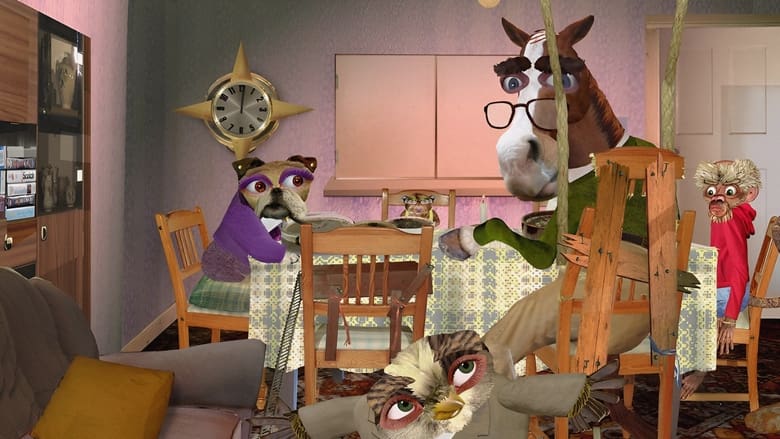
Its unique photo-collage animation style was a distinctive creative choice, setting it apart from other animated shows at the time. Critically, it was described as a "cheerfully sicko social commentary" and "deep, dark and funny". The show's legacy lies in its uncompromisingly satirical and intelligent approach to themes of class, identity, and the absurdity of modern life. It remains a hidden gem for fans of unconventional and thought-provoking animated comedy, existing in the same vein as other boundary-pushing British shows of the era like Jam and Monkey Dust.

Audience Reception

Audience reception for I Am Not an Animal has been characteristic of a cult classic. During its initial run, it did not find a large audience and was met with a somewhat indifferent response from BBC executives. However, those who connected with it did so strongly. Viewers praised its sharp, satirical writing, the stellar performances from the voice cast, and its unique and dark sense of humor. The distinct collage-style animation is often mentioned as a polarizing aspect; some viewers find it innovative and fitting for the show's strange tone, while others find it off-putting. Over time, through word-of-mouth and online availability, its reputation has grown, and it is now often cited as an underrated gem of British animation and black comedy. The main points of criticism are usually its short run, leaving audiences wanting more, and its relentlessly bleak tone, which can be alienating for some.

Interesting Facts

  • The series was created, written, and directed by Peter Baynham, who is also known for his collaborations with Steve Coogan, Chris Morris, and Sacha Baron Cohen, including co-writing for 'Borat' and 'I'm Alan Partridge'.
  • The show was produced by Baby Cow Productions, a company co-founded by Steve Coogan.
  • The unique visual style was born out of necessity. The creators initially considered CGI and motion capture but found them too expensive and restrictive for the time. Director of animation Tim Searle, a fan of collage, developed the distinctive photo-collage look which the BBC loved.
  • The title of the series, 'I Am Not an Animal', is a direct reference to the famous quote, "I am not an animal! I am a human being!" from David Lynch's 1980 film 'The Elephant Man'.
  • Despite a stellar cast and a cult following, the series only ran for one season of six episodes.
  • Creator Peter Baynham felt discouraged after the series was poorly received by some BBC executives, which partly prompted his move into feature film writing.

Easter Eggs

The animals' mistaken belief that they have landed on a 'Planet of the Apes' is a direct and sustained pop culture reference.

This is not just a passing joke but a core part of how the animals frame their absurd new reality. It's a satirical inversion of the film's premise, where intelligent animals perceive humans as the primitive, non-verbal species, highlighting their own arrogance and ignorance.

⚠️ Spoiler Analysis

Click to reveal detailed analysis with spoilers

Frequently Asked Questions

Explore More About This Movie

Dive deeper into specific aspects of the movie with our detailed analysis pages

Comments (0)

Leave a comment

No comments yet. Be the first to share your thoughts!