Skip to content
Cars
A sun-bleached desert fable about speed and stillness, where a rookie's roaring engine finally goes quiet under neon and starlight, and a forgotten road teaches him what winning cannot buy.
Cars

Cars

"Ahhh... it's got that new movie smell."

08 June 2006 United States of America 117 min 7.1 (15,470)

Director: John Lasseter

Cast: Owen Wilson, Paul Newman, Bonnie Hunt, Larry the Cable Guy, Cheech Marin

Animation Family Comedy Adventure Slowing down: the value of the detour Community versus individual glory Mentorship and buried history Progress, nostalgia and the death of small-town America Identity: who you are when nobody is watching
Budget: $120,000,000
Box Office: $461,983,149

Overview

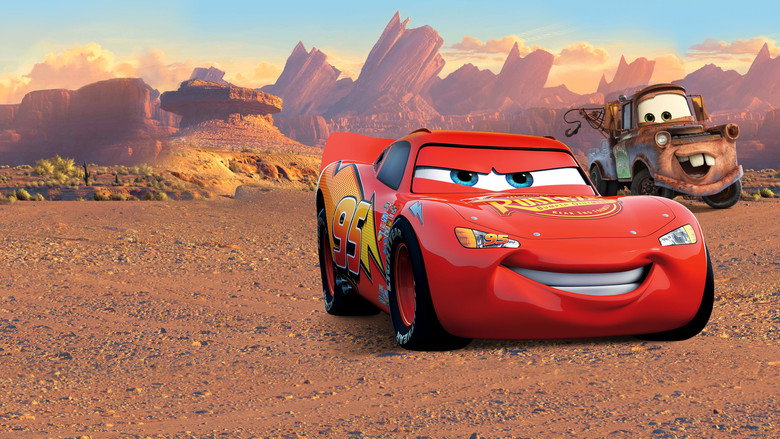
Lightning McQueen (Owen Wilson) is a rookie stock car with a spoiler full of talent and a chassis full of ego. Barreling toward the biggest race of his life — a tie-breaking showdown for the Piston Cup — he treats his crew as disposable, his sponsors as an embarrassment, and the word "teammate" as an insult. Then, somewhere between the finish line he just left and the one he is chasing, he takes a wrong turn.

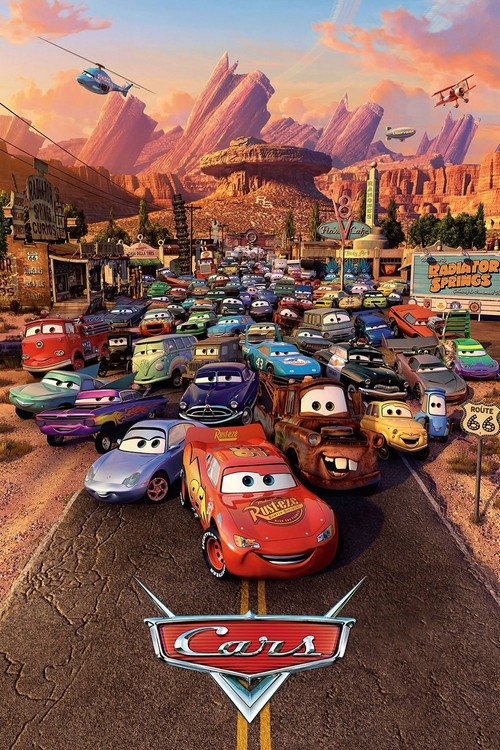
He lands in Radiator Springs, a nearly abandoned town on a bypassed stretch of the old highway, where the neon has gone dark and the only traffic is the tumbleweed kind. Sentenced to repair the road he tore up on arrival, McQueen is stuck among locals he initially sees as scenery: a rusty, gap-toothed tow truck named Mater (Larry the Cable Guy), a sharp, sunny attorney-turned-motel-owner called Sally (Bonnie Hunt), a lowrider body artist named Ramone (Cheech Marin), and a flinty, unreadable town doctor and judge, Doc Hudson (Paul Newman), who clearly knows more about racing than he is willing to admit.

Directed by John Lasseter and released by Pixar in June 2006, Cars was inspired by Lasseter's own cross-country road trip and by research journeys the crew took along Route 66, absorbing the culture and history of the small towns the interstate left behind. What begins as a sports comedy about a hotshot becomes a warm, unhurried story about detours — and about the difference between making great time and having a great time.

Core Meaning

At its heart, Cars argues that speed is not the same as direction. Lightning McQueen has optimized his whole existence for one metric — crossing a line first — and the film patiently dismantles the idea that the metric is the meaning. Critics identified the film's central movement as exactly this: a story about slowing down to appreciate the finer moments of life, wrapped around a nostalgia for a quieter, small-town America.

The film's second argument is historical rather than personal. Radiator Springs was not destroyed by a villain; it was killed by progress — a faster road built beside it, so that travellers could go through the country without ever being in it. Lasseter's crew drove the real Route 66 and met the people whose towns the interstate bypassed, and that grief is the emotional bedrock under the cartoon. The message: efficiency has a cost, and the cost is paid in places, in craftsmanship, and in the elders whose knowledge nobody bothers to ask for.

Finally, the film redefines victory. McQueen's arc ends not with a trophy but with a choice about what a trophy is for — loyalty over glory, gratitude over self-mythology, and the recognition that a career is something you are given by others, not something you take alone.

Thematic DNA

Slowing down: the value of the detour 28%
Community versus individual glory 24%
Mentorship and buried history 20%
Progress, nostalgia and the death of small-town America 16%
Identity: who you are when nobody is watching 12%

Slowing down: the value of the detour

The entire plot is a forced deceleration. McQueen's life is measured in lap times and sponsor deals until a literal wrong turn strands him in a town with no schedule. His sentence — repaving the road he destroyed — is a joke about penance that turns into a lesson about craft: he learns that doing a job badly and fast is worse than doing it slowly and well.

Sally's drive into the hills makes it explicit: the old highway followed the shape of the land, while the interstate cut through it to save minutes. The film's most quoted idea is that people once drove a road to have a great time, not to make great time.

Community versus individual glory

McQueen begins as a one-car team, dismissing pit crews, refusing to acknowledge his sponsors, and insisting he needs no one. Radiator Springs is the structural opposite: a place that survives only because everyone plays a role — mechanic, doctor, artist, tow truck, café.

The film literalizes the shift in its final act, when McQueen's real crew turns out to be the town itself. His growth is measured not by his speed but by whom he is willing to owe something to, and to whom he offers loyalty in return.

Mentorship and buried history

Doc Hudson is the hidden spine of the film: a legend who was thrown away by the sport the moment he was damaged, and who has spent decades pretending racing never happened to him. His bitterness — that the world moved on without a thank-you — is the adult wound at the center of a children's film.

McQueen's redemption requires him to stop performing and start listening; Doc's requires him to stop hiding. The mentor teaches the technique ("turn right to go left"), but the deeper lesson is that experience is worthless if it is hoarded out of pride.

Progress, nostalgia and the death of small-town America

Radiator Springs is a ghost of the pre-interstate roadside economy — the motels, curio shops and neon of the old highway. Its decline is shown as an act of infrastructure, not malice: a faster road was built and the traffic simply stopped coming.

Pixar built this out of direct research, travelling Route 66 and drawing Radiator Springs from real landmarks such as the wigwam motels, trading posts and vintage service stations. The town's restoration in the film is a wish-fulfilment answer to a real American loss.

Identity: who you are when nobody is watching

McQueen's persona is a product — a catchphrase, a paint job, a set of poses for the cameras. Stripped of his audience, he is forced to discover which parts of himself survive without an audience.

Mater is the counterweight: rusted, unpolished, entirely without pretense, and therefore the most secure character in the film. The friendship works because Mater does not care about the brand, only the car.

Character Analysis

Lightning McQueen

Owen Wilson

Archetype: Arrogant hero / the prodigal rookie Key Trait: Charismatic, showboating self-belief that slowly matures into humility

Motivation

Initially: to win the Piston Cup, secure a lucrative sponsorship and be adored. Ultimately: to deserve the town that adopted him, and to repay a mentor.

Character Arc

Begins as a self-made brand: talented, isolated, contemptuous of anyone slower than himself. Stranded and sentenced to manual labour, he moves through resentment, to reluctant belonging, to genuine gratitude. By the finale he can measure a race by something other than the finish line, and his loyalty to the sponsor he once found humiliating becomes the clearest proof that he has changed.

Doc Hudson

Paul Newman

Archetype: Reluctant mentor / wounded legend Key Trait: Flinty dignity concealing enormous, hard-won wisdom

Motivation

To protect his town and his own scar tissue — and, once he relents, to make sure a young racer is not thrown away the way he was.

Character Arc

A gruff small-town doctor and judge who wants the outsider gone, concealing that he was once a champion discarded by the sport after a career-ending crash. Watching McQueen repeat his own mistakes forces him to reopen a past he had sealed off; he moves from denial and hostility to open, generous mentorship, and finally reclaims his place trackside on his own terms.

All 5 characters and cast

Symbols & Motifs

The road (Route 66 and the interstate)

Meaning:

Two philosophies of life rendered as asphalt: the old road that curves with the land and the new one that cuts through it. One values the journey, the other only the destination.

Context:

The town's decline is caused by the bypass; McQueen's punishment is to repave the road he wrecked; Sally's hillside drive turns the highway into a sermon about how the country used to move.

Neon

Meaning:

Memory and dignity. Lit neon means a town that is seen; dark neon means a place that still exists but has been erased from the map of attention.

Context:

Radiator Springs is introduced in dusty daylight decay; the emotional climax of McQueen's stay is the moment the whole main street is switched back on at night, cruising restored.

Rust

Meaning:

The passage of time as something honest rather than shameful. Rust marks the characters who have lived, worked and been discarded — and the film insists they are the ones worth knowing.

Context:

Mater's battered body, Doc's hidden past, and the sponsor McQueen is embarrassed by all connect rust to authenticity, against McQueen's flawless factory finish.

The Piston Cup

Meaning:

The hollow trophy — the external metric that stands in for worth. It represents everything McQueen thinks he wants before he learns what a win actually costs and confers.

Context:

The tie-breaker race that opens the film and the championship showdown that closes it bracket the story, so that the same object means two completely different things at each end.

The dirt track (Willy's Butte)

Meaning:

Unlearning. The counterintuitive instruction to turn right to go left symbolizes surrendering instinct and ego in order to actually improve.

Context:

Doc humiliates McQueen there, then trains him there; the technique returns at the decisive moment of the final race.

The Hudson Hornet

Meaning:

Forgotten greatness. A make of car that genuinely dominated early stock car racing, standing for every champion the sport used up and left behind.

Context:

Doc Hudson is a 1951 Hudson Hornet, and his character draws on the real NASCAR pioneer Herb Thomas, who took Hudson Hornets to Grand National championships in 1951 and 1953; his hidden trophy room is the film's quiet gut-punch.

Memorable Quotes

Ka-chow!
— Lightning McQueen

Context

McQueen's trademark flash-and-pose for photographers and fans, deployed whenever he is performing rather than living.

Meaning

The whole McQueen persona compressed into two syllables: a catchphrase built for cameras and merchandise rather than for people. It became the film's defining pop-culture signature, so recognizable that his rival tries to copy it.

I am speed.
— Lightning McQueen

Context

His pre-race ritual in the dark of the trailer, psyching himself up before the opening Piston Cup event.

Meaning

A self-hypnotising mantra that reveals the flaw the film will cure: he has fused his identity with a single attribute, leaving nothing underneath.

All 5 quotes

Philosophical Questions

Is winning the same as being worth something?

McQueen's entire self-worth is denominated in trophies, and the film systematically detaches the two. Doc Hudson is the proof of concept: a car with more championships than anyone, whose life was still discarded — evidence that the scoreboard neither confers nor preserves value.

What does progress destroy that it cannot replace?

The interstate is not villainous; it is simply faster. The film asks whether saving time is worth the towns, trades and encounters that time contained, and answers with an entire community whose existence was quietly deleted by an engineering decision.

Do we owe anything to the people who made our success possible?

McQueen begins by treating his crew, sponsors and fans as interchangeable infrastructure. The plot repeatedly places him in debt — for repairs, for training, for friendship — until the climax forces him to decide whether obligation is a burden or the actual substance of a life.

Can a person change, or only be revealed?

The film hedges productively. McQueen's talent, charisma and taste for spectacle are unchanged at the end; what changes is what he points them at. Mater, meanwhile, never changes at all and is treated as already complete — suggesting growth may be less about becoming someone else than about noticing others.

Is it braver to compete or to withdraw?

Doc's retreat into Radiator Springs reads first as cowardice and later as survival; Sally's abandonment of a lucrative career for a dying town reads first as eccentricity and later as conviction. The film refuses to treat ambition as automatically admirable or retreat as automatically defeat.

Alternative Interpretations

As a conservative elegy. The most common reading treats Cars as a lament for pre-interstate America — a nostalgia for small-town life that some critics judged to be aimed squarely over the heads of its young audience, a grown-up's sorrow dressed in toy colours.

Full ending explanation

Cultural Impact

Cars arrived in June 2006 at a hinge moment for Pixar — the studio's run of near-universally acclaimed hits had raised expectations to an impossible height, and this was the film where critics first began writing about a possible dip. Reviews were the most divided of the studio's output to that point: some declared it Pixar's first dud, others called it an improbable success that should have misfired and somehow doesn't, and a common verdict was that judged against Pixar's own standard it was not firing on all cylinders, while judged against other studios' animation it was still a triumph.

Audiences disagreed with the sceptics emphatically. On a budget of around $120 million the film grossed roughly $460 million worldwide and, more importantly, generated a merchandising and franchise phenomenon — sequels, spin-offs, and a theme-park land — that made it one of the most commercially significant animated properties of its era. Awards followed: two Academy Award nominations including Best Animated Feature (losing to Happy Feet), the very first Golden Globe for Best Animated Feature Film, and Best Animated Feature at the Annie Awards, where it led the field with nine nominations.

Its most durable cultural effect may be off-screen. By building Radiator Springs from real Route 66 landmarks after a research road trip along the Mother Road, the filmmakers turned a children's movie into an act of preservation advocacy; the film is widely credited with renewing tourist interest in the bypassed towns and businesses it fictionalized. And in Lightning McQueen's "Ka-chow!" it produced a catchphrase that outlived the film's own critical debate, embedding itself in internet meme culture for a generation that first met the character as toddlers.

Audience Reception

What audiences praised. The warmth and sincerity of the Radiator Springs material is the film's most beloved element, along with Paul Newman's grave, weathered performance as Doc Hudson — carrying extra weight for viewers who know it was his final acting contribution and one he reportedly rated as his best since The Verdict. Mater's comedy, the tactile beauty of the desert animation, and the detail-rich recreation of Route 66 Americana are consistently singled out. Owen Wilson's easy, slightly abashed charm makes McQueen likeable long before he deserves to be.

Main criticisms. The most persistent complaints concern pacing — a long middle act in which very little happens — and a plot that follows a familiar redemption template with few surprises. Critics contrasted it unfavourably with Pixar's earlier work, calling it less magical, less transportive and less universal, and suggesting it courted auto enthusiasts and merchandising more than the studio's usual all-ages audience. The nostalgia for small-town life was widely judged to be pitched at parents rather than children.

Contested points. The internal logic of a world without humans invites endless good-natured argument; so does the question of whether the finale is earned emotion or sentimentality. And the film's enormous commercial afterlife — toys, sequels, a theme-park land — hardened opinions on both sides, with defenders noting that the merchandise did not exist yet when the film was made.

Verdict. Divisive among critics, adored by families. It grossed roughly $460 million worldwide, took the first Golden Globe for Best Animated Feature and the Annie for Best Animated Feature, and has aged into something warmer than its reviews: a slower, sadder, more sincere Pixar film than its rivals-and-racing marketing ever suggested.

Interesting Facts

  • The film grew out of director John Lasseter's own cross-country road trip; the Pixar crew, Lasseter included, then travelled Route 66 to study the culture, people and history of the towns the interstate had bypassed.
  • Radiator Springs is a composite of real Route 66 landmarks, drawing on sites such as the wigwam motel chain, the Jack Rabbit Trading Post and the Tower Station and U-Drop Inn.
  • Doc Hudson is a 1951 Hudson Hornet, a model that dominated NASCAR's early years; the character was based on real-life racing pioneer Herb Thomas, who won Grand National championships in Hudson Hornets in 1951 and 1953.
  • Paul Newman's voice work as Doc Hudson was his final acting contribution and his last American feature before his death in 2008; he reportedly considered it his best performance since 'The Verdict' (1982).
  • Co-director, co-writer and Pixar story veteran Joe Ranft died in a car accident on August 16, 2005, during production. He was central to the story and to character development — Mater in particular — and voiced Red, the fire engine.
  • The film was originally scheduled for November 4, 2005, but on December 7, 2004 it was pushed to June 9, 2006 after Steve Jobs decided Pixar films should open in summer.
  • Made for roughly $120 million, the film grossed around $460–462 million worldwide and launched a major franchise for the studio.
  • It received two Academy Award nominations, including Best Animated Feature, losing that category to 'Happy Feet'.
  • 'Cars' was the first-ever winner of the Golden Globe Award for Best Animated Feature Film, a category created for that ceremony.
  • The film led the 34th Annie Awards with nine nominations — the most feature nominations of any film that year — and won Best Animated Feature.

Easter Eggs

The 'EVILLE' license plate

One of several nods to Emeryville, California, the city where Pixar Animation Studios is based — the studio signing its own work inside the world of the film.

The 'City of Emeryville' sign at the final California race

A second Emeryville reference planted in the climactic race environment, turning the studio's hometown into part of the film's fictional geography.

Emeryville visible beneath the jet flyover

During the flyover at the California race, the actual city of Emeryville appears below — the most elaborate of the film's three studio in-jokes.

Joe Ranft as the voice of Red the fire engine

The film's co-director and co-writer, who died in a car accident during production in August 2005, is present in the finished film as the shy, silent-but-for-sobs fire truck — a small, poignant trace of one of Pixar's most important story artists.

Radiator Springs as a catalogue of real Route 66 architecture

Viewers who have driven the Mother Road can identify the wigwam motel, trading post and vintage service-station designs woven into the town — the film functions as an animated preservation record of a vanishing roadside America.

Frequently Asked Questions

Explore More About This Movie

Dive deeper into specific aspects of the movie with our detailed analysis pages

Comments (0)

Leave a comment

No comments yet. Be the first to share your thoughts!

Similar Movies