Skip to content
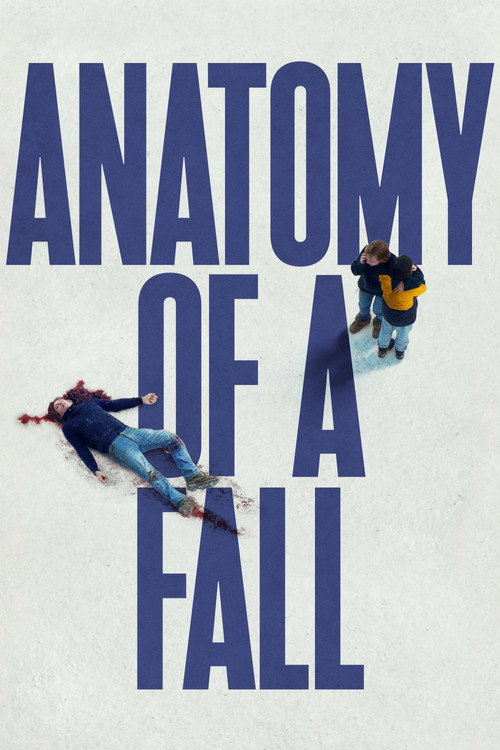
Anatomy of a Fall
An icy psychological courtroom drama steeped in suffocating paranoia and moral paralysis, where a fractured marriage dissolves like blood seeping into pristine Alpine snow, exposing the slippery, ungraspable nature of human truth.
Anatomy of a Fall

Anatomy of a Fall

Anatomie d'une chute

"Did she do it?"

23 August 2023 France 151 min 7.5 (3,385)

Director: Justine Triet

Cast: Sandra Hüller, Swann Arlaud, Milo Machado-Graner, Antoine Reinartz, Samuel Theis

Crime Thriller Mystery The Slipperiness of Truth & Subjectivity vs. Narrative The Anatomy of Marital Power Dynamics & Resentment Language, Translation, and Identity Alienation Perception, Memory, and Moral Choice The Boundary Between Fiction, Art, and Reality
Budget: $6,600,000
Box Office: $36,000,000

Overview

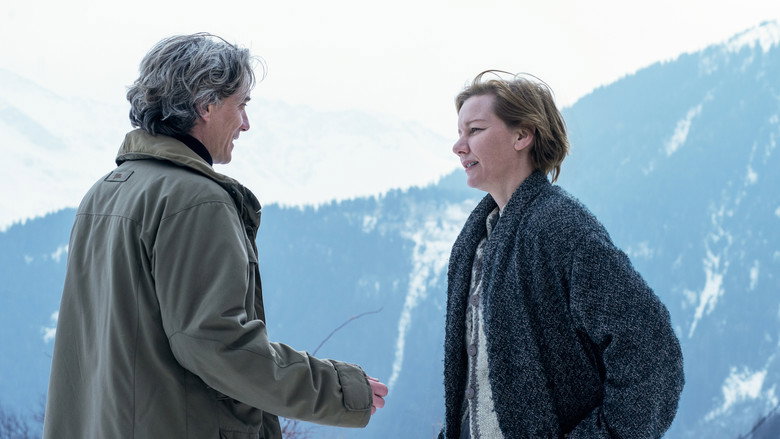
Anatomy of a Fall (Anatomie d'une chute) begins in an isolated, partially renovated wooden chalet nestled in the French Alps near Grenoble. German novelist Sandra Voyter (Sandra Hüller) lives there with her French husband, Samuel Maleski (Samuel Theis), and their 11-year-old visually impaired son, Daniel (Milo Machado-Graner), alongside their guide dog, Snoop. The calm is shattered when Samuel's body is discovered lying dead in the snow below a third-floor attic window, having suffered fatal head trauma. With no outside witnesses and ambiguous forensic evidence, authorities quickly open a homicide investigation, making Sandra the sole suspect.

Represented by her old friend and lawyer Vincent Renzi (Swann Arlaud), Sandra maintains that the fall was either a tragic accident or a suicide. However, as the case proceeds to a high-profile public trial, the prosecutor ruthlessly dissects Sandra's personal life. The court becomes an arena where her autofiction novels, her bisexuality, her past infidelities, and the latent professional jealousy between her and her struggling husband are weaponized as evidence of motive.

As the trial drags on, the couple's young son Daniel is thrust into an agonizing position. Burdened by his visual impairment and caught between competing legal narratives, Daniel must navigate conflicting memories and impossible doubts to determine what he believes happened—ultimately realizing that when objective proof is unattainable, he must actively choose a narrative to live with.

Core Meaning

Justine Triet's central ambition in Anatomy of a Fall is to interrogate the impossibility of absolute objective truth in human relationships and legal systems. The director explores how the judicial system demands a clean, binary narrative—murder vs. suicide, innocence vs. guilt—to explain complex, messy, and inherently chaotic human lives.

The film asserts that a marriage, like any intimate partnership, cannot be accurately judged or reconstructed by outsiders using isolated fragments of evidence, audio recordings, or artistic works. When objective proof fails, truth ceases to be something discovered; instead, it becomes a moral choice—a narrative construct that individuals and juries decide to accept in order to move forward.

Thematic DNA

The Slipperiness of Truth & Subjectivity vs. Narrative 30%
The Anatomy of Marital Power Dynamics & Resentment 25%
Language, Translation, and Identity Alienation 20%
Perception, Memory, and Moral Choice 15%
The Boundary Between Fiction, Art, and Reality 10%

The Slipperiness of Truth & Subjectivity vs. Narrative

The film continuously highlights how facts can be weaponized to construct entirely opposing, plausible stories. Neither the police, blood splatter experts, nor the audience ever witness the fall. Truth is shown as a malleable interpretation rather than a fixed reality.

The Anatomy of Marital Power Dynamics & Resentment

Through courtroom revelations and an explosive surreptitious audio tape, the film dissects gender roles, domestic compromise, artistic jealousy, and shared guilt over Daniel's accident. Sandra’s professional success contrasts sharply with Samuel’s writer's block and feelings of emasculation.

Language, Translation, and Identity Alienation

Language functions as a battlefield. As a German living in France forced to speak English as a "middle ground" in her home and French in court, Sandra suffers a loss of nuance and control over her words, making her appear cold or calculated to a French jury.

Perception, Memory, and Moral Choice

Represented primarily through Daniel's journey, the film explores how memory is unreliable, particularly under trauma. Forced to testify, Daniel must transition from a passive witness to an active decider of his mother's fate.

The Boundary Between Fiction, Art, and Reality

As an autofiction author, Sandra's literary works are dissected in court, blurring the line between creative imagination and real-life intent. The film questions whether an artist's dark thoughts on paper can be treated as legal evidence.

Character Analysis

Sandra Voyter

Sandra Hüller

Archetype: Unreliable Subject / Pragmatic Protagonist Key Trait: Unapologetic intellectual independence and self-possession.

Motivation

To prove her innocence, maintain her freedom, and preserve her remaining bond with her son Daniel.

Character Arc

She moves from an intellectual, self-contained woman guarding her private life to an exposed, emotionally battered defendant who must endure the public dissection of her character and marriage.

Daniel Maleski

Milo Machado-Graner

Archetype: Innocent Witness / Coming-of-Age Hero Key Trait: High sensory acuity and deep moral conscience.

Motivation

To find the truth about his father's death and determine whether his mother can be trusted.

Character Arc

Starts as a traumatized, visually impaired boy seeking objective certainty, but evolves into a mature agent who understands that he must actively decide what to believe when facts remain inconclusive.

All 5 characters and cast

Symbols & Motifs

The Instrumental Cover of 50 Cent's "P.I.M.P." (by BBE)

Meaning:

Symbolizes domestic passive-aggression, Samuel's overwhelming presence, and his attempt to drown out Sandra's voice.

Context:

Blared from the attic by Samuel during Sandra's opening interview. In court, the prosecutor attempts to frame the song's title as evidence of Sandra's "pimp"-like exploitation of her husband.

Snoop the Border Collie

Meaning:

Serves as a silent, unbiased witness to the family dynamics and an emotional anchor for Daniel.

Context:

Snoop becomes a proxy test subject when Daniel tests his hypothesis about Samuel's prior suicide attempt using aspirin.

The Unfinished Alpine Chalet

Meaning:

Symbolizes the couple's failed ambitions, financial strain, and unfinished emotional business.

Context:

The isolated, cold, and perpetually under-construction house where Samuel dies and where the family lived.

Languages (English / French / German)

Meaning:

Switching languages represents power dynamics and alienation.

Context:

English is the neutral territory where Sandra and Samuel compromised, while French in court strips Sandra of her natural fluency and puts her at a distinct disadvantage.

Piano Music (Chopin's Prelude in E Minor Op. 28 No. 4)

Meaning:

Reflects emotional disruption, grief, and unresolved tension within the home.

Context:

Practiced repeatedly by Daniel throughout the film.

Memorable Quotes

I did not kill him. / Vincent: That's not the point.
— Sandra Voyter & Vincent Renzi

Context

Early meeting where Sandra insists on her literal innocence.

Meaning

Sets up the central thesis of the movie: the court is not concerned with absolute truth, but with which narrative is most convincing to the jury.

Sometimes a couple is kind of a chaos and everybody is lost. Sometimes we fight together and sometimes we fight alone, and sometimes we fight against each other, that happens.
— Sandra Voyter

Context

Sandra testifying in court following the playback of the recorded argument.

Meaning

Captures the complex reality of long-term intimacy that cannot be reduced to simple legal evidence.

All 5 quotes

Philosophical Questions

Can objective truth ever be fully separated from subjective narrative?

The film demonstrates how identical empirical evidence (blood splatter, audio recordings) can support completely contradictory, logically sound conclusions.

In the absence of certainty, is belief a moral decision?

Through Daniel's storyline, the movie asks whether choosing what to believe is a necessary act of human survival when definitive facts are forever out of reach.

Is art an extension of moral character?

The courtroom scenes question whether an author's fictional writing and dark creative ideas can be used as evidence of real-world criminal intent.

Is equal reciprocity achievable in a marriage?

The film explores whether two ambitious individuals can coexist without one person's creative or personal fulfillment coming at the expense of the other.

Alternative Interpretations

Interpretation 1: Samuel's Suicide as an Act of Revenge: Samuel intentionally jumped from the attic to end his mental suffering while framing Sandra, knowing her literary history and their recent brutal argument would make her the prime suspect, effectively punishing her forever.

Full ending explanation

Cultural Impact

Anatomy of a Fall debuted at the 76th Cannes Film Festival in May 2023, where it won the Palme d'Or. It garnered international critical acclaim, earning five Academy Award nominations (including Best Picture, Best Director, and Best Actress for Sandra Hüller) and winning the Oscar for Best Original Screenplay.

The film sparked widespread cultural debate, particularly around female autonomy and domestic dynamics. Sandra Voyter defied conventional cinematic tropes of mothers on trial; she was written as an unapologetic, complex intellectual who refused to display performative grief.

A major political controversy erupted in France when Justine Triet used her Palme d'Or acceptance speech to criticize President Emmanuel Macron's government over pension reforms and the commercialization of cultural funding. Critics speculated that this speech influenced France's selection committee to choose The Taste of Things over Anatomy of a Fall as France's official submission for Best International Feature at the Oscars—a decision widely regarded as a major snub after Anatomy of a Fall went on to gain top-tier Oscar nominations independently.

Audience Reception

Praised Aspects: Universal praise was directed at Sandra Hüller’s masterful, morally ambiguous performance, Milo Machado-Graner’s emotional nuance, Messi the dog’s training, and the sharp, realistic screenplay. Audiences praised the film for avoiding melodramatic tropes and respecting viewer intelligence.

Main Points of Criticism: Some viewers found the 151-minute running time slow-paced and expressed frustration with the refusal to provide a definitive "whodunit" resolution.

Controversial Moments: The scene where Daniel intentionally drugs Snoop with aspirin caused emotional distress for animal-loving viewers. Additionally, the aggressive tactics of the prosecutor drew mixed reactions regarding legal accuracy versus dramatic license.

Overall Verdict: Widely hailed as a modern masterpiece of modern European cinema and one of the finest courtroom/psychological dramas of the decade.

Interesting Facts

  • Justine Triet and Arthur Harari wrote the screenplay specifically for Sandra Hüller after working with her on Sibyl (2019). Triet gave Hüller no instruction on whether Sandra was actually guilty or innocent, forcing Hüller to perform with genuine ambiguity.
  • Messi, the Border Collie playing Snoop, underwent two months of intensive training for his key scenes—particularly the scene where Snoop feigns being poisoned with aspirin. Messi won the Palm Dog Award at the 2023 Cannes Film Festival.
  • Triet originally wanted Dolly Parton’s "Jolene" for the opening scene, but copyright clearances were denied, leading them to choose the steel-drum cover of 50 Cent’s "P.I.M.P." by BBE, which turned out to be a central symbolic element.
  • The explosive 10-minute marital argument played on the audio recorder in court took over 60 rewrites to balance the dynamic so neither character emerged as purely the villain or victim.
  • Unlike Anglo-American adversarial trials, the film accurately depicts French legal procedure, where judges, prosecutors, defense attorneys, and witnesses can interrupt each other and debate dynamically.
  • Produced on a modest budget of around $6.6 million (€6.2 million), the film grossed over $36 million globally, making it one of the most commercially profitable Oscar Best Picture nominees of 2023.

Easter Eggs

Nod to Otto Preminger

The title Anatomy of a Fall is a direct reference to Otto Preminger’s classic 1959 courtroom drama Anatomy of a Murder.

The Opening Click

The film starts on a black screen with the distinct sound of a portable audio recorder turning on before any visual appears, foreshadowing the central courtroom sequence where an audio recording dictates reality without visual proof.

Snoop's Dog-Cam Tracking Shot

Early in the film, the camera drops down to Snoop's exact eye level during a tracking shot, establishing Snoop as an active narrative participant and observer.

True Crime Case Homage

Samuel's fatal fall and the debate over blood splatter on a lower roof metal overhang parallel the famous real-life case of Michael Peterson (The Staircase).

Frequently Asked Questions

Explore More About This Movie

Dive deeper into specific aspects of the movie with our detailed analysis pages

Comments (0)

Leave a comment

No comments yet. Be the first to share your thoughts!

Similar Movies