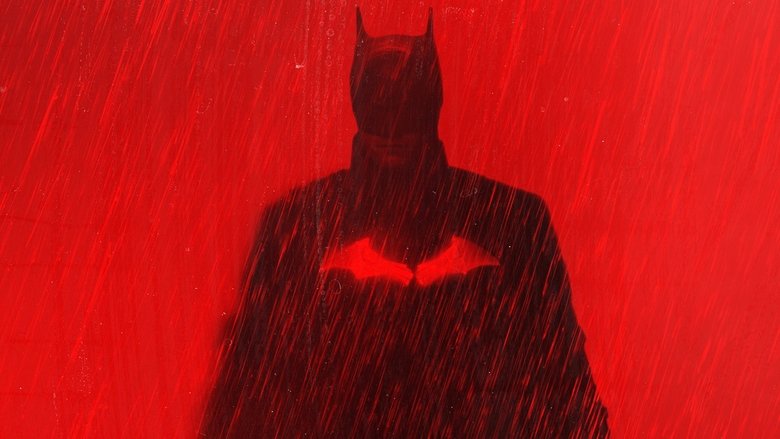
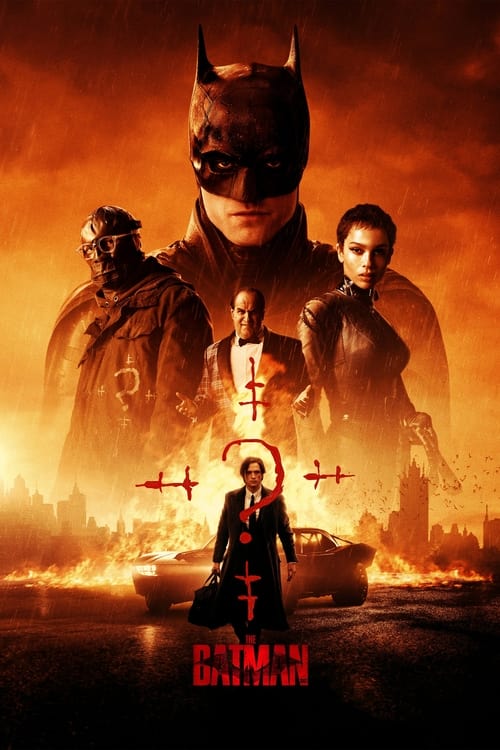
The Batman
"Unmask the truth."
Overview
Set in his second year of fighting crime, Bruce Wayne patrols the shadowy, rain-soaked streets of Gotham City as a terrifying force of vengeance. However, his brutal crusade is interrupted when a sadistic serial killer known as the Riddler begins targeting the city's corrupt elite, leaving a trail of cryptic clues specifically addressed to the Batman.
Forced to rely on his detective skills, Batman plunges into the city's seedy underbelly, crossing paths with characters like Selina Kyle, the Penguin, and mob boss Carmine Falcone. As the investigation peels back the layers of Gotham's institutional rot, Bruce uncovers unsettling truths that connect his own family's legacy to the very corruption he is trying to eradicate.
The film shifts the superhero paradigm into a gritty, David Fincher-esque crime procedural. Rather than focusing merely on high-octane action, it intricately explores the psychological toll of vigilantism, ultimately challenging its protagonist to rise above his anger and evolve from an instrument of fear into a symbol of hope.
Core Meaning
At its core, Matt Reeves' film is an exploration of trauma, class inequality, and the destructive cycle of violence. The director uses Batman's journey to argue that fear and vengeance are insufficient tools for systemic change. By mirroring Batman's motivations with the Riddler's twisted ideology, the film demonstrates how unchecked rage—even when aimed at corruption—only breeds more destruction. The ultimate message is that true heroism requires profound compassion and the willingness to be a beacon of hope, inspiring people to heal rather than simply punishing those who sin.
Thematic DNA
Vengeance vs. Justice
The central conflict of the film is Bruce Wayne's realization that his crusade of vengeance is toxic. Both he and the Riddler act out of deep anger against Gotham's decay, but Batman eventually learns that to truly save the city, he must pivot away from retribution toward genuine justice and hope.
Systemic Corruption and Class Divide
The film paints a grim picture of a society where institutions are deeply compromised. Through the Renewal fund, it highlights how the wealthy and powerful exploit the vulnerable, emphasizing the disconnect between Bruce Wayne's immense privilege and the reality of Gotham's disenfranchised citizens.
Trauma and Grief
Bruce Wayne's inability to move past the murder of his parents manifests as a self-destructive obsession. The narrative explores how unhealed psychological wounds can stunt emotional growth, depicted through Bruce's extreme isolation and his absolute reluctance to embrace his public billionaire persona.
Identity and The Mask
The film questions who the real person is: the man or the mask. For both Batman and the Riddler, their masks allow them to express their true, unfiltered selves, shedding societal restraints to unleash their deepest desires and fears upon the world without shame.
Character Analysis
Bruce Wayne / Batman
Robert Pattinson
Motivation
A deep-seated need to punish the criminal underworld as a coping mechanism for the unresolved trauma of his parents' tragic murder.
Character Arc
Starts as an angry, isolated vigilante completely consumed by vengeance. Through his terrifying parallels with the Riddler, he realizes that his brutality only inspires more violence, ultimately choosing to become a symbol of hope and protection.
Edward Nashton / The Riddler
Paul Dano
Motivation
Resentment toward Gotham's corrupt elite and Bruce Wayne for the squalid, abusive conditions of his orphanage following the failure of the Renewal fund.
Character Arc
Believes he is working alongside Batman to violently purge Gotham of corruption, but his path descends into mass terrorism, ending in his capture and hysterical realization that Batman entirely rejects his twisted ideology.
Selina Kyle / Catwoman
Zoë Kravitz
Motivation
To exact revenge on the corrupt men who exploit the vulnerable, specifically targeting her biological father, Carmine Falcone.
Character Arc
Begins as a desperate survivor seeking revenge and the truth about her missing roommate. She learns to temper her lethal instincts through her dynamic with Batman, though she ultimately decides Gotham is too far gone to be saved.
Lt. James Gordon
Jeffrey Wright
Motivation
To uproot the systemic corruption deeply embedded within Gotham's institutions and solve the high-profile serial murders.
Character Arc
Maintains his steady moral compass in a deeply corrupt police force, serving as Batman's only true bridge to the law and aiding him in unraveling the massive, city-wide conspiracy.
Symbols & Motifs
Water and The Flood
The apocalyptic flood at the climax serves as a biblical motif of both destruction and baptismal rebirth. It represents the ultimate consequence of the city's sins while also providing a slate-cleaning moment for a new beginning.
The Riddler destroys Gotham's seawalls, flooding the city. In the immediate aftermath, Batman physically steps down into the dark water to rescue trapped citizens, signaling his rebirth from a creature of the shadows to a guiding light.
The Flare
A literal and metaphorical beacon of hope, illumination, and salvation in the darkness.
In the pitch-black, flooded arena, Batman ignites a brilliant red flare to lead the injured and terrified citizens to safety, visually marking his transition from a vigilante who hides in the dark to a hero who leads people into the light.
Ave Maria
The classic hymn represents embitterment, lost innocence, and the perversion of good intentions. It highlights the failure of Thomas Wayne's Renewal project to save the city's most vulnerable children.
The song is used hauntingly throughout the film, notably in the opening murder scene and when sung by the Riddler in Arkham Asylum, serving as an eerie auditory motif for Edward Nashton's dark crusade.
The Journal / Drifter Disguise
Bruce's obsessive documentation and his drifter persona symbolize his extreme isolation, psychological trauma, and his desperate need to make sense of his pain while staying disconnected from society.
Bruce records his nightly patrols in a diary (reminiscent of Rorschach from Watchmen) and walks the streets in plain, grimy clothes to blend in, highlighting his complete detachment from his wealth and his immersion in the city's decay.
Memorable Quotes
Two years of nights have turned me into a nocturnal animal.
— Bruce Wayne / Batman
Context:
Heard in the opening voiceover as Bruce records his journal entries, detailing his nightly patrols in Gotham.
Meaning:
This line establishes the profound, unnatural psychological toll his vigilantism has taken on his humanity and overall well-being.
They think I am hiding in the shadows. But I am the shadows.
— Bruce Wayne / Batman
Context:
Spoken in voiceover as the Bat-Signal lights up the sky, showing criminals terrified of every dark alley and corner.
Meaning:
Highlights Batman's reliance on psychological warfare and intense fear as his primary weapons against the superstitious criminal element.
I'm vengeance.
— Bruce Wayne / Batman
Context:
Said after brutally beating a face-painted gang member in a subway station.
Meaning:
Encapsulates his initial, deeply flawed ideology. He views himself strictly as an instrument of punishment rather than a protector.
I just ordered a slice of pumpkin pie.
— Edward Nashton / The Riddler
Context:
Uttered calmly in a brightly lit diner just moments before heavily armed police officers surround and arrest him.
Meaning:
Juxtaposes his horrifying acts of extreme terrorism with mundane, everyday desires, emphasizing his chilling psychopathy.
Vengeance won't change the past, mine or anyone else's. I have to become more. People need hope.
— Bruce Wayne / Batman
Context:
Delivered in voiceover at the end of the film as he actively helps with the recovery efforts in the flooded remnants of Gotham.
Meaning:
The thematic climax of the film, marking his hard-won transformation from a figure of fear to a genuine superhero.
Philosophical Questions
Can true justice ever be achieved through vengeance?
The film intensely scrutinizes the morality of retribution. By having the Riddler's violent crusade directly mirror Batman's own brutal tactics, the narrative suggests that fighting crime with mere anger only perpetuates a vicious cycle of violence, demanding that true justice must be rooted in compassion and hope.
Are we defined by our family's legacy and past sins?
Bruce Wayne struggles immensely under the weight of his parents' mythic reputation. When he discovers his father's dark connection to mob boss Carmine Falcone, he must grapple with the philosophical dilemma of whether he is doomed by the sins of his father or if he can forge his own independent moral path.
What is the true cost of systemic class inequality?
Through the sharply contrasting lives of billionaire Bruce Wayne and the orphaned Edward Nashton (The Riddler), the film asks how much societal decay is responsible for creating monsters. It explores whether the elite's hoarding of resources (via the stolen Renewal fund) is the true source of Gotham's madness.
Alternative Interpretations
Critics and fans have discussed multiple fascinating interpretations of the film's narrative. One prominent reading views the climax not just as a standard superhero victory, but as a pointed socio-political commentary: the Riddler's followers, who are radicalized online to commit domestic terrorism, heavily parallel real-world internet radicalization and fringe extremist movements. From this perspective, Batman's ultimate battle isn't against a supervillain, but against the viral spread of violent ideology.
Another interpretation focuses on the ending's ambiguity regarding Gotham's fate. While Batman becomes a symbol of hope, the city is left physically destroyed and largely submerged. This suggests that deep-rooted systemic rot cannot simply be punched away by a vigilante—it must be washed clean in an almost biblical sense before true rebuilding can begin.
Additionally, some critics argue that the Riddler actually 'won' the conflict. He successfully assassinated all his targets, exposed the Wayne family's complicity to the public, and destroyed the city's infrastructure, essentially forcing Batman to react to his grand design rather than prevent the ultimate catastrophe.
Cultural Impact
The Batman (2022) made a significant cultural impact by successfully rebooting the iconic franchise completely outside of the DC Extended Universe (DCEU), successfully returning the character to his grounded roots as the 'World's Greatest Detective'. Released amidst the waning popularity of conventional, CGI-heavy superhero tropes, the film was lauded for its gritty neo-noir aesthetic that drew heavy, favorable comparisons to David Fincher thrillers like Se7en and Zodiac.
It sparked widespread critical discourse regarding its bold exploration of systemic corruption, class inequality, mental health, and white privilege—themes rarely addressed with such nuance in a comic book blockbuster. Furthermore, the film's unexpected use of Nirvana's track Something in the Way catapulted the 1991 song back onto global music charts, cementing the film's grungy, moody atmosphere firmly into the pop culture zeitgeist.
Its massive box office success and glowing critical reception proved that audiences were hungry for slower, director-driven character studies in the superhero genre. This success paved the way for an expansive new 'Bat-Epic' shared universe, eventually leading to the critically acclaimed television spin-off, The Penguin.
Audience Reception
Audience reception for The Batman was overwhelmingly positive, with the film securing high audience scores across major review aggregators. Viewers heavily praised Matt Reeves' distinct directorial vision, Greig Fraser's stunning, shadow-drenched cinematography, and Michael Giacchino's haunting, operatic score.
Robert Pattinson's brooding, vulnerable take on Bruce Wayne was widely celebrated for breaking the traditional suave playboy mold, while Paul Dano's terrifying, Zodiac-inspired Riddler was lauded as one of the most compelling comic book villains in recent memory. The focus on Batman's detective skills was highly appreciated by long-time comic fans.
However, the film was not without its criticisms. The main point of contention among some audience members was its formidable runtime of nearly three hours. Certain viewers felt the pacing dragged slightly during the third act, or that the deeply intricate conspiracy plot occasionally became overly convoluted. Despite these minor critiques, the overall verdict heralded the film as a masterful, atmospheric triumph that breathed fresh, necessary life into the superhero genre.
Interesting Facts
- Robert Pattinson improvised the timing of the iconic 'I'm vengeance' line during the subway fight, deciding to say it right as the thug was losing consciousness so it would seep into his dreams and permanently damage his psyche.
- Paul Dano's chilling portrayal of the Riddler drew heavy inspiration from the real-life Zodiac Killer, who also taunted authorities by leaving ciphers and coded messages at crime scenes.
- Director Matt Reeves listened to Nirvana while writing the script, which led to Kurt Cobain heavily influencing this grungy, reclusive, and depressed interpretation of Bruce Wayne.
- Actor Barry Keoghan shot fake scenes portraying a GCPD officer named Stanley Merkel to keep his actual casting as the Joker a complete secret during the film's production.
- Colin Farrell spent up to four hours in the makeup chair daily to undergo his totally unrecognizable transformation into the Penguin.
- To prepare for his screen test, Robert Pattinson auditioned wearing the exact batsuit previously worn by Val Kilmer in the 1995 film 'Batman Forever'.
- With a runtime of nearly three hours (2 hours and 56 minutes), this is the longest standalone Batman film ever released in theaters.
Easter Eggs
Shakespeare Bust in Wayne Tower
In Wayne Tower, a bust of William Shakespeare can be seen on a desk. This is a direct homage to the beloved 1960s Adam West Batman television series, where a hidden switch inside a similar bust opened the secret entrance to the Batcave.
The 'Hush' Reference
A video revealing the Wayne family's dark past flashes the word 'HUSH!' over a photo of Thomas Wayne. It also mentions a reporter named Edward Elliot, strongly hinting at Thomas Elliot, the man who becomes the bandaged villain Hush in the comics.
The Joker's Cameo
In Arkham Asylum, the Riddler speaks to an unseen, scarred inmate in the neighboring cell who offers him a riddle and laughs maniacally. Played by Barry Keoghan, this is the Matt Reeves universe's version of the iconic Joker.
Halloween Timeline
The film explicitly takes place during the week of Halloween. This serves as a massive nod to Jeph Loeb and Tim Sale's iconic comic series Batman: The Long Halloween, which heavily inspired the movie's grim detective-noir plot.
Mention of Blüdhaven
At the end of the film, Selina Kyle mentions moving to Blüdhaven. In DC Comics lore, Blüdhaven is a neighboring city to Gotham and is famously the base of operations for the hero Nightwing (Dick Grayson).
⚠️ Spoiler Analysis
Click to reveal detailed analysis with spoilers
Frequently Asked Questions
Explore More About This Movie
Dive deeper into specific aspects of the movie with our detailed analysis pages
Comments (0)
No comments yet. Be the first to share your thoughts!