Angel's Egg
天使のたまご
"Under a sky where clouds make sound as they move."
Overview
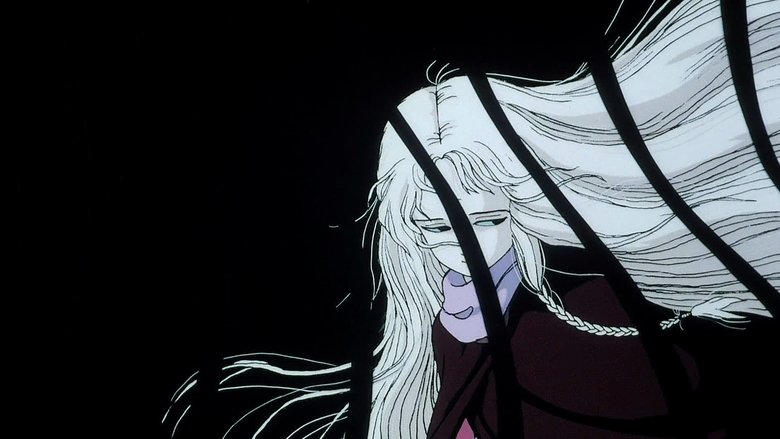
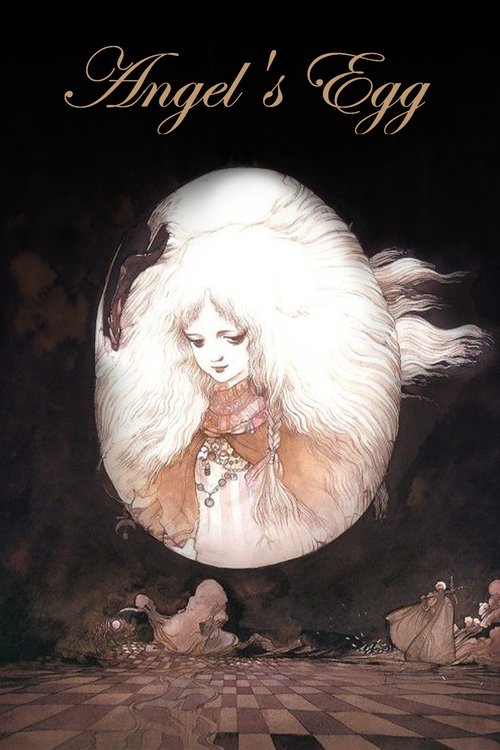
In a dark, desolate world of shadows and gothic ruins, a young girl wanders alone, fiercely protecting a large, mysterious egg under her dress. She collects water in glass bottles and navigates a landscape filled with strange biomechanical structures and fossilized remains. Her solitary existence is interrupted by the arrival of a wandering soldier who carries a cross-shaped weapon on his shoulder.
The two form a tenuous companionship as they traverse the dead city, where spectral fishermen hunt for the shadows of giant fish that no longer exist. The soldier questions the girl about the contents of her egg and the nature of their world, sharing a bleak retelling of Noah's Ark where the dove never returned. As their journey deepens, the tension between the girl's innocent faith and the soldier's weary skepticism reaches a shattering climax that transforms their reality forever.
Core Meaning
At its heart, Angel's Egg is a deeply personal expression of Director Mamoru Oshii's loss of Christian faith. It explores the painful transition from the comfort of blind belief (the egg) to the harsh desolation of reality. The film suggests that while faith gives purpose, it may ultimately be protecting an emptiness, and destroying that illusion—while tragic—is necessary for true existential awakening or transformation.
Thematic DNA
Loss of Faith
The central theme mirrors Oshii's own departure from Christianity. The girl represents blind, innocent faith, nurturing a potential salvation that may not exist. The shattering of the egg symbolizes the traumatic moment of realizing one's beliefs are hollow, a necessary but destructive act of truth-seeking.
Existentialism and Meaning
The characters wander a meaningless, post-apocalyptic void. The fishermen hunting shadow fish represent humanity's futile pursuit of illusions. The film questions whether it is better to live with a false hope (the egg) or face the crushing emptiness of a godless reality.
Memory and Oblivion
The world is a graveyard of forgotten memories, symbolized by the fossils and the Ark itself. The Boy posits that humanity has forgotten its origins and that the 'bird' of salvation is long dead, exploring how time erodes truth and leaves only rituals behind.
Character Analysis
The Girl
Mako Hyodo
Motivation
To protect the egg until it hatches, believing it contains a bird (salvation/angel) that will save their world.
Character Arc
She begins as a devoted guardian of the egg, living in naive hope. Her journey is one of tragic loss when her egg is broken, leading to her death/transfiguration in the water, where she ultimately births a new generation of potentiality.
The Boy
Jinpachi Nezu
Motivation
To discover the truth behind the world and the egg, driven by a need to expose the hollowness of false beliefs.
Character Arc
He arrives as a wanderer seeking truth. He challenges the girl's beliefs and ultimately destroys her egg to force her to face reality. He is left alone as a witness to her transformation and the true nature of their world.
Symbols & Motifs
The Egg
It represents fragile hope, blind faith, innocence, and potential. It is the vessel for the girl's dreams of salvation, but also a burden that keeps her tethered to a false reality.
The girl carries it under her dress like a pregnancy, protecting it from the world. When broken, it is revealed to be empty, symbolizing the void at the center of her belief.
The Water
A complex symbol of both death and rebirth, the unconscious, and the biblical flood. It is the source of life but also the medium of the girl's final transformation.
The girl collects it in bottles; the city is submerged; and she eventually falls into it, where her death creates new eggs, suggesting a cycle of sacrifice and renewal.
The Cross-shaped Weapon
Symbolizes the burden of reality, religious guilt, and the destructive power of truth. It is a perversion of the Christian cross, turned into a tool of violence or heavy responsibility.
The Boy carries it on his back throughout the film, evocative of Christ carrying the cross, but he uses it to shatter the girl's egg (her faith).
Shadow Fish
Illusions and the futile pursuit of non-existent goals. They represent the hollow rituals of religion where the substance (the fish/Christ symbol) is gone, leaving only a shadow.
Ghostly fishermen chase these shadows through the city streets, throwing harpoons that damage the stone buildings but catch nothing.
The Ark
The vessel of salvation that has become a tomb. It represents a promise from God that was forgotten or abandoned.
The final shot reveals the entire world they have been traversing is actually the fossilized, upside-down hull of Noah's Ark, drifting in a dark ocean.
Memorable Quotes
Tell me, what is inside the egg?
— The Boy
Context:
Asked repeatedly by the Boy as he follows the Girl, establishing the conflict between his skepticism and her protective secrecy.
Meaning:
The central question of the film, challenging the validity of the Girl's faith. It probes whether the object of her worship has substance or is merely a shell.
You can't hear anything. It's just the sound of your own breathing.
— The Boy
Context:
Spoken when the Girl claims she can hear breathing or a heartbeat coming from inside the egg she holds to her ear.
Meaning:
A devastating deconstruction of religious experience, suggesting that the 'voice of God' or spiritual confirmation is merely a projection of the believer's own self/desire.
I saw a bird once. I saw a bird... I think.
— The Boy
Context:
During a quiet moment of reflection, as he tries to recall the past or the legend of the flood.
Meaning:
Highlights the fallibility of memory and the fading of truth over time. He is unsure if salvation (the bird) ever truly existed.
Philosophical Questions
Is a false hope better than a harsh truth?
The film asks if the Girl was happier guarding an empty egg than facing the reality of her world. It explores the value of 'noble lies' and whether faith is a necessary survival mechanism for the human psyche in a meaningless universe.
Does God exist if he is forgotten?
Through the symbol of the fossilized Ark and the Boy's story of the non-returning dove, the film posits a theology of a 'Dead God' or a God who has abandoned his creation, asking what moral or existential framework remains for humanity in his absence.
Alternative Interpretations
While the 'loss of faith' reading is dominant, critics offer other views. Some see it as a Gnostic allegory where the physical world is a prison (the Ark) and the Girl's death is a liberation of the divine spark (the new eggs). Others interpret it through a Jungian lens, viewing the Girl and Boy as Anima and Animus—two parts of a single psyche trying to integrate, with the shattering of the egg being the painful breaking of the ego to achieve wholeness. A more optimistic reading suggests the ending is not death but transfiguration, where the Girl becomes the new Mother/Deity of a reborn world, succeeding where the old God failed.
Cultural Impact
Although a commercial flop that nearly ended Oshii's career in the 80s, Angel's Egg has achieved legendary cult status. It is revered as a masterpiece of 'art anime,' proving that animation could be a medium for serious, abstract, and somber philosophical inquiry. Its visual style, defined by Yoshitaka Amano, profoundly influenced the aesthetic of the Final Fantasy series and, more recently, Hidetaka Miyazaki's Dark Souls and Elden Ring games (specifically the design of Filianore and the concept of a ruined, stagnant world). It remains a touchstone for critics discussing surrealism and visual storytelling in cinema.
Audience Reception
Reception is historically polarized. Mainstream audiences often find the film boring, pretentious, and confusing due to its lack of dialogue, slow pacing, and opaque plot. However, fans of art-house cinema and animation aficionados hail it as a visual masterpiece and a profound atmospheric experience. It is frequently described as 'hypnotic' and 'haunting.' Modern reviews on platforms like Letterboxd are overwhelmingly positive, recognizing it as a unique, one-of-a-kind artistic achievement that transcends traditional genre constraints.
Interesting Facts
- Mamoru Oshii directed this film shortly after losing his own Christian faith, and he considers it a personal theological confession.
- The film was a commercial failure upon release, leading Oshii to be 'blacklisted' from directing anime for several years until 'Patlabor'.
- Character designs were created by Yoshitaka Amano, who would later become world-famous for his artwork in the 'Final Fantasy' video game series.
- The film contains very little dialogue; the first spoken lines do not occur until significantly into the runtime.
- Footage from 'Angel's Egg' was spliced into the 1987 live-action film 'In the Aftermath', creating a confusing hybrid movie.
- Oshii has stated that he doesn't fully understand the film himself and that it relies more on 'visual intuition' than logical narrative.
- The 'Angel Fossil' concept was originally developed by Oshii for a cancelled 'Lupin III' movie project.
- The film is often cited as a major visual influence on the 'Dark Souls' video game series, particularly the character Filianore in 'The Ringed City' DLC.
Easter Eggs
The Angel Fossil
The giant fossilized angel seen in the film is a direct reuse of a plot device Oshii created for a cancelled Lupin III film (which later evolved into Legend of the Gold of Babylon under a different director). It represents a 'dead god' idea Oshii was obsessed with.
The Upside-Down Ship
The final zoom-out reveals the world is the hull of a ship. This references Noah's Ark, confirming the Boy's story that they are the forgotten remnants of the biblical flood, stranded on the vessel meant to save them.
⚠️ Spoiler Analysis
Click to reveal detailed analysis with spoilers
Frequently Asked Questions
Explore More About This Movie
Dive deeper into specific aspects of the movie with our detailed analysis pages
Comments (0)
No comments yet. Be the first to share your thoughts!