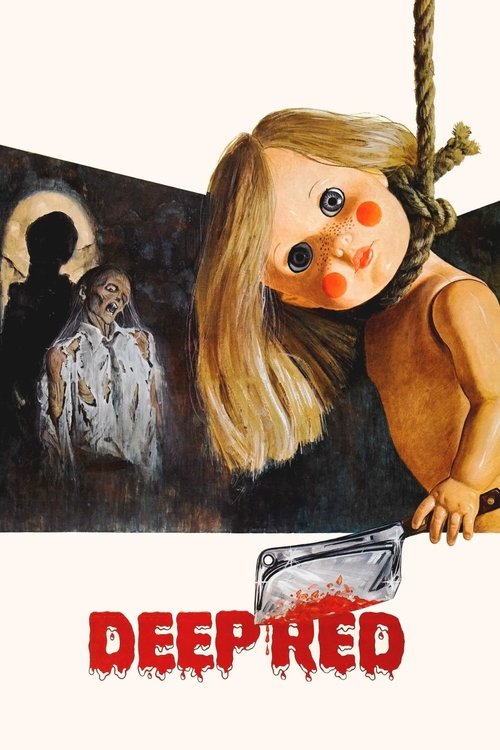
Deep Red
Profondo rosso
"When was the last time you were really scared?"
Overview
Deep Red (Profondo rosso) follows Marcus Daly, a British jazz pianist living in Rome, who witnesses the brutal murder of a German psychic, Helga Ulmann, after she senses a "twisted mind" in her audience. Drawn into the investigation, Marcus teams up with a tenacious reporter, Gianna Brezzi. He becomes obsessed with a fleeting visual detail from the crime scene—a painting he believes he saw in the victim's hallway that mysteriously vanished by the time the police arrived.
As Marcus delves deeper, he uncovers a tragic history involving a local legend of a "haunted" house and a grotesque nursery rhyme. The killer, wearing black leather gloves, eliminates witnesses with elaborate cruelty, inching closer to Marcus. The investigation leads him to an abandoned Art Nouveau villa and a hidden mural that reveals the origin of the killer's psychosis.
In a shocking climax, the truth about the "missing painting" is revealed to be a trick of the mind and memory. The killer's identity is unmasked as a figure close to the investigation, driven by a traumatic past event that has been reawakened, leading to a final, bloody confrontation in an elevator shaft.
Core Meaning
At its heart, Deep Red is a cinematic meditation on the fallibility of human perception and the persistence of trauma. Argento challenges the viewer's trust in their own eyes, suggesting that reality is subjective and easily distorted by memory. The film argues that the past is never truly buried; it lives on as a "ghost" in the present, manifesting as madness and violence that infects the next generation. It transforms the giallo mystery into a psychological horror where the act of "seeing" is both the detective's tool and his fatal flaw.
Thematic DNA
The Fallibility of Vision and Memory
The central mystery hinges not on what Marcus didn't see, but on what he did see and misinterpreted. The "missing painting" that drives the plot is actually a reflection in a mirror. Argento uses this to demonstrate how the mind edits reality, constructing a false narrative to protect itself from the truth. The camera often acts as a deceptive narrator, hiding clues in plain sight.
Gender Roles and Inversion
Argento subverts traditional gender tropes. Marcus, the male protagonist, is often passive, artistic, and physically weaker ("damsel in distress" moments), while Gianna is assertive, drives a beat-up Fiat, and physically rescues him. This dynamic challenges the masculine hero archetype typical of the genre.
Trauma and the Monstrous Mother
The killer's motivation is rooted in a primal, unresolved family trauma involving a dominant, murderous mother figure. This Freudian theme suggests that violence is a hereditary disease, passed down through blood and memory, turning the domestic space into a site of horror.
The Haunted Architecture of Modernity
The film contrasts the cold, alienation of modern fascist-era architecture (the EUR district, the square) with the decaying, organic horror of the Art Nouveau villa. This clash suggests that the secrets of the past fester beneath the clean surfaces of modern Italian society.
Character Analysis
Marcus Daly
David Hemmings
Motivation
To solve the puzzle of the "missing painting" and prove to himself that his memory is reliable.
Character Arc
Starts as a casual observer, an artist detached from the violence. He becomes obsessed with the truth, transforming into a proactive investigator, only to realize his own senses betrayed him. He ends the film traumatized, staring into his own reflection.
Gianna Brezzi
Daria Nicolodi
Motivation
Professional ambition and a growing affection for Marcus.
Character Arc
She pursues Marcus initially for a story but develops a genuine bond. She consistently challenges his masculinity and saves him from danger, subverting the "screaming victim" role.
Carlo
Gabriele Lavia
Motivation
To protect his mother and hide the shame of his family's past.
Character Arc
Presented as Marcus's troubled, alcoholic friend. He appears to be a victim of his own demons, but is revealed to be protecting the true monster, trapped in an eternal childhood trauma.
Martha
Clara Calamai
Motivation
Self-preservation and maternal possessiveness pushed to madness.
Character Arc
Initially appears as an eccentric older woman. Revealed to be the killer, a former actress driven mad by the fear of institutionalization and a need to control her son.
Symbols & Motifs
The Mirror / Reflection
Symbolizes the duality of truth and the distortion of reality. It represents the "double" self and the idea that the killer is a reflection of society's repressed madness.
Used as the central plot twist: Marcus sees the killer's face in a mirror but remembers it as a painting. The film also ends with a shot of Marcus staring at his own reflection in a pool of blood.
The Child's Song (Nursery Rhyme)
Represents the regression to a childlike state of amorality and the original moment of trauma. It signals the killer's presence and their mental break.
Played on a tape recorder by the killer before each murder to ritualistically recreate the atmosphere of the original crime.
The Automaton Doll
Symbolizes the uncanny, the loss of human agency, and the terrifying nature of childhood innocence corrupted.
In one of the film's most iconic jump scares, a mechanical doll runs out of the shadows towards Professor Giordani, distracting him before his murder.
The Eye
A recurring motif representing voyeurism, the vulnerability of the body, and the act of witnessing.
Extreme close-ups of the killer's eye, the victim's eye being pierced, and the camera's obsession with watching from hidden angles.
Red Water/Blood
The title Profondo rosso references the deep stain of violence. Water serves as a conduit for death (scalding water, drowning).
Amanda Righetti is drowned in scalding bathwater; the opening credits feature a child's silhouette and a bloody knife; the final shot reflects Marcus in blood.
Memorable Quotes
Tu credi di dire la verità, e invece dici soltanto la tua versione della verità.
— Carlo
Context:
Spoken to Marcus during a conversation on the street, foreshadowing Marcus's error in interpreting the crime scene.
Meaning:
"You think you're telling the truth, but you're only telling your version of the truth." This encapsulates the film's central philosophical theme regarding the subjectivity of perception.
I have entered into contact with a twisted, perverted mind.
— Helga Ulmann
Context:
During the parapsychology conference, right before she senses the killer in the audience.
Meaning:
Sets the tone for the film, establishing the killer not just as a criminal, but as a force of pure, psychological evil.
I'll kill you sooner or later.
— The Killer (Martha)
Context:
Whispered to Marcus through the door after playing the nursery rhyme tape.
Meaning:
A terrifying promise of inevitability, highlighting the killer's cat-and-mouse game with the protagonist.
Whatever it was... it has gone.
— Marcus Daly
Context:
Spoken to the police at the crime scene when he realizes the hallway looks different than when he first entered.
Meaning:
Refers to the "missing painting," the obsession that drives the entire narrative plot.
Philosophical Questions
Is objective reality accessible, or are we trapped in our own perceptions?
The film suggests that human perception is fundamentally flawed. Marcus's entire investigation is based on a false memory. Argento proposes that we reconstruct reality to fit our psychological needs, meaning "truth" is often a fiction we tell ourselves.
Can the past ever truly be repressed?
Through the character of Martha and the walled-up room, the film argues that the past is a living force. Attempting to bury trauma (physically or psychologically) only causes it to fester and erupt more violently later. The "ghosts" of Deep Red are not supernatural, but memories that refuse to fade.
Alternative Interpretations
The Generational Guilt Theory: Some critics interpret the film as an allegory for Italy's post-fascist generational trauma. The "monstrous mother" represents the buried, violent history of the previous generation that refuses to die and continues to infect the youth (Carlo).
The Crisis of Masculinity: The film can be read as a deconstruction of the male gaze. Marcus is consistently passive and wrong, while Gianna is the active, rational force. The "castration" anxiety is symbolized by the violent attacks and Marcus's inability to solve the mystery without female help.
Queer Reading: The character of Carlo and his relationship with Marcus, along with the flamboyant, non-conforming characters in the film, offer a subtext about homosexuality and repression in conservative Italian society.
Cultural Impact
Deep Red is widely considered the pinnacle of the giallo genre and a transitional masterpiece for Dario Argento, bridging his early thrillers with the supernatural horror of Suspiria. Culturally, it defined the aesthetic of modern horror with its aggressive use of color (specifically red), pounding progressive rock score by Goblin, and virtuosic camera work.
It influenced a generation of filmmakers, including Quentin Tarantino and John Carpenter, particularly in how it stylized violence and used music as a narrative character. The film solidified the 'black-gloved killer' trope and elevated the slasher movie to an art form. Critics initially dismissed it as exploitative, but it has since been re-evaluated as a sophisticated cinematic work, holding a 93% rating on Rotten Tomatoes and appearing on numerous 'Best Horror Films' lists.
Audience Reception
Praise: Audiences and critics alike laud the film's visual style, particularly the creative cinematography and the use of color. The Goblin score is frequently cited as one of the best in horror history. The central mystery and the "mirror twist" are praised for being clever and fair to the viewer.
Criticism: Some viewers criticize the dubbing (typical of the era) as distracting. Others find the plot occasionally incoherent or the acting melodramatic. The graphic violence, while stylized, was controversial at the time of release.
Verdict: It is widely regarded as a masterpiece and essential viewing for horror fans, often cited as the best entry point into Argento's filmography.
Interesting Facts
- The hands of the killer seen in the close-up murder scenes belong to director Dario Argento himself.
- The famous 'Blue Bar' scene is a direct visual recreation of Edward Hopper's painting 'Nighthawks'.
- The 'House of the Screaming Child' is a real location in Turin called Villa Scott; at the time of filming, it was a convent school run by nuns.
- David Hemmings was cast partly as a nod to his role in Antonioni's 'Blow-Up', which also deals with a witness questioning what they saw.
- The special effects, including the mechanical doll, were created by Carlo Rambaldi, who later created E.T. for Steven Spielberg.
- The film was shot without synchronized sound, a common practice in Italy at the time; all dialogue was dubbed in post-production.
- Clara Calamai, who plays the killer Martha, was a famous diva of the Italian 'White Telephone' cinema era (1930s-40s), adding meta-textual weight to her role as a faded actress.
- The score by the band Goblin was their first collaboration with Argento and was composed in just ten days after the original composer was fired.
Easter Eggs
Edward Hopper's 'Nighthawks'
The set design for the Blue Bar scene is an almost exact replica of Hopper's famous painting, emphasizing urban alienation and voyeurism.
Blow-Up Reference
Casting David Hemmings is a meta-reference to Michelangelo Antonioni's Blow-Up (1966), where Hemmings also played a character obsessed with a murder he may or may not have witnessed correctly.
The Killer's Reflection
In the very first scene of Marcus entering the apartment, the killer's face (Martha) is actually visible in the mirror for a split second. Argento plays fair; the audience sees exactly what Marcus sees but misses it due to the camera movement.
⚠️ Spoiler Analysis
Click to reveal detailed analysis with spoilers
Frequently Asked Questions
Explore More About This Movie
Dive deeper into specific aspects of the movie with our detailed analysis pages
Comments (0)
No comments yet. Be the first to share your thoughts!