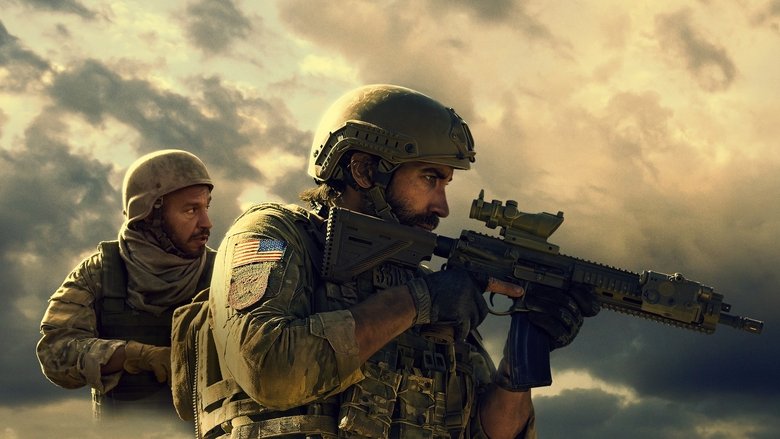
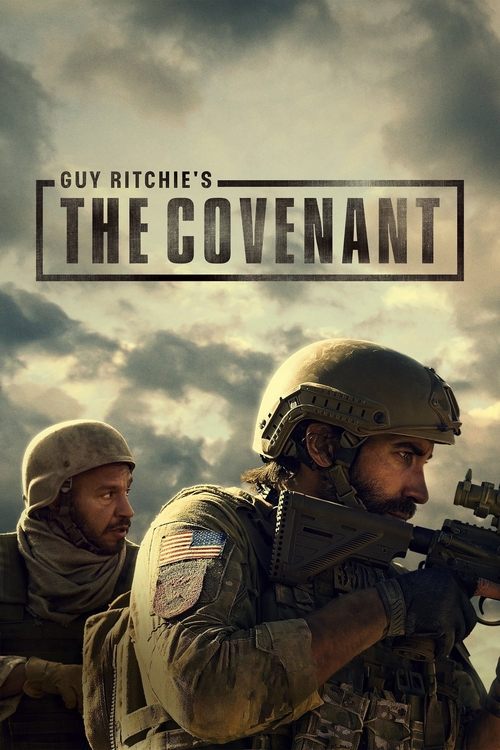
Guy Ritchie's The Covenant
A visceral modern Western disguised as a war thriller. Amidst the dusty, unforgiving Afghan mountains, a blood debt binds two men in a silent pact of survival, transforming bureaucratic failure into a mythical test of honor.
Guy Ritchie's The Covenant

Guy Ritchie's The Covenant

"A bond. A pledge. A commitment."

19 April 2023 United Kingdom 123 min ⭐ 7.7 (3,019)
Director: Guy Ritchie
Cast: Jake Gyllenhaal, Dar Salim, Sean Sagar, Jason Wong, Rhys Yates
War Action Thriller
The Burden of Debt Brotherhood Beyond Borders The Individual vs. Bureaucracy The Cost of War
Budget: $55,000,000
Box Office: $21,948,551

Overview

In 2018 Afghanistan, U.S. Army Master Sergeant John Kinley (Jake Gyllenhaal) leads a unit tasked with locating Taliban munitions. He recruits Ahmed (Dar Salim), a local interpreter with a reputation for being difficult but possessing sharp instincts and a deep hatred for the Taliban, who murdered his son. During a routine inspection that turns into a catastrophic ambush, Kinley's entire unit is wiped out, leaving only him and Ahmed alive in hostile territory.

Severely wounded and unable to walk, Kinley is kept alive by Ahmed, who single-handedly drags him across 100 kilometers of treacherous, Taliban-controlled terrain to safety. Back in the U.S., Kinley recovers physically but is mentally tormented by the realization that Ahmed and his family were not granted the promised visas and are now being hunted as traitors. Unable to live with the "hook" of debt in his soul, Kinley decides to return to the war zone on a unsanctioned solo mission to rescue the man who saved him.
Core Meaning

The film essentially deconstructs the definition of its title: a Covenant is not just a contract, but a sacred spiritual bond. Guy Ritchie moves away from his signature stylized crime capers to tell a story about integrity—the terrifying weight of a life-debt. The core message is that when institutions (governments, armies) fail to honor their promises, the individual must step in to fulfill the moral obligation, regardless of the personal cost.

Thematic DNA

The Burden of Debt 40%
Brotherhood Beyond Borders 30%
The Individual vs. Bureaucracy 20%
The Cost of War 10%

The Burden of Debt

The central psychological engine of the film. Kinley isn't just grateful; he is tortured by his survival. The film portrays gratitude not as a warm feeling, but as a visceral "hook" that drags a man back into hell because he cannot find peace while his savior suffers.

Brotherhood Beyond Borders

Kinley and Ahmed start with mutual suspicion—a transactional relationship between occupier and local. Through shared trauma and silence, this evolves into a bond deeper than blood, transcending language, culture, and politics.

The Individual vs. Bureaucracy

The film sharply critiques the U.S. military bureaucracy (USCIS). While the soldiers on the ground operate on a code of honor, the system is depicted as slow, indifferent, and broken. Kinley's rogue mission is a rebellion against a paper-pushing system that treats human lives as files.

The Cost of War

War is shown stripped of glory. It is dusty, exhausting, and brutal. The film highlights the specific plight of Afghan interpreters, thousands of whom were left behind to face retribution after the U.S. withdrawal.

Character Analysis

John Kinley

Jake Gyllenhaal

Archetype: The Haunted Soldier
Key Trait: Relentless determination

Motivation

To remove the 'hook' of guilt and save the man who saved him.

Character Arc

Starts as a pragmatic, by-the-book leader. After being saved, he transforms into a desperate man consumed by guilt, eventually becoming a 'rogue' operative willing to sacrifice his comfortable life to repay a moral debt.

Ahmed

Dar Salim

Archetype: The Stoic Guardian
Key Trait: Hyper-competence

Motivation

To protect his family and escape the Taliban (vengeance for his son is his backstory).

Character Arc

Begins as a mysterious, somewhat insubordinate interpreter doing a job for money. He reveals himself to be a warrior of immense skill and loyalty. In the second half, he becomes the hunted, waiting for a promise to be kept.

Eddie Parker

Antony Starr

Archetype: The Mercenary with a Heart
Key Trait: Cynical efficiency

Motivation

Profit, but tempered by respect for Kinley's mission.

Character Arc

A private military contractor who initially represents the transactional side of war but ultimately provides the critical support Kinley needs, proving that even in the private sector, the code of brotherhood exists.

Symbols & Motifs

The Hook

Meaning:

A metaphor for guilt and moral obligation.

Context:

Kinley describes his PTSD and insomnia as a literal hook in his chest, pulling him back to Afghanistan. It represents the inability to move forward until the debt is paid.

The Visa

Meaning:

The elusive promise of safety and the failure of the American Dream.

Context:

It appears constantly as a piece of paperwork that is promised, delayed, and denied. It symbolizes the hollow bureaucratic pledges made to local allies.

The Dam

Meaning:

A point of no return and a final stand.

Context:

The climax takes place at the Darunta Dam. Visually, it separates safety from danger, offering a bridge to freedom that must be crossed under fire.

The Cart

Meaning:

Sheer human will and physical burden.

Context:

The makeshift wooden cart Ahmed uses to drag Kinley over the mountains visually manifests the immense physical weight of saving another human life.

Memorable Quotes

There is a hook in me. One that you cannot see. But it is there.

— John Kinley

Context:

Kinley explaining to his wife and superior officer why he cannot sleep or function in his normal life.

Meaning:

The defining line of the film, explaining that his return to Afghanistan isn't a choice but a compulsion caused by moral debt.

I am a man who gets no rest.

— John Kinley

Context:

Spoken during his manic phase of trying to navigate the bureaucracy to get Ahmed's visas.

Meaning:

Highlights the psychological toll of the unpaid debt. Peace is impossible without honor.

You think he blessed you? He cursed me.

— John Kinley

Context:

Kinley speaking to his commanding officer, Colonel Vokes, about Ahmed's heroism.

Meaning:

Kinley reframes the act of being saved. Being alive is a curse if the person who saved you is left to die.

Philosophical Questions

Does a system's failure justify extra-legal action?

Kinley uses a private military contractor and goes rogue because the U.S. government fails to uphold its end of the deal. The film posits that individual morality supersedes legal or bureaucratic constraints when human life and honor are at stake.

What is the true weight of a life?

The film asks what one life is worth. Ahmed risks his family for Kinley. Kinley risks his future and millions of dollars for Ahmed. It suggests that a life saved creates a spiritual imbalance that can only be righted by reciprocity.

Alternative Interpretations

The White Savior Critique vs. Mutual Rescue:
Some critics viewed the second half—Kinley returning to save Ahmed—as falling into the "White Savior" trope. However, an alternative reading suggests the film is a structure of mutual rescue. Ahmed saves Kinley physically in the first half (a feat of superhuman endurance), and Kinley saves Ahmed bureaucratically and physically in the second. The "Covenant" implies equality; Kinley is not a savior, but a debtor paying a bill.

Cultural Impact

Released in 2023, the film served as a poignant reminder of the botched 2021 U.S. withdrawal from Afghanistan. It brought mainstream attention to the moral failure regarding the Special Immigrant Visa (SIV) program for Afghan allies. Critically, it marked a turning point for Guy Ritchie, earning him the best critical reviews of his career for its maturity and emotional depth. While it underperformed at the box office ($21M against a $55M budget), it became a streaming hit, resonating deeply with veterans and audiences for its depiction of soldierly loyalty.

Audience Reception

Audience Verdict: Overwhelmingly Positive (98% Rotten Tomatoes).

  • Praised: The intense chemistry between Gyllenhaal and Salim, the grueling survival sequence in the middle of the film, and the emotional payoff. Veterans praised the depiction of the bond between soldiers and interpreters.
  • Criticized: Some found the third act (the rescue) to be a bit generic action-movie fare compared to the gritty realism of the first half. A minority felt the "one man army" ending strained credibility.

Interesting Facts

  • The film was shot entirely in Alicante, Spain, which stood in for Afghanistan. The production design team built the base and village sets there.
  • Jake Gyllenhaal and director Guy Ritchie had never worked together before this film.
  • The film was originally titled 'The Interpreter', but it was changed to 'Guy Ritchie's The Covenant' to distinguish it from the 2005 Sydney Pollack film and to emphasize the thematic bond.
  • Unlike typical Guy Ritchie films, this movie features almost no comedy, rapid-fire editing, or nonlinear storytelling.
  • The closing title cards reveal that after the U.S. withdrawal in 2021, over 300 Afghan interpreters were murdered by the Taliban, and thousands are still in hiding.
  • Dar Salim, who plays Ahmed, is a Danish actor born in Iraq; he was a refugee himself and served in the Royal Guard, bringing personal authenticity to the role.
  • The AC-130 gunship scene in the climax is referred to by fans as the 'Angel of Death' moment.

Easter Eggs

The 'Teleporting' Building

In the final dam sequence, eagle-eyed viewers noticed a continuity error where Kinley runs to cover behind the same building twice in different shots, a rare technical slip in a high-budget production.

Ritchie's Restraint

The film acts as a 'meta' easter egg for Guy Ritchie fans by excluding his trademarks. There are no freeze-frames or on-screen text naming characters, signaling a deliberate maturation in his directing style.

⚠️ Spoiler Analysis

Click to reveal detailed analysis with spoilers

Frequently Asked Questions

Explore More About This Movie

Dive deeper into specific aspects of the movie with our detailed analysis pages

Comments (0)

Leave a comment

No comments yet. Be the first to share your thoughts!