Safety Last!
"You're Going to Explode With "Safety Laughs" when You see This Fun Bomb."
Overview
Harold (The Boy) leaves his small hometown of Great Bend for the big city, promising his girlfriend Mildred (The Girl) that he will send for her once he has "made good." In reality, he struggles as a lowly fabric clerk at the De Vore Department Store, surviving on pennies while sending Mildred expensive gifts he cannot afford to maintain the illusion of wealth and success.
When Mildred makes a surprise visit, Harold is forced to impersonate the store's General Manager to keep up his charade. Desperate for money to marry her and cover his lies, he overhears the real manager offering $1,000 to anyone who can attract a massive crowd to the store. Harold pitches a publicity stunt involving his friend, "Limpy" Bill, a steeplejack who will climb the building's exterior.
On the day of the climb, Bill is chased by a policeman he had previously pranked, forcing Harold to take his place. The film culminates in a harrowing comedic ascent where Harold scales the twelve-story skyscraper, facing increasingly dangerous obstacles—including pigeons, a mouse, a net, and a swinging window—while trying to survive the climb and win the prize.
Core Meaning
Safety Last! is a satire of the 1920s "go-getter" culture and the immense pressure young men faced to achieve social status. The film visualizes the climb to success as a literal, life-threatening struggle, suggesting that the American Dream requires risking everything—even one's life—just to maintain the appearance of prosperity. It exposes the anxiety beneath the optimism of the Roaring Twenties.
Thematic DNA
The Facade of Success
Harold's entire existence in the city is built on lies. He skips meals to buy jewelry and pretends to be the boss, highlighting the societal pressure to appear wealthy rather than actually be wealthy. The film critiques the fragility of status in the modern age.
Vertical Social Mobility
The physical act of climbing the building represents the social climbing Harold attempts. Every floor presents a new barrier (class struggle, nature, bad luck), literalizing the metaphor of "working your way up" the corporate ladder.
Love as Motivation
Harold's death-defying feats are not for personal glory but to secure a future with Mildred. The film posits that love is the ultimate driver of human ambition, capable of pushing an ordinary man to perform extraordinary, dangerous acts.
Character Analysis
The Boy (Harold)
Harold Lloyd
Motivation
To earn $1,000 to marry Mildred and prove he is the success he claimed to be.
Character Arc
Starts as a naive country boy full of optimism; becomes a struggling clerk drowning in lies; transforms into a courageous stuntman out of necessity, proving his worth through action rather than status.
The Girl (Mildred)
Mildred Davis
Motivation
To reunite with her future husband who she believes is a successful executive.
Character Arc
She travels to the city believing Harold's lies. While she is initially the catalyst for his deception, her presence forces him to confront reality and take the ultimate risk.
The Pal (Bill)
Bill Strother
Motivation
To help his friend and avoid the policeman he pranked.
Character Arc
Harold's roommate and a real human fly. He is supposed to do the climb but is sidelined by the law, forcing the protagonist to step up.
Symbols & Motifs
The Clock
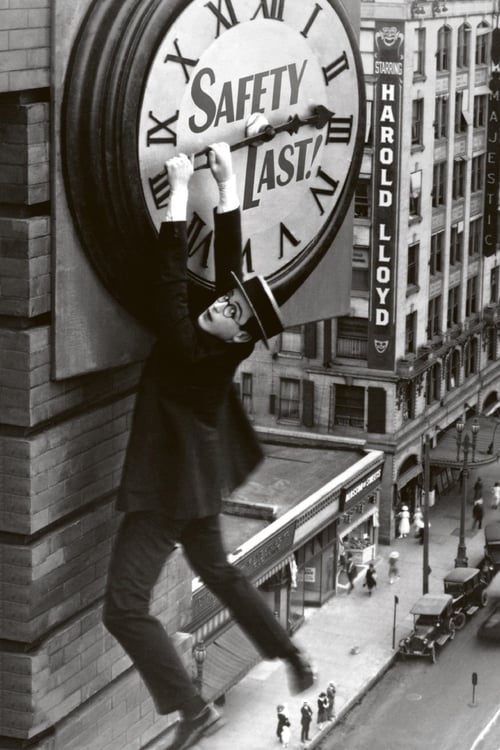
The most iconic symbol of the silent era, representing the pressure of time, the suspension of life over chaos, and the anxiety of modern urban existence.
Harold hangs desperately from the hands of the clock at 2:45, physically suspended over the city streets, visualizing the feeling of running out of time to succeed.
The Skyscraper
A symbol of modern capitalism and the daunting, impersonal nature of the city. It is both the vehicle for Harold's success and the monster that tries to kill him.
The Bolton Building (the fictional department store) looms over the characters, serving as the stage for the entire third act.
The Lavaliere (Pendant)
Represents the financial burden Harold places on himself to maintain a facade. It is a material object that signifies his love but also his reckless spending.
Harold spends his entire paycheck on this jewelry for Mildred, forcing him to pawn his phonograph and hide from his landlady.
Memorable Quotes
I've always wanted a boy who could do something to become famous.
— Mildred (The Girl)
Context:
Spoken in the early scenes before Harold leaves for the city, setting his motivation.
Meaning:
Establishes the stakes: Mildred values fame and success, unwittingly pressuring Harold to risk his life to please her.
Money talk? Why, he makes it shout!
— Townsperson
Context:
Intertitle shown when Harold's expensive gifts arrive in Great Bend, impressing the locals.
Meaning:
Ironic commentary on Harold's perceived success versus his actual poverty. Highlights the theme of public perception.
You'll do time for this! The first time I lay eyes on you again, I'll pinch you!
— The Law (Policeman)
Context:
After Bill knocks the policeman down, the cop vows revenge, setting up the conflict during the climb.
Meaning:
The plot device that prevents the professional climber (Bill) from doing the stunt, forcing the amateur Harold to do it.
Philosophical Questions
Is the American Dream worth the risk of self-destruction?
The film asks whether the pursuit of status and material wealth justifies the extreme physical and psychological peril Harold endures. He literally dangles over an abyss for $1,000.
How much of our identity is a performance?
Harold spends the majority of the film performing a role (the rich manager) for others. The film explores the anxiety of 'imposter syndrome' and the gap between who we are and who we pretend to be.
Alternative Interpretations
While traditionally viewed as a triumph of the little man, some critics view the film as a dark critique of capitalism. Harold is nearly killed by the very structures (the department store) he seeks to join. The ending, where he reaches the top, can be seen not just as a romantic victory, but as a survival of the trauma inflicted by a society that values money over safety. The title itself, Safety Last!, suggests that in the pursuit of the American Dream, personal safety is the least prioritized asset.
Cultural Impact
Safety Last! cemented Harold Lloyd as the "third genius" of silent comedy alongside Chaplin and Keaton. The image of Lloyd dangling from the clock is one of the most recognizable visuals in cinema history, representing the suspense-comedy genre (or "thrill comedy") that Lloyd pioneered. It influenced generations of filmmakers, from Alfred Hitchcock's tension building to Jackie Chan's physical stunts and the blockbuster action set pieces of modern Hollywood. In 1994, it was selected for preservation in the National Film Registry.
Audience Reception
Upon its 1923 release, the film was a massive commercial success. Audiences were reported to scream, gasp, and hide their eyes during the climbing sequence, a reaction Lloyd described as "hysterical laughter." Critics praised the perfect blend of slapstick and genuine suspense. Modern critics maintain this acclaim, citing the timeless nature of the visual effects and the universal theme of underdog ambition.
Interesting Facts
- Harold Lloyd was missing his thumb and forefinger on his right hand due to a prop bomb accident in 1919; he wore a prosthetic glove during the climb, which makes his stunts even more impressive.
- The 'human fly' character Bill was played by Bill Strother, who was a real-life steeplejack. Lloyd hired him after seeing him climb a building in Los Angeles.
- The iconic climb was filmed on the rooftops of three different buildings of varying heights to create the illusion of altitude while keeping safety nets (mattresses) hidden just below the frame.
- The film's title is a play on the industrial safety slogan 'Safety First,' which was popular in the 1920s.
- When the film was released, some theaters kept nurses and ambulances on standby because audiences were fainting from the suspense of the climbing sequence.
Easter Eggs
Project A Clock Drop
Jackie Chan's 1983 film Project A features a famous stunt where Chan hangs from a clock tower and falls; it is a direct homage to Safety Last!.
Back to the Future Opening
In the opening scene of Back to the Future (1985), a clock featuring a small figure of Harold Lloyd hanging from the minute hand can be seen, foreshadowing Doc Brown's later clock tower climax.
Hidden Prosthetic
Throughout the film, Lloyd carefully hides his right hand or uses the prosthetic glove. In the climbing scenes, you can occasionally spot that his right hand doesn't grip as naturally as his left.
⚠️ Spoiler Analysis
Click to reveal detailed analysis with spoilers
Frequently Asked Questions
Explore More About This Movie
Dive deeper into specific aspects of the movie with our detailed analysis pages
Comments (0)
No comments yet. Be the first to share your thoughts!