Skip to content
April and the Extraordinary World
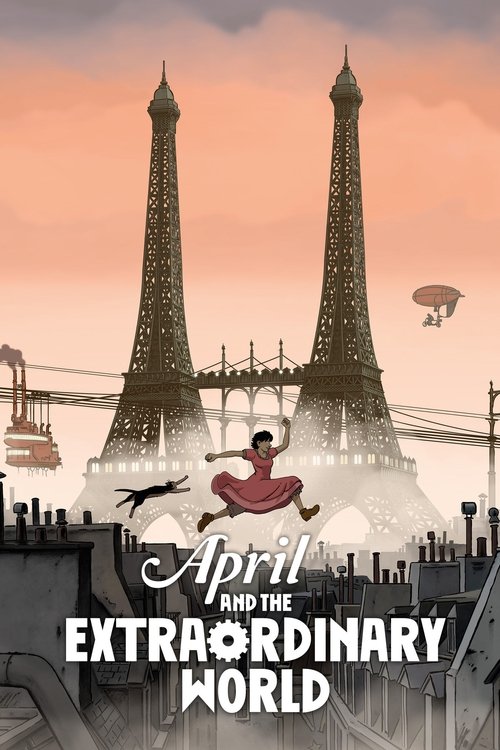
An exhilarating steampunk retro-thriller charged with resilient hope and defiant curiosity, where a soot-choked Paris of twin Eiffel Towers unfolds like an ink-stained graphic novel blooming into life.
April and the Extraordinary World

April and the Extraordinary World

Avril et le monde truqué

04 November 2015 France 106 min 7.1 (365)

Director: Franck Ekinci, Christian Desmares

Cast: Marion Cotillard, Philippe Katerine, Jean Rochefort, Olivier Gourmet, Marc-André Grondin

Animation Fantasy Thriller Comedy Adventure Science Fiction Ecological Catastrophe and Resource Depletion The Weaponization vs. Humanization of Science Totalitarianism and Controlled Knowledge Family, Loyalty, and Chosen Kinship Hubris and the Utopia Paradox
Budget: $10,000,000

Overview

Set in an alternate timeline where the Franco-Prussian War never happened and the French Empire endured under the Napoleonic dynasty, the 20th century failed to enter the electrical and digital age. For nearly a century, the world’s greatest scientists—from Albert Einstein and Enrico Fermi to Thomas Edison and Louis Pasteur—have systematically vanished into thin air without explanation. Denied access to modern inventions, humanity remains trapped in an aggressive, smog-blanketed coal and steam era, clear-cutting the Earth’s forests to feed towering steam locomotives and warring with neighboring nations over charcoal and timber.

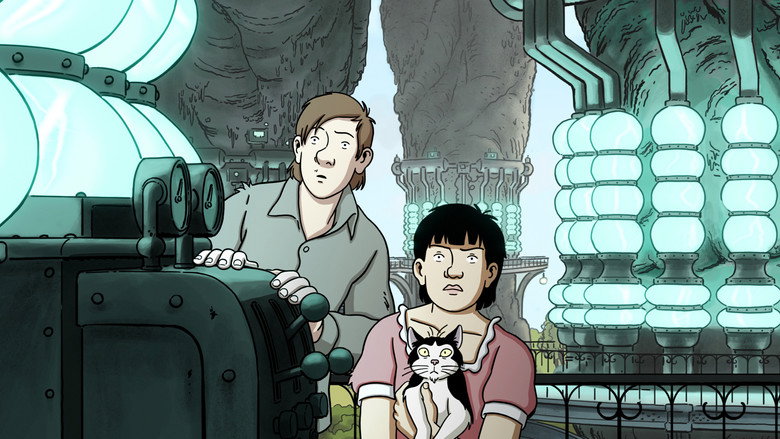
The story centers on April Franklin, a brilliant young woman whose parents and grandfather were clandestine chemists on the cusp of formulating an "Ultimate Serum" that grants invulnerability and health before being hunted down by the imperial police and mysterious forces. A decade after her parents' disappearance, April lives in the shadows of a soot-darkened Paris alongside Darwin, her cynical, highly articulate pet cat who gained the power of speech from an early dose of the serum.

Driven by an unyielding desire to finish her parents’ life work, April continues brewing chemical formulas in secret while dodging Inspector Pizoni, an obsessive police detective who deploys Julius, a charming young street rogue, to infiltrate April's orbit. When Darwin falls mortally ill from the toxic urban atmosphere, April’s breakthrough formula triggers an escalating sequence of escapes, mechanical contraptions, and globe-spanning discoveries, setting off an epic pulp adventure across a treacherous landscape where science is both a forbidden pursuit and the only salvation.

Core Meaning

Co-directors Christian Desmares and Franck Ekinci crafted the film as both a loving homage to early 20th-century speculative pulp fiction and a modern allegorical warning. The central message argues that scientific inquiry and technological advancement must remain free, ethical, and in service to life, rather than being co-opted by state militarism or authoritarian dogma.

The French title, Avril et le monde truqué ("April and the Rigged/Faked World"), underscores how institutional power structures build societies upon deceptions, environmental exploitation, and controlled information to sustain endless resource wars. The film champions humanistic curiosity and emotional empathy over technocratic arrogance: humanity’s survival depends not on abandoning our planet or enforcing peace through superior force, but on reconciling human ingenuity with nature and moral conscience.

Thematic DNA

Ecological Catastrophe and Resource Depletion 30%
The Weaponization vs. Humanization of Science 25%
Totalitarianism and Controlled Knowledge 20%
Family, Loyalty, and Chosen Kinship 15%
Hubris and the Utopia Paradox 10%

Ecological Catastrophe and Resource Depletion

The film’s soot-covered Paris and clear-cut continents serve as an ecological parable. Without clean energy alternatives, humanity strips the biosphere bare, fighting geopolitical wars for wood and coal. The narrative warns against unchecked extractivism and demonstrates how environmental collapse directly poisons individual lives.

The Weaponization vs. Humanization of Science

Science is caught between imperial warmongers seeking super-soldiers and eco-dictators pursuing forced purification, with April and her family embodying pure, ethical curiosity. The film emphasizes the responsibility of inventors to ensure scientific discovery is not transformed into a mechanism of violent oppression.

Totalitarianism and Controlled Knowledge

An empire running on surveillance, secret police, and coerced labor shows how autocratic states stagnate when they censor free thought. Denying society scientific freedom leads inevitably to cultural, intellectual, and technological paralysis.

Family, Loyalty, and Chosen Kinship

April’s enduring relationship with her grandfather, her cherished memory of her parents, her bond with Julius, and her affection for Darwin demonstrate that genuine courage and strength stem from personal devotion rather than abstract ideology.

Hubris and the Utopia Paradox

Even well-intentioned schemes to create a utopian, war-free sanctuary underground or on another celestial body reproduce tyranny when conceived through authoritarian coercion, misanthropy, and force.

Character Analysis

April Franklin

Marion Cotillard

Archetype: The Inquisitive Hero / Defiant Pioneer Key Trait: Relentless scientific brilliance paired with stubborn moral courage.

Motivation

To complete her parents' life work, heal Darwin, and discover the truth behind her family's abduction.

Character Arc

Begins as an isolated, mistrustful fugitive orphan living inside a bronze statue, obsessively focused on her flask of serum; she evolves into an emotionally open, self-sacrificing leader who reunites her broken family and reshapes the world’s ecological future.

Darwin

Philippe Katerine

Archetype: The Cynical Sidekick / Familiar / Moral Anchor Key Trait: Dry, deadpan wit and unconditional loyalty.

Motivation

Staying by April’s side, intellectual preservation, and survival.

Character Arc

Starts as a sickly, book-loving, melancholic cat resigned to an early grave; after receiving the perfected serum, he steps into heroic selflessness, ultimately accepting cosmic immortality to preserve life.

All 5 characters and cast

Symbols & Motifs

The Twin Eiffel Towers

Meaning:

Symbolizes an industrial dystopia that took the monuments of human progress and doubled down on utility, soot, and state mechanization.

Context:

Paris is depicted with two identical, connected Eiffel Towers serving as a monolithic railway depot for coal-powered cable cars.

The "Ultimate Serum" (Le Sérum de Vie)

Meaning:

Represents pure, uncorrupted life force, potential, hope, and rejuvenation, sharply contrasting with the dirty black coal and sulfur choking the planet.

Context:

Developed across generations of the Franklin family, this glowing green liquid provides invulnerability and healing, serving as the central quest item.

Darwin, the Talking Cat

Meaning:

Embodies the bridge between humanity and the natural world. His articulate commentary highlights human absurdity, while his fragile respiratory system represents the vulnerability of living creatures in an industrial wasteland.

Context:

Darwin lives with April, accompanying her through Paris while battling lung disease caused by the omnipresent soot.

The Mechanized Walking House

Meaning:

Symbolizes individual defiance, inventive playfulness, and safe haven from imperial surveillance.

Context:

Pops's clandestine home, constructed like an eccentric mechanical crustacean, allows him to travel undetected across the countryside.

Soot and Smog (La Suie)

Meaning:

The physical manifestation of political decay and historical stagnation, visibly demonstrating the physical cost of a society refusing to evolve.

Context:

A pervasive environmental element clinging to Paris buildings, clothing, and human lungs throughout the first two acts.

The Underground Biosphere

Meaning:

Symbolizes both preserved Edenic purity and an artificial cage born from cynical retreat and misanthropy.

Context:

A lush, subterranean biodome maintained beneath the planet’s crust, constructed by kidnapped scientists under reptilian supervision.

Memorable Quotes

Je parle, mais je ne suis qu'un chat !
— Darwin

Context

Darwin responding to April's intense scientific and existential demands upon him.

Meaning

Highlights Darwin's unique existential dilemma as an uplifted animal caught between his basic feline nature and human philosophical burden.

La science sans conscience n'est que ruine de l'âme.
— Prosper "Pops" Franklin

Context

Pops lecturing on the ethics of invention while resisting state exploitation.

Meaning

A deliberate quotation of François Rabelais that serves as the moral thesis of the entire film.

All 5 quotes

Philosophical Questions

Can technological progress exist in harmony with moral and environmental responsibility?

The film illustrates that technological advancement detached from conscience inevitably degenerates into imperial war machines or total ecological devastation, reinforcing Rabelais' principle that science without ethics ruins the soul.

Does humanity deserve a second chance when it repeatedly plunders its own habitat?

The conflict between Rodrigue’s cynical misanthropy and April’s empathy explores whether human civilization is intrinsically destructive or if love, curiosity, and ethical responsibility can redeem human stewardship of nature.

What constitutes true freedom in a society governed by fabricated realities?

Characters are forced to weigh whether an engineered, peaceful underground biosphere represents genuine safety or an authoritarian cage, contrasting comfortable illusions against the grueling fight for authentic truth on the surface.

Alternative Interpretations

The Anti-Imperialist Environmental Reading: Analyzes the film as an explicit critique of colonial extractivism and resource-driven capitalism. The Empire's military campaigns for Canadian timber reflect contemporary fossil fuel wars, demonstrating how institutional greed literally poisons and chokes humanity.

Full ending explanation

Cultural Impact

Released in 2015 during a period of intense global climate diplomacy (the year the Paris Agreement was negotiated), April and the Extraordinary World functioned as an incisive, timely allegory addressing environmental degradation, fossil fuel addiction, and political complacency through the lens of alternate-history fantasy.

Artistically, it stands as a hallmark achievement in translating the rich Franco-Belgian bande dessinée heritage to the big screen, alongside acclaimed adaptations like Persepolis, Tintin, and The Rabbi’s Cat. Although its worldwide box office haul was modest, its critical acclaim—including a 97% Rotten Tomatoes rating and the Annecy Cristal—has cemented its status as a modern classic in international animation and steampunk subcultures.

Audience Reception

The film earned widespread critical acclaim, highlighted by an Annecy Cristal win, a 97% rating on Rotten Tomatoes, and an 85 score on Metacritic. Audiences and reviewers widely celebrated:

  • The exquisite hand-drawn animation faithfully translating Jacques Tardi’s tactile line art and atmospheric grime.
  • Sophisticated, immersive alternate-history world-building that avoids generic steampunk tropes in favor of grounded socio-political stakes.
  • Philippe Katerine’s performance as Darwin, hailed as one of animated cinema’s most charming, intellectually dry sidekicks.
  • A thrilling genre hybridization of pulp mystery, family drama, and retro sci-fi.

Minor criticisms centered on the third-act introduction of sentient monitor lizards wearing armored suits, which struck some viewers as jarringly campy compared to the bleak political realism of earlier scenes, alongside occasional narrative compression during late-stage revelations.

Interesting Facts

  • The film’s distinct aesthetic is entirely based on the visual style and universe of celebrated French comic artist Jacques Tardi, who actively participated as visual designer and artistic consultant.
  • Co-director Christian Desmares previously served as the animation director on Marjane Satrapi and Vincent Paronnaud’s Oscar-nominated graphic-novel adaptation Persepolis (2007).
  • This film features one of the final cinematic performances by legendary French cinema icon Jean Rochefort (voicing Pops), who passed away two years later in 2017.
  • It took more than six years of production to bring the film to fruition, moving through studios in France, Belgium, and Canada to secure financing and complete the 2D digital animation.
  • For its international release by GKIDS, an English dub was produced featuring Academy Award winners and nominees, including Susan Sarandon, J.K. Simmons, and Paul Giamatti.
  • The film won the Cristal for Best Feature at the 2015 Annecy International Animated Film Festival, the world's most prestigious competitive honor in animation.

Easter Eggs

Historical Divergence Point (1870)

Napoleon III is killed by an explosion inside Gustave Franklin's lab on the eve of the Franco-Prussian War, prompting Napoleon IV to sign a peace treaty that preserves the French Empire into the 20th century rather than transitioning into the French Third Republic.

The Disappearing Scientists Hall of Fame

Montages of vanished scientists showcase Tardi-styled portraits and archival photos of real historical figures, such as Albert Einstein, Enrico Fermi, Alexander Fleming, Thomas Edison, and Louis Pasteur, explaining the lack of electricity and modern medicine.

Homage to Jules Verne

The retro-futuristic technologies—such as pneumatic message tubes, pedal-powered flying bicycles, dirigibles, and underwater submersibles—pay direct homage to Jules Verne's Paris in the Twentieth Century and Twenty Thousand Leagues Under the Sea.

Statue of the Republic Hideout

April’s concealed laboratory inside a gigantic hollow bronze Parisian monument serves as an affectionate wink to classic French pulp serial hideouts featured in Fantômas and Maurice Leblanc's Arsène Lupin.

Tardi’s Adèle Blanc-Sec Visual Motifs

Comic enthusiasts will recognize visual signatures from Tardi's The Extraordinary Adventures of Adèle Blanc-Sec, including distinct Parisian architecture, trench coats, heavy bowler hats, and intelligent prehistoric reptiles.

Frequently Asked Questions

Explore More About This Movie

Dive deeper into specific aspects of the movie with our detailed analysis pages

Comments (0)

Leave a comment

No comments yet. Be the first to share your thoughts!

Similar Movies