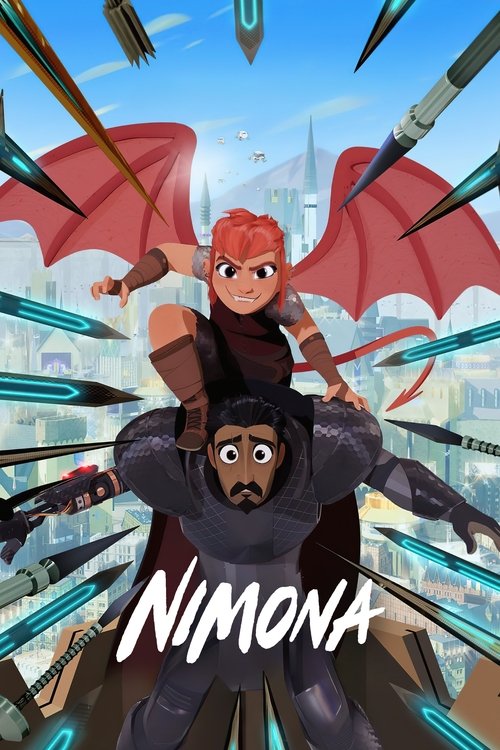
Nimona
"A new hero takes shape."
Overview
In a futuristic medieval kingdom, tradition is paramount. The Institute for Elite Knights, founded by the legendary hero Gloreth who defeated a great monster 1,000 years ago, protects the walled-off society. Ballister Boldheart is set to make history as the first commoner to be knighted, a progressive move championed by Queen Valerin. However, during the ceremony, his sword mysteriously fires a laser, assassinating the queen. Framed for the murder and with his arm severed by his lover and fellow knight, Ambrosius Goldenloin, Ballister becomes the kingdom's most wanted fugitive.
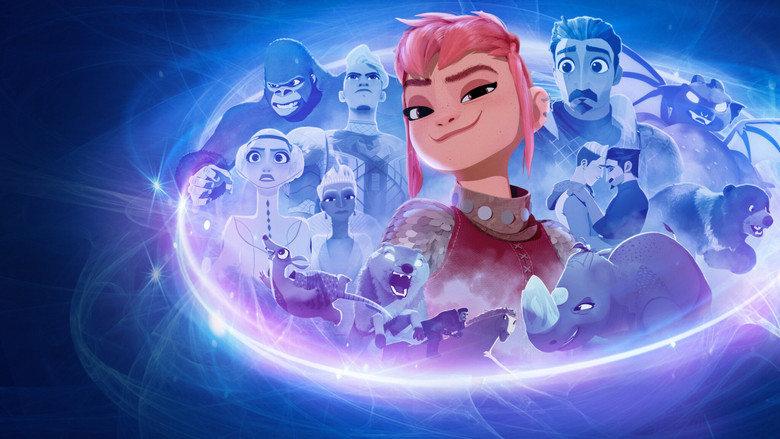
Hiding in the shadows, Ballister is unexpectedly found by Nimona, a chaotic, shapeshifting teenager who gleefully declares herself his new villainous sidekick. While Ballister is desperate to clear his name and prove his innocence, Nimona revels in causing mayhem and challenging the rigid order of the kingdom. Together, this unlikely pair must navigate a world that sees them both as monsters, uncovering a shocking truth about the kingdom's history and the real meaning of heroism along the way.
Core Meaning
The core meaning of "Nimona" revolves around the themes of acceptance, the questioning of authority, and the danger of institutionalized fear. The film argues that history is often a narrative written by the powerful to justify prejudice and maintain control. It champions the idea that individuals should not be defined by societal labels or fear of the 'other'. Nimona's very existence as a shapeshifter defies easy categorization, making her a powerful symbol for gender fluidity and the rejection of rigid identities. The film's central message is a call for empathy and understanding, urging the audience to look past appearances and preconceived notions to see the person within, ultimately asserting that love and acceptance are more powerful forces than fear and tradition.
Thematic DNA
Acceptance vs. Prejudice
The film's primary theme is the struggle for acceptance in a society built on prejudice. Nimona is feared and labeled a "monster" because she is different and cannot be easily defined. Ballister is ostracized for being a commoner and later a perceived killer. The entire kingdom is walled off, physically and mentally, from an outside world they've been taught to fear. The narrative champions the idea of accepting others for who they are, as demonstrated by Ballister's journey to see Nimona not as a monster, but as his friend.
Challenging Authority and Tradition
"Nimona" is a deeply anti-authoritarian story that questions the foundations of a rigid, traditionalist society. The Institute, led by the Director, represents an oppressive regime that maintains power by perpetuating a 1,000-year-old lie about Gloreth and the "monster." Nimona and Ballister's quest to clear his name evolves into a full-blown rebellion against the system, exposing the government's corruption and urging the citizens to question the historical narrative they've been fed.
Identity and Self-Perception
The theme of identity is central, particularly through the character of Nimona. As a shapeshifter, her physical form is fluid, serving as a powerful allegory for gender fluidity and non-conformity. When asked if she's a girl, she replies, "I'm Nimona." She resists labels and societal boxes. The film explores how being constantly labeled as a villain or monster can become a self-fulfilling prophecy, as Nimona states, "Once everyone sees you as a villain, that's what you are." Her journey, and Ballister's, is about defining oneself on one's own terms.
Love and Betrayal
The film explores love in its various forms: the romantic love between Ballister and Ambrosius, and the platonic, familial love that develops between Ballister and Nimona. It also delves into the pain of betrayal. Ballister is betrayed by the Institute and, in a moment of crisis, by Ambrosius. The historical core of the story reveals the original betrayal: Gloreth, Nimona's first friend, turned against her out of fear, creating the kingdom's founding myth. Ballister repeating this betrayal nearly destroys Nimona, but his ultimate apology and acceptance save her, showcasing love's redemptive power.
Character Analysis
Nimona
Chloë Grace Moretz
Motivation
Her core motivation is to find acceptance and companionship—to be seen and loved for who she is without being forced into a box. Having been betrayed and feared for a thousand years, she initially channels this desire into a rebellious and destructive persona, believing it's the only role society will allow her to play.
Character Arc
Nimona begins as a cynical, chaotic agent of mayhem who believes the world will only ever see her as a monster. She seeks out Ballister because she thinks he's a true villain. Through their friendship, she rediscovers hope and the possibility of being seen and accepted for who she is. After being betrayed again by Ballister's doubt, she succumbs to her rage and becomes the monster everyone fears, but is ultimately saved by Ballister's unconditional acceptance, allowing her to become the hero who saves the kingdom.
Ballister Boldheart
Riz Ahmed
Motivation
Initially, his motivation is to clear his name and restore his honor within the system. As the story progresses, this shifts to protecting Nimona and exposing the truth, even if it means destroying the very institution he once revered.
Character Arc
Ballister starts as a rule-following, earnest knight who believes in the integrity of the Institute. After being framed, he is stripped of his identity and forced to see the system's corruption from the outside. Initially, he resists Nimona's chaos and tries to clear his name according to the rules. His arc is about unlearning the prejudice he was taught, embracing the 'other' in Nimona, and realizing that true honor lies in challenging an unjust system, not upholding it.
Ambrosius Goldenloin
Eugene Lee Yang
Motivation
His primary motivation is a deep-seated conflict between his duty to the kingdom and his love for Ballister. He genuinely believes he is doing the right thing by upholding the law, but this belief is challenged as he witnesses the Director's cruelty and Ballister's integrity.
Character Arc
Ambrosius begins as the kingdom's champion knight and the loving partner of Ballister. Wracked with guilt after disarming Ballister, he is torn between his love for him and his duty to the Institute and his lineage as a descendant of Gloreth. He spends much of the film as an antagonist, hunting Ballister under the Director's orders. His arc concludes with him finally choosing love and morality over duty, defying the Director and standing with Ballister.
The Director
Frances Conroy
Motivation
Her sole motivation is to uphold tradition and protect the kingdom from any perceived threat or change, which she defines as anything 'other' or outside the established order. She murdered the Queen because her progressive ideals threatened this rigid structure. She is driven by a xenophobic and dogmatic adherence to Gloreth's manipulated legacy.
Character Arc
The Director is a static character who serves as the embodiment of the system's corruption and fear-based ideology. She does not grow or change, remaining committed to her prejudiced worldview until the very end. Her arc is one of escalating villainy, from framing Ballister to being willing to destroy her own city to kill Nimona, revealing the destructive endpoint of her beliefs.
Symbols & Motifs
The Wall
The massive wall surrounding the kingdom symbolizes fear, isolation, and the enforcement of prejudice. It is a physical manifestation of the institution's doctrine to fear the unknown and reject anything different from their established norm. Its destruction at the end signifies the breaking down of these mental and social barriers.
The Wall is a constant presence, enclosing the techno-medieval city. It was built by the order of the legendary hero Gloreth to "protect" the kingdom from monsters. The Director uses the wall's defenses to maintain control. The film's climax involves the wall's partial destruction, revealing a normal, non-threatening world outside and symbolizing a new era of openness for the kingdom.
Shapeshifting
Nimona's shapeshifting is a direct and powerful symbol of fluid identity, particularly gender fluidity. It represents a refusal to be categorized or confined to a single form or label. It is her nature and her power, but it is also the source of the world's fear and prejudice against her. She explains that not shifting would be akin to not truly living.
Throughout the film, Nimona transforms into a vast array of animals and even other people to fight, cause chaos, and express her emotions. Her shifting is often explosive and vibrant, visually represented by the color pink. When Ballister asks her to be "girl you," she pushes back, asserting her identity is simply "Nimona." The fluidity of her form is central to her character and the film's message.
Gloreth's Sword and Statue
The sword and statue of Gloreth symbolize the glorification of a false history and the institutional power of a lie. The statue is a constant reminder of the kingdom's founding myth: the heroic defeat of a monster. The sword represents the weaponization of that myth to justify violence against anyone deemed "other."
The statue of Gloreth stands prominently in the city center. At the film's climax, a despairing Nimona, having transformed into the very monster of the legend, attempts to commit suicide by impaling herself on the statue's sword, showing her internalization of the world's hatred. Ballister stepping in front of the blade to save her is the ultimate rejection of this violent legacy.
The Color Pink
The color pink is intrinsically linked to Nimona and symbolizes her rebellious, chaotic, and unapologetic nature. It's a vibrant, punk-rock color that visually contrasts with the rigid, metallic order of the Institute. It represents her unrestrained life force and emotions.
Nimona's primary human form has pink hair, and her transformations are often accompanied by flashes or explosions of pink. Her final, sacrificial form is a giant, phoenix-like creature of pink/red light, turning the color of her chaotic energy into a symbol of heroic salvation.
Memorable Quotes
I don't know what's scarier. The fact that everyone in this kingdom wants to run a sword through my heart, or that sometimes I just want to let them.
— Nimona
Context:
Nimona says this to Ballister during a quiet, vulnerable moment in their hideout after they have once again been hunted through the city. It's a turning point where Ballister begins to see the true emotional weight she carries.
Meaning:
This quote powerfully encapsulates the profound pain and exhaustion that comes from centuries of persecution. It reveals the deep-seated despair beneath Nimona's chaotic exterior, touching on themes of depression and suicidal ideation born from societal hatred.
Once everyone sees you as a villain, that's what you are. They only see you one way, no matter how hard you try.
— Nimona
Context:
Nimona says this early in her partnership with Ballister, explaining why she embraces the role of a villain's sidekick. She is trying to make him understand that the kingdom will never accept him now that he's been branded a killer.
Meaning:
This line speaks to the theme of societal labeling and prejudice. It reflects Nimona's cynical worldview, shaped by her experience that people's fear and hatred are immutable, forcing those who are different into the role of the monster.
Kids. Little kids. They grow up believing that they can be a hero if they drive a sword into the heart of anything different. And I'm the monster?
— Nimona
Context:
Nimona delivers this line after an encounter where she saves a child, only for the child to pick up a toy sword and call her a monster, reflecting the indoctrination of the kingdom's youth.
Meaning:
This quote directly challenges the kingdom's definition of 'hero' and 'monster.' It points out the moral bankruptcy of a society that teaches its children that heroism is achieved through violence against those who are different, flipping the narrative to suggest the society itself is monstrous.
I see you, Nimona. And you're not alone.
— Ballister Boldheart
Context:
Ballister says this at the film's climax, standing between Nimona (in her giant monster form) and the sword of Gloreth's statue. His words, and the apology that follows, are what convince Nimona to let go of her rage and pain.
Meaning:
This is the ultimate expression of acceptance that Nimona has craved for a thousand years. It signifies that Ballister truly understands her, sees past the 'monster' label, and offers the companionship she has always been denied. It is the emotional climax of their relationship.
I wouldn't die die. I just sure wouldn't be living.
— Nimona
Context:
Nimona says this in response to Ballister asking what would happen if she just stopped shapeshifting and tried to appear 'normal'. The scene is noted for having a trans flag subtly visible in the background.
Meaning:
This is a poignant statement about the necessity of living authentically. For Nimona, shapeshifting is an essential part of her being. To suppress it would be to suppress her identity, which is a form of death. It's a powerful line that resonates strongly with LGBTQ+ allegories about the importance of being true to oneself.
Philosophical Questions
Are heroes and villains created by their actions or by the stories society tells about them?
The film deeply explores this question by presenting a society where 'hero' and 'monster' are rigidly defined roles based on a 1,000-year-old story. Ballister, a hero, is instantly turned into a villain by a single event he didn't commit. Nimona has been labeled a monster for centuries simply for being different. The film argues that these labels are social constructs used to maintain order. It suggests that true heroism lies in defying these narratives, questioning authority, and showing compassion to those who have been villainized.
What is the relationship between identity and form?
Through Nimona's shapeshifting, the film questions the idea that identity is tied to a stable, physical form. Nimona is not a girl who can turn into a rhino; she is simply Nimona, and both forms are equally her. This challenges traditional notions of a fixed self, presenting identity as something fluid, performative, and internally defined rather than externally categorized. Her resistance to being labeled reflects a philosophical stance that the self transcends physical appearance and societal classification.
Can a society built on a foundational lie ever be just?
The kingdom's entire social and political structure—the wall, the Institute, the knights' purpose—is based on the lie that Gloreth vanquished an evil monster. This lie fosters fear, xenophobia, and institutional prejudice. The film demonstrates that this foundation inevitably leads to injustice, as seen in the persecution of Nimona and the framing of Ballister. The narrative concludes that for justice to be possible, the foundational lie must be exposed and the structures it supports (like the wall) must come down, suggesting that a just society cannot be built on a bed of fear and deception.
Alternative Interpretations
While the primary reading of "Nimona" focuses on its powerful LGBTQ+ allegory, alternative interpretations exist. One perspective views the film through a political lens, seeing it as a critique of institutional propaganda and state-controlled history. The Institute's 1,000-year-old lie about Gloreth serves as a metaphor for how governments can create foundational myths to justify nationalism, xenophobia, and authoritarian control. The film's ending, which breaks down the literal and figurative walls, can be interpreted as a call for radical transparency and the deconstruction of harmful nationalistic narratives.
Another interpretation focuses on mental health. Nimona's struggle can be seen as a metaphor for living with depression or complex trauma. Her line about sometimes wanting to let the knights run a sword through her heart speaks to suicidal ideation. Her transformation into the giant, rage-filled monster represents an overwhelming emotional breakdown triggered by betrayal and despair. In this reading, Ballister's unconditional acceptance is not just friendship, but a form of therapeutic intervention, showing that empathy and support can pull someone back from the brink.
Cultural Impact
"Nimona" made a significant cultural impact primarily through its unapologetic and central LGBTQ+ representation. The film's difficult production history—being canceled by Disney reportedly over its queer themes and then saved by Netflix—became a major talking point, highlighting ongoing debates about inclusivity in family animation. Upon release, it was widely praised by critics and audiences for featuring a prominent gay romance between Ballister and Ambrosius that was integral to the plot, not a background detail. More profoundly, Nimona's shapeshifting was embraced as a powerful and resonant allegory for gender fluidity and the trans experience, connecting deeply with queer audiences. The film proved that mainstream animated features could center queer narratives and characters, receiving critical acclaim and award nominations, including for the Academy Award for Best Animated Feature, challenging the more cautious approaches of established studios like Disney. It became a celebrated example of defiant, rebellious art triumphing over corporate censorship.
Audience Reception
"Nimona" received overwhelmingly positive reactions from audiences. It was widely praised for its vibrant and unique animation style, heartfelt story, and humor. A significant point of praise was its unabashed and meaningful LGBTQ+ representation, which many viewers found refreshing and vital for family animation. The relationship between Ballister and Ambrosius was celebrated for being a central, normalized gay romance. Nimona's character was lauded as a powerful and relatable allegory for the trans and gender non-conforming experience. The main points of criticism were minor, with some reviewers finding the humor occasionally hit-or-miss or the animation style taking some getting used to. However, the overall verdict from audiences was that "Nimona" was a triumphant, emotionally resonant, and important film that stood out as one of the best animated features of the year.
Interesting Facts
- The film had a troubled production history. It began at Blue Sky Studios (a subsidiary of 20th Century Fox) but was canceled in 2021 after Disney's acquisition of Fox, reportedly due to Disney's discomfort with the film's prominent LGBTQ+ themes, including a same-sex kiss.
- The project was saved in 2022 when Annapurna Pictures and Netflix revived it, with DNEG Animation taking over animation duties.
- The film's visual style was heavily influenced by the art of Eyvind Earle (known for his background work on Disney's 'Sleeping Beauty') and Charley Harper, blending medieval aesthetics with a modern, graphic sensibility.
- As a tribute to the original production team, the end credits feature a dedication that lists the entire staff of the now-defunct Blue Sky Studios.
- The film's creator, ND Stevenson, is transmasculine and non-binary, and created the character of Nimona out of his own experiences with identity, pain, and anger, even before he fully understood them himself.
- Directors Nick Bruno and Troy Quane also directed Blue Sky's last completed film, "Spies in Disguise" (2019).
Easter Eggs
A recurring battle cry in the film is, "Go back to the shadows from whence you came!"
This line is a direct homage to "The Lord of the Rings." It appears to be a blend of Gandalf's line to the Balrog ("Go back to the Shadow!") and Galadriel's line to Sauron in "The Hobbit" films ("Go back to the void from whence you came!"). This is fitting, as creator ND Stevenson is a known fan of Tolkien's work.
During a subway scene, Nimona briefly transforms into a rat carrying a slice of pizza.
This is a reference to the viral internet meme "Pizza Rat," which originated from a 2015 video of a rat dragging a slice of pizza down subway stairs in New York City. The reference has also appeared in other animated films like "Soul" and "We Bare Bears: The Movie."
The opening scroll of the film contains a tribute to Blue Sky Studios.
The text on the scroll reads, "Verily did the people live in the embrace of Blue Skies, tilling the good earth, harvesting the bounties of their animated labors." This is a direct nod to Blue Sky Studios, the original animation house for the film that was shut down by Disney before the project could be completed.
⚠️ Spoiler Analysis
Click to reveal detailed analysis with spoilers
Frequently Asked Questions
Explore More About This Movie
Dive deeper into specific aspects of the movie with our detailed analysis pages
Comments (0)
No comments yet. Be the first to share your thoughts!