Breaking Bad
"Change the equation."
Overview
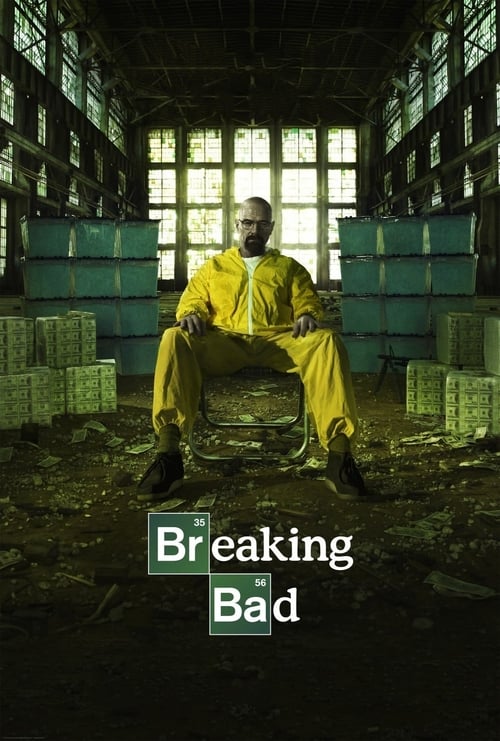
"Breaking Bad" chronicles the story of Walter White, a brilliant but underachieving high school chemistry teacher in Albuquerque, New Mexico. After being diagnosed with terminal lung cancer, and fearing his family will be left financially destitute, Walt decides to use his chemistry expertise to produce and sell high-purity methamphetamine. He partners with a former student, Jesse Pinkman, a small-time drug dealer.
As the series progresses over five seasons, Walt's initial motivation to provide for his family slowly morphs into a quest for power and dominance in the drug trade. He adopts the alias "Heisenberg," becoming a feared and ruthless figure. His descent into the criminal underworld has profound and often devastating consequences for himself, his family—including his wife Skyler and son Walter Jr.—and his DEA agent brother-in-law, Hank Schrader. The show meticulously charts his transformation from a sympathetic everyman into a complex and dangerous antihero, exploring themes of morality, choice, and the corrupting nature of power.

Core Meaning
The core meaning of "Breaking Bad" is a profound exploration of transformation and moral decay. Series creator Vince Gilligan famously described his goal as turning the protagonist from "Mr. Chips into Scarface." The series posits that under the right (or wrong) circumstances, anyone is capable of immense change and moral compromise. It delves into the nature of good and evil, questioning whether they are fixed states or the results of a series of choices. The show meticulously examines the consequences of one man's decision to break societal and moral laws, initially for his family, but ultimately for his own pride and ego. It serves as a tragic, modern-day cautionary tale about the seductive allure of power and the devastating ripple effects of a compromised soul.
Thematic DNA
Transformation and Moral Decay
The central theme is Walter White's metamorphosis from a meek, law-abiding citizen into the ruthless drug kingpin, Heisenberg. This transformation is not sudden but a gradual descent, marked by a series of increasingly immoral choices. Each decision—from his first kill to poisoning a child—erodes his original character. The show masterfully uses this arc to explore the idea that evil isn't an inherent trait but a path one chooses, step by step, until there's no turning back. This decay is mirrored in other characters, like Jesse, who is corrupted by Walt's influence but ultimately seeks redemption.
The Corruption of the Family and the American Dream
Walt's initial justification for his criminal enterprise is to provide for his family, a twisted version of the American Dream. However, his actions ultimately destroy the very family he claims to be protecting. The series deconstructs the traditional family unit, showing how lies, secrets, and criminality poison relationships from within. Skyler's journey, in particular, highlights the devastating impact on those caught in the orbit of the protagonist's choices, forcing her into complicity and moral compromise.
Power, Pride, and Ego
While cancer and financial insecurity are the catalysts, Walt's primary motivation evolves into a desperate need for power and respect—things he lacked in his life as a teacher and co-founder of a major tech company he left. His pride (or "hubris") is his tragic flaw. He rejects charity, insists on building his own "empire," and revels in the fear his alter ego, Heisenberg, inspires. The iconic line, "I did it for me. I liked it. I was good at it," is his final admission that his journey was fueled by ego, not necessity.
Consequences and Causality
"Breaking Bad" is a masterclass in demonstrating that every action has a reaction, often in unforeseen and catastrophic ways. Walt's decision to let Jane die leads indirectly to a plane crash over Albuquerque. His manipulation of Jesse leads to multiple deaths and Jesse's enslavement. The series operates like a finely tuned machine of cause and effect, where small moral compromises snowball into irreversible tragedies, illustrating that no one acts in a vacuum and that consequences are inescapable.
Character Analysis
Walter White
Bryan Cranston
Motivation
Initially, his motivation is his family's financial security after his death. This quickly evolves into a deep-seated need for respect, power, and control—things he feels he was denied in his earlier life. His wounded pride, stemming from his departure from Gray Matter Technologies, fuels his desire to build an "empire" and be the undisputed best at something. By the end, his motivation is purely self-serving: the thrill of being Heisenberg.
Character Arc
Walter White's arc is one of the most celebrated in television history, representing a complete moral descent. He begins as a sympathetic, downtrodden chemistry teacher diagnosed with cancer, motivated by a desire to secure his family's future. However, his journey into the meth business awakens a dormant pride and ambition. Over five seasons, his justifications wear thin, revealing a man driven by ego and a lust for power. He transforms from "Mr. Chips to Scarface," alienating his family, manipulating his partner Jesse, and leaving a trail of death and destruction. In the end, he admits he did it all for himself, completing his transformation into the villain of his own story.
Jesse Pinkman
Aaron Paul
Motivation
Jesse's motivations are more human and less grandiose than Walt's. He seeks acceptance, love, and a sense of purpose. Initially driven by a desire for money and a party lifestyle, his motivations shift toward protecting those he cares about, especially children like Brock and his girlfriend Andrea. Ultimately, his core motivation becomes survival and the desperate hope for redemption and a life free from the trauma Walt inflicted upon him.
Character Arc
Jesse starts as a small-time meth cook and user, seemingly immature and irresponsible. His partnership with Walt drags him into a world of violence and trauma he is ill-equipped to handle. Unlike Walt, Jesse retains a conscience and is tormented by the violent acts he witnesses and commits. He repeatedly tries to escape the criminal life but is continually manipulated and pulled back in by Walt. His arc is tragic; he loses everyone he loves and endures immense suffering, including being enslaved by a neo-Nazi gang. By the end of the series and the film El Camino, he escapes, scarred but free, representing the moral casualty of Walt's ambition.
Skyler White
Anna Gunn
Motivation
Her primary and unwavering motivation is the safety and well-being of her children, Walter Jr. and Holly. Every decision she makes, whether it's opposing Walt, helping him launder money, or attempting to escape with the children, is driven by this fierce maternal instinct. She navigates an impossible situation with the singular goal of protecting her family from the danger Walt has brought into their lives.
Character Arc
Skyler begins as a conventional suburban wife and mother. When she discovers Walt's criminal activities, her initial reaction is fear and opposition. Her arc is one of forced adaptation and moral compromise. To protect her family, she becomes entangled in Walt's crimes, laundering his money and becoming a reluctant accomplice. She is trapped between her fear of Walt and her desire to shield her children. Skyler's journey is a powerful depiction of the impossible choices faced by someone living with a monster, and she becomes a resilient, albeit broken, survivor.
Hank Schrader
Dean Norris
Motivation
Hank is motivated by a strong, straightforward sense of justice and duty. He is a career lawman dedicated to catching criminals. Initially, this is mixed with a desire for professional glory and recognition. After he discovers Walt is Heisenberg, his motivation becomes intensely personal and unwavering: to bring his own brother-in-law to justice, no matter the personal cost.
Character Arc
Hank starts as a loud, seemingly one-dimensional DEA agent, providing comic relief with his machismo. His character gains significant depth as the series progresses. Encounters with the cartel leave him with PTSD, and a violent attack leaves him temporarily unable to walk, revealing his vulnerability. His pursuit of the mysterious "Heisenberg" becomes an all-consuming obsession, transforming him from a simple cop into a determined and tragic hero. His arc is the inverse of Walt's; as Walt descends into villainy, Hank rises as the story's moral authority, driven by a pure desire for justice, which ultimately costs him his life.
Gustavo 'Gus' Fring
Giancarlo Esposito
Motivation
Gus is driven by two primary forces: business and revenge. On one hand, he is a pragmatist dedicated to building and maintaining a flawless, efficient, and discreet criminal enterprise. On the other hand, his actions are deeply fueled by a decades-long desire for revenge against the Salamanca cartel, specifically Hector Salamanca, who murdered his business partner and dear friend, Max. This personal vendetta is the one crack in his otherwise impeccable, emotionless facade.
Character Arc
Gus Fring is introduced as a meticulous, respected businessman who owns the fast-food chain Los Pollos Hermanos, which serves as a front for a vast meth distribution empire. His character does not have a traditional arc of change within Breaking Bad; rather, his backstory and true nature are slowly revealed. He is the ultimate professional—calm, precise, and utterly ruthless. He represents a different kind of criminal from Walt: one who operates with logic, patience, and a complete absence of emotion, making him Walt's most formidable antagonist.
Symbols & Motifs
The Pink Teddy Bear
The pink teddy bear, with its charred face and missing eye, symbolizes the loss of innocence and the widespread, collateral damage of Walt's actions. It represents the innocent victims caught in the fallout of his choices. Its unsettling appearance is a constant, haunting reminder of the human cost of Walt's empire. Some interpretations also suggest it foreshadows the facial injury of antagonist Gus Fring.
The bear first appears in Season 2, seen in black-and-white flash-forwards floating in Walt's pool. It is later revealed to be debris from the Wayfarer 515 plane crash, a tragedy indirectly caused by Walt's decision to let Jane Margolis die, which led her air-traffic controller father to be distraught at work. The bear's eye is later seen in the pool filter, a recurring visual motif.
Color Palette
Colors are used deliberately throughout the series to signify characters' emotional states, power dynamics, and moral alignment. For example, Marie is almost always seen wearing purple, representing royalty and self-deception. Walt often wears beige and green at the beginning, signifying his blandness and greed, but transitions to darker colors like black as he becomes Heisenberg. Jesse is associated with yellow and red, symbolizing his impulsiveness and connection to the drug trade. Pink is often tied to moments of innocence or tragic loss.
The use of color is consistent across all five seasons. Character wardrobes, set designs, and even the color of the meth itself are all imbued with symbolic meaning. The visual transition of characters' clothing is a subtle way the show telegraphs their internal transformations without dialogue.
The Fly (Episode: "Fly")
The fly in the superlab represents contamination, chaos, and Walter's overwhelming guilt. His obsessive, single-minded quest to kill it is a manifestation of his loss of control over his life and his desperate need to purify his conscience. It symbolizes the one uncontrollable element in his meticulously controlled environment, a tiny flaw that threatens to unravel everything.
In the Season 3 episode titled "Fly," Walt and Jesse are locked in the lab for the entire episode. Walt becomes fixated on killing a single fly, convinced it will contaminate their batch of meth. The episode serves as a deep dive into Walt's psyche, where he nearly confesses his role in Jane's death to Jesse, revealing the immense guilt tormenting him.
Walter White's Hats (Pork Pie Hat)
The pork pie hat is the primary symbol of Walter's transformation into his criminal alter ego, Heisenberg. When he puts on the hat, he sheds the persona of the meek Walter White and embodies the confident, ruthless, and powerful drug lord. It is a key part of his new identity, a mask that allows him to commit heinous acts.
Walt first dons the hat in Season 1 and it becomes his signature look as Heisenberg. The simple act of putting on or taking off the hat often signifies a shift in his personality. In the final season, the hat is iconic, representing the infamous criminal he has become, recognized by all in the criminal underworld.
Memorable Quotes
I am not in danger, Skyler. I am the danger. A guy opens his door and gets shot, and you think that of me? No. I am the one who knocks!
— Walter White
Context:
In Season 4, Episode 6, "Cornered," Skyler expresses her fear for Walt's safety, pleading with him to go to the police. Walt delivers this chilling speech to assert his dominance and control, revealing to Skyler (and the audience) the depth of his megalomania and how far he has descended.
Meaning:
This quote marks a pivotal moment in Walt's transformation. It's his explicit rejection of the victim persona and his full embrace of the powerful, menacing identity of Heisenberg. He is no longer a man caught in dangerous circumstances; he is the source of the danger itself. It crystallizes his shift from being motivated by fear to being motivated by power.
Say my name.
— Walter White
Context:
This iconic scene occurs in Season 5, Episode 7, "Say My Name." Walt meets with Declan in the desert to finalize a new distribution deal. When Declan dismisses him as the man who killed Gus Fring, Walt demands he acknowledge the name that has become legend: Heisenberg.
Meaning:
This is the ultimate assertion of Heisenberg's identity and power. After systematically eliminating his competition, Walt confronts a rival dealer, Declan. He isn't just selling a product; he's selling a brand built on fear and reputation. Forcing Declan to say "Heisenberg" is an act of psychological dominance, confirming that his name alone is a symbol of unparalleled power in the drug world.
I did it for me. I liked it. I was good at it. And I was... really... I was alive.
— Walter White
Context:
In the series finale, Season 5, Episode 16, "Felina," Walt visits Skyler one last time before his final confrontation. He gives her the location of Hank's body to help her secure a plea deal and uses the opportunity to finally tell her the real motivation behind his choices.
Meaning:
In his final conversation with Skyler, Walt finally abandons the pretense that his criminal empire was built for his family. This raw confession is the ultimate truth of his journey. The life of Heisenberg, filled with danger, power, and mastery, made him feel alive and fulfilled in a way his previous life never had. It is the tragic and honest culmination of his character arc.
Yeah, bitch! Magnets!
— Jesse Pinkman
Context:
In the premiere of Season 5, "Live Free or Die," Walt and Jesse devise a plan to destroy evidence on Gus Fring's laptop, which is in police custody. They use a massive junkyard magnet from outside the building to wipe the computer. After the magnet sends everything in the evidence room flying, Jesse celebrates their improbable success with this line.
Meaning:
This quote perfectly encapsulates Jesse's youthful exuberance and his moments of genuine, almost childlike, excitement when their harebrained scientific schemes succeed. It's a moment of levity and triumph that highlights the odd-couple dynamic between him and Walt, showcasing Jesse's role as the more emotionally expressive and less calculating partner.
Episode Highlights
Pilot
The first episode masterfully establishes Walter White's character: a brilliant chemist trapped in a mundane life, emasculated and facing a terminal cancer diagnosis. His decision to cook meth with Jesse Pinkman is presented as a desperate act. The episode's frantic, chaotic ending in the desert with the RV sets the unique tone of dark humor and high-stakes drama for the entire series.
It is one of the most acclaimed pilot episodes in television history, perfectly encapsulating the show's core premise: a good man's transformation into a criminal. It lays all the necessary groundwork for Walt's motivations and the central relationship with Jesse, immediately hooking the audience with its compelling narrative and cinematic style.
One Minute
This episode features a brutal and emotionally charged confrontation between Jesse and Walt, where Jesse unleashes all his anger and pain, blaming Walt for ruining his life. The climax is the terrifying and suspenseful shootout between Hank and the Salamanca twins in a parking lot. Hank survives, but the attack leaves him severely injured, forever changing him.
This episode marks a major turning point for Hank's character, moving him beyond comic relief into a tragic figure. It also deepens the complexity of Walt and Jesse's toxic, codependent relationship, while dramatically raising the stakes by showcasing the brutal violence of the cartel.
Crawl Space
The episode ends with one of the most haunting scenes in the series. Trapped and cornered by Gus Fring, Walt discovers that Skyler has given most of his money away. He is left laughing maniacally in the crawl space under his house, a man who has lost everything. The camera pulls back, framing him like a trapped animal, symbolizing his complete psychological breakdown.
This moment signifies Walt hitting rock bottom. All his plans have failed, his family is terrified of him, and he is powerless. His terrifying laughter signals a psychotic break, a point of no return from which the truly ruthless Heisenberg emerges, leading directly to the explosive final confrontation with Gus.
Face Off
The culmination of Walt's season-long chess match against Gus Fring. Walt devises an ingenious and shocking plan, using Hector Salamanca as a suicide bomber to eliminate Gus. The unforgettable image of Gus walking out of the explosion, adjusting his tie before collapsing dead with half of his face blown off, is a landmark moment in television history.
This episode solidifies Walt's status as a criminal mastermind. By defeating the seemingly invincible Gus Fring, Walt removes his greatest obstacle and ascends to the top of the drug trade. The final shot revealing that Walt poisoned the child Brock to manipulate Jesse confirms his full descent into villainy.
Ozymandias
Widely regarded as one of the greatest episodes of television ever made. It features the devastating desert shootout where Hank is killed, Jesse is captured, and Walt's family finally learns the full truth. The sequence where Walt kidnaps his own daughter and has a final, heartbreaking phone call with Skyler marks the complete and utter destruction of his life and family.
This episode is the climax of the entire series. It's the moment where Walt's empire crumbles completely and he faces the most severe consequences of his actions. Every lie and every crime comes crashing down at once, resulting in a perfectly executed hour of tragedy and tension that leaves no character unscathed.
Felina
The series finale provides a satisfying and definitive conclusion. Walt, returned from exile, systematically ties up loose ends. He ensures his family will receive his remaining money, says his goodbyes, and exacts revenge on Jack's neo-Nazi gang, freeing Jesse in the process. He dies alone in a meth lab, the place where he truly felt alive, with a faint smile on his face.
"Felina" is praised for providing a sense of closure to a complex narrative. It allows Walt a final, twisted form of redemption by accomplishing his last goals, albeit through violence. His final admission to Skyler and his peaceful death in the lab bring his tragic story to a fitting and poignant end, solidifying the show's legacy.
Philosophical Questions
Are we defined by our choices or our circumstances?
The series constantly explores the tension between free will and determinism. Walter White is dealt a terrible hand with his cancer diagnosis and financial struggles. The show asks whether these circumstances inevitably led to his transformation or if he actively chose to become Heisenberg at every turn. While his situation is the catalyst, the series seems to argue that his pride and his choices—to lie, to kill, to manipulate—are what truly define his descent. Jesse's arc provides a counterpoint, suggesting that even in the most dire circumstances, a different path can be chosen.
What is the nature of good and evil?
"Breaking Bad" challenges a binary understanding of morality. It presents a protagonist who commits evil acts for what he initially frames as a good reason. The series meticulously blurs the lines, forcing the audience to sympathize with a character even as he becomes monstrous. It suggests that evil is not a state of being, but a gradual process of moral compromise, where each small step into darkness makes the next one easier. The show asks if there is a point of no return, and whether a person can be both a loving father and a ruthless killer.
Can actions be justified if the initial motivation is noble?
This is the central ethical dilemma Walter White presents to himself and the audience. He starts his journey with the noble goal of providing for his family. The series continuously tests the age-old question of whether the ends justify the means. As Walt's actions become more and more heinous—from letting Jane die to poisoning a child—the show makes it increasingly clear that his initial noble motivation has become a hollow justification for acts driven by ego and a lust for power, suggesting that some means are so corrupting they invalidate any end.
Alternative Interpretations
One of the most debated aspects of "Breaking Bad" is the nature of Walter White's character and the series' ending. One interpretation is that the series is a tragic morality play, a clear depiction of a man's fall from grace due to hubris. In this view, Walt is an undeniable villain whose actions are a cautionary tale about ego and the consequences of evil.
Another interpretation views the series as a dark satire of the American Dream and the failures of the American healthcare system. From this perspective, Walt is a product of a society that devalues intellect and fails to provide a safety net, forcing him into extreme measures. His criminal career is a twisted, hyper-masculine fantasy of self-reliance and empowerment against a system that has cast him aside.
The ending is also open to interpretation. Some viewers see Walt's final acts—saving Jesse and securing money for his family—as a form of redemption, allowing him to die with a semblance of his original purpose fulfilled. Others argue there is no redemption for him; his final actions are still driven by ego and a desire to have the last word, and his death is simply the just conclusion for the monster he became.
Cultural Impact
"Breaking Bad" is widely considered a landmark series of television's "Golden Age" and one of the greatest TV shows of all time. Its airing from 2008 to 2013 coincided with a shift in television towards more cinematic, novelistic storytelling. The show revolutionized television by presenting a protagonist who undergoes a complete and irreversible transformation into the antagonist, challenging the episodic, status-quo nature of most television series before it.
Its influence is seen in the rise of the antihero protagonist and morally complex narratives in shows that followed, such as "Ozark" and "Fargo." The series set new standards for visual storytelling in television, with its distinct, cinematic cinematography and symbolic use of color raising the bar for the medium. The show's popularity exploded thanks to word-of-mouth and the rise of streaming platforms like Netflix, which allowed audiences to binge-watch and catch up, fundamentally changing how series could build an audience over time. The final season became a major cultural event, with viewership growing exponentially.
"Breaking Bad" permeated pop culture, with Walter White's Heisenberg persona, the blue meth, and iconic quotes becoming instantly recognizable. It spawned a successful franchise, including the prequel series "Better Call Saul" and the sequel film "El Camino: A Breaking Bad Movie," further cementing its legacy. The series is a touchstone for discussions on character development, narrative structure, and the artistic potential of television as a medium.
Audience Reception
The reception for "Breaking Bad" evolved significantly over its run. The first season received positive reviews but had modest viewership. Critical acclaim grew steadily with each season, with the final three seasons receiving universal praise as some of the best television ever produced. The show's audience grew exponentially, particularly after previous seasons became available on Netflix, which allowed new viewers to catch up. This led to a massive surge in ratings for the final season, turning the finale into a major cultural event with over 10.3 million viewers for its initial airing.
Audiences praised the brilliant writing, masterful acting (especially by Bryan Cranston and Aaron Paul), and the show's intense, suspenseful plotting. The character of Skyler White became a point of controversy, with some viewers directing intense dislike towards the character for obstructing Walt, which sparked discussions about gender roles and audience sympathy for antiheroes. The series finale, "Felina," was overwhelmingly praised by both critics and audiences for providing a conclusive and satisfying ending to Walter White's story.
Interesting Facts
- The creator, Vince Gilligan, initially intended for Jesse Pinkman to be killed off at the end of the first season, but Aaron Paul's performance was so compelling that he changed his mind.
- Bryan Cranston was cast as Walter White after Vince Gilligan remembered his performance in an episode of "The X-Files" that Gilligan had written.
- The coordinates Walt memorizes and buys a lottery ticket with (N 34° 59′ 20″ W 106° 36′ 52″) do not lead to his buried money but to Q Studios in Albuquerque, where the show was filmed.
- The famous blue meth was actually blue rock candy.
- In 2013, "Breaking Bad" entered the Guinness World Records as the most critically acclaimed TV show of all time.
- The show's title is a Southern American colloquialism meaning to "raise hell" or turn to a life of crime.
Easter Eggs
The titles of four episodes in Season 2 foreshadow the season's climactic plane crash.
The titles are "737," "Down," "Over," and "ABQ." When put together, they spell out "737 Down Over ABQ," explicitly foreshadowing the Wayfarer 515 disaster that happens in the season finale. This is a classic example of the show's meticulous planning and use of subtle clues for attentive viewers.
Vince Gilligan, the show's creator, worked extensively on "The X-Files" and included many actors from that show in "Breaking Bad."
Bryan Cranston, Aaron Paul, Dean Norris, and Bob Odenkirk all had roles in "The X-Files" years before "Breaking Bad." This created a fun connection for fans of both shows and demonstrated Gilligan's loyalty to actors he had worked with previously.
In the final season, Walter White is living in New Hampshire under the surname "Lambert."
This is a subtle nod to his wife Skyler's maiden name. It can be interpreted as a final, ironic connection to the family he has lost and the life he left behind, showing that even in his new identity, he cannot escape his past.
⚠️ Spoiler Analysis
Click to reveal detailed analysis with spoilers
Frequently Asked Questions
Explore More About This Movie
Dive deeper into specific aspects of the movie with our detailed analysis pages
Comments (0)
No comments yet. Be the first to share your thoughts!