
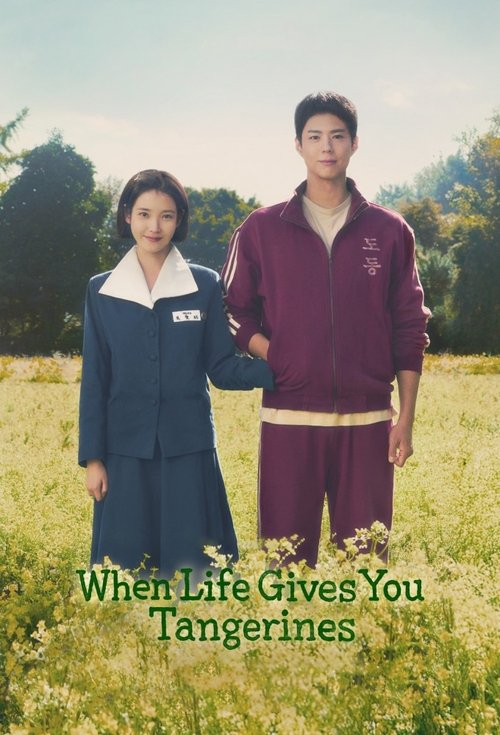
When Life Gives You Tangerines
폭싹 속았수다
"Dedicated to you. Still blooming, always dreaming."
Overview
"When Life Gives You Tangerines" chronicles the epic, fifty-year love story of the rebellious, aspiring poet Ae-sun and the steadfast, quiet Gwan-sik. Set against the backdrop of Jeju Island, the narrative spans from the 1950s to the present day, weaving their personal journeys through the turbulent currents of Korean history. The series follows their relationship from their youth, filled with dreams and hardships, through their marriage and the challenges of raising a family, tested by disapproving parents, economic struggles, and political strife.
Presented in a non-linear fashion, the story frequently shifts between the past and present, narrated by their older daughter, Yang Geum-myeong. This structure allows for a deep exploration of how past choices and sacrifices ripple through generations. The drama is a poignant tribute to a generation that endured immense hardship, celebrating the resilience of the human spirit and the quiet, unwavering power of lifelong devotion.

Core Meaning
The core message of "When Life Gives You Tangerines" is a profound exploration of enduring love as a form of unwavering support and quiet sacrifice over a lifetime. It posits that love isn't about grand gestures but about the steadfast choice to stand by someone through life's tumultuous seasons. The series, whose Korean title translates to "Thank You for Your Hard Work," serves as a tribute to the resilience and sacrifices of the parent and grandparent generations who navigated immense historical and personal hardships. It beautifully illustrates how personal dreams are often reshaped by responsibility and love for family, ultimately suggesting that a life dedicated to another can be its own form of fulfillment and a legacy in itself.
Thematic DNA
Enduring Love and Sacrifice
The central theme is the lifelong, unwavering love Gwan-sik has for Ae-sun. His love is not possessive but is expressed through constant, quiet support and sacrifice. He puts her dreams before his own, providing a stable foundation for her often-turbulent life. The series explores this love across decades, showing its evolution from youthful devotion to a deep, mature partnership that withstands poverty, societal pressure, and personal loss. It contrasts this with other forms of love, suggesting that true devotion is found in action and presence, not just words.
Generational Divides and Reconciliation
The story delves into the complex relationships between three generations of women: Ae-sun's mother (a haenyeo diver), Ae-sun, and her daughter Geum-myeong. It highlights the misunderstandings and emotional gaps that arise from different life experiences and societal contexts, from post-war Korea to the modern day. Ae-sun's struggle to understand her mother's sacrifices is mirrored in her own daughter's initial inability to appreciate hers. The series ultimately becomes a story of empathy and reconciliation, bridging these generational holes as characters come to understand the unspoken love and hardship that shaped their parents' lives.
Dreams vs. Reality
Ae-sun begins as a fiercely ambitious girl who dreams of escaping Jeju to become a famous poet. The series chronicles her lifelong struggle with this dream as the realities of poverty, marriage, and motherhood force her to make difficult choices. Her story is a poignant reflection on how life's circumstances can alter personal ambitions. Yet, the theme isn't one of defeat; it shows how dreams can transform. Gwan-sik's unwavering support eventually allows her to fulfill her dream in a different way, suggesting that it's never too late and that the path to one's passion can be unexpected.
The Scars of History
The narrative is deeply embedded in the historical context of South Korea, from the Korean War's aftermath to the IMF crisis. These major events are not just backdrops; they directly impact the characters' lives, shaping their opportunities and hardships. The series shows how personal stories are inextricably linked to the broader national story, grounding the characters' personal struggles in a tangible and often painful reality that would resonate deeply with a Korean audience.
Character Analysis
Ae-sun
IU (young), Moon So-ri (older)
Motivation
Her primary motivation is to escape the poverty and predetermined life of a Jeju islander. She craves recognition and a life defined by her own intellect and creativity, not by hardship. This motivation evolves into a fierce desire to provide her own children with the opportunities she never had, even at the cost of her own dreams.
Character Arc
Ae-sun begins as a spirited, rebellious, and fiercely intelligent girl who dreams of becoming a poet to escape her impoverished life on Jeju. Her arc is defined by the constant tension between her ambitions and the harsh realities she faces. Initially, she sees Gwan-sik's steadfast love as a potential trap, preferring to seek a richer life elsewhere. Over the decades, she evolves from a fiery youth into a pragmatic, resilient mother and wife. Her rebellious spirit softens into a deep, enduring strength. While she seemingly sets aside her personal dreams for her family, her arc comes full circle when, with Gwan-sik's help, she finally achieves her dream of being a published poet, realizing that her life's journey, filled with love and hardship, gave her the very stories she needed to tell.
Gwan-sik
Park Bo-gum (young), Park Hae-joon (older)
Motivation
His sole, unwavering motivation is Ae-sun's well-being and happiness. He loves her unconditionally and dedicates his life to being the person she can always rely on, no matter the circumstance.
Character Arc
Gwan-sik is introduced as a quiet, sincere, and incredibly diligent young man whose life's purpose is to love and protect Ae-sun. He is a man of few words, expressing his profound love through actions. His character arc is not about dramatic change, but about the consistent, unwavering nature of his devotion through decades of turmoil. He begins as a boy who silently supports Ae-sun, and he grows into a man who does the same, becoming the anchor in her life. His journey is one of quiet heroism and immense personal sacrifice. His ultimate act of love is fulfilled posthumously when he ensures Ae-sun's poems are published, demonstrating that his entire life was dedicated to her happiness and the realization of her dreams.
Yang Geum-myeong
IU
Motivation
Initially motivated by a desire for independence and to forge her own path away from what she perceives as a stifling family life in Jeju. This evolves into a deeper motivation to understand her roots and honor the legacy of her parents' love and endurance.
Character Arc
As Ae-sun and Gwan-sik's daughter, Geum-myeong represents the new generation, one that has more opportunities but initially lacks understanding of her parents' sacrifices. She often clashes with her mother, seeing her as overbearing without grasping the depth of her struggles. Her arc is one of maturation and empathy. As she navigates her own life, career, and romance, she begins to see her parents not just as figures of authority, but as individuals with their own complex histories and dreams. Her journey is about bridging the generational gap and coming to appreciate the silent sacrifices that paved her way, eventually finding success and happiness on her own terms while carrying her family's legacy.
Symbols & Motifs
Tangerines
Tangerines, Jeju Island's most famous crop, symbolize both the bitterness and sweetness of life. The English title is a clever twist on the saying "When life gives you lemons, make lemonade," adapting it to the local culture. It represents the idea of finding warmth and sweetness (like tangerine tea) even from the sour or difficult experiences life throws at you.
The symbol is interwoven throughout the series, representing the essence of Jeju Island and the resilience of its people. It's a constant visual motif that ties the characters to their homeland and the central theme of making the best of one's circumstances.
Poetry and Notebooks
Poetry represents Ae-sun's inner world, her dreams, and her rebellion against a life of hardship. The notebooks where she writes are sacred spaces for her ambition and identity. They symbolize the part of herself she fears losing to the demands of her reality.
From her youth, Ae-sun is seen with books and writing in notebooks. In the end, Gwan-sik helps her publish her poetry, fulfilling a lifelong promise and symbolizing his ultimate act of love—not just supporting her life, but ensuring her dreams come to fruition.
Haenyeo (Female Divers)
The haenyeo, Jeju's iconic female divers, symbolize the immense strength, resilience, and sacrifice of the women in the story, particularly Ae-sun's mother. Their difficult and dangerous work represents the harsh realities and burdens that the older generation of women endured to provide a better life for their children.
Ae-sun's mother is a haenyeo, and her life and struggles deeply shape Ae-sun's worldview and her desire to escape a similar fate. The imagery of the haenyeo is a recurring cultural and thematic touchstone throughout the series, grounding the story in the unique matriarchal traditions of Jeju Island.
Philosophical Questions
What is the true nature of a 'successful' life?
The series consistently challenges conventional notions of success. Ae-sun dreams of fame as a poet, a goal she seemingly abandons for family. Gwan-sik forgoes his own potential to become her unwavering support. The drama explores whether success is measured by external achievements and recognition or by the depth of one's love, the strength of one's character, and the legacy of sacrifice left for the next generation. It suggests that a life dedicated to the well-being of others can be a profound, if uncelebrated, form of success.
Can love truly endure through decades of hardship without changing?
The series presents the love between Ae-sun and Gwan-sik as a near-constant force. However, it subtly explores how this love is tested and transformed by time. It questions whether their bond is an idealized romance or a testament to human resilience and dependency forged in shared trauma and struggle. The narrative invites contemplation on whether their love is a choice made every day or an inevitable outcome of their circumstances, ultimately portraying it as a powerful, evolving bond that is both a comfort and a product of their challenging lives.
Alternative Interpretations
While the dominant interpretation of the series celebrates the beauty of Gwan-sik's selfless, lifelong devotion to Ae-sun, some viewers have offered a more critical perspective. This alternative reading questions whether Gwan-sik's complete sacrifice of his own ambitions for Ae-sun's is truly romantic or a depiction of a life unlived. This interpretation suggests the story could also be seen as a bittersweet tragedy, highlighting how societal expectations and relentless hardship can force individuals into lives of quiet desperation, even when rooted in love. Furthermore, some audience discussions have focused on the characterization of the children, particularly Geum-myeong, interpreting her initial attitude not as youthful ignorance but as a realistic portrayal of the generational disconnect felt by those raised in relative comfort by parents who endured extreme poverty.
Cultural Impact
"When Life Gives You Tangerines" achieved significant global success, topping Netflix's non-English series charts in numerous countries. The series was praised by critics and audiences for its deep emotional resonance, masterful storytelling by writer Im Sang-choon, and poignant direction by Kim Won-seok. It has been lauded as a 'masterpiece' and one of the best K-dramas of the year, celebrated for its realistic, grounded portrayal of life, love, and family across generations.
The drama also shone a spotlight on the unique culture and dialect of Jeju Island, introducing international audiences to the history of the haenyeo (female divers) and the island's scenic beauty. Its thoughtful narrative, which intertwines personal stories with major events in modern Korean history like the IMF crisis, provided a rich, layered viewing experience that resonated both locally and globally. The series won several accolades at the 61st Baeksang Arts Awards, including Best Drama and Best Screenplay, cementing its legacy as a culturally significant and critically acclaimed work.
Audience Reception
"When Life Gives You Tangerines" received widespread praise from audiences globally for its heartfelt storytelling, rich character development, and powerful performances, particularly by IU and Park Bo-gum. Many viewers found the emotional depth and realistic portrayal of life's struggles deeply moving, often describing the series as a 'masterpiece' that leaves a lasting impact. The chemistry between the leads was consistently highlighted as a major strength.
Points of criticism were minor but present. Some viewers found the pacing slow, characteristic of the 'slice-of-life' genre, which doesn't appeal to everyone. A few reviews also noted a perceived over-reliance on crying scenes in the early episodes. There was also some minor discussion about the casting of the older counterparts, with some feeling Park Hae-joon didn't physically resemble a future version of Park Bo-gum's Gwan-sik. Despite these points, the overall verdict from audiences was overwhelmingly positive, with many demanding a second season.
Interesting Facts
- The Korean title, '폭싹 속았수다' (Pokssak Sogatsuda), is a phrase in the Jeju dialect that means 'Thank you for your hard work.'
- The series had a substantial budget of around ₩60 billion (approximately $41.5 million USD), which allowed for meticulous period set design and location filming.
- This is the second collaboration between director Kim Won-seok and actress IU, following their critically acclaimed 2018 drama 'My Mister'.
- Writer Im Sang-choon is known for writing other hit dramas like 'When the Camellia Blooms' and 'Fight for My Way', and is famously reclusive, never having shown her face publicly.
- Main actors IU and Park Bo-gum are the same age (born in 1993) and were friends before filming, having starred in a commercial together in their teens.
- To achieve a natural flushed look for a scene, actress IU admitted to drinking alcohol on set instead of relying on makeup.
- The production team built extensive, realistic sets to depict Jeju Island from the 1950s onwards, including using real boats to create an entire town.
- During the ending credits of episode 13, a tribute was included for actress Kang Myung-joo, who played an antagonistic mother-in-law figure and passed away after a long illness. The series was her final work.
Easter Eggs
Cameo appearance by actor Kim Seon-ho.
Kim Seon-ho, a popular actor known for roles in 'Hometown Cha-Cha-Cha' and 'Start-Up', makes a significant appearance in the latter half of the series as Park Chung-seob, the love interest and eventual husband of the daughter, Geum-myeong. Director Kim Won-seok intentionally kept his role a surprise to viewers.
⚠️ Spoiler Analysis
Click to reveal detailed analysis with spoilers
Frequently Asked Questions
Explore More About This Movie
Dive deeper into specific aspects of the movie with our detailed analysis pages
Comments (0)
No comments yet. Be the first to share your thoughts!