Skip to content
Backrooms
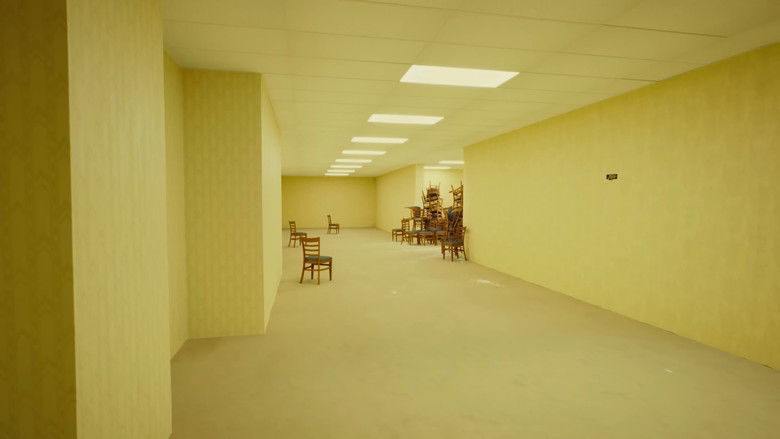
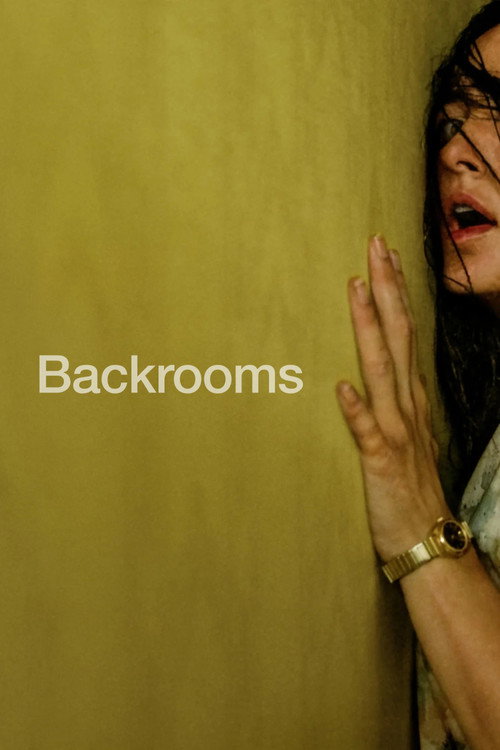
A suffocating journey into an endless yellow purgatory. The film weaves creeping liminal dread with profound human regret as a vast, buzzing corporate maze swallows reality whole.
Backrooms

Backrooms

"See how far it goes."

27 May 2026 United States of America 111 min 6.8 (980)

Director: Kane Parsons

Cast: Chiwetel Ejiofor, Renate Reinsve, Mark Duplass, Finn Bennett, Lukita Maxwell

Mystery Science Fiction Horror Nostalgia and Liminality The Architecture of Despair Trauma and Dissociation Human Connection vs. the Infinite Void
Budget: $10,000,000
Box Office: $366,424,047

Overview

Directed by the 20-year-old internet prodigy Kane Parsons, Backrooms (2026) expands his viral YouTube found-footage series into a staggering A24 feature film. The story follows Clark (Chiwetel Ejiofor), a failed architect and owner of a struggling furniture store, "Cap'n Clark's Ottoman Empire." When Clark inexplicably discovers a gateway into a seemingly infinite labyrinth of yellow-wallpapered, fluorescent-lit hallways right in his store's basement, he becomes obsessed and eventually lost in the void.

Dr. Mary Kline (Renate Reinsve), Clark's therapist, is forced to cross the threshold into this unknown dimension to save her patient. The film trades jump scares for psychological torment, relying on the terrifying vastness of its 30,000-square-foot practical set and unsettling liminal atmosphere to disorient both the characters and the audience.

As Mary ventures deeper, the laws of physics and time warp around her. She uncovers the Async Research Institute's presence and must evade entities that mimic human life, including a horrifying "Still Life" entity masquerading as Clark. The film bridges corporate existential dread with raw childhood trauma, leaving audiences questioning the very fabric of reality.

Core Meaning

At its core, Backrooms is a meditation on the isolating nature of modern commercialism and the crushing weight of unresolved trauma. The endless, empty office spaces and fluorescent lights serve as a metaphor for the hollow promises of corporate life—a purgatory built from the discarded remnants of the 20th century.

Director Kane Parsons utilizes the concept of "no-clipping" out of reality not just as a sci-fi gimmick, but as an exploration of dissociation. Clark, as a failed architect, becomes trapped in a structure that has no purpose, reflecting his own feelings of failure and alienation. The film ultimately suggests that our greatest horrors aren't monsters in the dark, but the overwhelming, indifferent emptiness of the structures we build to contain ourselves.

Thematic DNA

Nostalgia and Liminality 35%
The Architecture of Despair 25%
Trauma and Dissociation 20%
Human Connection vs. the Infinite Void 20%

Nostalgia and Liminality

Revealed through the retro 1990s aesthetic, yellow chevron wallpaper, and office layouts that feel familiar yet profoundly wrong, evoking a sense of twisted, sickening nostalgia.

The Architecture of Despair

Clark's background as a failed architect ties into the nonsensical, purposeless maze of the Backrooms. It reflects the entrapment of the working class in an endless, mundane corporate purgatory.

Trauma and Dissociation

Mary's role as a therapist brings an emotional anchor to the film. The act of falling into the Backrooms mirrors the psychological dissociation experienced during profound grief or mental breakdowns.

Human Connection vs. the Infinite Void

Mary's desperate search for Clark juxtaposed against the vast, indifferent emptiness of the complex emphasizes the fragility and necessity of human relationships in a chaotic universe.

Character Analysis

Clark

Chiwetel Ejiofor

Archetype: Tragic Victim / The Explorer Key Trait: Obsessive

Motivation

To find meaning, an escape from his failures as an architect, and to comprehend the impossible glitch in reality.

Character Arc

Clark transitions from a struggling, depressed store owner to a man obsessed with a dimensional anomaly, ultimately succumbing to the madness of the very architecture he sought to understand.

Dr. Mary Kline

Renate Reinsve

Archetype: The Rescuer / Hero Key Trait: Empathetic

Motivation

Driven by professional duty, guilt, and a genuine, desperate desire to save her patient from the abyss.

Character Arc

Starting as a grounded professional analyzing Clark's apparent delusions, Mary is forced to confront the impossible, evolving into a courageous survivor navigating an alien dimension.

Phil

Mark Duplass

Archetype: The Knowledge Keeper Key Trait: Pragmatic

Motivation

Scientific curiosity masked by corporate duty and a need to contain the anomaly.

Character Arc

As a researcher for the Async Institute, Phil serves as a bridge between the scientific reality of the Backrooms and the terrifying unknown, ultimately grappling with the moral weight of their discoveries.

Symbols & Motifs

The Yellow Chevron Wallpaper

Meaning:

Represents the sickening, endless repetition of mundane life and the decay of reality.

Context:

Coats the walls of the infinite labyrinth, providing a suffocating, monochromatic backdrop to the horror.

The Buzzing Fluorescent Lights

Meaning:

Symbolizes an artificial, inescapable reality and the sensory overload of corporate existence.

Context:

Provides the constant, maddening soundtrack to the characters' isolation throughout the dimension.

The Furniture

Meaning:

Represents the commodification of comfort and domesticity, rendered entirely useless in a void.

Context:

Found in Clark's struggling store and occasionally seen misplaced within the unnatural spaces of the Backrooms.

The "Still Life" Entity

Meaning:

Symbolizes the distortion of identity and the primal fear of losing oneself to an environment.

Context:

A terrifying entity created by the Backrooms that attempts to mimic Clark's appearance to deceive.

Memorable Quotes

All these places and buildings, rooms, misremembering themselves. It's a real mess, but also beautiful in a way, no?
— Clark

Context

Spoken by Clark as he describes the strange, physics-defying nature of the labyrinth to those outside.

Meaning

Highlights the distorted reality and uncanny "glitch in reality" nature of the Backrooms, which attempts to mimic human spaces but fails at the nuances.

Imagine describing a dog to someone who's never seen one before and then asking them to draw it. It will look similar, but the devil is in the details...
— Clark

Context

Clark explaining the unsettling nature of the rooms and why the dimension feels so deeply unnatural despite looking like a normal office.

Meaning

A profound analogy explaining the liminal horror of the Backrooms. It perfectly encapsulates the feeling of "wrongness" in the environment.

You are not supposed to be here.
— Async Researcher

Context

A warning given regarding the dangers of trespassing into the dimensional anomaly.

Meaning

Reinforces the core theme that the Backrooms is a restricted, unnatural space, indifferent or actively hostile to unauthorized human presence.

Philosophical Questions

Does humanity's desire to categorize and control the universe ultimately lead to our own isolation?

Through the Async Institute's attempts to map and utilize the infinite space of the Backrooms, the film questions the hubris of science and corporate expansion into domains that defy human logic.

What happens to our identity when we are stripped of all context and purpose?

As Clark wanders the endless, identical yellow hallways, his sense of self deteriorates. The film asks whether our identities are intrinsic or merely the result of our surroundings and social functions.

Can memory be a trap?

The Backrooms often 'misremember' reality, creating disjointed, nostalgic environments. The film explores how clinging to the past—or distorted memories of it—can trap us in a psychological purgatory.

Alternative Interpretations

While the film presents the Backrooms as a physical, extradimensional space accessed via a portal, many critics and viewers have proposed psychological interpretations. A prevailing theory suggests that the entire Backrooms complex is a manifestation of Clark's fracturing psyche—a physical embodiment of his depression, his failures as an architect, and his inability to connect with the real world.

Another reading focuses on the socio-economic angles, viewing the endless, rotting office spaces as a critique of late-stage capitalism. In this interpretation, the characters are literally swallowed by the corporate machine, forced to wander an infinite purgatory of middle-management architecture where "Everything Must Go."

Furthermore, the confusing nature of the timeline has led some to speculate about time loops. Because the Backrooms distort time, some fans theorize that the entities are actually future or past versions of the victims, heavily mutated by the environment, making Mary's rescue mission tragically futile.

Cultural Impact

Backrooms (2026) represents a watershed moment in cinema, successfully bridging the gap between internet creepypasta, Gen-Z YouTube content creation, and prestige Hollywood filmmaking. A24's gamble on a 19-year-old director paid off massively, proving that viral analog horror could be translated into a financially successful, critically acclaimed feature film without losing its soul.

The film cemented "liminal space horror" into the mainstream consciousness. It shifted the horror genre away from traditional slashers and jump scares toward environmental dread and psychological unease. Critics praised Chiwetel Ejiofor's grounded performance and Parsons' masterful command of tone, drawing comparisons to the existential dread found in Tarkovsky's Stalker and Kubrick's The Shining.

Commercially, it became A24's highest-grossing film, proving that internet folklore, when treated with cinematic respect, possesses massive box-office potential. It set a new precedent for how studios discover talent, paving the way for more digital-native creators to enter traditional Hollywood systems.

Audience Reception

Audience reception for Backrooms was overwhelmingly positive, earning it a massive box office haul and high audience scores. Viewers widely praised Kane Parsons' transition from YouTube to the big screen, marveling at the film's suffocating atmosphere, meticulous sound design, and the seamless blend of live-action sets with digital animation.

Chiwetel Ejiofor and Renate Reinsve received acclaim for bringing emotional weight to a concept that could have easily felt like a hollow technical exercise. However, the film was not without its detractors. Some general audiences criticized the pacing, noting that the emphasis on mood and environmental dread occasionally dragged the narrative, and fans of the YouTube series noted the absence of the iconic 'Bacteria' monster.

The ending proved highly controversial and divisive; many praised its ambiguous, haunting nature, while others found it frustratingly unresolved, feeling it prioritized aesthetic mystery over character closure. Despite these critiques, it was widely celebrated as a groundbreaking achievement in modern horror.

Interesting Facts

  • Director Kane Parsons was only 20 years old when he directed the film, having created the original YouTube series 'The Backrooms (Found Footage)' at age 16 using the 3D software Blender.
  • The production built an enormous 30,000-square-foot practical set to capture the suffocating, endless feel of the Backrooms without relying entirely on CGI.
  • An extended cut of the film, titled the 'Everything Must Go Edition,' was released in theaters on July 3, 2026, adding new footage that expanded the lore.
  • The film became A24's highest-grossing release in its history, pulling in nearly $350 million worldwide and surpassing expectations for a YouTube adaptation.
  • The terrifying 'Still Life' entity, a distorted mimic of Clark, was played by 7-foot-7 Romanian basketball player Robert Bobroczkyi.

Easter Eggs

"No-clipping" through reality

The film references the original internet creepypasta and video game culture by depicting the entry into the Backrooms as "no-clipping" through a solid wall, mimicking a known video game bug where players fall out of the map.

The Async Research Institute

A direct nod to Kane Parsons' expansive YouTube lore, Async is the mysterious organization responsible for opening the threshold to the Complex, linking the film directly to the established web series universe.

Cap'n Clark's Ottoman Empire

The mundane items from Clark's store serve as a visual anchor, contrasting with the empty liminal space, and subtly hinting at how the Backrooms absorb fragments of our commercial reality.

⚠️ Spoiler Analysis

Click to reveal detailed analysis with spoilers

Frequently Asked Questions

Explore More About This Movie

Dive deeper into specific aspects of the movie with our detailed analysis pages

Comments (0)

Leave a comment

No comments yet. Be the first to share your thoughts!

Similar Movies