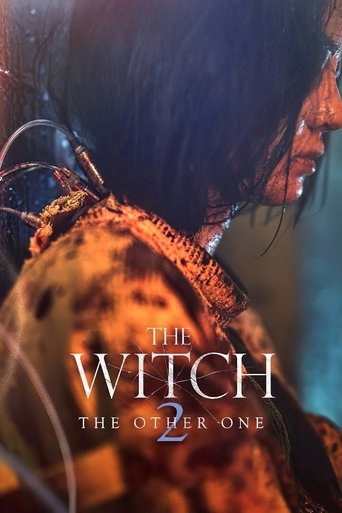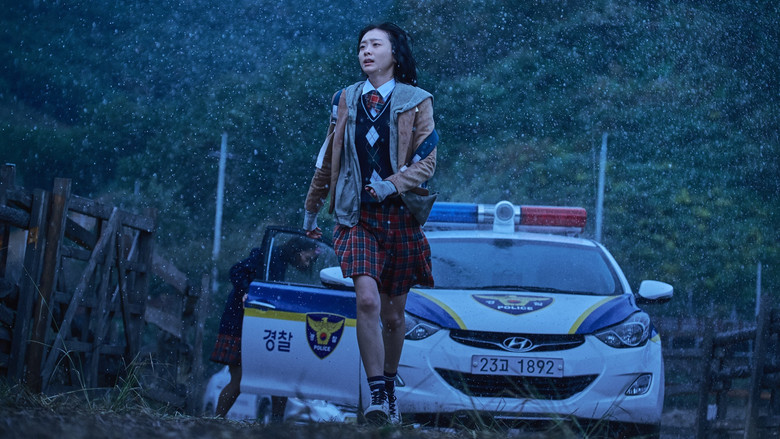
The Witch: Part 1. The Subversion
마녀
"Everything changed after they appeared."
Overview
"The Witch: Part 1. The Subversion" begins with a young girl escaping a mysterious and violent incident at a secret laboratory, leaving a trail of bodies. She collapses on a farm and is taken in by an elderly couple who raise her as their own, naming her Ja-yoon. Ten years later, Ja-yoon (Kim Da-mi) is a bright high school student living a peaceful life, seemingly with no memory of her past. However, she suffers from debilitating headaches. To help her family with their financial struggles and her adoptive mother's progressing dementia, Ja-yoon's best friend Myung-hee (Go Min-si) convinces her to enter a nationally televised singing competition.
During the audition, Ja-yoon showcases a 'magic trick'—levitating the microphone—which goes viral. This public display of her telekinetic power alerts the very people she escaped from a decade ago. Soon, she is approached by enigmatic and dangerous figures from her past, including a cocky young man known as Nobleman (Choi Woo-shik) and the ruthless Dr. Baek (Cho Min-soo), the scientist who ran the experiments. As these sinister characters close in, threatening her family and idyllic life, the facade of the innocent country girl begins to crumble, hinting at a much darker and more complex truth hidden beneath her supposed amnesia.

Core Meaning
The core meaning of "The Witch: Part 1. The Subversion" explores the dark consequences of scientific hubris and the inescapable nature of one's identity. Director Park Hoon-jung poses a critical question about what defines humanity: is it our upbringing and the love we receive (nurture), or the inherent traits we are born with (nature)? The film deconstructs the typical superhero origin story by presenting a protagonist whose powers are not a gift but a curse born from unethical experimentation. It serves as a commentary on the generational conflict, where an older generation of scientists creates and then fears their powerful, younger creations, ultimately failing to control them. The 'subversion' of the title refers not only to the plot twist but to the subversion of audience expectations, transforming a seemingly gentle coming-of-age story into a brutal tale of premeditated vengeance.
Thematic DNA
Nature vs. Nurture
This is the central theme of the film. Ja-yoon is raised for ten years in a loving home, developing into a kind and dutiful daughter. This idyllic life represents the 'nurture' aspect. However, the film brutally reveals that her innate, genetically engineered nature as a powerful and ruthless weapon ('nature') was merely suppressed, not erased. The ultimate reveal shows that her 'nature' drove her to manipulate her 'nurture' all along to achieve her goals, suggesting a cynical view where inherent programming can override even a decade of loving care.
Identity and Memory
Ja-yoon's entire persona for the first half of the film is built on the premise of amnesia. She is defined by what she doesn't remember. The narrative questions whether identity is the sum of our memories or something more intrinsic. The shocking twist—that she never lost her memory—re-contextualizes her entire character arc. Her journey is not one of rediscovery, but of calculated execution. Her identity was never lost; it was a mask she wore, proving that one's true self can be a weaponized secret.
The Hubris of Science
Dr. Baek and her organization embody scientific ambition without moral restraint. They genetically modify children to create superhumans, viewing them as experiments rather than people. The film acts as a cautionary tale, demonstrating that creating beings with immense power without considering the ethical implications or the potential for them to develop their own agency is a recipe for disaster. The creators are ultimately outsmarted and destroyed by their own creation, a classic Frankenstein-esque theme of science's arrogance leading to its downfall.
Deception and Manipulation
Deception operates on multiple levels. Ja-yoon deceives her adoptive family, her friends, her enemies, and the audience. She masterfully manipulates everyone around her by playing the part of a vulnerable, amnesiac girl to orchestrate a confrontation with her creators on her own terms. The film itself is a grand act of manipulation, leading the audience down a familiar path before violently subverting their expectations in the final act. Dr. Baek also tries to manipulate Ja-yoon with the promise of a cure, but finds herself completely outplayed.
Character Analysis
Koo Ja-yoon
Kim Da-mi
Motivation
Her primary motivation is survival. She learns that her powers are causing a degenerative brain condition that will kill her without a monthly serum or a permanent cure from a blood relative. Every action she takes—from escaping as a child, finding a family, going on television, to confronting her creators—is a calculated step in her desperate and ruthless plan to find this cure.
Character Arc
Ja-yoon's perceived arc is that of a classic 'sleeper hero'—an innocent girl who discovers her powers when her loved ones are threatened. However, her true arc is revealed to be completely flat; she was never innocent. She begins the film as a supremely intelligent, powerful, and manipulative individual feigning weakness, and she ends the film as the same, having successfully executed a long-term plan. Her development is not about becoming powerful, but about revealing the power she always possessed.
Dr. Baek
Cho Min-soo
Motivation
Her motivation is the pursuit of scientific advancement at any cost, specifically in the realm of human enhancement. She wants to create and control the ultimate human weapon. She feels a twisted sense of parental pride in Ja-yoon's abilities but ultimately sees her as a successful, yet rogue, experiment that must be brought back under control or eliminated.
Character Arc
Dr. Baek is a static character who embodies scientific hubris. She begins the film as the cold, calculating head of the project, proud of her 'perfect' creation even as she hunts her down. She believes she can control Ja-yoon through psychological manipulation and a dependency on the serum. Her arc is one of underestimation; she never evolves beyond her belief that she is the master, which leads directly to her demise at the hands of the very 'perfection' she created.
Nobleman
Choi Woo-shik
Motivation
His motivation seems to be a mix of duty to Dr. Baek and a personal desire to prove his superiority over Ja-yoon, whom he remembers from their time in the lab. He enjoys the power and violence his abilities afford him and seeks to dominate others, especially Ja-yoon, who represents the one who got away and was considered the project's masterpiece.
Character Arc
Nobleman is another product of the same experiments, positioned as Ja-yoon's peer and rival. His arc is one of frustrated superiority. He clearly feels he is the superior creation and is infuriated by Ja-yoon's feigned ignorance and later, her superior power. He doesn't develop much beyond his initial role as an arrogant, violent enforcer, serving primarily as a physical and psychological obstacle for Ja-yoon and a representation of what she could have been had she not escaped.
Mr. Choi
Park Hee-soon
Motivation
His motivation is damage control and elimination of threats. Unlike Dr. Baek who wants to study and control Ja-yoon, Mr. Choi simply wants her dead, viewing her as a failed experiment that is too dangerous to exist. His past injury, inflicted by Ja-yoon during her initial escape, likely adds a personal, vengeful element to his pursuit.
Character Arc
Mr. Choi acts as the more grounded and pragmatic antagonist compared to Dr. Baek's scientific zeal. He sees the child experiments for what they are: uncontrollable monsters. His arc is a grim, straight line. From the beginning, his solution is to eliminate the threat, a stance that never wavers. He correctly assesses the danger Ja-yoon poses but is ultimately no match for her power, his pragmatic approach failing in the face of overwhelming force.
Symbols & Motifs
The Farm
The farm symbolizes the idyllic, peaceful life of normalcy and the 'nurture' side of Ja-yoon's identity. It represents warmth, family, and innocence. It is a carefully chosen sanctuary where she can hide in plain sight and construct her facade.
The film visually contrasts the warm, natural lighting and earthy tones of the farm with the cold, sterile, and brutalist architecture of the laboratory. Ja-yoon's life on the farm, filled with mundane chores and loving interactions, serves as the perfect cover for the calculated predator lying in wait. Her ultimate return to provide her parents with the serum shows a lingering attachment, but also solidifies that the farm was a means to an end.
Boiled Eggs
In the context of the film, the boiled eggs eaten on the train represent a moment of manufactured normalcy and camaraderie with her friend, Myung-hee. However, they also hint at her immense, suppressed physical capabilities and her calculated persona.
During a train scene, Ja-yoon and Myung-hee eat boiled eggs, a common snack in South Korea. In a behind-the-scenes anecdote, it's revealed actress Kim Da-mi ate nearly three trays (around 90) of eggs during filming for this one scene, a feat that humorously mirrors her character's hidden superhuman nature. The simple act of eating becomes a subtle symbol of the extraordinary hiding within the ordinary.
The Laboratory
The laboratory is a symbol of Ja-yoon's true origin, her 'nature'. It represents the cold, unethical, and detached world of science that created her. It is a place of trauma, power, and ultimately, confrontation with her identity.
The film opens and closes within the confines of such facilities. Depicted with sterile, concrete corridors and a palette of cold blues and greys, it's the antithesis of the warm, lively farm. When Ja-yoon is brought back, she is restrained and treated like a specimen, but it is here that she sheds her false identity and unleashes her full power, reclaiming the space of her trauma as the stage for her revenge.
Memorable Quotes
She baited us. We didn't find her, she found us.
— Dr. Baek
Context:
Spoken in the laboratory after Ja-yoon has been injected with the stabilizing serum and reveals she never had amnesia. Dr. Baek finally understands that Ja-yoon's appearance on the TV show was not an accident but a deliberate trap to lure them out.
Meaning:
This line marks the turning point of the film, where Dr. Baek (and the audience) realizes the full extent of Ja-yoon's manipulation. It signifies the complete subversion of the narrative, revealing that the hunted was the hunter all along.
You created me like this.
— Koo Ja-yoon
Context:
Ja-yoon says this to Dr. Baek during their confrontation in the lab. After shedding her innocent persona, she uses this line to justify her impending violence, framing it as the inevitable outcome of the experiment Dr. Baek started.
Meaning:
This is a powerful statement of accountability, where Ja-yoon throws the responsibility for her monstrous nature back onto her creator. It's a classic Frankenstein moment, highlighting the theme of scientific hubris and the consequences of playing God.
I'm in a class of my own.
— Koo Ja-yoon
Context:
Said during her brutal fight with Nobleman in the laboratory's final act. After easily overpowering him, she makes this statement to emphasize that she was always, and will always be, superior to the other 'upgraded' children.
Meaning:
This quote encapsulates Ja-yoon's supreme confidence and the revelation of her true power level. It's a direct challenge to Nobleman and the others who believe themselves to be her equal, establishing her as the apex predator in their hierarchy.
Philosophical Questions
Can nurture ever truly overcome a malevolent nature?
The film explores this question through Ja-yoon's ten-year life with her loving adoptive parents. For all intents and purposes, she was raised to be a good person. However, the narrative reveals this entire period was a calculated phase in her master plan. The film leans towards a deterministic and cynical conclusion: that her genetically engineered, ruthless nature was always the dominant force, merely using the tools of 'nurture'—love, family, friendship—as a disguise to achieve its own selfish ends. It questions whether genuine change is possible for someone 'born bad'.
What responsibility does a creator have for its creation?
Dr. Baek is the creator, and Ja-yoon is her creation. The film uses their conflict to examine scientific ethics. Dr. Baek feels a sense of ownership and pride, but no parental responsibility or empathy; to her, Ja-yoon is a product. Ja-yoon's line, "You created me like this," directly confronts this. The film suggests that creators cannot absolve themselves of the consequences of their work. Dr. Baek's refusal to accept responsibility, and her attempt to control rather than understand her creation, leads directly to her own destruction, serving as a grim answer to the question.
What is the true cost of survival?
Ja-yoon's core motivation is to survive a terminal illness caused by her powers. The film presents her journey not as a heroic struggle, but as a path of extreme manipulation, violence, and betrayal. She sacrifices her relationship with her adoptive parents (by revealing her true self and leaving), murders dozens of people, and lives a ten-year lie. The film asks the audience to consider what lines they would be willing to cross for their own survival. Ja-yoon's answer is clear: there are no lines she will not cross.
Alternative Interpretations
While the film's main twist is quite explicit, the ending leaves room for several interpretations and fan theories, primarily concerning the final scene.
- Dr. Baek's Twin as Ja-yoon's Mother: A prominent theory suggests that Dr. Baek's twin sister, whom Ja-yoon confronts at the end, is actually her biological mother. The cure for Ja-yoon's condition is a bone marrow transplant from a blood relative, which would give the sister immense leverage. This interpretation adds a layer of personal drama to the search for a cure, suggesting Ja-yoon may have to confront or coerce her own mother in the sequel.
- The Scarred Girl's Allegiance: In the final moments, a mysterious young woman with scars on her face appears. One interpretation is that she is another escaped experiment, potentially hostile and a new antagonist for the sequel. Another reading suggests she might be an ally or subordinate to Dr. Baek's sister, acting as her bodyguard. Ja-yoon's immediate threat to her implies a history between them, possibly from the original lab massacre.
- The Adoptive Father's Knowledge: When Ja-yoon leaves her family, her adoptive father alludes to having always known, or at least suspected, what she was capable of. This can be interpreted in a few ways. He might have simply put the pieces together over the years due to small, unexplainable events. A more complex interpretation is that he had a deeper understanding of her origins than he let on, perhaps even having some past connection to the organization, which would re-contextualize his decision to take her in.
Cultural Impact
Released in 2018, "The Witch: Part 1. The Subversion" arrived during a period of surging global interest in South Korean cinema, a trend that would culminate with "Parasite's" Oscar win a couple of years later. The film was a significant box office success in South Korea, attracting over 3.1 million viewers.
Critically, the film was often analyzed as a South Korean take on the Hollywood superhero and YA dystopian genres, sharing narrative elements with franchises like "X-Men" or films like "Hanna" and "Logan". However, it was praised for subverting those familiar tropes with a distinctly Korean cinematic sensibility, blending intimate high-school drama with visceral, bloody action and a shocking narrative twist. The slow-burn pacing of the first half, which suddenly explodes into hyper-violent action, was noted by many critics as a bold structural choice.
The film's greatest impact was arguably the launch of Kim Da-mi's career. Her layered performance as the seemingly innocent girl who reveals herself to be a cunning anti-hero was universally acclaimed and established her as a major new talent in the industry. The character of Ja-yoon became an iconic female action anti-hero, celebrated for her intelligence and agency as much as her physical prowess, contributing to a growing trend of powerful female protagonists in Korean media. The movie successfully established a new franchise, with its sequel further expanding the universe and solidifying its place in modern Korean genre cinema.
Audience Reception
Audience reception for "The Witch: Part 1. The Subversion" was largely positive, with viewers praising its unique blend of genres and its thrilling second half. The most consistently lauded aspect of the film was the breakout performance of Kim Da-mi, whose ability to transition from a sweet, innocent schoolgirl to a cold, calculating killer was considered phenomenal. The final 30-40 minutes of the film, which feature intense, well-choreographed, and brutal action sequences, were frequently highlighted as a major strength. The shocking plot twist was also a significant point of praise, with many viewers enjoying how it re-contextualized the entire preceding narrative.
Points of criticism often centered on the film's pacing. Some viewers found the first half, which focuses on building Ja-yoon's life as a normal teenager, to be slow compared to the explosive finale. Another common critique was the heavy reliance on dialogue and exposition in the final act to explain the backstory and the nature of the experiments, which some felt was clunky. Despite these criticisms, the overall verdict from audiences was that it was a fresh and exciting entry in the action/sci-fi genre, with many eagerly anticipating the sequel.
Interesting Facts
- Lead actress Kim Da-mi was chosen for the role of Ja-yoon after auditioning against 1,500 other candidates.
- This was Kim Da-mi's first major lead role, and her performance earned her numerous Best New Actress awards, including at the prestigious Blue Dragon Film Awards and Grand Bell Awards.
- The film was written and directed by Park Hoon-jung, who is also known for writing the screenplay for the acclaimed Korean thriller "I Saw the Devil" (2010).
- For the train scene where Ja-yoon and her friend eat boiled eggs, actress Kim Da-mi reportedly ate nearly three trays of eggs (approximately 90 eggs) during the course of filming.
- The film was always intended to be the first part of a larger series, as indicated by its title. A sequel, "The Witch: Part 2. The Other One," was released in 2022.
⚠️ Spoiler Analysis
Click to reveal detailed analysis with spoilers
Frequently Asked Questions
Explore More About This Movie
Dive deeper into specific aspects of the movie with our detailed analysis pages
Comments (0)
No comments yet. Be the first to share your thoughts!