Skip to content
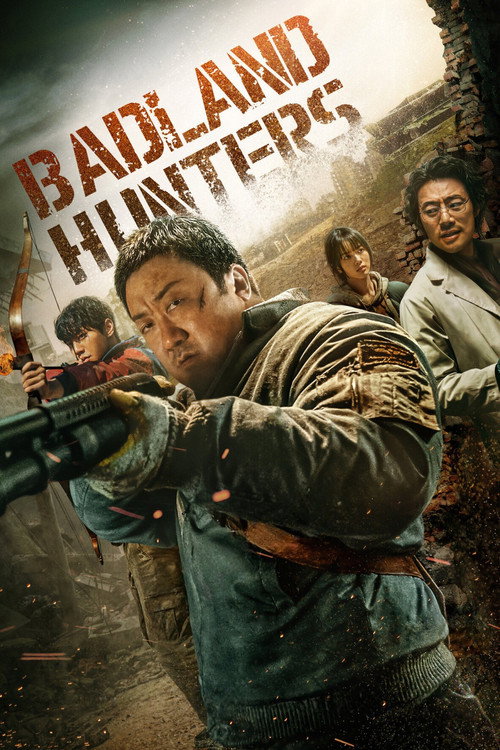
Badland Hunters
In a sun-bleached post-apocalyptic dustbowl of fractured concrete and raw desperation, visceral primal vengeance unleashes like a runaway freight train crashing through the broken remnants of human morality.
Badland Hunters

Badland Hunters

황야

"One last hunt to save us all."

26 January 2024 South Korea 107 min 6.7 (823)

Director: Heo Myeong-haeng

Cast: Don Lee, Lee Jun-young, Lee Hee-jun, Roh Jeong-eui, Ahn Ji-hye

Action Thriller Adventure Paternal Grief and Redemption False Utopias and Exploitative Cults Ethics of Scientific Ambition Survival of Moral Integrity in Chaos

Overview

Three years after a catastrophic earthquake turns Seoul into an orderless, arid wasteland, the surviving population struggles for basic necessities like clean water and food. Amidst the ruins, Nam-san, a formidable wasteland hunter, roams the desolate landscape alongside his young companion Choi Ji-wan. Together, they scavenge for resources, hunt wild beasts, and trade with a small enclave of survivors residing in a makeshift village built from abandoned buses and rubble. The duo forms a warm, protective bond with Han Su-na, an observant teenage artist living with her grandmother.

Their precarious peace is shattered when a group claiming to be volunteer welfare workers arrives from the Hwang Gung Apartments—the only high-rise building still standing in Seoul. Promising abundant clean water, safety, and education, they persuade Su-na and her grandmother to relocate to their fortified enclave, claiming teenagers represent the future of humanity. However, after Su-na's grandmother is murdered during the journey and Su-na is separated, Nam-san and Ji-wan realize that the offer was a trap.

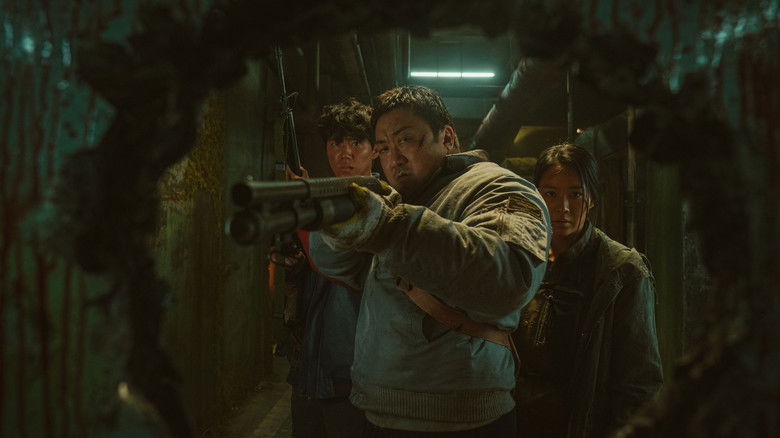
Joined by Lee Eun-ho, a former Air Force special forces sergeant seeking to expose the truth, Nam-san and Ji-wan embark on a relentless rescue mission into the heart of the apartment complex. They soon discover that the sanctuary is controlled by Dr. Yang Gi-su, an unhinged scientist conducting lethal human experiments under the guise of saving mankind. Nam-san must fight through militarized cultists and mutated super-soldiers to rescue Su-na before she becomes the doctor's next victim.
Core Meaning

At its core, Badland Hunters uses high-octane action and post-apocalyptic tropes to explore the corruption of hope and the dangers of uncurbed scientific ethics. Directed by veteran stunt coordinator Heo Myeong-haeng, the film emphasizes pure, visceral entertainment while contrasting two opposing visions of human survival:

  • Organic Community vs. Totalitarian Messiahs: Nam-san’s community relies on mutual cooperation, fair trade, and shared burden despite extreme poverty. In contrast, Dr. Yang’s regime at Hwang Gung Apartments promises clean water and shelter, but demands total conformity, authoritarian submission, and the literal sacrifice of the young.
  • Paternal Love vs. Paternal Obsession: Both Nam-san and Dr. Yang lost daughters during the catastrophe. Nam-san channels his grief into protecting the living youth around him, respecting their autonomy. Dr. Yang’s unresolved grief morphs into a monstrous god complex, treating living human beings as mere biological raw material to sustain his deceased daughter's remains.

Thematic DNA

Paternal Grief and Redemption 30%
False Utopias and Exploitative Cults 25%
Ethics of Scientific Ambition 25%
Survival of Moral Integrity in Chaos 20%

Paternal Grief and Redemption

Nam-san lost his daughter in the initial collapse. His bond with Su-na gives him a second chance at fatherhood, motivating his relentless crusade to save her. Conversely, Dr. Yang keeps his dead daughter’s severed torso alive in a portable life-support apparatus, sacrificing other children to achieve his goal.

False Utopias and Exploitative Cults

Hwang Gung Apartments appears as an oasis in the desert. The residents are brainwashed into believing that sacrificing their children’s freedom is a privilege necessary for the new humanity. The film critiques how traumatized populaces readily surrender agency to charismatic tyrants offering basic security.

Ethics of Scientific Ambition

Dr. Yang believes that extreme environmental collapse justifies rewriting human biology. By attempting to engineer a human subspecies that can survive without water, he loses all respect for human life, transforming his test subjects and soldiers into reptilian, mindless mutants.

Survival of Moral Integrity in Chaos

In a world devoid of laws, characters are defined by how they treat the weak. While gangs and cults exploit others, Nam-san, Ji-wan, and Sgt. Eun-ho maintain personal codes of justice, demonstrating that true survival requires preserving one's moral compass.

Character Analysis

Nam-san

Ma Dong-seok (Don Lee)

Archetype: The Unstoppable Protector / Hero Key Trait: Overwhelming physical strength, deadpan humor, and fierce loyalty.

Motivation

Rescuing Su-na and redeeming his past failure to save his own daughter.

Character Arc

Transforms from a weary hunter focused on basic village survival into an active savior dismantling a totalitarian regime.

Choi Ji-wan

Lee Jun-young

Archetype: The Eager Sidekick / Young Apprentice Key Trait: Youthful agility, archery skills, and unwavering loyalty to Nam-san.

Motivation

Protecting and winning the affections of Su-na.

Character Arc

Grows from an inexperienced, headstrong youth who nearly gets killed by a crocodile into a brave combatant.

All 5 characters and cast

Symbols & Motifs

The Crocodile

Meaning:

Represents the raw, uncivilized violence of the badlands.

Context:

Featured in the opening action scene, where Nam-san wrestling and slaying it symbolizes human strength triumphing over wild threats to protect the community.

Purified Water

Meaning:

Symbolizes life, control, and deception.

Context:

Dr. Yang uses clean water to entice survivors, while secretly lacing it with chemicals that subdue captives and facilitate his experiments.

The Suitcase Life-Support Apparatus

Meaning:

Symbolizes Dr. Yang's refusal to accept death, embodying the literal baggage of unresolved grief.

Context:

Carried by Dr. Yang throughout the film, containing his daughter’s upper body and head.

The Machete and Shotgun

Meaning:

Symbolizes direct, unfiltered justice relying on raw physical force to end evil.

Context:

Used as Nam-san’s signature primary weapons against hostile scavengers and mutated soldiers.

Hwang Gung Apartments

Meaning:

Symbolizes both a physical refuge and a psychological prison of authoritarian delusion.

Context:

Standing solitary amid crushed debris as the sole remaining concrete structure in Seoul.

Memorable Quotes

세상이 망했다고 인생까지 망한 건 아니잖아.
— Nam-san

Context

Spoken during a quiet moment in the bus district.

Meaning

Summarizes Nam-san's pragmatic optimism and refusal to let environmental collapse destroy the human spirit.

내가 인류의 미래다.
— Dr. Yang Gi-su

Context

Spoken in the apartment laboratory while defending his experiments.

Meaning

Exposes his god complex and his detachment from moral ethics.

All 5 quotes

Philosophical Questions

Does existential survival justify compromising ethical boundaries?

Dr. Yang argues that environmental extinction renders traditional morality obsolete. The film rejects this by demonstrating that abandoning ethics turns humans into literal monsters.

What constitutes true human dignity in the absence of civilization?

Explored through Nam-san's community, where dignity is maintained through fair trade, mutual assistance, and protection of the vulnerable.

Is an engineered, regimented utopia preferable to chaotic freedom?

Hwang Gung Apartments offers clean rooms and water at the price of complete submission and child sacrifice, contrasting with the harsh but genuine freedom of the badlands.

Alternative Interpretations

The film can be analyzed through several distinct lenses:

Full ending explanation

Cultural Impact

Badland Hunters arrived during a wave of South Korean dystopian productions (such as Train to Busan, Peninsula, Concrete Utopia, and All of Us Are Dead) reflecting societal anxieties regarding urban infrastructure, disaster preparedness, and social isolation.

The film demonstrated a shift where top Korean stunt directors transition into feature film directors, leading to direct action design. Director Heo Myeong-haeng went on to direct The Roundup: Punishment immediately after.

Audience Reception

Praised Aspects: Viewers praised the visceral, heavy-hitting action choreography with practical impact, Don Lee’s charismatic screen presence and deadpan comedy, Ahn Ji-hye's martial arts performance, and fast-paced entertainment value.

Criticisms: Critics noted a formulaic, predictable storyline with thin character backstories, lack of emotional depth compared to Concrete Utopia, and underdeveloped villains.

Divided Elements: Audiences were divided over the genre shift from grounded post-apocalyptic survival into mutant super-soldier monster brawls, as well as tonal shifts between dark themes and lighthearted comedy.

Interesting Facts

  • The film marks the feature directorial debut of Heo Myeong-haeng, a veteran stunt coordinator who worked on Oldboy, Train to Busan, The Good, the Bad, the Weird, and The Roundup series.
  • Director Heo and lead star Ma Dong-seok have collaborated for over 20 years as actor and stunt director, with Ma personally selecting Heo to direct.
  • Ma Dong-seok co-conceived the project from an 8-page treatment he wrote about post-apocalyptic reptilian mutations, which was merged with Climax Studio's disaster universe.
  • Ma Dong-seok intentionally trimmed back character backstories to maintain a fast, video game-like pace suited for global streaming audiences.
  • Actress Ahn Ji-hye performed nearly all of her high-level tactical martial arts combat scenes without a stunt double.
  • Upon its release on Netflix on January 26, 2024, the film claimed the #1 spot on Netflix's Non-English Global Film chart, amassing over 26 million viewing hours within its first week.

Easter Eggs

Hwang Gung Apartments

The primary setting is Hwang Gung Apartments, directly referenced from the 2023 film Concrete Utopia. Producer Byun Seung-min produced both films set in the same post-earthquake universe three years later.

Homage to The Good, the Bad, the Weird

Nam-san wielding a lever-action shotgun and machete in a barren wasteland pays homage to Kim Jee-woon’s 2008 South Korean western, on which director Heo worked as a stunt performer.

The Machete Reach Gag

In a hallway brawl, Nam-san cannot reach his machete strapped to his back due to his massive shoulder muscle mass, playing on Don Lee's real-life physical build.

Reptilian Mutation Concept

The military guard mutants displaying lizard-like regeneration stem directly from Ma Dong-seok's original reptilian human treatment draft.

Frequently Asked Questions

Explore More About This Movie

Dive deeper into specific aspects of the movie with our detailed analysis pages

Comments (0)

Leave a comment

No comments yet. Be the first to share your thoughts!

Similar Movies