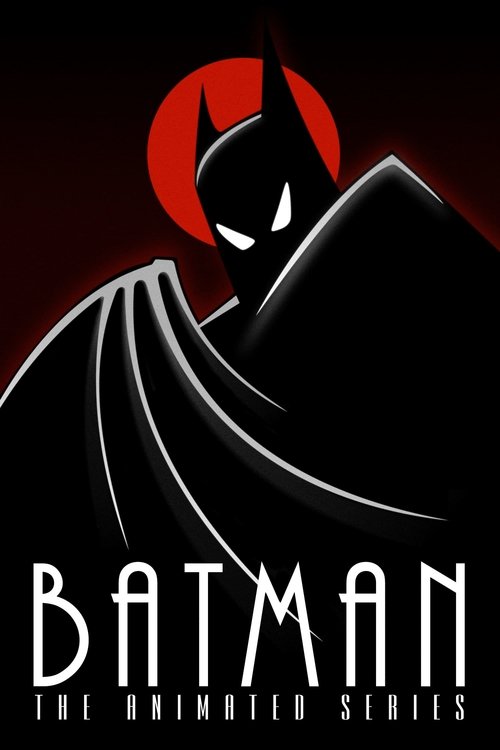
Batman: The Animated Series
Overview
"Batman: The Animated Series" presents a mature, nuanced take on the Batman mythos, set in the visually distinct, timeless metropolis of Gotham City. The series follows billionaire Bruce Wayne, who, haunted by the murder of his parents, wages a one-man war on crime as the nocturnal vigilante, Batman. The narrative is not a continuous arc but a collection of episodic stories that explore the complex psychology of Batman, his allies, and his extensive rogues' gallery. While fighting crime is central, the show dedicates significant time to developing its characters, often portraying its villains not as simple criminals, but as tragic figures born from trauma, obsession, or societal failings.
Across its run, the series delves into Bruce Wayne's internal struggle, his unwavering, self-imposed moral code, and the toll his crusade takes on his personal life. It introduces and develops his key relationships with loyal butler Alfred Pennyworth, the first Robin, Dick Grayson, and Commissioner James Gordon. The show avoids a simple black-and-white morality, instead exploring themes of justice, vengeance, redemption, and the very nature of good and evil within the dark, atmospheric confines of Gotham. It is a character-driven drama as much as it is a superhero action show, setting a new standard for animated storytelling.
Core Meaning
The core meaning of "Batman: The Animated Series" is an exploration of trauma and its aftermath, examining how individuals cope with profound loss and injustice. The creators convey that one's response to suffering defines their character. Bruce Wayne channels his pain into a rigid, non-lethal code of justice, becoming a symbol of hope for a corrupt city. Conversely, many of his antagonists are depicted as individuals who have been broken by their own tragedies—a corrupt system, a terrible accident, or personal loss—and have succumbed to madness, revenge, or nihilism. The series posits that the line between hero and villain is often blurred by shared experiences of pain, and true heroism lies not in the absence of darkness, but in the constant struggle to overcome it without sacrificing one's humanity.
Thematic DNA
Duality and the Fractured Psyche
The series is built on the theme of duality. The most prominent example is Bruce Wayne and his alter ego, Batman, representing the conflict between a public facade and a hidden, tormented self. Kevin Conroy was the first actor to use two distinct voices for the roles, emphasizing this split. This theme extends to villains like Two-Face, whose every action is dictated by the flip of a coin, symbolizing his fractured identity and the struggle between good and evil within him. Other characters, like Catwoman, embody moral ambiguity, constantly shifting between self-interest and heroism. The show consistently explores the psychological toll of leading a double life and the internal conflicts that define its characters.
Tragedy and Sympathetic Villainy
A hallmark of the series is its humanization of villains. Many antagonists are not inherently evil but are products of tragic circumstances. The Emmy-winning episode "Heart of Ice" famously revamped Mr. Freeze from a B-list gimmick villain into a tragic figure, a scientist driven to crime in a desperate attempt to save his terminally ill wife. This approach is applied to characters like Clayface, an actor disfigured and driven mad, and Two-Face, a noble district attorney psychologically broken by crime and betrayal. The show suggests that anyone, under the right pressure, can break, making its villains more relatable and their stories more poignant.
Justice vs. Vengeance
The series constantly examines Batman's motivations and the fine line he walks between justice and vengeance. Haunted by his parents' murder, his crusade is deeply personal. Episodes like "I Am the Night" show Batman questioning his own effectiveness and purpose after Commissioner Gordon is shot, wondering if his mission is a mere charade to cope with his trauma. The iconic line from "Nothing to Fear,"—"I am vengeance! I am the night! I am Batman!"—is delivered as he overcomes a fear toxin-induced vision of his father expressing disapproval, reclaiming his identity not just as a man seeking revenge, but as a symbol of justice that criminals should fear. His strict no-kill rule is a recurring test of his moral code, differentiating his methods from the criminals he pursues.
The Nature of Fear
Fear is a central element, used as both a weapon and a psychological hurdle. Batman weaponizes fear, using his appearance and reputation to intimidate Gotham's underworld. His entire persona is crafted to be a terrifying symbol. However, the series also delves into Bruce Wayne's own fears and vulnerabilities, particularly through the villain Scarecrow. In "Nothing to Fear," Scarecrow's toxin forces Batman to confront his deepest anxieties: the fear of failing his parents' memory. The show explores how characters either master their fears or are consumed by them, making it a powerful motivator for both heroes and villains.
Character Analysis
Bruce Wayne / Batman
Kevin Conroy
Motivation
Batman's primary motivation is the childhood trauma of witnessing his parents' murder. This singular event fuels his relentless, lifelong mission to rid Gotham of the crime that took their lives. His motivation evolves from a simple desire for vengeance into a more complex dedication to an abstract ideal of justice. He is driven by a profound sense of responsibility and an unwavering belief that he can prevent others from suffering the same fate he did, holding himself to a strict moral code, most notably his refusal to kill.
Character Arc
Bruce Wayne's arc throughout the series is not one of radical transformation, but of deepening resolve and the subtle healing of trauma. Initially driven purely by the vow he made after his parents' murder, his journey involves learning to accept help and build a surrogate family. His tense but evolving partnership with Dick Grayson (Robin/Nightwing) and his mentorship of Barbara Gordon (Batgirl) force him to open up and share the burden of his crusade. While he remains a brooding and solitary figure, his interactions with these allies reveal his capacity for growth and emotional connection, slowly transforming his mission from a solitary vendetta into a collaborative effort to protect his city.
The Joker
Mark Hamill
Motivation
The Joker's motivation is theatrical anarchy. He lacks a desire for wealth or power in the traditional sense; his goal is to prove that life is a meaningless joke and that anyone, even the stoic Batman, can be broken. He is driven by a compulsive need to create chaos and to engage in a psychological battle with his nemesis. His crimes are elaborate, twisted performances designed to entertain himself and torment Batman, whom he views as the ultimate straight man for his deadly comedy routine.
Character Arc
The Joker's character does not have a traditional arc of growth; instead, he remains a constant force of chaos and nihilism. His portrayal is that of a fully-formed psychopath whose sole purpose is to challenge Batman and spread mayhem for his own amusement. His arc is less about internal change and more about the escalating nature of his schemes and his deepening obsession with Batman. He represents the antithesis of Batman's order and control. The series establishes him as Batman's most personal and dangerous foe, a menacing, merciless, and dangerously charismatic villain whose unpredictability is his greatest weapon.
Dick Grayson / Robin / Nightwing
Loren Lester
Motivation
As Robin, Dick is motivated by a desire to bring the criminals who murdered his own family to justice, a goal that mirrors Bruce's own. He is also driven by a youthful idealism and a genuine desire to help people, which provides a necessary balance to Batman's grim determination. As he matures, his motivation shifts towards forging his own identity outside of Batman's shadow, proving to himself and to Bruce that he can be his own man and a different kind of hero.
Character Arc
Dick Grayson undergoes one of the most significant character arcs in the series. He begins as Batman's loyal but occasionally headstrong partner, Robin. As the series progresses, their relationship becomes strained due to Batman's controlling nature and Dick's desire for independence. This tension culminates in him quitting his role as Robin. He later returns in "The New Batman Adventures" as Nightwing, a hero in his own right, operating on his own terms. This evolution from sidekick to independent hero is a classic coming-of-age story, showing his growth from a ward into an equal.
Harleen Quinzel / Harley Quinn
Arleen Sorkin
Motivation
Harley's initial motivation is a desperate, obsessive love for the Joker. She craves his approval and affection, enduring constant abuse in the hope of receiving it. Her actions are almost entirely aimed at making him happy or impressing him. As the series progresses, a secondary motivation emerges: a desire for friendship and a life of her own, most notably through her partnership with Poison Ivy. This internal conflict between her toxic obsession and her burgeoning self-awareness drives her character.
Character Arc
Created for the series, Harley Quinn has a remarkable arc. She starts as the Joker's ditzy, completely subservient sidekick and abused girlfriend, Dr. Harleen Quinzel, a former Arkham psychiatrist who fell for her patient. Over time, she begins to show flashes of independence. Episodes like "Harley and Ivy" show her finding friendship and agency away from the Joker. While her toxic devotion to him is a recurring theme, her arc plants the seeds of her evolution, showing her slowly recognizing the abuse and finding her own identity, a journey from a one-note villain's moll to a complex, beloved, and tragic anti-heroine in her own right.
Symbols & Motifs
Shadows and Darkness
Shadows symbolize the hidden, the unknown, and the psychological depths of the characters. They represent the duality of Gotham City and its inhabitants, particularly Batman himself, who is a creature of the night. The darkness is his ally, a tool he uses for stealth and intimidation, but it also reflects his inner turmoil and brooding nature.
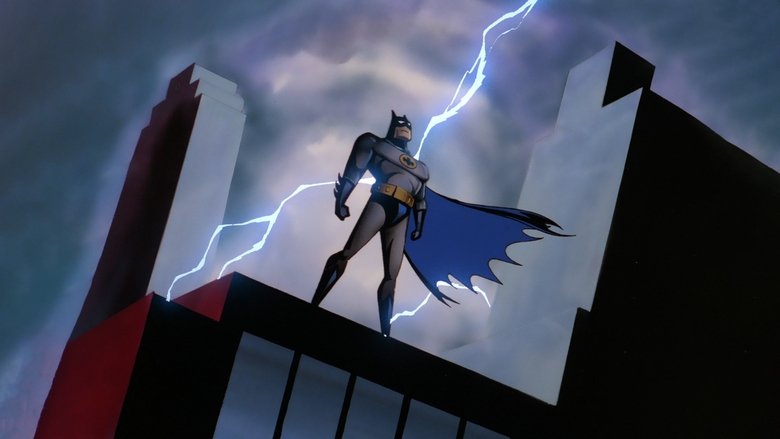
Visually, the entire series is steeped in shadow. The unique "Dark Deco" art style was achieved by painting on black paper instead of white, ensuring that darkness was the default canvas. Batman is almost always introduced emerging from or melting back into the shadows. This visual motif is constant across all episodes, defining the show's film noir atmosphere and reinforcing the psychological weight of its stories.
Gotham's Art Deco Architecture
The towering, stylized Art Deco skyscrapers of Gotham City symbolize a kind of corrupted grandeur and timelessness. The architecture evokes an era of classic noir films, suggesting a city perpetually stuck in a stylish but morally decaying past. These structures are both beautiful and menacing, representing a city with a grand potential that is constantly being undermined by crime and corruption.
The city's design, a key element of the "Dark Deco" style, is a consistent backdrop. From the opening credits, the sharp, angular buildings and police blimps establish a unique, non-specific time period that blends 1940s aesthetics with futuristic technology. This "otherworldly timelessness" is a constant visual presence, making Gotham a character in its own right throughout the series.
The Bat-Signal
The Bat-Signal symbolizes hope in the midst of darkness. It is a direct call to Batman, but more broadly, it represents the idea that even in a city as corrupt and dangerous as Gotham, there is a force for justice that can be summoned. It is a beacon that pierces the perpetual night, signifying that no matter how powerful the criminal element becomes, they are being watched and will be held accountable.
The Bat-Signal is used frequently throughout the series by Commissioner Gordon to summon Batman. Its appearance in the sky is a recurring visual cue that a new crisis has begun. It often appears at the beginning of an episode, cutting through the dark clouds over Gotham, immediately establishing a sense of urgency and setting the stage for Batman's intervention.
Memorable Quotes
I am vengeance! I am the night! I am Batman!
— Batman
Context:
From the Season 1 episode "Nothing to Fear." After being dosed with Scarecrow's fear toxin, Batman hallucinates his father telling him he is a disgrace. He fights off the effects of the gas, defiantly shouting this line at the Scarecrow, reaffirming his mission and conquering his own self-doubt.
Meaning:
This is arguably the most iconic quote from the series, encapsulating Batman's entire persona. It is a powerful declaration of his identity and purpose, delivered as he overcomes his deepest fears. It signifies that he is not merely a man in a costume, but a force of nature—an embodiment of the justice and fear he instills in the hearts of criminals.
You're not a murderer. I'm a murderer. I'm the one who killed Batman.
— The Joker
Context:
From the Season 1 episode "The Man Who Killed Batman." A small-time, nebbish crook named Sid the Squid seemingly kills Batman by accident. The Joker, rather than being pleased, is furious that someone so insignificant stole his moment. He confronts the terrified Sid, delivering this line before attempting to kill him.
Meaning:
This quote chillingly highlights the Joker's twisted worldview and his unique relationship with Batman. He is disappointed and angered that a common thug might have killed his nemesis, as he sees Batman's destruction as his sole privilege. It underscores his obsession and the idea that their conflict is a deeply personal, theatrical performance that no one else is allowed to end.
I never said thank you.
— Batman
Context:
From the theatrical film "Batman: Mask of the Phantasm," which is part of the series' continuity. After a flashback where Alfred encourages a young Bruce Wayne to abandon his vow for a chance at happiness with Andrea Beaumont, Bruce tearfully puts on the cowl for the first time. In the present, he turns to Alfred and quietly says this, acknowledging Alfred's unwavering support through his darkest moments.
Meaning:
A rare and powerful moment of vulnerability from Batman. This simple phrase, directed at his most steadfast ally, reveals the deep gratitude and affection hidden beneath his stoic exterior. It's a significant moment of character development, showing him acknowledging his dependence on others and expressing an emotion he usually keeps buried.
Without Batman, crime has no punchline.
— The Joker
Context:
From the episode "The Man Who Killed Batman," after it is believed Batman has been killed by a low-level thug. The Joker is shown to be in a state of depression, unable to find joy in his usual mayhem, lamenting to Harley Quinn that his entire reason for being is gone.
Meaning:
This quote perfectly encapsulates the Joker's symbiotic relationship with Batman. For the Joker, crime is not about gain but about performance and chaos. Batman provides the order that makes his chaos meaningful and the audience for his deadly jokes. Without his nemesis, his actions lose their purpose and become, in his view, humorless and dull.
Episode Highlights
Heart of Ice
This episode completely redefined the villain Mr. Freeze. Previously a joke character, writer Paul Dini reimagined him as Dr. Victor Fries, a brilliant cryogenics scientist whose criminal acts are motivated by a desperate attempt to cure his terminally ill wife, Nora. A lab accident caused by a ruthless corporate CEO leaves Fries unable to survive above sub-zero temperatures. The episode is a heartbreaking story of love, loss, and vengeance.
"Heart of Ice" won a Daytime Emmy Award for Outstanding Writing in an Animated Program and is considered a landmark in animated television. It established the series' commitment to mature, emotionally complex storytelling and its signature approach of creating sympathetic, tragic villains. This tragic backstory was so successful that it was adopted into the main DC Comics canon and has become the definitive origin for the character.
Two-Face, Parts I & II
This two-part episode chronicles the tragic downfall of Gotham's district attorney, Harvey Dent. A close friend of Bruce Wayne, Dent is portrayed as a good man with a repressed, severe anger issue (a second personality named "Big Bad Harv"). Under pressure from crime boss Rupert Thorne, Dent's psyche fractures, and a chemical explosion scars half his face, fully unleashing his malevolent alter ego, Two-Face.
This is one of the darkest and most psychologically intense stories in the series. It masterfully builds the suspense and tragedy of Dent's transformation, grounding his villainy in a believable mental illness. It cemented the show's ability to handle complex psychological themes and provided what many still consider the definitive origin story for Two-Face, highlighting his personal connection to Bruce Wayne.
Joker's Favor
A mild-mannered man named Charlie Collins accidentally cuts off the Joker in traffic and, after a terrified plea, is spared in exchange for a single, unspecified "favor" to be called in later. Years later, the Joker cashes in the favor, forcing Charlie to help him with an attack on Commissioner Gordon. The episode is a tense thriller centered on an ordinary person pulled into Batman's extraordinary world.
This episode is critically important for introducing the character of Harley Quinn. Originally intended as a one-off walk-on role for a female henchperson, she was so well-received that she became a recurring character and eventually one of DC Comics' most popular figures. The episode itself is a masterclass in building suspense from a simple, relatable premise.
Almost Got 'Im
Several of Batman's most famous villains—Joker, Penguin, Two-Face, Poison Ivy, and Killer Croc—gather for a poker game and trade stories about the times they each came closest to killing Batman. The episode is structured as an anthology of short vignettes, each showcasing a different villain's perspective and methodology. The climax reveals a classic Batman twist.
"Almost Got 'Im" is celebrated for its clever narrative structure and its deep dive into the personalities of the rogues' gallery. It perfectly captures the essence of each villain and their unique relationship with Batman. It's a fan-favorite episode that highlights the strength of the show's supporting cast of antagonists and showcases the writers' creativity and reverence for the source material.
Perchance to Dream
Bruce Wayne awakens one morning to find his life is perfect: his parents are alive, he is engaged to Selina Kyle, and someone else is Batman. He initially embraces this dream reality, believing his nightmare is finally over. However, inconsistencies begin to gnaw at him, forcing him to confront the devastating possibility that this idyllic life is a lie and he must choose to return to his painful reality.
This is one of the most profound and psychologically powerful episodes of the series, serving as a deep character study of Bruce Wayne. It explores his deepest desires and reaffirms his unwavering commitment to his mission, suggesting that even in his subconscious, he cannot escape the call to be Batman. The episode is a tragic and sophisticated look at the core of his character.
Philosophical Questions
Can one truly overcome trauma, or is it a life sentence that can only be managed?
The series explores this question primarily through Bruce Wayne. His entire life is a reaction to a single traumatic event. While he channels his pain into a productive, albeit violent, crusade, he is never truly free from it. Episodes like "Perchance to Dream" show that his deepest desire is a life where the trauma never occurred, yet his own mind rejects this fantasy, suggesting his identity is inextricably linked to his suffering. The villains offer a darker answer; characters like Two-Face and Mr. Freeze are consumed by their trauma, unable to move past it, letting it define them and drive them to criminality. The series suggests that while trauma may be a permanent scar, the choice of how to live with it is what defines a person.
What is the nature of identity?
This question is central to many characters. Bruce Wayne lives a dual life, and the series often questions which identity—the billionaire playboy or the dark avenger—is the "real" one. Characters like Clayface, an actor who loses his original face, and Two-Face, a man split between two warring personalities, explore this theme literally. Harley Quinn's journey is a struggle to define an identity for herself outside of her toxic relationship with the Joker. The series repeatedly examines whether identity is inherent, chosen, or imposed by external circumstances and trauma.
Does the end justify the means?
Batman's strict moral code, particularly his refusal to kill, is the central pillar of this philosophical debate. He uses fear, intimidation, and violence to fight crime, operating outside the law. Yet, he draws a hard line that he will not cross, believing that to do so would make him no better than the criminals he hunts. This code is constantly tested by villains like the Joker, who tries to prove that Batman's morality is a fragile pretense. The series uses Batman's struggle to explore the complexities of justice, questioning whether a fundamentally good outcome can be achieved through morally ambiguous methods.
Alternative Interpretations
One prominent alternative interpretation of the series frames Batman not as a hero, but as a mentally ill man whose crusade is a symptom of his arrested development and inability to process his childhood trauma. From this perspective, his rogues' gallery represents external manifestations of his own fractured psyche. The Joker is his nihilistic, chaotic impulse; Two-Face is his internal conflict between his public and private selves; and the Scarecrow embodies his weaponization of his own fear. In this reading, Batman perpetuates the very cycle of violence and theatricality he claims to be fighting, attracting and perhaps even creating the super-criminals who give his obsession purpose.
Another interpretation, explored in the episode "Trial," posits that Batman is directly responsible for the creation of his supervillains. The episode puts him on a mock trial where the villains argue that his very existence as a costumed vigilante escalated the nature of crime in Gotham. Before him, there were simple mobsters; after his arrival, the city became plagued by theatrical, themed criminals. This perspective suggests Batman is not a solution to Gotham's problems but rather a catalyst for its unique brand of insanity, turning organized crime into a surreal circus of Freudian nightmares.
Cultural Impact
"Batman: The Animated Series" is widely regarded as a landmark in television animation and one of the most influential adaptations of a comic book character ever created. Premiering in 1992, it emerged in the wake of Tim Burton's dark, successful Batman films and revolutionized what a superhero cartoon could be. Rejecting the bright, simplistic fare common in children's programming at the time, the series adopted a mature, sophisticated tone, complex psychological themes, and a groundbreaking visual style.
Its most significant influence was its elevation of storytelling in animation. The series tackled subjects like grief, mental illness, and moral ambiguity with a seriousness previously unseen in Western cartoons. The decision to create sympathetic, tragic backstories for villains like Mr. Freeze had a lasting impact, with this version becoming canon in the comics and influencing subsequent portrayals in other media. The show also introduced Harley Quinn, who became a cultural phenomenon and one of DC's most popular characters.
The series received widespread critical acclaim, winning multiple Emmy Awards and proving that animation could be a medium for sophisticated, dramatic storytelling that appealed to adults as well as children. Its unique "Dark Deco" visual style, which blended film noir, Art Deco architecture, and German Expressionism, created a timeless and iconic Gotham City that has influenced the aesthetic of Batman comics, films, and video games ever since. The series launched the DC Animated Universe (DCAU), a multi-show shared continuity that set the standard for interconnected superhero storytelling for over a decade. The legacy of "Batman: The Animated Series" is its definitive portrayal of the Dark Knight and his world, which for many fans remains the most faithful and artistically successful adaptation of the character.
Audience Reception
"Batman: The Animated Series" was met with widespread acclaim from both audiences and critics upon its debut and its reputation has only grown over time. It was praised for its mature writing, thematic complexity, and artistic innovation, which set it apart from typical children's programming. The show was a ratings success and was even promoted to a primetime slot, a rare achievement for an animated series. It won numerous awards, including several Daytime Emmy Awards, most notably for the episode "Heart of Ice."
Audiences particularly lauded the voice cast, with Kevin Conroy's distinct portrayals of Bruce Wayne and Batman and Mark Hamill's unhinged, gleeful Joker becoming the definitive voices for an entire generation. The sympathetic and tragic portrayals of villains were also a frequent point of praise, adding emotional depth to the stories. While the initial run was universally beloved, the stylistic changes and character redesigns for the follow-up, "The New Batman Adventures" (often syndicated as a later season), were met with a more mixed, though still generally positive, reaction from some viewers. Over the decades, its popularity has endured, and it is consistently ranked among the greatest animated series of all time, maintaining a legacy as a masterclass in adaptation and storytelling.
Interesting Facts
- The show's creators coined the term "Dark Deco" to describe its unique visual style, which combined 1940s Art Deco architecture with dark, film noir aesthetics.
- To achieve the dark, moody atmosphere, the background artists painted on black paper instead of the traditional white, a groundbreaking technique for television animation.
- The character of Harley Quinn was created specifically for the series by Paul Dini and Bruce Timm, first appearing in the episode "Joker's Favor." She was so popular she was later added to the DC Comics canon.
- Kevin Conroy was the first actor in animation to use two distinct voices for Bruce Wayne and Batman, a practice that has since become standard for the character.
- Voice actors for the series recorded their lines together in one room, rather than in separate sessions, to foster a more natural and interactive performance. Mark Hamill (The Joker) would often stand up and move around to better capture the character's manic energy.
- Tim Curry was originally cast as the voice of the Joker but was replaced by Mark Hamill after developing bronchitis.
- The series never shows an on-screen title card. Producers felt the character of Batman was so iconic that a title was unnecessary.
- The success of the series led to the creation of the DC Animated Universe (DCAU), a shared continuity of shows including "Superman: The Animated Series," "Justice League," and "Batman Beyond."
Easter Eggs
In the episode "Beware the Gray Ghost," the titular character, a fictional pulp hero who inspired Bruce Wayne as a child, is voiced by Adam West, the actor who famously portrayed Batman in the 1960s live-action TV series.
This was a deliberate and affectionate homage to the history of the Batman character. By casting West as Bruce Wayne's childhood hero, the show's creators paid tribute to his iconic portrayal while simultaneously passing the torch to their new, darker iteration of the character. It's a meta-commentary on the character's evolution and a beloved moment for fans.
Several creators and producers of the show make background cameos. In "The Man Who Killed Batman," a sketch artist drawing Sid the Squid is a caricature of producer Bruce Timm.
These small cameos are fun, inside jokes for the production team and eagle-eyed fans, a common practice in animation to leave a personal mark on the project. It shows the creators' deep personal involvement and affection for the series.
In the episode "Joker's Millions," the Joker is seen watching a television show. The animation on the TV screen is from a real, unproduced Looney Tunes short called "The Duck That Cried Wolf," directed by Chuck Jones.
This is a deep-cut reference for animation buffs, showcasing the creators' reverence for the history of Warner Bros. Animation. It serves as a subtle nod to the studio's legendary past while placing the Joker within that legacy of classic cartoon mischief.
⚠️ Spoiler Analysis
Click to reveal detailed analysis with spoilers
Frequently Asked Questions
Explore More About This Movie
Dive deeper into specific aspects of the movie with our detailed analysis pages
Comments (0)
No comments yet. Be the first to share your thoughts!