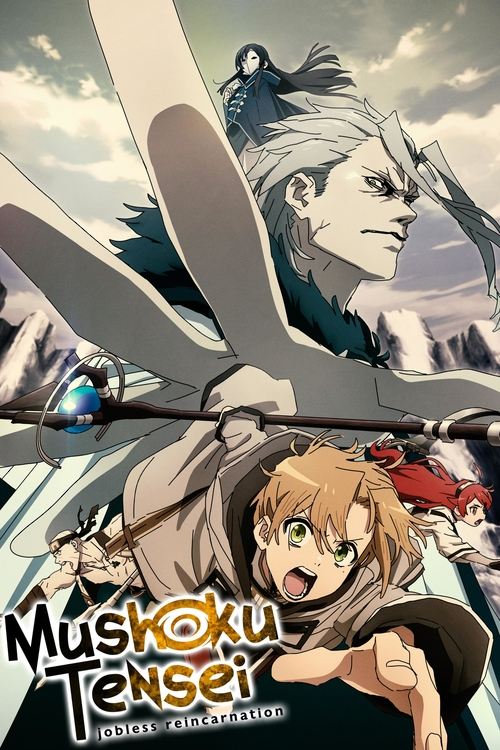
Mushoku Tensei: Jobless Reincarnation
無職転生 ~異世界行ったら本気だす~
Overview
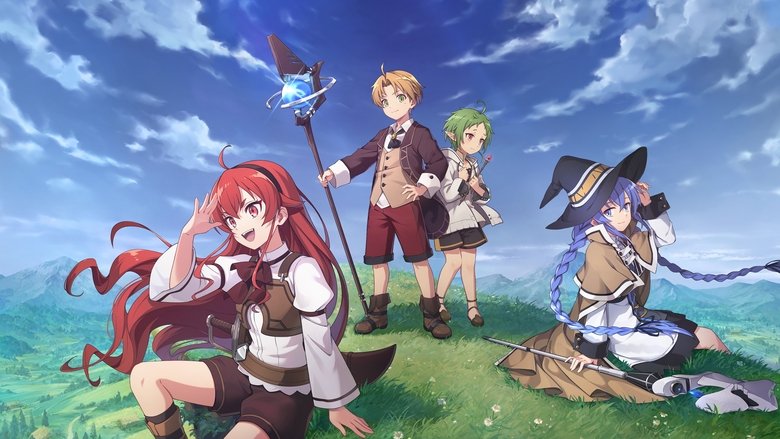
"Mushoku Tensei: Jobless Reincarnation" follows a 34-year-old jobless and hopeless Japanese man who, after a tragic and pathetic end, is reincarnated into a world of swords and sorcery. Retaining all the memories and regrets of his past life, he is reborn as Rudeus Greyrat. Determined not to repeat his past mistakes, he vows to live this new life to the fullest, without regrets. From infancy, he applies his adult mind to mastering magic with prodigious talent, quickly surpassing his tutors and family's expectations.
The series is a sprawling, lifelong epic that chronicles Rudeus's journey from childhood to old age. It's a meticulous character study focused on his slow and often painful process of overcoming deep-seated trauma, social anxiety, and his perverted tendencies leftover from his past life. The story is segmented by significant 'turning points,' from the magical cataclysm that teleports him across the world as a child, forcing him into a perilous journey home, to his later struggles with depression, love, and the responsibilities of family. Across its seasons, the narrative expands from a personal story of redemption to a grand fantasy epic involving continental wars, political intrigue, and a cosmic conflict against a manipulative entity known as the Man-God.
Core Meaning
The core meaning of "Mushoku Tensei" is a profound exploration of redemption and the concept of a second chance. It posits that even someone who has hit rock bottom—a person considered 'societal garbage' in their past life—can achieve growth and live a fulfilling life if they genuinely try. The series argues that redemption isn't a single act of heroism, but a long, arduous, and non-linear process of confronting one's flaws, making mistakes, learning from them, and slowly building meaningful relationships. It delves into the idea that overcoming past trauma and deep-seated personality defects is a lifelong battle, and true strength lies in the persistent effort to be a better person than you were yesterday, even when you stumble.
Thematic DNA
Redemption and Second Chances
This is the central theme of the entire series. Rudeus begins as the reincarnation of a deeply flawed and regretful man. His new life is a conscious effort to overcome the failures of his past. This isn't a simple, heroic transformation; it's a messy, lifelong struggle. He constantly battles his ingrained perversion, cowardice, and selfishness. Key moments, like his reconciliation with his father Paul, showcase him actively choosing a different path than his past self, who ran from confrontation and relationships. His journey illustrates that redemption is not about erasing the past but about building a better future despite it.
Overcoming Trauma
Rudeus's actions and personality are heavily shaped by the severe bullying and isolation he suffered in his previous life. This trauma manifests as social anxiety, a fear of the outside world, and an inability to form healthy relationships. The series meticulously details his slow progress, from his initial fear of leaving the house as a child to his later struggles with severe depression after being abandoned by Eris. His journey shows that overcoming deep-seated psychological wounds is not a quick fix but requires time, support from loved ones, and a conscious will to move forward.
Family and Found Family
The concept of family is a powerful, evolving force in Rudeus's life. He is born into the Greyrat family, and his relationships with his parents, Paul and Zenith, are complex and formative. The Teleportation Incident shatters this initial unit, forcing Rudeus to form a new 'found family' with the warrior Ruijerd and his cousin Eris, creating the adventure party 'Dead End'. This bond, forged through hardship, is crucial to his early development. Later in life, his primary motivation becomes protecting the family he builds with Sylphiette, Roxy, and Eris, demonstrating his growth from a self-centered recluse to a devoted patriarch.
Moral Ambiguity
The series deliberately avoids a simple black-and-white morality. The protagonist, Rudeus, is an anti-hero who, despite his efforts to be better, retains many of his perverted and morally questionable traits from his past life. The narrative doesn't always condemn his actions, often presenting them from his flawed perspective, which has been a source of controversy. This forces the audience to grapple with whether a character's good intentions and genuine growth can outweigh their reprehensible actions and thoughts. It challenges the viewer to look beyond simplistic labels of 'good' and 'evil'.
Character Analysis
Rudeus Greyrat
Yumi Uchiyama (Japanese), Tomokazu Sugita (Japanese, Inner Voice)
Motivation
Initially, his motivation is purely selfish: to live a fulfilling life and avoid the regrets of his past. He wants to experience love, friendship, and success. After the Teleportation Incident, this evolves into a desire to reunite with and protect his scattered family. In the later stages of his life, his primary motivation becomes ensuring the safety and happiness of his wives and children, even putting himself in opposition to god-like beings to do so.
Character Arc
Rudeus's arc is one of the most extensive in modern isekai, spanning his entire life. He begins as a reincarnated 34-year-old NEET, retaining his perverted nature, trauma, and regrets. His initial goal is simply to 'try hard' and not waste his second chance. In Season 1, he focuses on mastering magic and slowly overcoming his social anxiety with the help of Sylphy, Roxy, and Eris. The Teleportation Incident forces him into the real world, marking the true beginning of his growth. Season 2 sees him grapple with profound depression and impotence after Eris leaves him, a crucible that forces him to find a new purpose beyond just survival. He eventually finds love and begins building a family, shifting his motivation from self-improvement to protecting his loved ones. By the end of the story (in the source material), he has evolved from a deeply flawed recluse into a wise, powerful, and respected family man who has confronted his past and found a measure of peace, even if his perverted quirks never fully disappear.
Eris Boreas Greyrat
Ai Kakuma (Japanese)
Motivation
Her initial motivation is to defy her family's expectations and do as she pleases. After meeting Rudeus, her motivation shifts to becoming stronger to protect him. This desire is solidified after their defeat by Orsted, launching her on a solitary quest for power so she can be his equal and stand with him against any threat.
Character Arc
Eris starts as a violent, spoiled, and aggressive noble brat with a short temper. Under Rudeus's tutelage in Season 1, she slowly learns patience, literacy, and magic, revealing a fiercely loyal and surprisingly vulnerable side. The Teleportation Incident is her turning point; the brutal realities of the Demon Continent force her to mature rapidly. She transforms from a sheltered noble into a hardened warrior. Her decision to leave Rudeus at the end of Season 1 is a pivotal moment of growth; recognizing her own weakness after their encounter with Orsted, she leaves to become strong enough to stand by his side as an equal, not as someone who needs protecting. Her journey is about channeling her wild nature into disciplined strength and understanding that true partnership requires mutual power.
Sylphiette
Ai Kayano (Japanese)
Motivation
Her primary motivation is her deep love and loyalty for Rudeus. From childhood, she wants to be with him and support him. During their separation, this motivation is channeled into protecting Princess Ariel, who becomes a surrogate figure to protect. Upon their reunion, her core motivation returns to building a life with Rudeus and being a central pillar of support for him and their family.
Character Arc
Sylphiette, or Sylphy, begins as a timid, bullied child who is rescued and befriended by Rudeus, becoming his first friend. She is kind, gentle, and fiercely loyal to him. After the Teleportation Incident, she is separated from Rudeus for many years. During this time, she endures her own hardships which force her to become more independent and courageous. She takes on the male guise of 'Fitz' and becomes a guardian knight to Princess Ariel. Her arc is about finding her own strength and identity outside of her relationship with Rudeus. When they reunite in Season 2, she has grown from a dependent child into a confident and capable mage in her own right, allowing their relationship to resume on more equal footing.
Roxy Migurdia
Konomi Kohara (Japanese)
Motivation
Roxy is driven by a desire to explore the world and make a place for herself, as she felt like an outcast in her own village due to her inability to use telepathy. As a teacher, she is motivated by a genuine desire to nurture talent and help her students grow. Her motivation later expands to include finding and helping Rudeus's family, driven by the strong bond she formed with him and the Greyrats.
Character Arc
Roxy is Rudeus's first magic teacher and the person who helps him take his first literal steps out of his home and his shell. As a member of the long-lived Migurdia demon race, she is an outsider herself, which allows her to empathize with Rudeus. Her arc is less about personal transformation and more about her impact on others, especially Rudeus. She is a constant source of guidance and wisdom in his life, even when absent. Later in the story, she undertakes her own perilous journey to find Rudeus's family, proving her deep affection and loyalty. She eventually becomes a key figure in Rudeus's life, not just as a mentor but as a cherished part of his family. She represents the ideal of a teacher and the benevolent guiding force in his chaotic life.
Symbols & Motifs
Roxy's Pendant
Symbolizes guidance, hope, and a connection to his first mentor and savior. Roxy was the first person to lead Rudeus out of his self-imposed isolation (both literally, by getting him to leave his house, and metaphorically). The pendant is a physical manifestation of her teachings and the hope she represents.
Rudeus receives the pendant from Roxy upon her departure in Season 1. He treasures it throughout his journeys. In his darkest moments of depression and despair, particularly after being abandoned by Eris, he prays to the pendant (along with a pair of her stolen panties), treating it as a holy relic that gives him the strength to carry on.
The Man-God (Hitogami)
The Man-God symbolizes manipulation, temptation, and deceptive guidance. He appears in Rudeus's dreams offering seemingly helpful advice, but his true motives are selfish and destructive. He represents the easy path and the temptation to rely on an external force rather than one's own judgment and effort, a constant test of Rudeus's free will.
Starting in Season 1, the Man-God frequently appears to Rudeus in his dreams, offering cryptic advice that often helps him out of immediate danger. However, it's slowly revealed that his guidance is a long-term manipulation designed to serve his own goals, which are in opposition to another powerful figure, Orsted. A major turning point in the source material involves Rudeus realizing the catastrophic consequences of blindly trusting the Man-God.
Rudeus's Staff (Aqua Heartia)
The staff represents Rudeus's magical prowess, his identity as a mage, and his independence. Created by himself with Roxy's help, it is a tool of his own making, symbolizing his hard-earned skill and the journey he has undertaken to become powerful.
Rudeus receives the staff as a birthday present in Season 1, a gift from Roxy that he helped create. It is his primary weapon and tool throughout all his adventures. The gem in the staff, a piece of Aqua Heartia, is a high-level material, signifying his exceptional talent from a young age.
Memorable Quotes
I bet even I can make it. If I live and try as hard as everyone else.
— Rudeus Greyrat
Context:
This is Rudeus's internal monologue in Season 1, Episode 1, shortly after being reincarnated. As a baby, realizing he has a fresh start, he vows not to repeat the mistakes of his past and to live his new life with genuine effort.
Meaning:
This quote, from the very first episode, encapsulates the entire premise and Rudeus's core resolve. It's a declaration of hope from someone who had given up on life, establishing the central theme of making the most of a second chance through sheer effort.
I know how it feels when you sink so low and can't sink any lower... The gratitude you feel when somebody pulls you up.
— Rudeus Greyrat
Context:
Rudeus says this in Season 1 while defending Ruijerd Superdia, a member of a demon race feared and hated by the world. He recognizes Ruijerd as another outcast and extends a hand of friendship, drawing a parallel to his own past desperation.
Meaning:
This line reveals Rudeus's capacity for empathy, born from the suffering of his past life. It shows his character growth, as he uses his own traumatic experiences not as a crutch, but as a way to understand and connect with the pain of others, a stark contrast to the selfish recluse he once was.
It's no good to overestimate me. Victory is something that you grasp by always being modest, you know.
— Rudeus Greyrat
Context:
This is part of Rudeus's internal thoughts during his early training and adventures in Season 1. He frequently reminds himself not to get cocky, understanding that his power doesn't make him invincible and that careful planning is essential.
Meaning:
This quote highlights the humility Rudeus has learned. In his past life, arrogance and a warped sense of self contributed to his downfall. In his new life, despite his prodigious talents, he is keenly aware of his weaknesses and the dangers of pride, showing a significant level of maturity.
Episode Highlights
Jobless Reincarnation
The first episode masterfully establishes the series' core premise. It introduces the protagonist's pathetic past life and his death, followed by his reincarnation as Rudeus Greyrat. We witness his resolve to live this new life to the fullest and his discovery of his immense magical aptitude. It sets the tone for a slow-burn character study, prioritizing world-building and Rudeus's internal state over immediate action.
This episode is foundational, laying out the central themes of redemption and second chances. It establishes Rudeus's core motivation that will drive the entire narrative and introduces the blend of dark, mature themes with a high-fantasy setting.
Turning Point 1
This episode marks a dramatic shift in the series' narrative. A mysterious, large-scale magical phenomenon, later known as the Teleportation Incident, engulfs the entire Fittoa Region in a blinding white light. Rudeus and Eris are teleported to the middle of the hostile Demon Continent, violently ending the slice-of-life tutoring arc and thrusting the young characters into a perilous survival journey.
This is the first major 'Turning Point' that fundamentally alters the plot's direction. It shatters the comfortable world Rudeus knew, separates him from his family, and forces him to mature rapidly. It initiates the epic adventure that defines the rest of the first season and beyond.
Reunion
Rudeus is finally reunited with his father, Paul, but the meeting is disastrous. Paul, broken by the loss of his family and struggling with alcoholism, lashes out at Rudeus, leading to a physical and emotional fight. The episode focuses on the painful aftermath and their slow, difficult reconciliation, where Rudeus uses the memory of his past life's failures to bridge the gap with his father.
This episode is a masterclass in character drama and a pivotal moment for Rudeus's growth. He confronts familial conflict head-on instead of running away, a direct contrast to his previous life. The raw, emotional reconciliation demonstrates the series' thematic depth, focusing on empathy and overcoming pride.
The White Mask
At the Ranoa University of Magic, Rudeus continues his research to cure his impotence while growing closer to his silent bodyguard, Fitz. This episode builds the mystery around Fitz's identity, culminating in the reveal that Fitz is, in fact, his long-lost childhood friend, Sylphiette, whose hair had turned white due to magical exhaustion.
This episode marks the long-awaited reunion of Rudeus and Sylphiette, a key moment for both their character arcs. It begins the resolution of Rudeus's emotional and physical trauma that has plagued him since the start of the season and sets the stage for one of the series' central romantic relationships.
I Want to Tell You
Following the reveal of Sylphy's identity, this episode focuses on their emotional reconnection. Rudeus, finally overcoming his impotence and despair through their rekindled bond, proposes to Sylphiette. It's a quiet, emotional climax to the first half of the second season.
This episode represents a major turning point in Rudeus's recovery and life. His proposal to Sylphy signifies his readiness to move forward, build a new family, and embrace a future he thought was lost to him. It solidifies his emotional growth and marks the end of his prolonged depression.
Philosophical Questions
What does it truly mean to have a second chance?
The series explores this question through Rudeus's entire life. It rejects the idea that a second chance is a magical reset. Instead, it portrays it as a continuous, difficult process. Rudeus retains all his memories, flaws, and trauma from his first life. His second chance isn't an escape from his old self, but an opportunity to actively fight against that self every day. The story suggests that a second chance is not about becoming a perfect hero, but about the lifelong commitment to trying to be better, making new mistakes, and learning to live with the person you are while striving for the person you want to be.
Can a person with a reprehensible past truly achieve redemption?
"Mushoku Tensei" tackles this by making its protagonist deeply unsympathetic at his core. He is a former NEET who engaged in disturbing behavior. The series constantly forces the audience to question if his efforts in his new life—his bravery, his loyalty, his desire to protect his family—are enough to atone for the person he was. It suggests that redemption isn't a destination one arrives at, but a continuous journey. The answer is left ambiguous; while Rudeus becomes a 'good man' by the standards of his new world, the narrative never fully absolves him of his past or his ingrained flaws, leaving the final judgment to the viewer.
Alternative Interpretations
One of the primary points of debate surrounding "Mushoku Tensei" is the interpretation of its protagonist, Rudeus Greyrat. One perspective sees the series as a genuine and earnest story of redemption. From this viewpoint, Rudeus's deeply flawed nature is the entire point; his perversion and moral failings are the low starting point from which his gradual, lifelong growth is measured. His journey is about the struggle to overcome one's worst impulses, and his eventual transformation into a loving family man is seen as a powerful message that anyone can change for the better through sustained effort.
A more critical interpretation views the series as an unsavory power fantasy that excuses or even glorifies its protagonist's toxic behavior. From this perspective, Rudeus's inner monologue and actions are not just a starting point for growth but are often played for comedy or presented without sufficient condemnation, making the narrative complicit in his sexism and perversion. Critics of this view argue that Rudeus never truly faces consequences for some of his worst actions and that his 'redemption' is unearned, as he is rewarded with a harem and immense power despite his flaws. This interpretation suggests the series fails to adequately challenge its protagonist's worldview, instead creating a fantasy world that caters to it.
Cultural Impact
"Mushoku Tensei: Jobless Reincarnation" holds a significant place in the landscape of modern anime and the isekai genre. Originating as a web novel in 2012, it is widely considered a foundational work that popularized and codified many of the tropes now common in isekai stories, such as reincarnation as a new person (rather than being summoned) and starting from birth with memories intact. Its influence on a generation of web novelists on the platform Shōsetsuka ni Narō is a major reason for the subsequent explosion of the genre in the 2010s.
Upon its anime release in 2021, the series was met with both critical acclaim and significant controversy. Critics and audiences lauded its exceptionally high production quality, with Studio Bind delivering stunning, fluid animation and detailed world-building that set a new standard for television anime. However, the series also drew heavy criticism for its portrayal of the protagonist, Rudeus. His perverted and sometimes predatory thoughts and actions, stemming from his pathetic past life, were seen by many as deeply problematic and off-putting, leading to intense debates about the show's moral compass. This controversy led to the series being temporarily pulled from the Chinese streaming service Bilibili.
Despite the controversy, the series has been a massive success, receiving high ratings and fostering a dedicated fanbase. It has influenced the isekai genre by shifting the focus from simple power fantasies to more nuanced, long-form character studies. The story's commitment to showing a flawed character's slow, lifelong journey of redemption has resonated with many, proving that audiences are receptive to more complex and morally ambiguous protagonists. Its legacy is twofold: it is both a pioneer that shaped a genre and a controversial work that continues to spark important conversations about character morality and storytelling in anime.
Audience Reception
Audience reception for "Mushoku Tensei: Jobless Reincarnation" has been largely positive, though polarized. On platforms like MyAnimeList and among dedicated fan communities, the series consistently ranks as one of the highest-rated anime of its year, with particular praise for its second cour in 2021. Fans celebrate its stunning, movie-quality animation by Studio Bind, its deep and meticulous world-building, and its commitment to a long-form character arc for Rudeus. Many viewers appreciate the realistic and slow-paced approach to character development, finding Rudeus's struggle to overcome his past trauma and flaws to be a compelling and emotionally resonant journey.
However, the series is also highly controversial and has faced significant criticism from a portion of the audience. The main point of contention is the protagonist's perverted and morally ambiguous character. Many viewers find his inner monologues and actions, especially concerning his lecherous behavior while in a child's body, to be repulsive and inexcusable. This aspect has been a major barrier to entry for some, leading to heated online debates and accusations that the show promotes or normalizes predatory behavior. While some fans defend it as a realistic portrayal of a deeply flawed individual on a path to redemption, critics argue that the show often frames these moments humorously, thereby failing to properly condemn them. This division has made "Mushoku Tensei" one of the most debated anime in recent years.
Interesting Facts
- The anime is the debut project of Studio Bind, which was specifically founded by the production company Egg Firm and animation studio White Fox with the sole purpose of producing a complete and faithful adaptation of the "Mushoku Tensei" light novel.
- The author, Rifujin na Magonote, was heavily influenced by other works, including the manga "Lucifer and the Biscuit Hammer" and "Parasyte," particularly in their focus on family and human relationships.
- "Mushoku Tensei" is often called the 'grandfather' of the modern isekai genre. While not the absolute first web novel of its kind, its massive popularity on the web novel site Shōsetsuka ni Narō codified many tropes that became staples of the genre, such as reincarnation with past memories intact and a detailed progression from infancy.
- The anime series uniquely forgoes a standard opening theme sequence for most of its episodes, instead integrating the opening credits and song into the episode's narrative to enhance immersion.
- The author has stated that one of the driving forces behind writing the story was channeling his own past regrets, aiming to write a story about overcoming past difficulties.
⚠️ Spoiler Analysis
Click to reveal detailed analysis with spoilers
Frequently Asked Questions
Explore More About This Movie
Dive deeper into specific aspects of the movie with our detailed analysis pages
Comments (0)
No comments yet. Be the first to share your thoughts!