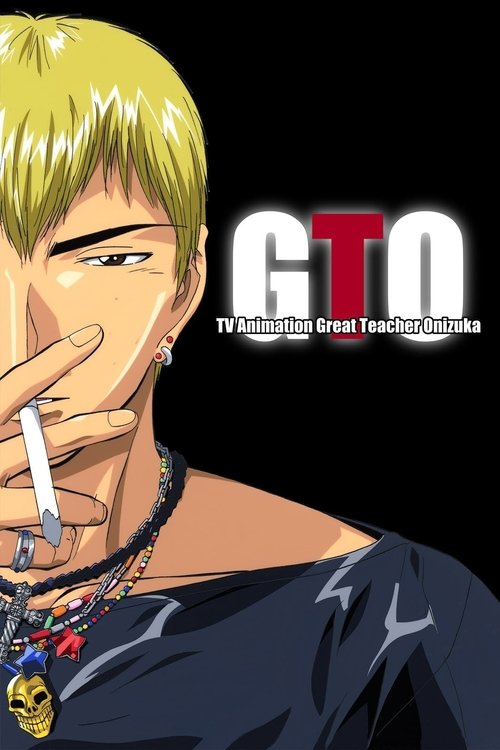
Great Teacher Onizuka
グレート・ティーチャー・オニヅカ
Overview
Great Teacher Onizuka follows the unconventional journey of Eikichi Onizuka, a 22-year-old former biker gang leader who, despite his crude manners and lack of academic pedigree, decides to become a teacher. Initially motivated by the prospect of meeting high school girls, Onizuka's perspective shifts when he is hired by Holy Forest Academy to manage the notorious Class 3-4. This group of intelligent but deeply cynical students has successfully driven every previous homeroom teacher to psychological collapse through ruthless harassment and blackmail.
The series unfolds as a battle of wills between Onizuka's street-smart intuition and the students' sophisticated malice. Rather than following a standard curriculum, Onizuka employs extreme, often illegal, and always spectacular methods—from bungee jumping to street fighting—to address the underlying traumas of his pupils. As he dismantles the systemic rot of bullying, parental neglect, and administrative corruption, Onizuka transitions from a self-serving delinquent to a genuine protector of youth, challenging the very definition of what it means to be an educator in a rigid society.
Core Meaning
The core message of Great Teacher Onizuka is a scathing critique of the "Exam Hell" and the dehumanizing nature of the traditional Japanese education system. The series argues that true education is not the accumulation of facts, but the cultivation of character and the courage to live authentically. Through Onizuka, the creators suggest that the youth do not need more authority figures or bureaucrats; they need "human" mentors who are willing to bleed for them. It posits that the labels of "delinquent" or "failure" are often products of a failing system, and that human connection is the only effective tool for breaking the cycle of social withdrawal and despair.
Thematic DNA
Rebellion against Institutional Rigidity
The show constantly pits Onizuka's chaotic, impulsive nature against the sterile, rule-bound world of the school faculty. This theme develops as Onizuka proves that formal protocols are often used to hide cowardice or protect the status quo, while his "outlaw" tactics actually solve the deep-seated problems of the students.
The Burden of Academic Pressure
Across the series, several students (notably Kanzaki and Kikuchi) represent the psychological toll of being a "genius" or a high achiever in Japan. The show explores how society's obsession with grades turns children into commodities, leading to isolation and self-destructive behavior.
Mentorship and Emotional Intelligence
Onizuka lacks subject knowledge but possesses immense emotional intelligence. The theme highlights that a teacher's primary role is to act as a mirror for the student's potential and a safety net for their failures, rather than just a source of information.
Healing from Trauma and Bullying
The series tackles dark subjects like suicide, physical abuse, and systemic bullying. It shows that healing requires confronting the source of pain directly—often through radical empathy or, in Onizuka's case, a literal sledgehammer to the walls that divide people.
Non-Conformity as a Virtue
Onizuka remains true to his biker roots, refusing to wear a suit or speak formally. This theme evolves into a lesson for the students: that personal integrity and staying true to one's "soul" is more important than fitting into a pre-defined social mold.
Character Analysis
Eikichi Onizuka
Wataru Takagi
Motivation
Initially driven by the desire to date high school girls, his motivation evolves into a fierce, protective love for his students, whom he views as his younger "comrades."
Character Arc
Onizuka begins as a self-centered, horny ex-biker looking for a "lazy" job. By the series finale, he has matured into a selfless protector who is willing to take the fall for his students' crimes and leave his dream behind to ensure their future. His growth is not in his intelligence, but in the depth of his commitment to his pupils.
Azusa Fuyutsuki
Junko Noda
Motivation
A genuine desire to help children, which is initially stifled by her fear of conflict but later empowered by Onizuka's radicalism.
Character Arc
Starting as a timid, by-the-book teacher who is easily intimidated by both students and faculty, Fuyutsuki finds her voice through Onizuka's influence. She learns that being a "good teacher" involves more than just following the curriculum, eventually becoming a courageous advocate for the students alongside Onizuka.
Urumi Kanzaki
Kotoe Taichi
Motivation
Seeking revenge against a world that treats her as a specimen rather than a child; eventually seeks genuine human connection.
Character Arc
Kanzaki enters as a cold, manipulative terrorist who uses her 200 IQ to destroy teachers. Through Onizuka, she confronts her traumatic origin and the abandonment by her parents, transitioning from a nihilistic threat to Onizuka's most loyal and protective ally.
Hiroshi Uchiyamada
Chafurin
Motivation
Restoring order and protecting the school's reputation (and his car) at any cost.
Character Arc
The Vice Principal serves as the primary foil to Onizuka. While he remains largely an antagonist, his arc reveals the tragedy of the "salaryman"—a man who lost his family's respect and his own passion for life, finding solace only in his car. He occasionally shows glimpses of his former, better self due to Onizuka's chaos.
Noboru Yoshikawa
Kousuke Okano
Motivation
Desire to escape his pain, which evolves into a desire to protect his new friends and his teacher.
Character Arc
The first student Onizuka saves from suicide. Yoshikawa transforms from a terrified victim of bullying into a brave young man who eventually stands up to his tormentors and finds love, symbolizing the success of Onizuka's life-first teaching philosophy.
Symbols & Motifs
The Toyota Cresta
Symbolizes fragile adult materialism and the obsession with status.
Belonging to Vice Principal Uchiyamada, the car is repeatedly destroyed throughout the series. Its destruction represents how the rigid, material-focused adult world is shattered every time Onizuka intervenes in his students' lives.
The Sledgehammer
Symbolizes shattering barriers and systemic change.
In the first episode, Onizuka literally breaks down a wall in a student's home to force her parents to look at each other. This motif recurs metaphorically as he breaks down the psychological walls of his students.
Onizuka's Kawasaki Z1
Symbolizes freedom and the "Oni-Baku" legacy.
The motorcycle represents Onizuka's refusal to leave his past behind and his commitment to a life on the road, free from the constraints of corporate or academic society.
Cosplay and Costumes
Symbolizes authenticity through absurdity.
Onizuka often wears ridiculous costumes (Doraemon, an elephant, etc.) to teach lessons. This visually signals that he doesn't care about his dignity as an "authority figure," only about getting through to the kids.
Memorable Quotes
I'm Eikichi Onizuka, 22 years old. Nice to meet you!
— Eikichi Onizuka
Context:
Repeated throughout the series, most notably in Lesson 1 and the series finale.
Meaning:
This iconic self-introduction highlights his pride in his identity as a simple, single man, rather than hiding behind the title of "Sensei."
Do you think you can just erase the past? You can't. But you can change the future.
— Eikichi Onizuka
Context:
Often said during pivotal moments when students are contemplating suicide or giving up.
Meaning:
Underlines the show's philosophy of redemption. Onizuka doesn't ask students to forget their mistakes but to take responsibility and move forward.
There's a word for teachers like you! GARBAGE!!
— Eikichi Onizuka
Context:
Lesson 1, when Onizuka confronts a teacher who is more worried about his career than a student's suicide attempt.
Meaning:
A direct attack on the apathy of the educational board that prioritizes reputation over lives.
Episode Highlights
Lesson 1: GTO - The Legend Begins
Onizuka performs his first "miracle" by smashing a literal wall in the Mizuki household with a sledgehammer to force a family to communicate. This sets the tone for the entire series: physical destruction as a path to emotional healing.
Establishes Onizuka's methods as violent but effective, and marks his transition from trainee to a man with a true mission.
Lesson 12: The Fall of the Cresta
Onizuka rescues Yoshikawa from a group of bullies by performing a terrifying bungee jump off a school roof. In the process, Vice Principal Uchiyamada's beloved Cresta is crushed for the first time.
A pivotal moment that cements the bond between Onizuka and the first of his students to truly trust him.
Lesson 27: The Girl with the 200 IQ
The introduction of Urumi Kanzaki. She nearly ruins Onizuka's life through brilliant manipulation, but he wins her over by showing he is the only adult who views her as a person rather than a genius tool.
Introduces the most complex student antagonist and shifts the stakes from physical delinquency to psychological warfare.
Lesson 39: Alone in the Dark
During a school trip, Yoshikawa and his former bully Anko get trapped in a cave. They are forced to rely on each other, leading to a profound moment of reconciliation and the start of a romantic bond.
Demonstrates the long-term effectiveness of Onizuka's strategy to heal social divides.
Lesson 43: Onizuka's Final Lesson
Onizuka takes the blame for a student's action (stabbing an abusive former teacher) and flees the country to avoid arrest, ending up as a teacher in California.
An anime-original ending that emphasizes the sacrifice a "Great Teacher" must make, suggesting that Onizuka's spirit is too big for a single school.
Philosophical Questions
Does a mentor need to be 'moral' to be effective?
Onizuka is a pervert, a gambler, and a former criminal. Yet, he is the only one who saves the students. The series asks if personal flaws are secondary to the sincerity of one's actions and the ability to empathize with the suffering of others.
Is the destruction of property justifiable for emotional breakthroughs?
Through the recurring destruction of the Cresta and the smashing of walls, the show explores the ethics of 'radical intervention.' It suggests that in a society where facades are everything, sometimes the only way to reach the truth is to physically break the masks people hide behind.
What is the true purpose of education?
The show constantly challenges whether school is meant to produce efficient workers or well-rounded human beings. Onizuka's 'Lessons' are never about math or history, but about how to survive, how to love, and how to forgive oneself.
Alternative Interpretations
Critics and fans have debated the series' ending and Onizuka's true nature. One common interpretation is that Onizuka is a 'Peter Pan' figure—a man who refuses to grow up and thus is the only one who can truly understand children. His move to California in the anime is often viewed as a metaphorical admission that his radical methods cannot be permanently integrated into the rigid Japanese structure; he must remain a wandering 'ronin' of education. Another perspective suggests the show is a modern samurai tale, where the 'Way of the Warrior' (bushido) is replaced by 'The Way of the Teacher,' with Onizuka's loyalty and sacrifice serving as his code of honor.
Cultural Impact
Great Teacher Onizuka remains a seminal work in the 'rebel teacher' subgenre of Japanese media. Released during the 'Lost Decade' of the 1990s, it resonated deeply with a generation of Japanese youth feeling crushed by the collapse of the economic bubble and the relentless pressure of the education system. The show became a cultural touchstone for discussing 'Ijime' (bullying) and 'Hikikomori' (social withdrawal) in a way that traditional dramas avoided. Its legacy persists in modern series like Assassination Classroom and Gokusen, which draw heavily from Onizuka's 'unqualified mentor' archetype. Even decades later, Eikichi Onizuka is frequently voted as one of the most beloved and influential characters in anime history, symbolizing a hope for a more compassionate and human-centric society.
Audience Reception
The 1999 anime received critical acclaim and high viewership, particularly for its blend of slapstick comedy and heavy social drama. While some critics initially found Onizuka's perversions off-putting, the consensus evolved to praise the character's hidden depth and the show's uncompromising look at teen mental health. The anime-original ending was somewhat controversial among manga purists for its abruptness, but it was generally accepted as a fitting, poetic conclusion to Onizuka's journey. Today, it holds an 'Excellent' rating across major databases like MyAnimeList and Anime News Network, often cited as a 'must-watch' for its emotional honesty and timeless social commentary.
Interesting Facts
- The name Eikichi Onizuka is a tribute to the legendary Japanese rock singer Eikichi Yazawa, of whom creator Tohru Fujisawa is a massive fan.
- The anime features an original ending because the manga was still being serialized and hadn't finished its run when the production reached its 43rd episode.
- Onizuka's legendary 'Great Faces'—the over-the-top, distorted facial expressions—were painstakingly hand-drawn to mimic the specific aesthetic of the manga's 'impact' panels.
- The series director, Noriyuki Abe, also directed other massive hits like 'Bleach' and 'YuYu Hakusho'.
- In the Gundam-themed episode (Lesson 37), several voice actors from the original Mobile Suit Gundam series provide cameos.
- The anime notably toned down some of the manga's more explicit sexual content and violence to suit a television broadcast audience.
- Onizuka's bike, the Kawasaki Z1, is a legendary model in Japanese biker (bosozoku) culture, further grounding the character in 1970s/80s delinquent history.
Easter Eggs
Mobile Suit Gundam References
In Lesson 37, there are numerous visual and audio references to Gundam, including character voice actors and model kits. It highlights the 'otaku' side of Japanese youth and Onizuka's ability to relate to any subculture.
Cameos from Shonan Junai Gumi
Characters from the prequel series (like Ryuji Danma and Saejima) appear throughout. Their presence reminds the audience that Onizuka's 'Greatness' is built on a history of real-world struggle.
Evangelion Homages
Lesson 39 features visual framing and psychological sequences that parody Neon Genesis Evangelion, specifically during the exploration of the students' inner traumas.
⚠️ Spoiler Analysis
Click to reveal detailed analysis with spoilers
Frequently Asked Questions
Explore More About This Movie
Dive deeper into specific aspects of the movie with our detailed analysis pages
Comments (0)
No comments yet. Be the first to share your thoughts!