Skip to content
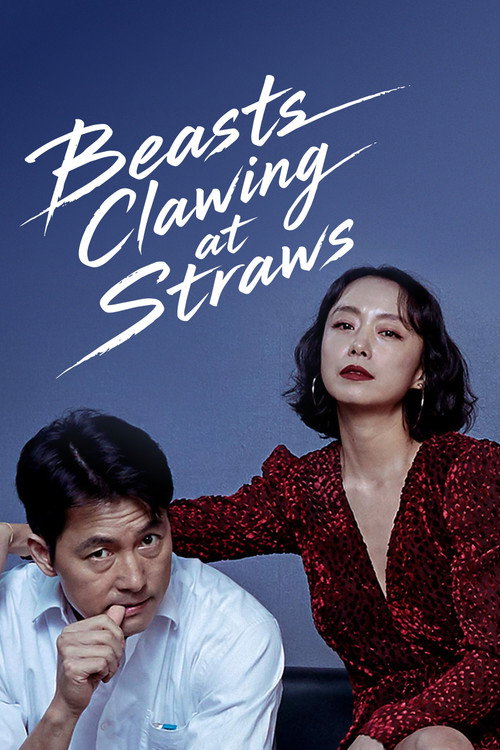
Beasts Clawing at Straws
A neon-lit, darkly comic crime puzzle where desperation curdles into greed. A single luxury bag drifts through a port town like a lure on a hook, and everyone who grabs it is dragged under.
Beasts Clawing at Straws

Beasts Clawing at Straws

지푸라기라도 잡고 싶은 짐승들

"When it comes to money... trust no-one."

19 February 2020 South Korea 108 min 7.0 (293)

Director: Kim Yong-hoon

Cast: Jeon Do-yeon, Jung Woo-sung, Bae Sung-woo, Jeong Man-sik, Yoon Je-moon

Drama Crime Thriller Mystery Deception and Betrayal Greed and desperation Fate, coincidence and karma Class and economic precarity Violence against women and the burden of care
Box Office: $5,707,415

Overview

Beasts Clawing at Straws is Kim Yong-hoon's feature debut. It adapts a Japanese novel by Keisuke Sone into a black-comic neo-noir set in the port city of Pyeongtaek. A Louis Vuitton bag stuffed with cash is left in a sauna locker, and the film follows the people who touch it, chase it or kill for it. It is split into titled chapters, and the story is told out of order.

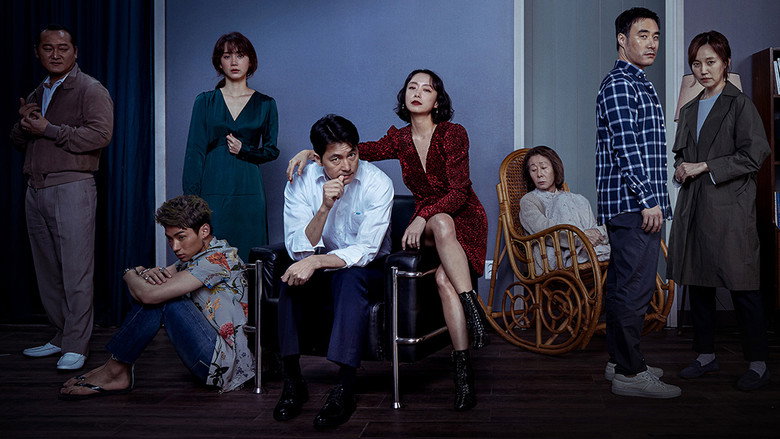
Several desperate people carry the story. Joong-man is a sauna worker stuck in a thankless job and caring for his ailing mother. Tae-young is a customs officer in debt to a gangster, and he schemes with one of the gangster's henchmen to run a scam on a "sucker" trying to leave the country. Mi-ran is an escort with an abusive husband, and a client offers to kill him in exchange for a share of the insurance money. Around them circle a ruthless crime boss, a cold femme fatale played by Jeon Do-yeon, a suspicious cop and other hangers-on.

The tone sits between Coen brothers deadpan, Tarantino-style structure and pulp noir. The violence is grisly and the humor is gallows humor. The film keeps asking who will end up holding the bag, and what it will cost them.
Core Meaning

The film argues that desperation in a ruthless economic order turns people into beasts. It is also fatalistic about luck. Reviewers have read it as a colorful critique of the capitalist free-for-all underlying Korean society, where even dirty money that trickles down to people who really need it can cost too much.

The title describes people who will grab at anything to survive, and the film shows that grabbing usually drowns them. The money does eventually reach someone who has quietly endured, and that gives the ending a thin, ironic hope. The film suggests that surviving, "with two arms and two legs", matters more than winning.

Thematic DNA

Greed and desperation 30%
Fate, coincidence and karma 25%
Class and economic precarity 20%
Deception and betrayal 15%
Violence against women and the burden of care 10%

Greed and desperation

Every character is in debt, trapped or abused, and the bag of cash turns survival instincts into betrayal and murder. Nobody who fights for it gets to enjoy it.

Fate, coincidence and karma

The interlocking, non-linear chapters show how coincidence and colliding agendas drive events. The film begins and ends by following the bag, like a karmic circle that keeps turning.

Class and economic precarity

Joong-man's job and his dependent mother, Tae-young's debts and Mi-ran's lack of options present money problems as moral traps in an unforgiving capitalist society.

Deception and betrayal

Scams, double-crosses and a femme fatale who exploits the vulnerable make trust a luxury. Those who seem to help, such as Mi-ran's rescuers, prove the most dangerous.

Violence against women and the burden of care

Mi-ran's abusive husband, Joong-man's wife who carries the caregiving, and the older mother figure show women bearing the heaviest costs, and sometimes finally getting the last laugh.

Character Analysis

Yeon-hee

Jeon Do-yeon

Archetype: Femme fatale / villain Key Trait: Chillingly amoral and charming

Motivation

Getting the money and freeing herself, at any human cost.

Character Arc

She manipulates Mi-ran and murders Mr. Park to take the money, then sets a fire to cover her crime. In the end she is killed by Park's lieutenant, and she drops the key to the locker that holds her bag of money.

Tae-young

Jung Woo-sung

Archetype: Antihero Key Trait: Scheming, quick on his feet and always one step from disaster

Motivation

Paying off his debt and surviving the gangsters.

Character Arc

A customs officer buried in debt to a loan shark after his girlfriend vanished with the money. He gets deeper into scams and faces both gangsters and a cop who suspects him.
All 5 characters and cast

Symbols & Motifs

The Louis Vuitton bag

Meaning:

Greed, status and fate. It is a transferable curse that brings misfortune to whoever holds it at the moment.

Context:

The film opens with a tracking shot that follows the bag into a sauna locker and ends by following it again. It moves from hand to hand through every storyline.

The sauna locker and key

Meaning:

Hidden opportunity and the arbitrary nature of luck. A small, mundane object holds life-changing money.

Context:

Joong-man finds the bag in a locker. At the end a dropped locker key lets Joong-man's wife find the money.

Straws (the title)

Meaning:

Last-ditch hope that cannot actually save anyone.

Context:

Each protagonist grasps at a plan, a scam, a murder or a stranger's offer to escape ruin, and most of them drown anyway.

The shark tattoo

Meaning:

Predation disguised as belonging or rescue.

Context:

The femme fatale has Mi-ran get the same shark tattoo as hers while promising her a new life, before betraying her.

Raw intestines and the animal imagery

Meaning:

Humans reduced to appetite and prey. The title's "beasts" are literal in the gangster's habits.

Context:

The hulking henchman eats raw intestines, which hints at what may happen to those who owe the gangsters.

Philosophical Questions

Does desperation excuse moral transgression?

Mi-ran, Tae-young and Joong-man all do wrong things out of need. The film sympathizes with them but still shows the consequences, and the more ruthless Yeon-hee shows what it looks like when need becomes pure predation.

Is fortune earned or random?

The non-linear structure reveals that events once seemingly separate were tightly linked by chance. The money ends up with the person who never schemed for it, which suggests luck rather than merit or morality.

What does money cost the people who need it most?

Even when the cash finally reaches someone who needs it, it arrives carrying blood and loss. The film questions whether any gain in this system is clean.

How It Ends

Alternative Interpretations

Some viewers read the film as a pure black-comic puzzle, a clockwork game of coincidence with little moral weight. Others see a moral fable: the characters who act out of greed are punished, and the ones who endure and stay decent, such as Joong-man's wife, are rewarded. The finale can be read as justice, or as a random stroke of luck. The ever-revolving bag suggests the cycle will simply begin again for someone else.

Full ending explanation

Cultural Impact

The film arrived in 2020 as part of a wave of Korean genre cinema after the international attention for Korean films. It drew on the Japanese crime novel tradition and on Hollywood film noir. Critics regularly compared it to the Coen brothers (Blood Simple, Fargo), Tarantino and Guy Ritchie, and some mentioned A Simple Plan and The Grifters.

It won the Special Jury Award at Rotterdam, and critics took it as a promising debut. Some read it as a satirical critique of capitalist Korean society, where money is the only lifeline. A few critics found it derivative of the directors it imitates.

Audience Reception

Most critics and viewers praised the intricate, interlocking structure, the stylish black comedy and the strong ensemble cast, especially Jeon Do-yeon's amoral role. The payoff in the final act drew particular approval. Letterboxd users rate it about 3.6 out of 5, and IMDb users about 7.0 out of 10.

Critics noted that the opening is somewhat confusing and slow, and that Tae-young's strand is less interesting than the others. Detractors called it derivative of Tarantino and the Coens, with thin characters and perfunctory violence. Its graphic violence, including domestic violence, is also noted as a content warning. The overall verdict is a slick, entertaining debut that is more skilled than original.

Interesting Facts

  • The film is adapted from the Japanese novel of the same name by Keisuke Sone, and it is Kim Yong-hoon's feature debut as writer-director.
  • Kim Yong-hoon was formerly an assistant to the director Jang Jin.
  • It premiered in the Tiger Competition at the 49th International Film Festival Rotterdam in 2020 and won the Special Jury Award.
  • It was named one of the Top 10 Films at the 40th Korean Association of Film Critics Awards.
  • The film is divided into five chapters, each announced by a title card, and the first is titled 'Debt'.
  • It runs 109 minutes and was produced by B.A. Entertainment.
  • Its box office is listed at about US$5.8 million.
  • Jeon Do-yeon, who plays the film's femme fatale, won Best Actress at Cannes in 2007 for Secret Sunshine.

Frequently Asked Questions

Explore More About This Movie

Dive deeper into specific aspects of the movie with our detailed analysis pages

Comments (0)

Leave a comment

No comments yet. Be the first to share your thoughts!

Similar Movies