Skip to content
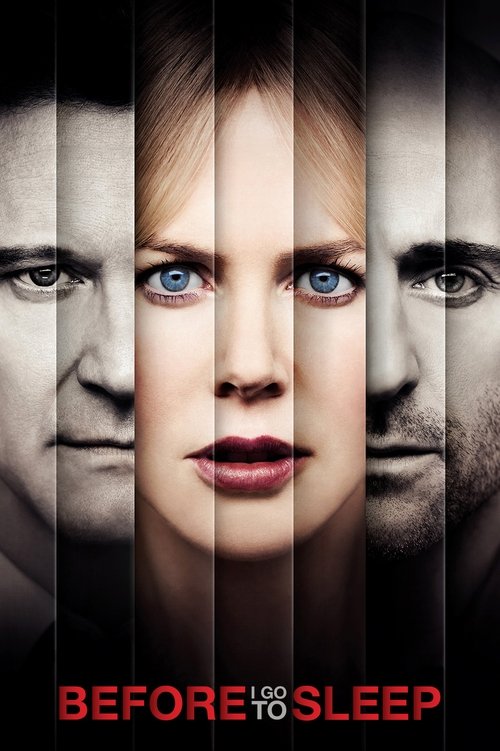
Before I Go to Sleep
Trapped in a cyclical nightmare of erased memories and shifting domestic shadows, an amnesiac woman pieces together her fractured existence through a fragile lens of paranoia and suppressed dread.
Before I Go to Sleep

Before I Go to Sleep

"Who do you trust?"

03 September 2014 France 92 min 6.5 (2,221)

Director: Rowan Joffé

Cast: Nicole Kidman, Colin Firth, Mark Strong, Ben Crompton, Anne-Marie Duff

Thriller Mystery The Fragility of Identity and Memory Domestic Abuse and Gaslighting Trust and Paranoia Grief, Guilt, and Repression
Budget: $22,000,000
Box Office: $17,669,776

Overview

Christine Lucas wakes each morning in an unfamiliar suburban home beside a man she cannot recognize. Suffering from a severe form of anterograde amnesia, her brain resets each night while she sleeps, leaving her stranded in the mindset of an unmarried twenty-something woman while looking into the mirror at a stranger in her forties. The man beside her introduces himself as Ben, her devoted husband of fourteen years, patiently explaining the trauma that erased her past and guiding her through a daily routine constructed via sticky notes and family photographs pinned across their bathroom wall.

Her fragile equilibrium shatters when she receives an illicit telephone call from Dr. Nasch, a neuropsychologist conducting experimental therapy with her behind Ben's back. He directs her to a hidden digital camera tucked away in the back of her wardrobe, where Christine has been recording daily video entries documenting her fleeting thoughts, visceral flashes of memory, and burgeoning suspicions. As the video diary accumulates, discrepancies emerge between Ben's soothing explanations and the violently fragmented recollections of her past.

As Christine navigates conflicting accounts of her history—including buried friendships, a forgotten child, and the true violent assault that caused her brain injury—she descends into severe paranoia. Caught between two men who offer competing narratives of care and guidance, she is forced to play amateur detective inside her own compromised mind, questioning whether the home protecting her is actually an elaborate domestic prison.

Core Meaning

At its core, Before I Go to Sleep examines how identity and autonomy are fundamentally predicated on memory. The film explores the profound vulnerability of individuals whose reality can be curated, rewritten, or violently dictated by those possessing narrative power over them. Rowan Joffé constructs a chilling parable of gaslighting and coercive domestic control, illustrating that when a person is stripped of their history, they are also stripped of their agency, leaving them at the mercy of manipulative protectors masquerading as saviors.

Thematic DNA

The Fragility of Identity and Memory 35%
Domestic Abuse and Gaslighting 30%
Trust and Paranoia 20%
Grief, Guilt, and Repression 15%

The Fragility of Identity and Memory

The narrative demonstrates how an individual's sense of self dissolves when disconnected from continuity. Christine must construct her identity anew each morning, showing that selfhood is not an immutable core but an ongoing, fragile narrative woven together by recollection.

Domestic Abuse and Gaslighting

Beneath the amnesia mystery lies an acute examination of coercive control. The domestic sphere becomes an isolated trap where the abuser completely dictates the parameters of the victim's reality, isolating her from external support systems.

Trust and Paranoia

Lacking dependable empirical knowledge, Christine is forced to weigh emotional intuition against material records. The film highlights the psychological terror of being unable to differentiate between an ally and an attacker.

Grief, Guilt, and Repression

The characters' actions are driven by unresolved guilt and trauma—Christine's hidden guilt regarding her extramarital affair and motherhood, juxtaposed with the obsessive, destructive possessiveness born out of rejected desire.

Character Analysis

Christine Lucas

Nicole Kidman

Archetype: The Vulnerable Detective / Persecuted Heroine Key Trait: Resilient, bewildered, intuitively perceptive

Motivation

To reconstruct the truth about her past, discover the origins of her trauma, and recover the lost connection to her maternal identity.

Character Arc

Begins as a terrified, helpless amnesiac entirely dependent on the men around her, but gradually evolves into a determined investigator who weaponizes her fragmented recordings to reclaim her autonomy and confront her abuser.

"Ben" Lucas / Mike

Colin Firth

Archetype: The Psychopathic Impostor / Shadow Husband Key Trait: Deceptive, possessive, superficially tender

Motivation

To monopolize Christine completely and sustain a fabricated romantic reality wherein she depends entirely on him, erasing any trace of her real family.

Character Arc

Initially presents as a devoted, stoic husband wearied by fourteen years of caretaking, before gradually slipping into authoritarian anger and ultimately being unmasked as Mike, the obsessive ex-lover responsible for Christine's condition.

All 4 characters and cast

Symbols & Motifs

The Digital Video Camera

Meaning:

Symbolizes externalized memory and reclaimed agency. Because Christine's biological neural pathways cannot retain new information across sleep cycles, the camera serves as a technological surrogate for her consciousness, allowing her past self to communicate truth to her future self.

Context:

Hidden inside her wardrobe by Dr. Nasch, the camera is consulted secretly every morning after Ben leaves the house, becoming the sole reliable archive of her authentic voice.

The Wall of Sticky Notes and Photographs

Meaning:

Represents manufactured truth and paternalistic control. While initially framed as loving assistance, the static photos and concise notes curate an idealized, sanitized history that deliberately excises traumatic ruptures and inconvenient people.

Context:

Lining the master bathroom, the photo collage is the first visual apparatus Christine encounters each morning to inform her who she is and who she belongs to.

The Bathroom Mirror

Meaning:

Signifies dissociation and existential dislocation. Looking into the mirror confronts Christine with the stark dissonance between her internal, youthful self-image and her weathered, mature biological reality.

Context:

The camera frequently lingers in tight close-ups on Christine's disoriented gaze as she stares at her reflection immediately upon waking, unable to reconcile the forty-year-old face with her internal memories.

Memorable Quotes

Don't trust Ben.
— Christine Lucas

Context

Recorded onto the hidden video camera after discovering contradictions in her life, watched by Christine upon reawakening.

Meaning

The catalyst line that ruptures the illusion of domestic safety, signaling to Christine that her own recorded instincts view her primary caregiver as a threat.

You have problems remembering things.
— Dr. Mike Nasch

Context

Spoken during an early clandestine consultation as Dr. Nasch explains the mechanics of her condition and therapy.

Meaning

Summarizes the foundational vulnerability that defines Christine's existence and sets the terms of her daily rehabilitation.

All 3 quotes

Philosophical Questions

Can personal identity exist independently of episodic memory?

The film explores whether moral intuition, personal preferences, and core instincts endure when the episodic timeline of memories is severed each night, showing Christine reacting with instinctual disgust or tenderness even without contextual knowledge.

How ethical is paternalistic deception when performed under the guise of protection?

Through both the impostor Mike's fabrications and the real Ben's original decision to conceal painful truths, the story interrogates whether withholding agonizing reality from a vulnerable person is compassionate care or an insidious violation of dignity.

How It Ends

Alternative Interpretations

While the film resolves its plot as a literal psychological mystery, critics have highlighted two distinct readings:

Full ending explanation

Cultural Impact

Released in the autumn of 2014, Before I Go to Sleep arrived during a popular wave of literary domestic thrillers headlined by adaptations like David Fincher's Gone Girl. While S.J. Watson's novel had been a runaway global publishing phenomenon, Rowan Joffé's cinematic adaptation had a more modest cultural imprint, experiencing a difficult theatrical run and grossing roughly $15 million against a $22 million budget. In retrospective critical circles, the film is frequently discussed in comparison to amnesia landmarks such as Christopher Nolan's Memento and Peter Segal's romantic comedy 50 First Dates, analyzed as an earnest, dark psychological variation that explores anterograde memory loss through the lens of psychological domestic captivity.

Audience Reception

Audience and critical reception toward Before I Go to Sleep was largely divided and lukewarm, earning a 37% rating on Rotten Tomatoes. Reviewers widely praised the caliber and commitment of the central cast—singling out Nicole Kidman's raw emotional vulnerability and Colin Firth's chilling transformation from gentle caregiver to violent predator. However, the film faced widespread criticism for its formulaic script, reliance on conventional psychological thriller tropes, and noticeable narrative contrivances. While many general viewers appreciated the brisk 92-minute pacing and claustrophobic tension, others found the climactic twists predictable and the melodrama hard to sustain compared to Watson's page-turning novel.

Interesting Facts

  • The film was adapted from the 2011 bestselling debut novel by British author S.J. Watson, which had been published in more than 40 languages.
  • Ridley Scott served as one of the film's executive producers through his production banner Scott Free Productions.
  • Nicole Kidman, Colin Firth, and Mark Strong formed a close-knit trio of acclaimed British and Australian talent; Firth and Strong had previously starred together in 'Tinker Tailor Soldier Spy' and reunited shortly after in 'Kingsman: The Secret Service'.
  • Mark Strong, who frequently played calculating villains and antagonists in mainstream cinema, was deliberately cast as the sympathetic doctor to play against audience expectations and misdirect their suspicions.
  • In Watson's original novel, Christine's son Adam is nineteen years old with a live-in partner, but for Rowan Joffé's film adaptation, he was de-aged to a young boy to heighten the maternal pathos.

Easter Eggs

Subversion of Colin Firth's gentlemanly persona

The casting of Colin Firth weaponizes his celebrated cinematic history as romantic, noble archetypes (such as Mr. Darcy in Pride and Prejudice and King George VI in The King's Speech) to disarm viewers before pulling off a vicious villain turn.

Echoes of mid-century gothic 'gaslight' thrillers

The narrative structure and minimalist domestic setting pay direct homage to classical 1940s noir thrillers such as Gaslight (1944) and My Name Is Julia Ross (1945), where a woman's sanity is systematically manipulated within her own residence.

Frequently Asked Questions

Explore More About This Movie

Dive deeper into specific aspects of the movie with our detailed analysis pages

Comments (0)

Leave a comment

No comments yet. Be the first to share your thoughts!

Similar Movies