
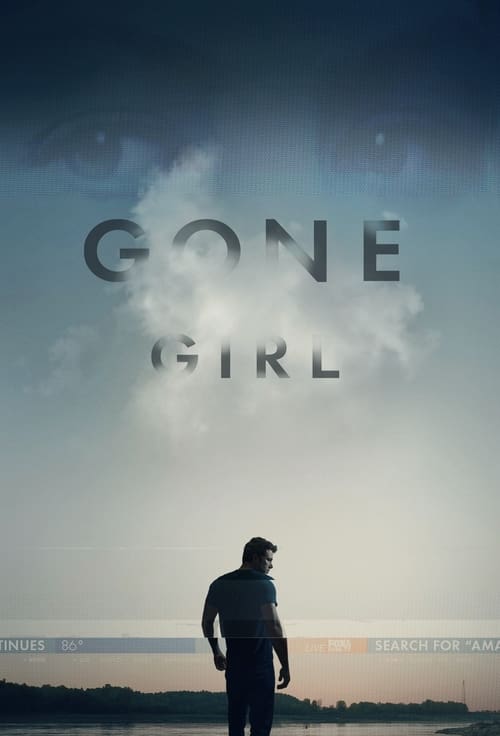
Gone Girl
"You don't know what you've got 'til it's..."
Overview
On the day of their fifth wedding anniversary, Nick Dunne (Ben Affleck) reports that his beautiful wife, Amy (Rosamund Pike), has gone missing. Under pressure from the police and a growing media frenzy, Nick's portrait of a blissful union begins to crumble. Soon his lies, deceits, and strange behavior have everyone asking the same dark question: Did Nick Dunne kill his wife?
As the investigation unfolds, the narrative shifts between Nick's present-day perspective and excerpts from Amy's diary, which paint a picture of a loving relationship that slowly soured and became fraught with fear. The film masterfully peels back layers of a complex and toxic marriage, leading to a shocking mid-point revelation that turns the entire story on its head. It becomes clear that what appears to be a straightforward mystery is a meticulously crafted game of manipulation and revenge, where the lines between victim and perpetrator are terrifyingly blurred.
Core Meaning
At its core, Gone Girl is a scathing critique of modern marriage, media sensationalism, and the curated identities people project in their relationships and public lives. Director David Fincher explores the toxic nature of performing for a partner, embodying an idealized version of oneself—the "Cool Girl" or the "Good Husband"—until resentment and deception fester underneath. The film suggests that the pressure to maintain these facades can lead to devastating consequences.
Furthermore, it delves into the power of narrative and how easily public perception can be manipulated by a compelling story, regardless of the truth. The media's hunger for a simple, dramatic villain-and-victim narrative is shown to be a destructive force, capable of convicting someone in the court of public opinion long before any facts are established. Ultimately, the film poses unsettling questions about authenticity, intimacy, and the dark, transactional nature that can define contemporary relationships.
Thematic DNA
Marriage and Deception
The film deconstructs the institution of marriage, portraying the Dunne's union as a performance of idealized roles. Amy's famous "Cool Girl" monologue reveals her resentment at having played the part of the perfect, easy-going wife for Nick. Their entire relationship is built on layers of deceit, from Nick's infidelity to Amy's meticulously fabricated diary and, ultimately, her entire disappearance. The narrative suggests that their marriage is a battleground of competing narratives, where love has been replaced by a struggle for control and a desire to punish the other for failing to live up to a projected fantasy.
Media Manipulation and Public Perception
Gone Girl provides a sharp critique of how the 24-hour news cycle and social media shape public opinion. The media quickly casts Nick as the villain, turning his awkwardness and lack of conventional grief into evidence of guilt. Both Amy and Nick eventually learn to weaponize the media for their own ends. Amy crafts her disappearance narrative to be perfectly consumed by a sensation-hungry public, while Nick, guided by his lawyer, stages a public relations campaign to win back sympathy. The film highlights the terrifying power of a well-told story to eclipse the truth.
Identity and Performance
The theme of performing an identity is central to the film. Amy grew up as the real-life inspiration for her parents' "Amazing Amy" books, a fictionalized, perfect version of herself she could never live up to. This sense of living as a character extends into her marriage, where she performs the role of the "Cool Girl." Nick also performs, first as the charming romantic and later as the repentant husband on television. The film suggests that modern identity is often a collection of curated personality traits, leading to a loss of genuine selfhood. The characters are trapped by the personas they've created, unable to escape even when the performance becomes destructive.
Control and Revenge
Amy's elaborate plan is an extreme act of revenge and a desperate attempt to reclaim control over her life and her narrative. Feeling betrayed by Nick's affair and his complacency, she orchestrates a scenario where she controls every detail, punishing him in the most public and humiliating way possible. The treasure hunts she designs for Nick each anniversary are an earlier, more benign form of this control. The film's dark ending, where Nick is forced to stay with Amy, solidifies her ultimate victory in this power struggle, leaving him permanently under her control.
Character Analysis
Amy Elliott Dunne
Rosamund Pike
Motivation
Amy's primary motivation is revenge against Nick for his infidelity, his laziness, and for taking her for granted, effectively "killing" the woman she was. She feels he destroyed the ideal life she meticulously built. Her actions are also driven by a deep-seated need for control, stemming from a childhood spent in the shadow of her parents' fictional creation, "Amazing Amy." She desires to be the author of her own story and to force Nick to become the man she wants him to be.
Character Arc
Amy begins as the perceived victim, the perfect wife who has mysteriously vanished. Through her diary, she appears loving and later terrified. The film's major twist reveals her true nature: a highly intelligent, calculating, and vengeful woman who has faked her own death to frame her unfaithful husband. Her arc is one of transformation from a passive-aggressive wife into an active, ruthless architect of her own narrative. She ultimately reclaims her power, not by escaping her marriage, but by trapping Nick in it under her complete control, solidifying her status as a triumphant, albeit sociopathic, antihero.
Nick Dunne
Ben Affleck
Motivation
Initially, Nick's motivation is self-preservation; he wants to avoid being convicted of a murder he didn't commit. He is driven by a desire to uncover the truth of what Amy has done. As the story evolves, his motivation shifts. After Amy returns, his goal becomes exposing her, but he is ultimately thwarted. His final motivation is a complex mix of fear, a sense of paternal responsibility for his unborn child, and a grim resignation to his fate with a woman he both hates and, on some level, understands.
Character Arc
Nick is initially presented as a seemingly average, albeit unlikable, husband who becomes the prime suspect in his wife's disappearance. His arc is a journey from passive apathy and dishonesty to a forced, active participant in Amy's twisted game. He is forced to confront his own failings as a husband and learn how to manipulate public perception to save himself. By the end, he chooses to stay with the monstrous Amy, ostensibly for their unborn child, but also perhaps because he recognizes a part of himself in their shared darkness and toxicity. He is trapped, but he has also become a willing performer in their public charade of a happy marriage.
Margo 'Go' Dunne
Carrie Coon
Motivation
Margo's motivation is simple and unwavering: to protect her brother. She provides Nick with financial, emotional, and practical support throughout the crisis. She is driven by loyalty and a desire to see Nick clear his name and free himself from a marriage she has always viewed with suspicion.
Character Arc
Margo is Nick's twin sister and the film's moral compass. She remains steadfastly supportive of Nick, even as she learns of his lies and betrayals. Her arc is one of dawning horror as she realizes the depth of both her brother's flaws and the true, terrifying nature of his wife, Amy. She is the only character who consistently sees the truth of the situation and voices it, urging Nick to escape the toxic relationship. Her final scene shows her disillusionment and fear as she watches her brother willingly walk back into Amy's trap.
Detective Rhonda Boney
Kim Dickens
Motivation
Boney's motivation is to solve the case of Amy's disappearance. She is driven by a professional desire to follow the clues and bring a perpetrator to justice. She is meticulous and intelligent, piecing together the evidence as it is presented, even though the evidence is entirely fabricated by Amy.
Character Arc
Detective Boney begins as a sharp, by-the-book detective who is immediately suspicious of Nick's strangely calm demeanor. Her arc follows the evidence, and she becomes increasingly convinced of Nick's guilt based on Amy's masterful framing. However, she retains a professional skepticism. Even after Amy returns and provides a seemingly airtight story of kidnapping, Boney's lingering doubts and perceptive questions show that she, unlike the public, is not entirely convinced. She represents the limitations of law enforcement when faced with a perfect narrative and a lack of hard evidence to the contrary.
Tanner Bolt
Tyler Perry
Motivation
Tanner's motivation is to win his case and maintain his reputation. He is driven by professional expertise and a clear understanding of the modern media landscape. He provides Nick with the tools and strategy needed to fight back against Amy's narrative, not out of a belief in Nick's inherent goodness, but because it's his job to create a winning defense.
Character Arc
Tanner Bolt is a high-profile defense attorney who specializes in representing men accused of killing their wives. He enters the story as a cynical but brilliant strategist. His arc is not one of personal change, but of professional execution. He guides Nick through the treacherous waters of media manipulation, teaching him how to perform for the cameras and win public sympathy. He is a pragmatist who understands that in high-profile cases, the court of public opinion is as important as the court of law.
Symbols & Motifs
Amy's Diary
Amy's diary symbolizes the power of narrative to shape reality and the instability of truth. It is not a genuine record of her feelings but a carefully constructed piece of evidence designed to frame Nick. It represents how a compelling, albeit false, story can be more powerful than the actual truth, especially in the eyes of the media and the public.
The film frequently cuts to flashbacks narrated by Amy's diary entries, which initially present her as a loving wife growing fearful of her husband. The diary is discovered by the police and becomes the primary evidence against Nick, dictating the public's perception of him as a murderer. The later revelation that the diary is entirely fabricated is the film's central twist.
The Treasure Hunt
The annual anniversary treasure hunt symbolizes the manipulative games and power dynamics within Nick and Amy's marriage. While appearing to be a romantic tradition, it's a test of Nick's attention and devotion, one he consistently fails in Amy's eyes. On their fifth anniversary, the hunt becomes the central mechanism of her revenge plot, leading the police and Nick himself through a trail of manufactured clues designed to incriminate him.
Amy sets up a treasure hunt for Nick on the day of her disappearance. Each clue is a rhyming poem leading to a location significant to their marital problems, particularly Nick's affair. The clues are discovered by the police, who interpret them as signs of a struggle and Nick's guilt, just as Amy intended.
Punch and Judy Puppets
The Punch and Judy puppets are a direct and grim symbol of domestic violence and the murderous narrative Amy is creating. The traditional puppet show involves Punch killing his wife Judy, mirroring the crime Amy is framing Nick for. By leaving the puppets for Nick to find, she is symbolically casting him as the violent husband and herself as the innocent victim in a scripted performance for the public.
The puppets are one of the final "gifts" Nick discovers as part of the treasure hunt. They are found in his sister's woodshed, where other incriminating evidence has been planted. The discovery is a chilling moment where the violent undertones of Amy's plan become explicit.
The Mississippi River
The Mississippi River, which flows through their Missouri town, serves as a motif representing the inescapable and dark undercurrents of their lives. It is a constant, looming presence. Amy threatens to send Nick "up the river" to prison, linking the river to confinement and doom. It symbolizes a force that can carry away secrets and truths, and ultimately, the inability of the characters to escape their toxic situation.
The river is a prominent feature of the film's setting. Nick often goes to its banks to think. The setting in a riverside town also connects to Mark Twain and Huckleberry Finn, who faked his own death, mirroring Amy's plot.
Memorable Quotes
When I think of my wife, I always think of the back of her head. I picture cracking her lovely skull, unspooling her brain, trying to get answers. The primal questions of a marriage: What are you thinking? How are you feeling? What have we done to each other?
— Nick Dunne
Context:
This is the film's opening voiceover, spoken by Nick as he strokes Amy's hair. It sets up the central mystery not just of Amy's disappearance, but of who Amy and Nick truly are to each other.
Meaning:
This opening line immediately establishes the film's dark, unsettling tone and the profound disconnect within the Dunne's marriage. It's a shocking and violent image that frames the entire narrative, suggesting that beneath the surface of their relationship lies a deep well of resentment and a fundamental lack of understanding between husband and wife.
I'm the bitch who makes you a better man.
— Amy Elliott Dunne
Context:
This is said by Amy towards the end of the film, after she has returned and trapped Nick in the marriage once again. Nick is expressing his hatred for her, and she retorts with this line, asserting her continued dominance and control over him.
Meaning:
This line encapsulates Amy's twisted justification for her actions and her perception of her role in the marriage. She believes that her extreme, manipulative behavior is necessary to force Nick out of his apathy and into being the man she wants him to be. It's a chilling expression of a toxic, codependent relationship where control is framed as a form of improvement.
We're so cute, I want to punch us in the face.
— Amy Elliott Dunne
Context:
Amy says this in a flashback to the early, happy days of her and Nick's relationship in New York. They are at a party, being the charming, witty couple, and she whispers this to Nick, highlighting the constructed nature of their public persona.
Meaning:
This quote, from early in their relationship, reveals a self-awareness of the performative nature of their 'perfect' coupledom. Even in the beginning, Amy recognizes the almost nauseating perfection of the image they project. It foreshadows the later resentment that builds from maintaining this facade and hints at the underlying cynicism beneath their romantic exterior.
You two are the most fucked-up people I have ever met.
— Margo 'Go' Dunne
Context:
Margo says this to Nick near the end of the film, after Amy has returned and he has decided to stay with her. Margo is horrified and disgusted by their decision to continue their charade of a marriage, and she delivers this line with complete exasperation.
Meaning:
Spoken by the film's most grounded and morally centered character, this line serves as the audience's verdict on Nick and Amy's relationship. It cuts through all the manipulation and media spin to state the plain, horrifying truth: their dynamic is profoundly and pathologically toxic. It's a moment of raw, unvarnished honesty in a film filled with deception.
Philosophical Questions
What is the nature of truth in an age of media saturation?
The film relentlessly questions whether objective truth can exist or even matters when narrative is more powerful. Amy creates a fictional diary that the public and police accept as reality. Nick, in turn, must create a counter-narrative on television to save himself. Gone Girl suggests that the 'truth' is often simply the most compelling or emotionally satisfying story that is told. It explores how easily an audience can be swayed by a well-crafted performance, raising questions about our own consumption of media and our rush to judgment in public scandals.
Are we performing roles in our relationships rather than being our authentic selves?
The film uses the marriage of Nick and Amy to explore the idea of performative identity in relationships. Amy's 'Cool Girl' monologue is a direct indictment of the personas people adopt to be loved. Nick also plays the part of the charming, devoted husband at the beginning of their relationship. The film asks whether true authenticity is possible in a romantic partnership, or if relationships are inherently a form of theater where both parties agree to play certain roles. The devastating conclusion suggests that sometimes, the performance is all that's left.
Can two 'wrong' people be right for each other?
The ending of Gone Girl forces the audience to consider a disturbing philosophical question. Nick and Amy are both deeply flawed, manipulative, and dishonest people. Yet, by the end, they seem to have reached a twisted form of equilibrium. The film challenges conventional notions of love and compatibility by suggesting that perhaps these two destructive individuals, who bring out the worst in each other, are also the only ones who can truly understand and match one another's intensity. It leaves the viewer to ponder whether their shared toxicity constitutes a unique, albeit terrifying, kind of soulmate connection.
Alternative Interpretations
While the film's primary reading focuses on a toxic marriage and media satire, several alternative interpretations exist. One perspective views the film as a dark comedy about the absurd lengths people go to maintain a relationship. Some critics and viewers have interpreted both Nick and Amy as psychopaths who are, in their own twisted way, perfect for each other. This reading suggests that Nick's decision to stay at the end is not just out of fear or for his child, but because he is drawn to Amy's intensity and recognizes that no "normal" life would ever be as compelling. He has, in a sense, become the man Amy wanted him to be—someone who can play the game.
Another interpretation focuses more heavily on the feminist angle, viewing Amy not as a simple villain but as a product of a society that forces women into performative roles. Her extreme actions, in this light, are seen as a radical and violent rejection of patriarchal expectations. While not condoning her methods, this view analyzes her as an antiheroine who reclaims her agency in the most shocking way possible. The ending is seen not as a bleak trap for Nick, but as Amy's ultimate victory in creating a world on her own terms.
Cultural Impact
Gone Girl was a significant cultural phenomenon upon its release, sparking widespread conversations about gender dynamics, marriage, and media ethics. The film, and specifically the character of Amy Dunne, became a focal point for debates on feminism, misogyny, and the portrayal of complex, unlikable female characters in popular culture. Amy's "Cool Girl" monologue, in particular, became an iconic and widely quoted piece of social commentary, resonating with many who felt the pressure to perform a certain version of femininity in relationships.
Critically, the film was highly acclaimed, praised for David Fincher's taut and stylish direction, Gillian Flynn's sharp screenplay, and Rosamund Pike's star-making performance, which earned her an Academy Award nomination. It was a commercial success, becoming Fincher's highest-grossing film. The movie's success led to a resurgence in the popularity of the psychological thriller genre, particularly those featuring unreliable narrators and domestic settings, often dubbed the "Gone Girl effect." It influenced a wave of similar books and films that explored the dark side of suburban life and relationships. The term "Gone Girl" itself entered the pop culture lexicon as shorthand for a story involving a mysterious disappearance and a potentially sinister spouse.
Audience Reception
Audiences generally had a highly positive, if unsettled, reaction to Gone Girl. The film was widely praised for its suspenseful plot, sharp writing, and stylish direction. Viewers were particularly captivated by the shocking mid-film twist, which was a major topic of discussion. Rosamund Pike's performance as Amy Dunne received immense praise, with many finding her portrayal both terrifying and mesmerizing. Ben Affleck's casting, initially met with some skepticism, was also lauded for perfectly capturing Nick's blend of charm and untrustworthiness.
The main points of criticism, when they arose, often centered on the film's bleak and cynical view of humanity and marriage, which some viewers found off-putting. The ending was also a point of controversy and debate; many were frustrated and angered that Amy 'gets away with it,' while others found the dark conclusion to be a fitting and thought-provoking statement on the film's themes. Overall, the film was considered a smart, gripping, and masterfully crafted thriller that lingered long after the credits rolled.
Interesting Facts
- Gillian Flynn, the author of the novel, also wrote the screenplay for the film.
- Reese Witherspoon's production company acquired the film rights to the novel, and she serves as a producer on the film. She initially considered playing Amy but ultimately thought she wasn't the right fit.
- Director David Fincher is known for his meticulousness and demanding multiple takes. For 'Gone Girl,' the crew reportedly averaged close to 50 takes per scene.
- Ben Affleck, a die-hard Boston Red Sox fan, famously shut down production for four days because he refused to wear a New York Yankees cap for a scene. They eventually compromised on a New York Mets cap.
- To prepare for the role of Amy, Rosamund Pike worked with a dialect coach to perfect her American accent and studied the body language of Carolyn Bessette-Kennedy for inspiration, due to her enigmatic and rarely-heard public persona.
- The film was the first feature to be shot entirely on the Red Dragon digital camera in 6K resolution.
- In the lead-up to the film's release, Gillian Flynn and David Fincher falsely claimed they had significantly changed the book's third act to mislead fans of the novel and preserve the twists.
- The real-life case of Laci and Scott Peterson was one of the inspirations for Gillian Flynn when she was writing the novel.
⚠️ Spoiler Analysis
Click to reveal detailed analysis with spoilers
Frequently Asked Questions
Explore More About This Movie
Dive deeper into specific aspects of the movie with our detailed analysis pages
Comments (0)
No comments yet. Be the first to share your thoughts!