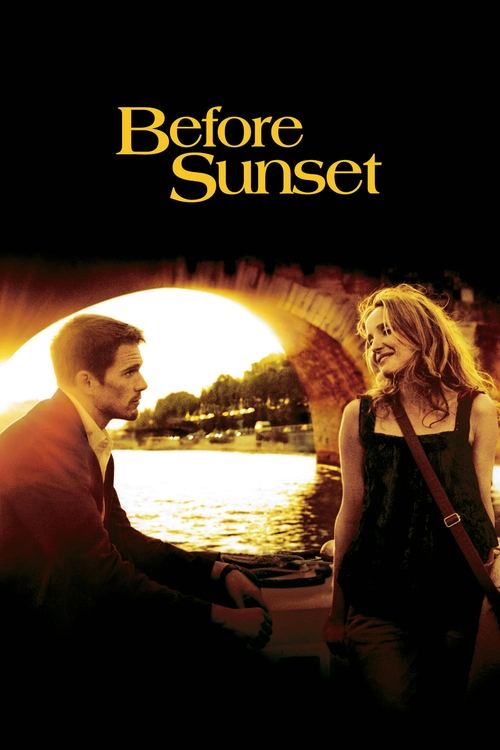
Before Sunset
"What if you had a second chance with the one that got away?"
Overview
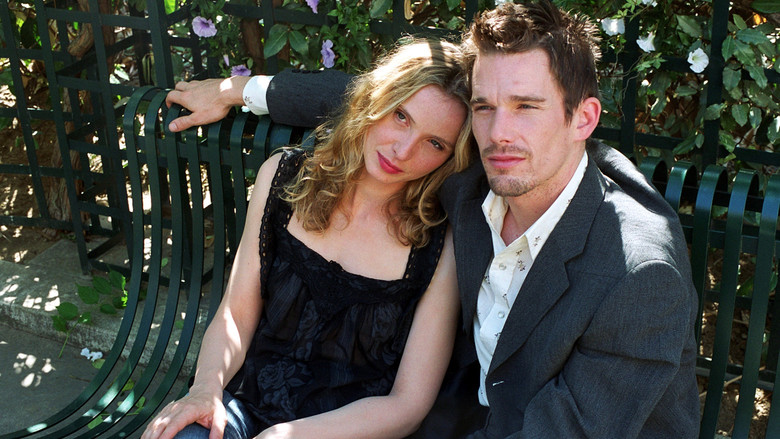
Nine years after their brief, magical encounter in Vienna, Jesse and Celine cross paths again in Paris. Jesse, now a successful author on a promotional book tour, is surprised by Celine's appearance at a local bookstore. With only eighty minutes remaining before Jesse must board a flight back to the United States, the two spend their final moments together wandering through the city's streets, cafes, and parks.
As they walk, the tentative small talk of their initial reunion evolves into a raw, deeply personal conversation. They discuss the divergent paths their lives have taken, their professional struggles, and the lingering influence of that one night in Vienna. The film unfolds in near real-time, heightening the tension as the deadline of Jesse's departure looms over their rekindled connection, forcing them to confront the dissatisfaction of their current lives and the possibility of a shared future.
Core Meaning
Director Richard Linklater explores the transformative power of time and the persistence of emotional connection. The film suggests that while life's responsibilities and the passage of years can build walls of cynicism and regret, a single authentic connection can strip those layers away. It serves as a meditation on the "what ifs" of adulthood, questioning whether we are defined by the choices we made or the possibilities we let slip away. Ultimately, the film carries a message of vulnerability as a catalyst for truth, arguing that true intimacy requires the courage to admit one's unhappiness and the willingness to risk stability for the sake of the soul.
Thematic DNA
The Passage of Time and Aging
The film highlights how nine years have reshaped the characters from idealistic youths into weary adults. Their dialogue reflects the weight of accumulated experiences, showing how time has both hardened their hearts and deepened their understanding of themselves.
Regret and Missed Opportunities
Central to the narrative is the "one that got away" trope, elevated by the characters' honest admission that their lives have felt incomplete since their first meeting. They grapple with the realization that their missed reunion in Vienna fundamentally altered the trajectory of their happiness.
Idealism vs. Cynicism
Jesse and Celine struggle to reconcile their youthful romanticism with their current realities—Jesse’s stagnant marriage and Celine’s environmental activism. The tension between who they wanted to be and who they have become provides the film's emotional backbone.
Communication and Connection
The film is almost entirely composed of dialogue, illustrating that true connection is an active, verbal process of discovery. Their ability to speak freely with each other, in contrast to their failing relationships with others, underscores the rarity of their bond.
Character Analysis
Jesse
Ethan Hawke
Motivation
Driven by a desperate need to find meaning and connection in a life that has become performative and hollow.
Character Arc
Begins the film as a successful but emotionally numb author hiding behind professional polish. He gradually sheds his defensive cynicism, finally admitting his profound unhappiness and his desire to stay with Celine.
Celine
Julie Delpy
Motivation
Motivated by a desire to protect herself from further heartbreak while simultaneously craving the intensity of the connection she once had.
Character Arc
Starts by projecting a content, busy life as an activist. As the day progresses, her anger and resentment regarding her failed relationships boil over, leading to a raw confession of how the night in Vienna "ruined" her for other men.
Bookstore Manager
Vernon Dobtcheff
Motivation
Maintaining the order of the book tour and the legacy of the historic bookstore.
Character Arc
Remains a static figure of the Parisian literary world, facilitating the reunion without being part of the emotional turmoil.
Symbols & Motifs
The Ticking Clock
Represents the relentless pressure of reality and the finite nature of human opportunity.
The film emphasizes the 80-minute window before Jesse's flight, with clocks occasionally appearing in the background to remind the audience that their time is running out.
The Book (This Time)
Symbolizes Jesse's attempt to rewrite the past and reach out to Celine through fiction.
Jesse's novel, which details their night in Vienna, serves as the reason they are reunited at the Shakespeare and Company bookstore.
The Tourist Barge
Represents the transition and the flow of life that continues despite individual desires.
As they drift down the Seine, the characters are physically moving while their conversation dives deeper into their stationary, stagnant personal lives.
The Waltz / Nina Simone
Symbolizes vulnerability, personal expression, and the breaking of social masks.
In the final scene, Celine plays a song she wrote about Jesse and dances to Nina Simone, showing him the 'real' her that she usually keeps hidden.
Memorable Quotes
I guess when you're young, you believe that you will meet many people with whom you'll connect with, but later you realize it only happens a few times.
— Celine
Context:
Spoken during their walk as they reflect on the scarcity of the bond they shared nine years prior.
Meaning:
Reflects the sobering realization of adulthood that deep human connection is a rare commodity, not an infinite resource.
Memory is a wonderful thing if you don't have to deal with the past.
— Celine
Context:
Said while discussing why she found Jesse's book painful to read.
Meaning:
Points to the pain of nostalgia and the difficulty of living in the present when the past remains unresolved.
Baby, you are gonna miss that plane.
— Celine
Context:
The final line of the film, spoken as Celine dances in her apartment while Jesse watches her.
Meaning:
A playful yet profound acknowledgement that their connection has overridden Jesse's external obligations.
I know.
— Jesse
Context:
Jesse's final response to Celine, closing the film on a note of ambiguous but certain choice.
Meaning:
The ultimate acceptance of fate; Jesse chooses the moment over his responsibilities, signaling his decision to stay.
Philosophical Questions
Is identity static or fluid over time?
The characters debate whether they are the same people they were at 23. The film explores the idea that while our circumstances change, our essential 'frequency' or way of connecting with the world remains constant.
Does 'the one that got away' actually exist, or is it a projection?
The film questions if their intense connection is due to their inherent compatibility or the fact that they never had to deal with the mundane reality of a daily life together.
Alternative Interpretations
While the ending is often seen as a romantic triumph, some critics interpret it as a tragedy. In this view, Jesse and Celine are two broken people clinging to a ghost of their youth to escape the difficult work of their actual lives. Another reading suggests that the entire reunion is a manifestation of the fiction Jesse wrote—that they are essentially characters trapped in the "moment inside every moment" he describes at the bookstore, unable to ever truly move forward.
Cultural Impact
Before Sunset is widely regarded as one of the greatest sequels in cinema history, praised for successfully maturing with its audience. It helped define the "walk and talk" subgenre of indie film, heavily influenced by the style of Eric Rohmer. Culturally, it moved the conversation of romantic cinema away from the "meet-cute" and toward the complexities of long-term regret and adult disillusionment. It solidified the Before Trilogy as a landmark achievement in longitudinal storytelling, mirroring the real aging of its actors and director.
Audience Reception
The film received near-universal acclaim from critics, currently holding a 94% on Rotten Tomatoes. Audiences were initially polarized by the abrupt, ambiguous ending, with many expressing frustration at not seeing Jesse board or miss the plane. However, over time, this ending has been hailed as one of the most perfect closures in film, praised for trusting the audience's intuition over literal resolution. It is frequently cited as the strongest entry in the trilogy due to its emotional intensity and structural elegance.
Interesting Facts
- The film was shot in only 15 days on a limited budget.
- Ethan Hawke and Julie Delpy co-wrote the screenplay with Richard Linklater and received Academy Award nominations for Best Adapted Screenplay.
- The movie takes place in near real-time, lasting roughly 80 minutes, which is the same amount of time Jesse has before his flight.
- The legendary Shakespeare and Company bookstore in Paris, where the film opens, allowed filming on location.
- Ethan Hawke was going through a real-life separation from Uma Thurman during filming, which many critics believe informed his character's weary performance.
- Unlike the first film, which was more improvisational during rehearsals, the dialogue in Before Sunset was meticulously scripted to appear spontaneous.
Easter Eggs
The 'Waking Life' Connection
Before this sequel was made, Jesse and Celine appeared in a dream sequence in Linklater's animated film Waking Life (2001). Some fans theorize that scene represents one of the dreams Jesse mentions having about Celine in Before Sunset.
James Joyce Reference
The first film took place on June 16th (Bloomsday). In Before Sunset, they meet at the bookstore where James Joyce's Ulysses was famously published, continuing the subtle literary parallels.
⚠️ Spoiler Analysis
Click to reveal detailed analysis with spoilers
Frequently Asked Questions
Explore More About This Movie
Dive deeper into specific aspects of the movie with our detailed analysis pages
Comments (0)
No comments yet. Be the first to share your thoughts!