
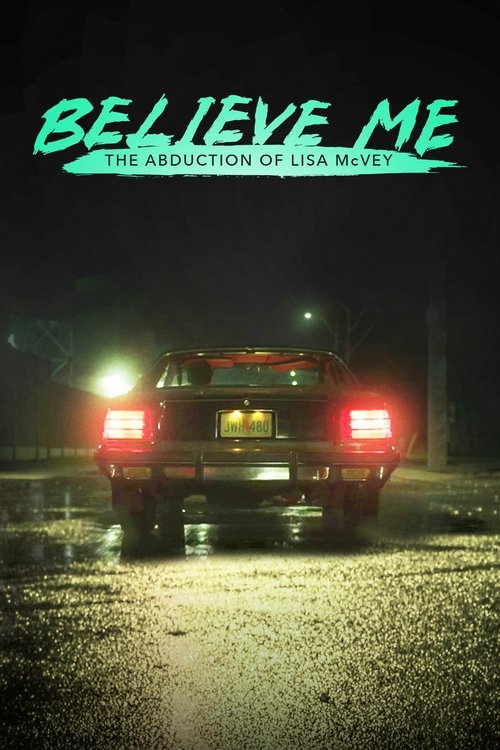
Believe Me: The Abduction of Lisa McVey
Overview
"Believe Me: The Abduction of Lisa McVey" is a Canadian-American television film that recounts the harrowing true story of 17-year-old Lisa McVey in Tampa, Florida, in 1984. On the night she plans to take her own life due to ongoing sexual abuse at home, Lisa is abducted by a stranger while cycling home from her job at a doughnut shop. The man is later identified as Bobby Joe Long, a serial killer responsible for the murders of at least ten women in the area.
Held captive for 26 hours, Lisa endures repeated assaults but shows incredible presence of mind. Drawing on psychological survival skills honed from her abusive childhood, she begins a careful game of manipulation to gain her captor's trust while mentally cataloging every possible detail about him, his car, and his apartment. She strategically leaves behind evidence like fingerprints and hair samples, determined that if she doesn't survive, he will be caught.
After managing to convince her attacker to release her, Lisa returns home to a wall of disbelief from both her family and most of the police investigators. Her story, filled with an incredible amount of detail, is initially dismissed as a fabrication. However, one detective, Sgt. Larry Pinkerton, believes her and recognizes that her testimony may hold the only key to stopping the serial killer terrorizing the region.

Core Meaning
The core meaning of "Believe Me: The Abduction of Lisa McVey" is a powerful testament to the resilience of the human spirit in the face of unimaginable trauma. The director, Jim Donovan, focuses the narrative squarely on the survivor's perspective, emphasizing not the killer, but the victim who triumphed over him. The film's title underscores its central message: the critical importance of believing survivors of sexual assault and the devastating consequences of skepticism. It explores the idea that strength can be forged in darkness, as Lisa's traumatic past paradoxically equips her with the psychological tools to outwit her captor. Ultimately, the film is a story of empowerment, showing how one young woman's courage and intelligence not only saved her own life but brought a reign of terror to an end and transformed her into an advocate for others.
Thematic DNA
Survival and Resilience
The film's primary theme is the sheer will to survive. Lisa, already contemplating suicide due to her abusive home life, finds a renewed reason to live when faced with her abductor. Her resilience is not just physical but psychological. She consciously shifts from a passive victim to an active participant in her own survival, using reverse psychology and manipulation—skills she tragically learned from previous abuse—to connect with her captor and convince him to spare her.
The Power of Observation and Memory
This theme is central to the plot's resolution. Believing she might die, Lisa makes a conscious effort to memorize every detail of her ordeal. Despite being blindfolded for much of the 26 hours, she takes mental notes of the route taken, the feel of her captor's face, the interior of his car and apartment, and the sounds around her. She also intentionally leaves behind forensic evidence. This incredible retention of detail, which initially causes police to doubt her, becomes the very key to identifying and capturing a serial killer.
The Failure to Protect and the Importance of Belief
The film's title, Believe Me, directly addresses this theme. Upon her return, Lisa is met with skepticism from her family and law enforcement, who find her detailed account too incredible to be true. This highlights a systemic failure to believe victims of sexual violence. Her home life is a microcosm of this theme, where her grandmother is complicit in the abuse she suffers. The narrative pivots on the moment one detective, Larry Pinkerton, chooses to believe her, demonstrating how a single act of trust can be the catalyst for justice.
Transformation of Trauma into Strength
The film powerfully illustrates how Lisa transforms her trauma into a force for good. Her survival is a direct result of the coping mechanisms she developed during years of childhood abuse. After the ordeal, she doesn't just heal; she channels her experience into a career. The postscript reveals that the real Lisa McVey became a sheriff's deputy in the sex crimes unit, dedicating her life to protecting vulnerable children, embodying the ultimate triumph over her past.
Character Analysis
Lisa McVey
Katie Douglas
Motivation
Initially, her motivation is pure survival—to live through the next minute, the next hour. This is quickly coupled with a desire for justice. Believing she might be killed, she is motivated to leave a trail of evidence so her killer can be caught. After her escape, her motivation shifts to being believed and ensuring her attacker cannot harm anyone else.
Character Arc
Lisa begins as a deeply traumatized and suicidal teenager, trapped in an abusive home where she feels worthless. Her abduction becomes a paradoxical turning point. Instead of succumbing to fear, she rediscovers her will to live and taps into a deep well of resilience. Through her ordeal, she transforms from a passive victim into a shrewd and strategic survivor who actively works to ensure her captor's downfall. Her arc culminates in her liberation, not just from her kidnapper, but from her abusive family, and she ultimately finds her purpose by becoming a protector of others in law enforcement.
Bobby Joe Long
Rossif Sutherland
Motivation
His motivation, as described in the film and based on the real case, stems from a deep-seated hatred and desire for power over women. He is what the FBI termed a "power assertive rapist." He seeks to dominate and destroy his victims to compensate for his own feelings of inadequacy and past traumas.
Character Arc
Bobby Joe Long is a static character who serves as the film's antagonist. He is portrayed as a manipulative and brutal serial rapist and murderer who terrorized the Tampa Bay area. The film provides glimpses into his psychology, particularly his issues with women, which Lisa exploits to survive. His arc is one of escalating violence that is brought to an abrupt end by the unexpected resilience of his final intended victim. His capture and imprisonment are the direct result of underestimating Lisa.
Sgt. Larry Pinkerton
David James Elliott
Motivation
His motivation is a professional and personal commitment to justice for victims of sexual assault. He is driven by empathy and an experienced eye that allows him to see the truth in Lisa's detailed, though seemingly incredible, testimony. He is determined to catch the serial killer plaguing his city.
Character Arc
Sgt. Pinkerton (based on the real Detective Larry Pinkerton) is a veteran detective specializing in sex crimes. He enters the story as the sole authority figure who listens to and believes Lisa's story when others dismiss it. His arc is one of validation; his experience and intuition lead him to trust Lisa, and this trust is what ultimately breaks the case. He develops a close, protective, and fatherly bond with Lisa, becoming the first trusted adult figure in her life and helping her transition to a safe environment after her ordeal.
Memorable Quotes
Why did I live?
— Lisa McVey
Context:
This question is posed during a moment of deep emotional vulnerability after her rescue, likely in conversation with Sgt. Pinkerton, as she grapples with the knowledge that many other women did not survive their encounters with the same man.
Meaning:
This quote encapsulates Lisa's profound struggle with survivor's guilt and the search for meaning after her horrific ordeal. It reflects her questioning of why she was the only one of Bobby Joe Long's victims to be spared, a central emotional conflict in her journey towards healing.
Philosophical Questions
Can profound trauma paradoxically create extraordinary strength?
The film explores this question through Lisa's backstory. It is explicitly suggested that the psychological survival skills she developed to endure years of childhood sexual abuse are the very tools she uses to outwit and survive a serial killer. She knows how to appease an abuser, how to use reverse psychology, and how to remain calm under extreme pressure. This raises a complex question about the nature of resilience: whether the horrific experiences of her past, which nearly led her to suicide, were also what uniquely equipped her to survive an encounter that proved fatal for at least ten other women.
What is the social responsibility in believing a victim's testimony?
The film's title, "Believe Me," places this question at its forefront. After surviving a 26-hour nightmare, Lisa's greatest challenge becomes convincing her family and the authorities of the truth. The narrative demonstrates how skepticism can be a second assault on a victim. It contrasts the dismissive attitude of most detectives with the empathetic approach of Sgt. Pinkerton, whose choice to believe Lisa is the turning point for justice. The film argues that belief is not a passive act but an active and crucial component of the justice process, without which perpetrators can continue to act with impunity.
Cultural Impact
"Believe Me: The Abduction of Lisa McVey" made a significant impact, particularly after its release on Netflix in 2021, where it found a massive global audience and became a viral sensation. While created as a TV movie for Lifetime, its raw and sensitive portrayal of a true crime story resonated deeply with viewers interested in the genre.
Unlike many true-crime dramas that can be criticized for glorifying the perpetrator, this film was widely praised for its focus on the survivor. It shifted the narrative lens firmly onto Lisa's intelligence, resilience, and perspective, which was a refreshing and empowering approach. The film's success brought renewed attention to Lisa McVey's incredible story of survival and her subsequent career in law enforcement, turning her into an inspirational figure for many.
Critically, the film was well-received for its powerful performances, especially by Katie Douglas as Lisa, and for its gripping narrative. It won Canadian Screen Awards for Best TV Movie and Best Writing, cementing its status as a high-quality production within its category. Culturally, the film tapped into the ongoing conversation about the importance of believing survivors of sexual assault, with its title serving as a direct and poignant message that felt incredibly relevant and contemporary, despite the events taking place in 1984.
Audience Reception
Audience reception for "Believe Me: The Abduction of Lisa McVey" has been overwhelmingly positive, particularly after its debut on Netflix which introduced it to a wider, global audience. Viewers frequently describe the film as "disturbing," "mind-blowing," and "heart-wrenching," while praising its powerful and inspiring message. The performance of Katie Douglas as Lisa McVey received widespread acclaim for its emotional depth and realism.
A common point of praise is the film's focus on the victim's strength and intelligence rather than glorifying the killer. Many viewers found the true story of Lisa's survival and her subsequent career in law enforcement to be incredibly moving and empowering. The fact that the story is true added to its emotional weight, with many viewers taking to social media to express their shock and admiration for the real Lisa McVey. Criticism is minimal, though the subject matter is intense and difficult to watch for some. The overall verdict from audiences is that it is a gripping, well-made, and important true-crime drama that is worth watching.
Interesting Facts
- The film is based on the true story of Lisa McVey Noland, who was abducted by serial killer Bobby Joe Long in Tampa, Florida, on November 3, 1984.
- The real Lisa McVey Noland has a cameo appearance at the end of the film. She is shown as a police officer driving away from the tree where she was released, symbolizing her journey of transforming trauma into a career of helping others.
- Lisa McVey Noland was actively involved in the making of the movie, collaborating with the producers and writer to ensure her story was told accurately and respectfully.
- During her visit to the set, Lisa, who is a real police officer, taught the actors how to properly apply handcuffs for the scene where Bobby Joe Long is arrested.
- The film received a special theatrical screening in Tampa at the very same movie theater where Bobby Joe Long was arrested in 1984. The real Lisa McVey attended this screening.
- The film won two Canadian Screen Awards in 2020: Best TV Movie and Best Writing in a Television Film for Christina Welsh.
- After its initial release on Lifetime and Showcase in 2018, the film gained massive international attention and went viral on platforms like TikTok after it was released on Netflix in 2021.
- Bobby Joe Long, the serial killer depicted in the film, was executed by lethal injection in Florida in 2019.
⚠️ Spoiler Analysis
Click to reveal detailed analysis with spoilers
Frequently Asked Questions
Explore More About This Movie
Dive deeper into specific aspects of the movie with our detailed analysis pages
Comments (0)
No comments yet. Be the first to share your thoughts!