Along with the Gods: The Two Worlds
신과함께-죄와 벌
"Fate continues even after death."
Overview
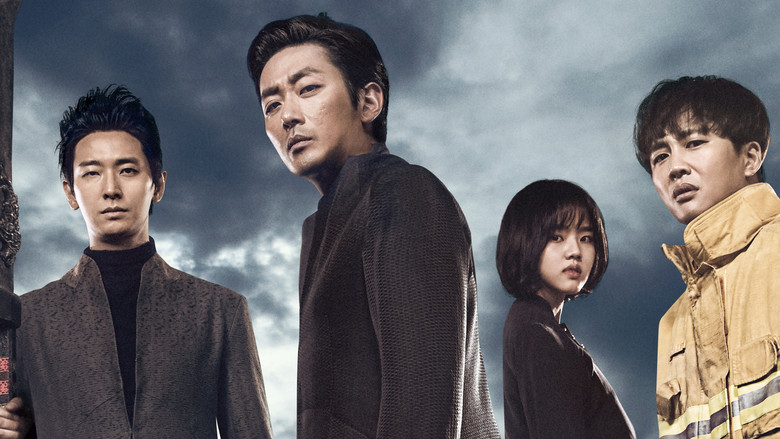
"Along with the Gods: The Two Worlds" follows the journey of Kim Ja-hong, a firefighter who dies heroically in the line of duty. Upon his death, he is met by three guardians of the afterlife: the leader Gang-rim, the agile Haewonmak, and the empathetic Deok-choon. They inform him that because he is a "paragon," a soul who lived a noble life, he will undergo seven trials in 49 days to determine his reincarnation. His guardians will act as his defenders in these trials, which are based on the seven deadly sins of Buddhist tradition.
As Ja-hong travels through the different realms of hell, each presided over by a different deity, the seemingly straightforward case of a selfless hero becomes more complex. Sins from his past, both intentional and unintentional, come to light, challenging his status as a paragon and forcing him to confront painful memories he has long buried. The trials test his actions in relation to murder, indolence, deceit, injustice, betrayal, violence, and filial piety.
Meanwhile, a vengeful spirit from the living world begins to disrupt the afterlife, creating dangerous anomalies during Ja-hong's trials. Gang-rim ventures back to the world of the living to investigate and discovers a tragic secret involving Ja-hong's family, which is deeply connected to his final and most challenging trial. The film masterfully weaves together the spectacular trials in the afterlife with the emotional family drama unfolding on Earth, culminating in a powerful story about forgiveness, sacrifice, and the enduring power of familial love.
Core Meaning
The core meaning of "Along with the Gods: The Two Worlds" revolves around the profound themes of redemption, forgiveness, and the significance of human connection. The film posits that a person's life is not judged solely by their grand heroic deeds, but by the smaller, often unseen, acts of kindness and the intentions behind their actions. It emphasizes that everyone, no matter how righteous, carries burdens of guilt and regret.
Through Ja-hong's trials, the director, Kim Yong-hwa, explores the idea that true atonement comes not from divine judgment, but from seeking forgiveness from those one has wronged. The film's emotional climax underscores that the most important judgment comes from family, and their forgiveness holds the power to absolve even the gravest of sins. Ultimately, the film conveys a powerful message that a life lived with devotion and sacrifice for loved ones is the most noble life of all, and that the bonds of family transcend even death itself.
Thematic DNA
Redemption and Forgiveness
This is the central theme of the film, explored through Ja-hong's journey. While he is initially presented as a paragon, his trials reveal hidden sins and past mistakes for which he must seek redemption. The film suggests that true redemption is not about passing divine tests but about earning forgiveness from those who were hurt by one's actions. The ultimate act of forgiveness comes from his mother, which proves to be the key to his final judgment.
Filial Piety and Family
Deeply rooted in Korean culture, the theme of filial piety is crucial to the film's emotional core. Ja-hong's entire life was dedicated to supporting his deaf mother and his brother, a sacrifice that is both lauded and questioned during his trials. The film's most powerful moments revolve around his relationship with his family, highlighting the immense sacrifices made out of love and the enduring pain of unresolved conflicts.
Judgment and the Afterlife
The film presents a visually imaginative and intricate depiction of the afterlife based on Korean Buddhist and mythological traditions. The seven trials represent a systematic judgment of a person's life, not just their major actions but also their intentions and the indirect consequences of their choices. This theme invites the audience to reflect on their own lives and the moral weight of their decisions.
Sacrifice
Sacrifice is a recurring theme, embodied by the protagonist Ja-hong, who sacrifices his own happiness and well-being for his family. The film explores the multifaceted nature of sacrifice, questioning whether a life lived entirely for others can still harbor personal failings and regrets. The guardians themselves are also on a path of penance, hoping to achieve reincarnation through their service.
Character Analysis
Kim Ja-hong
Cha Tae-hyun
Motivation
His primary motivation throughout his life was to provide for his deaf mother and younger brother, whom he left behind in his youth out of guilt and a desire not to be a burden. In the afterlife, his motivation is to pass the seven trials to be reincarnated and, in his own way, find peace.
Character Arc
Ja-hong begins as a seemingly perfect hero, a selfless firefighter who died a noble death. As he progresses through the trials, his flaws and past traumas are revealed, transforming him from an idealized paragon into a relatable human being burdened by guilt. His arc is about confronting his past and accepting that his life, while dedicated to others, was not without sin. His ultimate redemption comes from his family's forgiveness, not from passing the divine trials alone.
Gang-rim
Ha Jung-woo
Motivation
As the leader, his motivation is to successfully guide their 49th paragon to reincarnation, which will allow him and his fellow guardians to be reincarnated. However, he is also driven by a strong sense of justice and a deep-seated affection for humans.
Character Arc
Gang-rim is the stoic and wise leader of the three guardians. He is resolute in his duty to defend Ja-hong. His arc involves him becoming personally invested in Ja-hong's case, even bending the laws of the afterlife to uncover the truth in the living world. This shows a compassionate side to his otherwise stern demeanor and hints at his own mysterious past, which is further explored in the sequel.
Haewonmak
Ju Ji-hoon
Motivation
Like the other guardians, his main goal is to achieve reincarnation. He is also motivated by his loyalty to Gang-rim and his protective instincts over Deok-choon, the youngest member of their team.
Character Arc
Haewonmak is the skilled fighter of the trio, often providing comic relief with his sarcastic and laid-back attitude. He is initially cynical about their chances but grows to respect and care for Ja-hong. His arc shows a development from a detached guardian to a more engaged and protective figure, especially towards Deok-choon.
Lee Deok-choon
Kim Hyang-gi
Motivation
Her motivation is rooted in a genuine desire to help souls find peace and successfully reincarnate. She is driven by empathy and a strong belief in the inherent goodness of people. She also shares the goal of reincarnation with her fellow guardians.
Character Arc
Deok-choon is the youngest and most compassionate of the guardians, possessing the ability to see a person's past. She has unwavering faith in Ja-hong's goodness from the beginning. Her arc is about maintaining her innocence and empathy in the harsh reality of the afterlife. Her kindness often serves as the moral compass for the group.
King Yeomra
Lee Jung-jae
Motivation
His motivation is to uphold the laws of the afterlife and ensure that souls are judged fairly according to their deeds. He represents the principle of cosmic justice and karma.
Character Arc
King Yeomra is the formidable ruler of the afterlife who oversees all the trials. He appears as an intimidating and impartial judge. His arc in this film is more static, serving as the ultimate authority figure. However, his interactions with Gang-rim and his final judgment of Ja-hong reveal a deeper understanding of human nature and the importance of earthly forgiveness.
Symbols & Motifs
The Seven Hells
Each of the seven hells symbolizes a different moral failing according to Buddhist beliefs: murder, indolence, deceit, injustice, betrayal, violence, and filial piety. They represent the internal and external consequences of one's earthly actions and serve as a structured framework for judging a soul's worthiness for reincarnation.
Ja-hong must travel through each of these hells, which are depicted as vast and treacherous landscapes with unique punishments. The order of the trials is determined by the severity of his sins, and he must be acquitted in each one to proceed to the next.
The Vengeful Spirit
The vengeful spirit, who is revealed to be Ja-hong's brother, Soo-hong, symbolizes unresolved trauma and injustice in the living world. His rage disrupts the balance between the two worlds, demonstrating that the grievances of the living can directly impact the fate of the dead.
Soo-hong's transformation into a vengeful spirit is a major subplot. His actions on Earth cause chaos in the afterlife, complicating Ja-hong's trials and forcing Gang-rim to intervene in the mortal realm to uncover the truth behind Soo-hong's death.
Mother's Dream
The dream sequence where Soo-hong communicates with his mother symbolizes the ultimate form of forgiveness and understanding that transcends the boundaries of life and death. It is in this spiritual space that the family's deepest pains are revealed and healing can begin.
In the film's emotional climax, Gang-rim facilitates a meeting between Soo-hong's spirit and their unconscious mother in her dream. Here, the truth about Ja-hong's past actions and his mother's unconditional love is revealed, leading to the forgiveness that ultimately allows Ja-hong to be reincarnated.
Memorable Quotes
저승법 제1조 1항. 이승에서 용서받은 죄는 저승에서 다시 논하지 않는다.
— King Yeomra
Context:
King Yeomra declares this law during Ja-hong's final trial in the Hell of Filial Impiety. After witnessing through Soo-hong's dream that their mother had already forgiven Ja-hong for the darkest moment of their past, Yeomra applies this fundamental law, nullifying the charge and granting him reincarnation.
Meaning:
"Underworld Law, Article 1, Clause 1: A sin that has been forgiven in the living world will not be judged again in the underworld." This quote encapsulates the film's central message about the power of human forgiveness over divine judgment. It is the legal and moral principle that ultimately saves Ja-hong.
고개 드세요, 김자홍 씨. 당신 아직 죄인 아닙니다.
— Gang-rim
Context:
Gang-rim says this to a distraught Ja-hong early in the film as they are about to begin the trials. Ja-hong is overwhelmed and feels like a sinner, but Gang-rim reassures him that his fate is not yet sealed and that they will fight for him.
Meaning:
"Lift your head, Mr. Kim Ja-hong. You are not a sinner yet." This line establishes the role of the guardians as defenders and provides a crucial sense of hope for Ja-hong at the beginning of his daunting journey. It signifies the principle of being innocent until proven guilty, even in the afterlife.
Philosophical Questions
What is the true measure of a 'good life'?
The film constantly challenges the definition of a good life. Is it defined by heroic, public acts of sacrifice, like Ja-hong's job as a firefighter? Or is it measured by the private, often painful, sacrifices made for one's family? The trials reveal that even a 'paragon' has committed sins, suggesting that a perfect, blameless life is impossible. The film posits that the measure of a life lies not in its flawlessness, but in the love that motivates one's actions and the willingness to atone for one's mistakes.
Does divine judgment matter more than human forgiveness?
"Along with the Gods" powerfully argues that human forgiveness, particularly from family, holds more weight than the judgment of deities. The entire intricate system of the afterlife, with its powerful gods and strict laws, is ultimately superseded by a mother's forgiveness for her son. This raises the question of whether true absolution is an external verdict or an internal peace achieved through reconciliation with loved ones.
Can actions taken for a good cause be considered sinful?
The film delves into moral ambiguity. Ja-hong tells lies, but they are to comfort the daughter of a deceased colleague. He works obsessively for money, but it is to support his family. The trials force a nuanced look at his actions, separating intent from outcome. This explores the complex idea that sins are not always born of malice, and that context and motivation are crucial in judging a person's character.
Alternative Interpretations
While the film's primary message is one of redemption through familial forgiveness, some alternative interpretations exist. One perspective is to view the entire afterlife journey as a psychological exploration of Ja-hong's own guilt and suppressed memories. The trials are not literal judgments by gods, but rather a manifestation of his internal struggle to forgive himself for the choices he made. The guardians, in this reading, could represent different facets of his own conscience guiding him toward self-acceptance.
Another interpretation focuses on the socio-economic commentary embedded in the narrative. Ja-hong's 'sin' of abandoning his family stems directly from poverty. His life of relentless work and sacrifice can be seen as a critique of a society that forces individuals into impossible situations, where familial love is tested by economic hardship. The afterlife, therefore, becomes a space where the injustices of the mortal world are re-examined, and the true measure of a person is their response to systemic pressures.
Cultural Impact
"Along with the Gods: The Two Worlds" had a significant cultural impact in South Korea and across Asia. Released in late 2017, it quickly became a box office phenomenon, resonating with audiences for its unique blend of fantasy, action, and heartfelt drama. Its success demonstrated the viability of large-scale, VFX-heavy productions in the Korean film market, setting a new benchmark for fantasy epics.
The film's themes are deeply rooted in Korean cultural and religious beliefs, particularly Buddhist concepts of karma, reincarnation, and the afterlife, as well as the strong Confucian value of filial piety. This cultural specificity, however, did not hinder its international appeal; its universal message of family, forgiveness, and redemption touched audiences worldwide. The film sparked renewed interest in the original webtoon and generated widespread discussion about life, death, and morality. Its portrayal of the afterlife, with its seven distinct hells, has become an iconic part of modern Korean pop culture.
Critically, the film received mixed but generally positive reviews. While some critics found the melodrama overwrought and the narrative structure repetitive, many praised its ambitious visual effects, strong performances, and emotional weight. The audience reception was overwhelmingly positive, with many viewers deeply moved by the film's climax, solidifying its status as a modern classic of Korean cinema.
Audience Reception
The audience reception for "Along with the Gods: The Two Worlds" was overwhelmingly positive, particularly in South Korea, where it became a cultural phenomenon. Viewers widely praised the film for its stunning visual effects, which brought the imaginative worlds of the afterlife to life in a way not previously seen in Korean cinema. The star-studded cast's performances were also highly commended, especially the emotional depth brought by Cha Tae-hyun as the protagonist and the compelling dynamic of the three guardians.
The film's biggest strength, according to audiences, was its powerful emotional core. Many viewers reported being deeply moved and brought to tears by the story, particularly the climax involving Ja-hong's relationship with his mother and brother. The themes of family, sacrifice, and forgiveness resonated strongly with the public. The main points of criticism from some viewers and critics were aimed at its sometimes overt sentimentality and melodramatic moments, which felt emotionally manipulative to a minority. Some also found the plot, with its sequential trials, to be somewhat repetitive. Overall, however, the verdict from the audience was that it was a spectacular, entertaining, and profoundly touching film that made them reflect on their own lives.
Interesting Facts
- The film is based on a highly popular webtoon series by Joo Ho-min.
- "Along with the Gods: The Two Worlds" and its sequel, "Along with the Gods: The Last 49 Days," were filmed simultaneously, a first for the South Korean film industry.
- It became the second highest-grossing film in South Korean cinema history at the time of its release.
- The visual effects were handled by Dexter Studios, a company founded by director Kim Yong-hwa himself.
- Actor Kim Woo-Bin was initially offered the lead role but had to decline.
- The film's depiction of the afterlife is inspired by Korean Joseon dynasty Buddhist paintings and early Buddhist texts about the Ten Kings of Hell.
⚠️ Spoiler Analysis
Click to reveal detailed analysis with spoilers
Frequently Asked Questions
Explore More About This Movie
Dive deeper into specific aspects of the movie with our detailed analysis pages
Comments (0)
No comments yet. Be the first to share your thoughts!