Skip to content
Benedetta
A sumptuous, provocative historical drama of cloistered ecstasy and ruthless ambition, where sacred devotions collide with carnal rebellion like a lit match dropped into a sanctuary of dry cedar.
Benedetta

Benedetta

"I don't know God's ways, but he works his will through me."

09 July 2021 Belgium 131 min 6.6 (1,196)

Director: Paul Verhoeven

Cast: Virginie Efira, Charlotte Rampling, Daphné Patakia, Lambert Wilson, Olivier Rabourdin

Drama History Romance The Ambiguity of Faith, Ecstasy, and Delusion Institutional Corruption and Patriarchal Hegemony Female Eroticism, Desire, and Bodily Reclamation Survival, Performance, and Machiavellian Politics
Budget: $24,350,000
Box Office: $2,652,725

Overview

Set in late 17th-century Tuscany against the looming shadow of the bubonic plague, Benedetta follows Benedetta Carlini, a devout young woman who was dedicated to the Convent of the Mother of God in Pescia as a child. From early youth, Benedetta demonstrates a seemingly miraculous affinity for religious visions and divine intervention, earning both reverence and guarded skepticism from the convent’s pragmatic Abbess, Sister Felicita.

As an adult, Benedetta’s cloistered life is upended by two pivotal forces: the arrival of Bartolomea, an abused, destitute farm girl seeking sanctuary, and an escalating series of intense, visceral visions of Jesus Christ. When Benedetta suddenly manifests the bleeding wounds of the stigmata, the convent is thrust into the center of ecclesiastical politics, transforming her into a revered local mystic and destabilizing the monastery's established hierarchy.

As Benedetta and Bartolomea embark on an intimate, forbidden love affair behind convent walls, spiritual zeal merges inextricably with earthly desire and political maneuvering. The convent becomes a volatile arena of factional rivalry, prompting local authorities and the papal nuncio to investigate whether Benedetta is an authentic vessel of God, a dangerous heretic, or an extraordinarily shrewd opportunist.

Core Meaning

Director Paul Verhoeven uses the historical case of Benedetta Carlini to dissect the boundary between genuine spiritual ecstasy and calculated political performance. The film posits that within a rigidly patriarchal, repressive institution, a woman's body, desires, and claimed communion with the divine become her only viable weapons for agency and self-preservation. Rather than definitively categorizing Benedetta as either a pure saint or an outright charlatan, Verhoeven illustrates that belief, eroticism, theatricality, and power often coexist within the same human impulses.

Thematic DNA

The Ambiguity of Faith, Ecstasy, and Delusion 30%
Institutional Corruption and Patriarchal Hegemony 25%
Female Eroticism, Desire, and Bodily Reclamation 25%
Survival, Performance, and Machiavellian Politics 20%

The Ambiguity of Faith, Ecstasy, and Delusion

The narrative continuously balances the supernatural and the psychosomatic. Benedetta’s stigmata and visions are depicted with vivid literalism, yet the film frequently shows how she actively engineers circumstances to validate her divine mandate, exploring whether a miracle ceases to be miraculous if human hands aid its manifestation.

Institutional Corruption and Patriarchal Hegemony

The Catholic Church is presented as a bureaucratic enterprise where dogma serves economic and political interests. Miracles are commodified for local prestige and pilgrims' revenue, while female autonomy is systematically policed and ruthlessly crushed when it threatens male ecclesiastical supremacy.

Female Eroticism, Desire, and Bodily Reclamation

The cloister's mandate to mortify the flesh ("Your worst enemy is your body") is subverted through Benedetta and Bartolomea’s relationship. Sensual pleasure is reframed not as an offense against God, but as an ecstatic extension of spiritual devotion and personal liberation.

Survival, Performance, and Machiavellian Politics

Within an oppressive structure offering women few exits, performing holiness becomes an art of survival. Benedetta, Abbess Felicita, and the novice Christina all navigate power through shifting alliances, public spectacles, and calculated maneuvers.

Character Analysis

Benedetta Carlini

Virginie Efira

Archetype: The Mystic / Subversive Anti-Heroine Key Trait: Unyielding self-conviction and charismatic theatricality

Motivation

To fulfill her perceived divine destiny as the bride of Christ while preserving her agency, romantic bond, and authority within the convent.

Character Arc

Evolves from a deeply devout, fearful novice into an authoritative, stigmata-bearing Abbess who commands convent politics, balancing ecstatic devotion with cunning stagecraft.

Sister Felicita

Charlotte Rampling

Archetype: The Pragmatic Mentor / Institutional Realist Key Trait: Razor-sharp intellect, sardonic pragmatism, and worldly cynicism

Motivation

Preserving monastic order, financial solvency, and the fragile autonomy of her nunnery against external clerical intrusion.

Character Arc

Starts as the shrewd, cynical head of the convent managing balances of power and finances; stripped of her title by Benedetta's rise, she turns to the Inquisition, only to be horrified by the resulting brutality.

All 5 characters and cast

Symbols & Motifs

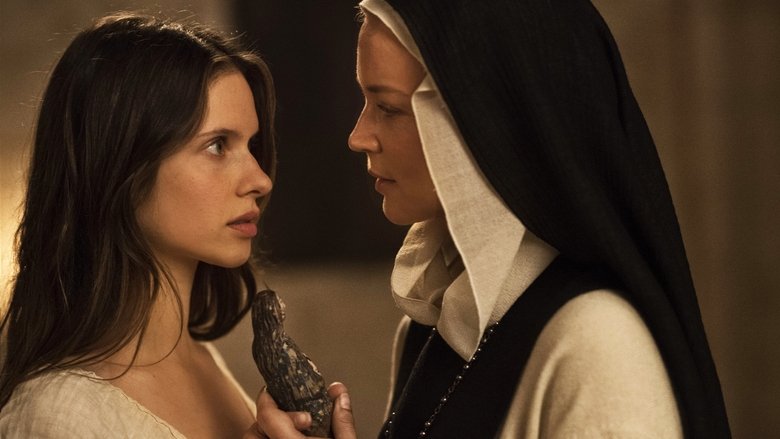
The Wooden Figurine of the Virgin Mary

Meaning:

Symbolizes the fusion of sacred adoration and carnal desire, demonstrating how instruments of religious indoctrination can be repurposed for intimate rebellion.

Context:

Given to young Benedetta by her mother as a sacred talisman, it is later carved into an erotic object by Bartolomea.

The Stigmata / Holy Wounds

Meaning:

Represents the ultimate currency of holy authority, functioning as a physical battleground between divine sanction, psychosomatic suffering, and self-inflicted leverage.

Context:

The bloody markings manifest on Benedetta's hands, feet, and brow during intense spiritual experiences and trances.

The Bubonic Plague

Meaning:

A biological equalizer and physical manifestation of impending apocalypse, exposing the hypocrisy and vulnerability of the ruling elite while serving as an uncontrollable force that defies institutional containment.

Context:

Looming over Tuscany and outside the walls of Pescia, forcing secular and clerical authorities to face their own mortality.

The Eroticized Warrior Christ

Meaning:

Embodies both Benedetta's repressed sexual impulses and her subconscious desire for an invincible protector against earthly abusers.

Context:

Appears in Benedetta’s visions not as an ethereal shepherd, but as a sword-wielding hero defending her from serpents and acting as a passionate bridegroom.

The Bird Dropping on the Bandit

Meaning:

Introduces Verhoeven's signature recurring motif questioning whether occurrences are providential divine intervention or pure coincidence seized upon by a gifted opportunist.

Context:

Occurs in the prologue when a bird defecates directly into a highwayman’s eye after young Benedetta prays.

Memorable Quotes

Votre pire ennemi, c'est votre corps. Il ne faut pas s'y attacher.
— Sister Felicita

Context

Spoken to young Benedetta upon her entry into the convent.

Meaning

Establishes the foundational dogma of ascetic bodily mortification that Benedetta and Bartolomea systematically deconstruct throughout the narrative.

Les miracles ne se font pas au lit.
— Sister Felicita

Context

Addressed to Benedetta during the investigation into her divine experiences.

Meaning

Highlights the irreconcilable divide between institutional Catholicism's rigid suspicion of bodily pleasure and Benedetta's synthesis of the sacred and the erotic.

All 4 quotes

Philosophical Questions

What constitutes the authenticity of a spiritual experience?

The film asks whether the internal validity of faith depends on objective supernatural truth, or if religious power is intrinsically rooted in emotional conviction and communal reception.

Can genuine devotion coexist with deliberate deception?

The narrative questions whether an individual can simultaneously believe in God while manufacturing "miracles" to advance divine or earthly goals.

How can autonomy be established within totalitarian institutions?

The story explores how marginalized subjects navigate systems designed for their subjugation, asking whether co-opting and weaponizing the oppressor's language is the only viable path to freedom.

Alternative Interpretations

The Cunning Machiavellian Con Artist: Benedetta is viewed as an acute political strategist who consciously manufactures visions, self-inflicts stigmata with glass shards, and uses religious theater to usurp power from the Abbess and protect her lesbian relationship within a deadly patriarchal society.

Full ending explanation

Cultural Impact

In early 17th-century Italy, convents frequently operated as aristocratic warehouses for unmarried daughters and centers of regional economic activity. For cloistered women, claiming mystical visions was one of the few avenues available to challenge ecclesiastical hierarchies.

Filmed in 2018 and delayed to 2021 due to the COVID-19 pandemic and post-production schedules, the film's depiction of a community besieged by the bubonic plague and enforcing strict quarantine borders carried uncanny contemporary resonance.

Premiering at Cannes 2021, the film drew praise for its fearless tonal balance, biting humor, Jeanne Lapoirie’s rich cinematography, and central performances by Efira and Rampling. Critics noted its subversive deconstruction of church dogma and gender dynamics, though some conservative groups condemned it for blasphemy.

Audience Reception

Regarded by arthouse audiences and film scholars as a late-career triumph for Paul Verhoeven—a provocative historical study that interrogates faith, power, and desire with characteristic audacity.

Praised elements include:

  • Virginie Efira’s performance, balancing holiness, sexual magnetism, and ambiguity.
  • Charlotte Rampling’s sharp, nuanced portrayal of the pragmatic Abbess.
  • The script's wit, refusal to moralize, and blending of high-art aesthetic with pulp vitality.
  • Jeanne Lapoirie’s lensing and Anne Dudley’s choral score.

Points of criticism and controversy centered on polarizing reception of explicit erotic sequences and the Virgin Mary statuette scene, debates regarding whether the sensuality leaned into the "male gaze" or functioned as feminist subversion, and tonal shifts moving between serious historical drama, camp, and body horror.

Interesting Facts

  • The screenplay adapts Judith C. Brown’s 1986 academic study Immodest Acts: The Life of a Lesbian Nun in Renaissance Italy, which uncovered trial records from the State Archives of Florence.
  • Gerard Soeteman, Verhoeven’s longtime screenwriter on classics like Soldier of Orange and Black Book, originally developed the project but requested to have his name removed from the screenplay credits because he felt the direction overemphasized eroticism at the expense of pure political history; David Birke stepped in to co-write.
  • Principal photography took place across Italy—including Montepulciano, Bevagna, and San Quirico d'Orcia in Tuscany and Umbria—as well as the medieval Cistercian abbeys of Silvacane and Le Thoronet in southern France.
  • During the Italian location shoot, the 80-year-old Verhoeven required hip surgery due to the strenuous physical demands of navigating steep hills and ancient cobblestones.
  • The film reassembled key creative personnel from Verhoeven’s 2016 French hit Elle, including producer Saïd Ben Saïd, screenwriter David Birke, editor Job ter Burg, and composer Anne Dudley.
  • The film premiered in competition for the Palme d'Or at the 2021 Cannes Film Festival, where it received standing ovations, but was subsequently picketed at the New York Film Festival by the conservative Catholic organization Tradition, Family, and Property (TFP) and banned in Singapore due to its religious-erotic content.

Easter Eggs

Homage to Ken Russell's The Devils (1971)

The film's combination of ecclesiastical hysteria, convent politics, grotesque inquisitorial torture, and religious fever directly references Russell’s historical masterpiece.

Verhoeven’s Long-Gestating Jesus Project

Verhoeven, a member of the Jesus Seminar and author of the biographical book Jesus of Nazareth, channelled decades of historical research and personal interpretations of Christ into the cinematic depictions of Benedetta's visions.

Echoes of Baroque Art

Several tableaus and lighting setups consciously evoke the dramatic chiaroscuro of Caravaggio and the sensuous, agonizing religious ecstasy captured in Gian Lorenzo Bernini’s sculpture The Ecstasy of Saint Teresa.

Subversion of 1970s Nunsploitation Cinema

While nodding to the tropes of Euro-cult nunsploitation films (e.g., Walerian Borowczyk’s Behind Convent Walls), Verhoeven upends the genre by centering the narrative on female political agency and psychological depth rather than mere titillation.

Frequently Asked Questions

Explore More About This Movie

Dive deeper into specific aspects of the movie with our detailed analysis pages

Comments (0)

Leave a comment

No comments yet. Be the first to share your thoughts!

Similar Movies