Little Women
"Own your story"
Overview
Greta Gerwig's "Little Women" chronicles the lives of the four March sisters—Meg, Jo, Beth, and Amy—as they navigate the path from girlhood to womanhood in Concord, Massachusetts, during and after the American Civil War. The film employs a non-linear narrative, jumping back and forth between their adventurous, close-knit youth and their more complicated adult lives seven years later.
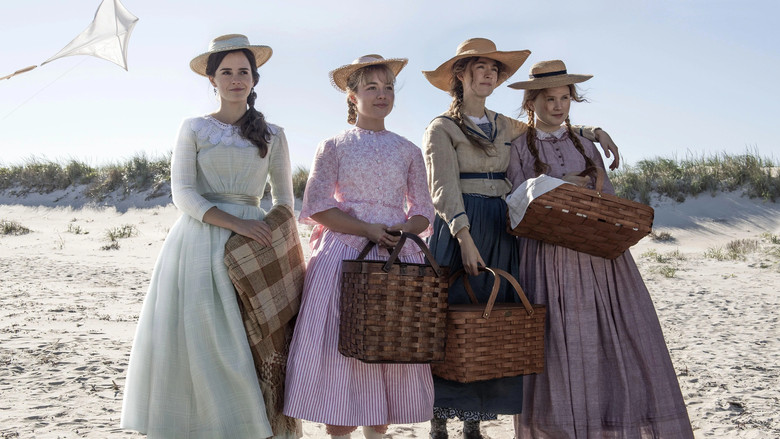
We follow the fiercely independent and aspiring writer Jo (Saoirse Ronan), the traditional and romantic Meg (Emma Watson), the gentle and musically gifted Beth (Eliza Scanlen), and the pragmatic and artistic Amy (Florence Pugh). Guided by their resilient mother, Marmee (Laura Dern), the sisters pursue their individual dreams, grapple with poverty, experience first loves, and face profound loss, all while their unbreakable bond is tested by time, distance, and differing ambitions. The story explores their relationships with their wealthy neighbor Laurie (Timothée Chalamet) and confronts the limited choices available to women in the 19th century.
Core Meaning
Greta Gerwig's "Little Women" is a profound exploration of female ambition, artistry, and economic independence. The film's core message asserts that the domestic lives of women—their joys, struggles, relationships, and creative pursuits—are subjects of immense importance and worthy of great art. Gerwig reframes the classic story to highlight the tension between a woman's desire for personal and professional fulfillment and the societal expectation that her life's purpose is marriage. By weaving in elements of Louisa May Alcott's own life and creating a meta-narrative around Jo's authorship, the film celebrates the act of a woman telling her own story and, crucially, owning it—both creatively and financially. It argues that there are many ways to be a woman and that all dreams, whether they lead to marriage and family or to a canoe paddled alone, are valid and important.
Thematic DNA
Women, Art, and Ambition
The central theme is the tension between female ambition and the societal constraints of the 19th century. Each March sister embodies a different facet of this struggle. Jo's fierce desire to be a professional writer drives the narrative, questioning why women's stories are considered less important. Amy's artistic ambitions are tempered by a pragmatic understanding that she must marry well to succeed, famously stating, "I want to be great, or nothing." Even Meg, who chooses a traditional domestic life, must defend her dreams as being just as valid as Jo's, stating, "Just because my dreams are different than yours, it doesn't mean they're unimportant." The film champions the idea that women's creative and professional lives are as vital as their romantic ones.
The Economic Status of Women
Gerwig foregrounds the economic realities facing women. Characters frequently discuss money, and marriage is explicitly framed as an "economic proposition" by Amy. Her powerful monologue to Laurie explains that as a woman with no way to earn her own money, her choice of husband is not just a romantic one but a financial one that impacts her entire family. Aunt March constantly reminds the girls of the importance of marrying into wealth. Jo's ultimate victory is not just finding love but negotiating the copyright and royalties for her novel, securing her own financial independence through her art—a meta-commentary on Louisa May Alcott's own life.
Sisterhood and Family
The unbreakable, albeit complex, bond between the four sisters is the emotional heart of the film. Their relationships are portrayed with a chaotic, overlapping energy that feels authentic. They support, inspire, and clash with one another intensely. Jo's plea to Meg on her wedding day, "You will be bored of him in two years, and we will be interesting forever," underscores the primacy of their sororal bond. The family home is a sanctuary of creativity and warmth, a world built by and for women, which contrasts sharply with the patriarchal society outside its walls. The film movingly portrays how this bond endures through tragedy, distance, and the sisters' diverging paths.
Nostalgia and the Passage of Time
The film's non-linear structure, which cuts between the golden-hued past of the sisters' girlhood and the colder, more complex reality of their adulthood, powerfully evokes a sense of nostalgia and loss. This structure highlights the pain and beauty of growing up. The vibrant, joyful memories of the past constantly inform the challenges and decisions of the present. This juxtaposition makes moments like Beth's illness and death all the more poignant, as the audience experiences the joyful past and the sorrowful present almost simultaneously, mirroring the act of memory itself.
Character Analysis
Josephine 'Jo' March
Saoirse Ronan
Motivation
Jo is driven by a powerful ambition to make her own way in the world and be recognized as a serious writer. She is also fiercely loyal to her sisters and family, and much of her early writing is motivated by a desire to provide for them. Ultimately, her core motivation is to live a life of purpose and meaning on her own terms, refusing to be confined by society's expectations for women.
Character Arc
Jo begins as a fiery, tomboyish girl fiercely protective of her family and determined to become a great writer. She scorns the idea of marriage, viewing it as a constraint on her freedom. As she moves into adulthood, she faces loneliness, rejection, and the profound grief of losing her sister, Beth. Her journey is about learning to reconcile her fierce independence with her deep-seated need for love and connection, and to channel her personal experiences of joy and sorrow into her art. Her arc culminates not in marriage, but in the professional triumph of publishing her novel and securing her own financial and creative independence.
Amy Curtis March
Florence Pugh
Motivation
Amy's primary motivation is to secure a comfortable and respected life for herself and, by extension, her family. She is ambitious not just to be a great artist, but to elevate her social and economic standing. She operates with a clear-eyed view of society's limitations, motivated by a desire to achieve the best possible life within the system she has been given.
Character Arc
Amy starts as the youngest, somewhat spoiled and self-centered sister, prone to vanity and melodrama. Gerwig's adaptation gives her a significant arc of maturation. As she grows up, Amy develops a keen, pragmatic understanding of the world and her place in it as a woman. Her artistic ambitions are tempered by the realization that she may not be a genius and that marriage is an economic necessity. She evolves from a girl who burns her sister's manuscript in a fit of pique to a poised, insightful woman who understands the compromises necessary for survival and happiness, ultimately finding a marriage that is both loving and practical.
Margaret 'Meg' March
Emma Watson
Motivation
Meg is motivated by a deep desire for love, family, and a happy domestic life. Unlike Jo, she doesn't fight against societal expectations but seeks to find happiness within them. Her motivation is to build a loving home and find personal fulfillment in her role as a wife and mother, proving that this dream is as worthy as any other.
Character Arc
Meg, the eldest sister, begins with a romantic dream of a traditional life: marriage, home, and children. She is tempted by wealth and society, as seen at the debutante ball where she is called 'Daisy', but her arc is about embracing her own, more modest dreams. She falls in love with the poor tutor, John Brooke, and chooses love over money. Her journey involves grappling with the financial hardships of her choice and defending the importance and validity of her domestic ambitions against Jo's more unconventional path, finding contentment in the life she has chosen for herself.
Elizabeth 'Beth' March
Eliza Scanlen
Motivation
Beth's motivation is simple and pure: to love and support her family and to find joy in music and home life. She has no grand ambitions for the outside world; her entire world is her family. She is motivated by a desire to please others, keep the peace, and ensure that her sisters are happy and together.
Character Arc
Beth is the shy, gentle heart of the March family. Her arc is not one of dramatic change but of quiet, profound impact. She is the emotional glue that holds the sisters together. Her journey is a tragic one, as she contracts scarlet fever as a girl and never fully recovers, with her health declining in adulthood. Her illness and eventual death force her sisters, especially Jo, to confront mortality and the fragility of their idyllic childhood. Beth's arc is about the strength found in kindness and the enduring legacy of a quiet, loving spirit.
Symbols & Motifs
Fire and Hearths
Fire and the hearth symbolize the warmth, creativity, and emotional center of the March family home. It represents their close-knit bond and the sanctuary they have created for themselves away from the cold, restrictive outside world.
Many key scenes of the sisters' youth are set around the fireplace in their living room, where they read, perform plays, and share secrets. This warm, golden light contrasts with the colder, bluer light of the present timeline, especially in scenes where Jo is alone in New York or the family is grieving.
Jo's Cut Hair
Jo cutting and selling her hair symbolizes her rejection of traditional femininity and her willingness to sacrifice a conventional symbol of beauty for the sake of her family and her independence. It is an act of agency and pragmatism, prioritizing her family's needs and her ability to contribute over societal standards.
When Marmee needs to travel to Washington to care for their ill father, Jo, needing to contribute money for the journey, sells her "one beauty." She returns home with a boyish haircut, a tangible representation of her unconventional nature and her devotion to her family. The act is both a sacrifice and a declaration of her identity.
The Published Book, "Little Women"
The physical book that Jo writes and publishes at the end of the film is the ultimate symbol of her realized ambition and independence. It represents the culmination of her artistic journey and the validation of her voice. It is her true love, the offspring of her talent and perseverance, and the key to her economic freedom.
The final scenes of the film cross-cut between the romantic, fictional ending Jo writes for her protagonist and the real-world triumph of Jo watching her own book being printed, bound, and holding the finished copy, titled "Little Women." This meta-ending emphasizes that her greatest achievement is her art.
Memorable Quotes
Women, they have minds, and they have souls, as well as just hearts. And they've got ambition, and they've got talent, as well as just beauty. I'm so sick of people saying that love is all a woman is fit for.
— Jo March
Context:
Jo says this to Marmee in the attic after returning from New York. She is feeling lonely and has just confessed that she thinks she might have been too quick to turn down Laurie's proposal, but immediately pivots to this powerful assertion of her core beliefs, even as she grapples with her own emotional turmoil.
Meaning:
This is the film's central thesis, a passionate declaration of female intellectual and creative capacity beyond the prescribed role of wife and lover. It encapsulates Jo's frustration with the limitations placed upon women and her desire for a life of purpose.
Just because my dreams are different than yours, it doesn't mean they're unimportant.
— Meg March
Context:
Meg says this to Jo on her wedding day, just after Jo has made a last-ditch effort to convince her to run away and pursue a life of art and adventure together. Meg firmly but lovingly stands her ground, validating her own choice to marry for love.
Meaning:
This line is a crucial defense of traditional choices made from a place of genuine desire. It argues that feminism and female empowerment can encompass a wide spectrum of life paths, including domestic ones, as long as they are freely chosen.
I'm not a poet, I'm just a woman. And as a woman, there's no way for me to make my own money. Not enough to earn a living or to support my family. And if I had my own money, which I don't, that money would belong to my husband the moment we got married. And if we had children, they would be his, not mine. They would be his property. So don't sit there and tell me that marriage isn't an economic proposition, because it is.
— Amy March
Context:
Amy delivers this speech to a drunken Laurie in Paris, after he criticizes her for considering marrying the wealthy Fred Vaughn. Her words cut through his romantic idealism to explain the stark choices she faces.
Meaning:
This monologue brilliantly articulates the harsh economic reality for 19th-century women, reframing Amy's seemingly materialistic ambitions as a pragmatic and intelligent response to an oppressive system. It is one of the film's most direct and powerful feminist statements.
The world is hard on ambitious girls.
— Amy March
Context:
Amy says this to Laurie in Europe while discussing her own artistic ambitions and the difficulty of becoming a truly great painter as a woman in a world dominated by men.
Meaning:
A succinct and poignant observation that speaks to the historical and ongoing challenges faced by women who dare to want more than what society has allocated for them. It is a line taken directly from the novel that resonates with modern audiences.
I intend to make my own way in this world.
— Jo March
Context:
Jo says this to her wealthy Aunt March, who is lecturing her on the importance of marrying well to secure her future. Jo's statement is a direct refusal of her aunt's worldview and a confident assertion of her own abilities.
Meaning:
This is Jo's declaration of independence, a simple but powerful statement of her life's goal. It encapsulates her rejection of a predetermined path and her commitment to forging her own identity through her talent and hard work.
Philosophical Questions
What is the true meaning of a 'successful' life for a woman?
The film explores this by presenting the four March sisters, each with a different definition of happiness and success. Jo seeks creative and professional glory. Meg finds fulfillment in marriage and family. Amy pursues art and social standing through a pragmatic marriage. Beth finds contentment in her home and music. The film resists placing one life path above another, instead asking the audience to consider that success is not a monolithic concept. It questions the societal pressure on women to prioritize marriage and family above all else, while also validating domestic choices if they are made freely. The central conflict between Jo and Meg, and Jo and Amy, revolves around their differing life ambitions, forcing a conversation about whether ambition must always be public-facing or if a private, domestic life can be equally fulfilling.
Is compromise an essential part of ambition, especially for women?
"Little Women" deeply investigates the theme of compromise. Amy is the most explicit practitioner, willing to compromise on marrying for love to secure her family's future and ultimately giving up her dream of being a great painter. Jo, who seems uncompromising, also learns to adapt. She writes sensationalist stories she doesn't respect to make money and, in the film's meta-ending, compromises on her book's plot to satisfy her publisher. Meg compromises on her desire for wealth to marry for love. The film suggests that for women in a restrictive society, ambition is not a straight line but a series of negotiations and sacrifices to achieve a measure of independence and happiness.
How does our past shape our present identity?
Through its non-linear structure, the film constantly juxtaposes the past and present, showing how the sisters' adult selves are direct products of their childhood experiences. The warmth, creativity, and struggles of their youth are the foundation for their adult decisions, strengths, and flaws. The golden-hued memories are not just nostalgic; they are the source of Jo's novel, the root of the sisters' unbreakable bond, and the cause of their deepest griefs. The film posits that we are in constant dialogue with our younger selves and that understanding the past is essential to navigating the present.
Alternative Interpretations
The most significant area for alternative interpretation is the film's ending. Gerwig deliberately creates ambiguity around Jo's romantic fate. One interpretation is that the audience sees two endings simultaneously: the one from the book, where Jo marries Professor Bhaer and opens a school, and a new, meta-ending where this romantic conclusion is a commercial compromise Jo makes to get her novel published. In this reading, the "real" happy ending is not the marriage but the shot of Jo holding her published book, a symbol of her artistic and financial independence. The romantic scenes with Bhaer are shot with the same warm, golden glow as the childhood flashbacks, suggesting they are part of the idealized, fictional narrative Jo has written. Another, simpler interpretation is that Jo gets both. She gets the romantic fulfillment of her marriage to Bhaer AND the professional fulfillment of publishing her book. In this view, Gerwig's point is not that Jo *didn't* get married, but that the wedding is not the single, defining climax of her story; it is one part of a rich life that also includes her greatest love: her work. This dual focus honors both the novel's text and the real-life independence of its author, Louisa May Alcott, allowing the audience to choose which ending feels truest.
Cultural Impact
Greta Gerwig's "Little Women" was released to critical acclaim and significant cultural conversation, proving the story's enduring relevance. By making deliberate changes, such as the non-linear timeline and the meta-narrative ending, Gerwig's adaptation reinvigorated the classic for a new generation, bringing its feminist themes to the forefront in a way that resonated powerfully with contemporary audiences. The film sparked widespread discussions about female ambition, the economic constraints on women both past and present, and the value of women's stories. Florence Pugh's portrayal of Amy March, in particular, led to a significant cultural reassessment of a character who had often been disliked, reframing her as a pragmatic survivor. The movie was praised for its authentic depiction of sisterhood and for its warm, lived-in aesthetic, influencing period dramas that followed. Despite Gerwig being snubbed for a Best Director nomination at the Academy Awards—a decision that itself fueled debate about gender bias in Hollywood—the film was a commercial and critical success, cementing Gerwig's status as a major directorial voice and demonstrating the box office power of female-led and female-directed stories.
Audience Reception
Audience reception for "Little Women" was overwhelmingly positive. Viewers praised the film for its warmth, emotional depth, and the vibrant chemistry of the ensemble cast. Many lauded Greta Gerwig's fresh take on the classic story, particularly the non-linear timeline which was seen as an innovative way to highlight the themes of memory and the consequences of choices. The performances of Saoirse Ronan as Jo and Florence Pugh as Amy were frequently singled out for praise, with many viewers noting that the film made them appreciate the character of Amy for the first time. The film's modern feminist sensibilities resonated strongly, with audiences celebrating the focus on women's economic lives and creative ambitions. Criticisms were minor and less frequent, with a small number of viewers finding the non-linear structure initially confusing. Overall, audiences found the film to be a heartfelt, intelligent, and beautifully crafted adaptation that was both faithful to the spirit of the novel and refreshingly modern.
Interesting Facts
- Greta Gerwig was pregnant during the production of the film and kept it a secret from the cast and crew. She gave birth just one day after submitting her director's cut.
- Saoirse Ronan essentially cast herself in the role of Jo March. After working with Gerwig on "Lady Bird," she approached the director and told her, "I know you're doing Little Women, and I think I should be Jo."
- The entire film was shot on location in Massachusetts, the setting of the novel. One scene was even filmed in the actual schoolhouse where Louisa May Alcott's father taught.
- To create an authentic and chaotic family dynamic, Gerwig had the actors speak over each other, with their dialogue overlapping, a technique she encouraged to make their interactions feel more natural and real.
- Costume designer Jacqueline Durran assigned each sister a specific color palette that carried through the film: Jo is red and indigo, Meg is green and lavender, Beth is pink and brown, and Amy is light blue.
- The film was shot entirely on 35mm film by cinematographer Yorick Le Saux to give it a timeless, textured, and authentic period feel.
- Florence Pugh filmed "Little Women" immediately after wrapping the intense and disturbing horror film "Midsommar," calling the experience of making Gerwig's film "therapy."
- Amy's powerful monologue about marriage as an "economic proposition" was a last-minute addition to the script, inspired by a conversation Gerwig had with Meryl Streep about the historical legal limitations placed on women.
Easter Eggs
Jo March often wears a hat that is a direct reproduction of one seen in a painting by Winslow Homer, a 19th-century American artist.
This is part of a larger visual strategy by Gerwig and the production team to root the film's aesthetic in the art of the period. Gerwig has stated that many shots, particularly the beach scenes, were inspired by Homer's paintings, giving the film a rich, painterly quality.
The dialogue in the film, while feeling modern and fresh, is almost entirely sourced from Louisa May Alcott's own writing.
Greta Gerwig drew not only from the novel "Little Women" but also from Alcott's other novels, journals, and personal letters. This gives the film a deep authenticity and serves as a tribute to Alcott's own voice, demonstrating how radical and modern her own thinking was.
⚠️ Spoiler Analysis
Click to reveal detailed analysis with spoilers
Frequently Asked Questions
Explore More About This Movie
Dive deeper into specific aspects of the movie with our detailed analysis pages
Comments (0)
No comments yet. Be the first to share your thoughts!