Bluey
"For real life?!"
Overview
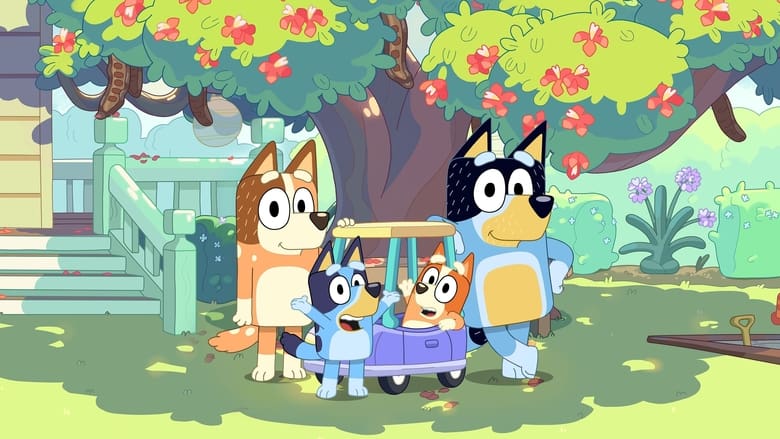
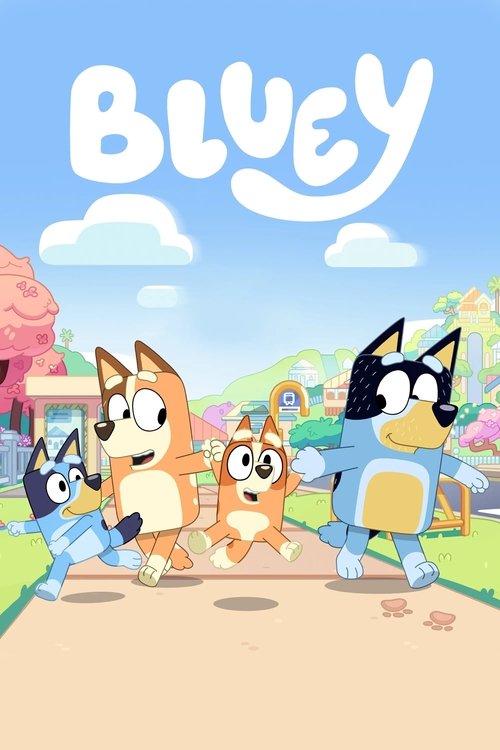
"Bluey" follows the adventures of a tireless and imaginative six-year-old Blue Heeler puppy who lives in Brisbane, Australia, with her father, Bandit; mother, Chilli; and younger sister, Bingo. The series is not driven by a continuous narrative arc but is comprised of short, seven-minute episodes, each focusing on a specific, often mundane, aspect of family life. These everyday situations—from a trip to the local pool to simply playing with a balloon—are transformed into extraordinary adventures through the boundless imagination of Bluey and Bingo.
Across its seasons, the show subtly explores the growth of its characters. Bluey and Bingo mature emotionally and socially, while their parents, Bandit and Chilli, navigate the highs and lows of modern parenting with humor and patience. The core of the series is the family's dedication to imaginative play, which serves as the primary vehicle through which the children learn about the world, process their emotions, and strengthen their bonds with each other and their parents. The show beautifully illustrates how play is not just a pastime but a crucial tool for development, problem-solving, and emotional connection.
Core Meaning
The core meaning of "Bluey" is a celebration of imaginative play as the fundamental engine of childhood development and family bonding. Creator Joe Brumm intended to show parents that when children are engaged in unstructured, self-directed play, they are not just "mucking around"; they are learning crucial life skills like empathy, negotiation, problem-solving, and emotional regulation. The series carries the profound message that being a present and engaged parent is more important than being a perfect one. It champions a parenting style rooted in patience, empathy, and a willingness to join children in their make-believe worlds, suggesting that these shared moments of imaginative fun are the cornerstones of a resilient and loving family.
Thematic DNA
The Power of Imaginative Play
This is the central theme of the entire series. Nearly every episode revolves around Bluey and Bingo initiating a game of make-believe. These games are never just frivolous; they are the primary way the children process their world, understand complex emotions, and learn social skills. In episodes like "Shadowlands," a simple game of avoiding the sunlit ground becomes a lesson in rule-following and creative problem-solving. The parents, particularly Bandit, actively participate, demonstrating that play is a vital tool for connection and teaching, effectively showing that unstructured play is crucial for children's development.
Modern Parenting and Family Dynamics
"Bluey" is widely praised for its realistic and relatable depiction of modern family life. Bandit and Chilli are portrayed as a dual-income couple (he's an archaeologist, she works in airport security) who share household and parenting duties. They are not perfect; they get tired, frustrated, and sometimes make mistakes, as seen in episodes like "Duck Cake." The series validates the struggles of contemporary parents while showcasing a gentle, respectful parenting philosophy. This theme evolves by subtly tackling more mature topics like parental fallibility and the importance of apologizing to your children, making parents feel seen and understood.
Emotional Growth and Resilience
The show gently explores a wide range of emotions, teaching emotional literacy in an accessible way. Episodes often focus on learning to cope with disappointment, fear, jealousy, and sadness. In "Baby Race," Chilli recounts her anxieties as a new mother, teaching a profound lesson about running your own race and that children develop at their own pace. A recent study found that nearly half of all episodes feature a clear theme of resilience, showing characters facing a challenge and finding the strength, often through family support, to overcome it. Characters learn to "pick themselves up, dust themselves off, and keep going."
Australian Culture
The series is unapologetically Australian, set in a recognizable Brisbane and filled with local culture, slang ("Oh, biscuits!"), and landmarks. The characters' accents, the flora and fauna in episodes like "The Creek," and references to Australian life ground the show in a specific, authentic identity. This theme provides a unique flavor that has resonated globally, introducing international audiences to a slice of Australian life. Creator Joe Brumm explicitly wanted to create an Australian equivalent to the British cultural footprint of "Peppa Pig."
Character Analysis
Bluey Heeler
Unknown (Child of production crew member)
Motivation
Bluey's primary motivation is to turn every moment of life into a fun and engaging game. She is driven by an insatiable curiosity about the world and a desire to understand how it works, using play as her main tool for exploration and learning. Her motivation evolves from simply seeking fun to using play to solve problems and connect with her family on a deeper level.
Character Arc
Bluey begins the series as an energetic and curious six-year-old whose life revolves around inventing elaborate games. Throughout the seasons, her arc is one of subtle emotional maturation. While she remains imaginative and playful, she develops a deeper understanding of empathy, compromise, and the feelings of others. In early episodes, she can be bossy in her games, but she gradually learns to share control and listen to others' ideas, particularly her sister Bingo's. By season three, at age seven, Bluey shows more complex reasoning and a greater capacity for navigating social situations with her friends and family, as seen in episodes where she comforts others or acknowledges her own mistakes.
Bandit Heeler / Dad
Dave McCormack
Motivation
Bandit's core motivation is to be a present and loving father by actively participating in his daughters' imaginative worlds. He understands that play is his children's language and uses it to teach, comfort, and connect with them. He is also motivated by a desire to make mundane tasks enjoyable and to create lasting, happy memories for his family.
Character Arc
Bandit is presented from the start as a highly engaged and playful father. His arc isn't about becoming a better dad, but rather about showcasing the multifaceted nature of modern fatherhood. Across the series, while his commitment to play is constant, we see more of the challenges he faces: balancing work (as an archaeologist), exhaustion, and his own emotional needs with the demands of his children. Episodes like "The Dump" and "Duck Cake" reveal his vulnerability and imperfections, showing him learning alongside his children. His character arc deepens the show's portrayal of parenting, moving from a seemingly perfect dad to a wonderfully realistic and relatable one.
Chilli Heeler / Mum
Melanie Zanetti
Motivation
Chilli is motivated by a deep love for her family and a desire to provide a stable, emotionally healthy environment for her children to thrive. She often facilitates games from the sidelines, gently guiding her daughters to find their own solutions and learn important lessons. She is motivated to teach them empathy, kindness, and the importance of resilience, often through calm conversation and comforting words.
Character Arc
Chilli is the steady, nurturing heart of the family. Initially, she is often portrayed as the more grounding counterpart to Bandit's boisterous playfulness. Her arc involves a progressive reveal of her own playful side, her personal history, and her emotional depth. Episodes like "Baby Race" and "Onesies" delve into her past experiences and vulnerabilities, exploring the anxieties of new motherhood and her family's struggles with infertility, respectively. She evolves from the supportive mum into a deeply nuanced character who embodies the quiet strength, emotional intelligence, and resilience required to hold a family together.
Bingo Heeler
Unknown (Child of production crew member)
Motivation
Bingo's primary motivation is to connect with her family and be included in the fun. She is driven by love and a desire for harmony. As she grows, her motivation expands to expressing her own unique feelings and ideas, even when they differ from her older sister's. She is often the emotional core of an episode, reminding the family of the importance of kindness and consideration.
Character Arc
Bingo, Bluey's younger sister, starts the series at age four as a more sensitive and often quieter participant in Bluey's games. Her character arc is defined by her journey of finding her own voice and confidence. While she often follows Bluey's lead, episodes like "Yoga Ball" show her learning to stand up for herself using her "big girl bark." As the series progresses, she becomes more assertive and frequently initiates her own imaginative games. Her development highlights the unique challenges and triumphs of being a younger sibling, growing from a follower into a confident and capable individual in her own right.
Symbols & Motifs
The Long Dog
The "Long Dog" (a dachshund) symbolizes the show's playful connection with its audience and the creators' attention to detail. It is a recurring hidden visual motif, a fun secret for observant fans to spot.
A Long Dog is reportedly hidden in almost every episode of the series. It might appear as a toy, a drawing on a piece of paper, or an object in the background. Finding the Long Dog has become a meta-game for viewers, enhancing the rewatchability of the series and fostering a sense of community among fans who share their discoveries.
The Magic Xylophone
The Magic Xylophone symbolizes the power of children to influence and control their world through play. When played, it has the power to freeze adults, giving Bluey and Bingo a sense of agency and control over their much larger parents.
Introduced in the very first episode, "Magic Xylophone," this toy is one of the earliest and clearest examples of how imaginative play dictates the rules of the Heeler household. It establishes the core premise that when a game is afoot, everyone, especially the parents, must commit to its rules, no matter how silly.
Tennis Balls
The recurring tennis balls are a nod to a beloved canine trope and the creators' love for the sport. They symbolize simple, everyday joy and the fun that can be found in the most ordinary objects.
Tennis balls are frequently hidden throughout the series, similar to the Long Dog. They can be seen on bedsheets, in pictures, or on objects in the background. This recurring motif adds another layer for eagle-eyed fans to discover, reinforcing the show's richly detailed and thoughtfully constructed world.
Memorable Quotes
Remember, I'll always be here for you. Even if you can't see me. Because I love you.
— Chilli Heeler
Context:
This line is spoken in the highly acclaimed Season 2 episode, "Sleepytime." As Bingo drifts off to sleep and embarks on an epic dream journey through the solar system, Chilli's voice provides this comforting mantra, represented by a warm, sun-like presence, guiding Bingo back to safety.
Meaning:
This quote is a profound and comforting expression of a parent's enduring love. It reassures a child that the bond of love transcends physical presence, offering a powerful message of security and emotional permanence, especially for children dealing with separation anxiety or fear of being alone.
We all fail mum school sometimes. We can just try again tomorrow.
— Chilli Heeler
Context:
In the Season 2 episode "Mum School," Bluey pretends to be a mother to a brood of unruly balloons. When she feels she has failed, Chilli offers this gentle wisdom, validating both her daughter's feelings and the universal experience of parents everywhere.
Meaning:
A cornerstone of the show's philosophy, this quote provides immense comfort to parents. It acknowledges that parenting is difficult and perfection is unattainable. It champions the idea of self-compassion and resilience, reminding parents that what matters is not the failure, but the commitment to keep trying.
Magic Claw has no children. His days are free and easy.
— Bandit Heeler
Context:
From the Season 1 episode "The Claw," Bandit is playing a game where he is a "Magic Claw" arcade machine. When his kids call him "Dad," he responds with this line, fully in character, perfectly summing up the fantasy of a responsibility-free life.
Meaning:
This hilariously relatable quote captures the bittersweet feeling many parents have of wistfully recalling their pre-child freedom. It's a moment of playful honesty about the relentless demands of parenting, delivered with a comedic timing that makes parents feel seen and understood in their exhaustion.
I don't want a valuable life lesson, I just want an ice cream.
— Bluey Heeler
Context:
This iconic line comes from the Season 2 episode "Markets." After giving away her tooth fairy money to a friend, Bandit tries to frame it as a valuable lesson, but Bluey's response is endearingly blunt and focused on her immediate desire.
Meaning:
This quote perfectly encapsulates a child's perspective. It's a funny and honest rejection of the constant moralizing that can occur in children's entertainment and parenting. It highlights that sometimes, a kid just wants to be a kid and enjoy a simple pleasure without it needing to be a teachable moment.
Flowers may bloom again, but a person never has a chance to be young again.
— Bandit Heeler
Context:
In the Season 1 episode "Takeaway," while waiting for a food order with his restless children, Bandit reflects on the importance of savoring this phase of life, choosing patience over frustration in a moment of quiet reflection.
Meaning:
A surprisingly poignant and philosophical line for a children's show, this quote is a reminder to cherish the fleeting moments of childhood. It urges parents (and adults in general) to have patience and perspective, recognizing that the chaotic energy of youth is precious and temporary.
Episode Highlights
Sleepytime
This episode is widely regarded as a masterpiece of animation and storytelling. It follows Bingo's dream journey through the solar system as she tries to sleep in her own bed for the whole night. With minimal dialogue, the episode uses Gustav Holst's "The Planets" to create a deeply emotional and visually stunning narrative about a child's growing independence and the constant, reassuring presence of a mother's love.
"Sleepytime" elevated the series to international critical acclaim, winning an International Emmy Kids Award. It is a perfect encapsulation of the show's ability to tackle profound themes—like the unbreakable bond between mother and child—with incredible artistry and emotional depth, proving that a seven-minute children's cartoon could be a piece of high art.
Camping
While on a camping holiday, Bluey befriends a French-speaking Labrador named Jean-Luc. Despite the language barrier, they form a deep connection through the universal language of play. When Jean-Luc leaves without a chance for a proper goodbye, Bluey is heartbroken. The episode beautifully handles the topic of transient but meaningful friendships.
This episode is significant for its touching portrayal of childhood friendship and loss. The final scene, which flashes forward to Bluey as a teenager reuniting with Jean-Luc, is incredibly moving and demonstrates the show's sophisticated approach to storytelling and its trust in its young audience to handle complex emotions like sadness and hope.
Flat Pack
While Bandit and Chilli assemble flat-pack furniture, Bluey and Bingo play with the leftover cardboard and packaging. Their simple game evolves into a breathtakingly ambitious allegory for the entire span of life and evolution, from single-celled organisms to civilized society and beyond into the cosmos.
"Flat Pack" is a fan and critic favorite for its incredible narrative efficiency and profound philosophical undertones. It showcases the show's genius in transforming a mundane, relatable activity into a profound meditation on life, growth, parenting, and what we pass on to the next generation, all within seven minutes.
Baby Race
Chilli narrates the story of Bluey's infancy, recalling her own anxieties as a first-time mother when Bluey wasn't reaching developmental milestones like rolling over and walking as quickly as other babies. The episode culminates in a touching moment of solidarity from another mother.
This episode is deeply significant for its honest and empathetic portrayal of new-parent anxiety and the pressures of comparison. Its message—"you're doing great" and that everyone runs their own race—resonated powerfully with parents, becoming one of the show's most beloved and emotionally impactful episodes.
Rain
On a rainy day, Bluey becomes determined to build a dam on the front walkway to stop the flow of water. The episode has almost no dialogue, relying instead on its beautiful animation, sound design, and music to tell the story. Chilli initially tries to keep Bluey from making a mess but eventually gives in and joins her daughter in the simple joy of playing in the rain.
"Rain" is a perfect summary of the show's core philosophy: the importance of embracing the moment and prioritizing connection over cleanliness. It's a visually poetic episode that champions unstructured play and a parent's ability to let go of adult concerns and share in their child's world.
The Show
For Mother's Day, Bluey and Bingo put on a show for Chilli, re-enacting the story of her and Bandit's life together, including when Chilli was pregnant with Bluey. During the play, Bingo uses a balloon under her shirt, which unexpectedly pops.
This episode is significant for a subtle, powerful moment that implies the parents may have experienced a miscarriage. When the balloon pops, Bandit wordlessly reaches for Chilli's hand, and their shared, somber expression suggests a past trauma. It's a prime example of how "Bluey" trusts its audience to understand complex, mature themes with incredible nuance and sensitivity.
Philosophical Questions
What is the true purpose of play?
The series consistently explores the idea that play is not merely a diversion but a fundamental aspect of learning and being. It posits that through imaginative games, children are engaging in the serious work of understanding the world. Episodes demonstrate that play is a laboratory for social skills, a canvas for emotional expression, and a tool for problem-solving. The show asks us to reconsider our adult definitions of productivity and value, suggesting that the seemingly frivolous act of make-believe is one of the most essential and formative human experiences.
How can one be a 'good' parent in the modern world?
"Bluey" rejects the notion of a perfect, all-knowing parent. Instead, it explores the idea that good parenting is rooted in presence, patience, and a willingness to be vulnerable. Bandit and Chilli are good parents not because they never make mistakes, but because they are emotionally available, they apologize when they are wrong, and they prioritize connecting with their children on their level. The series philosophically explores a model of parenting based on empathy and respect, questioning authoritative norms and championing a collaborative family dynamic.
How do we find joy in the mundane?
A central philosophical question in "Bluey" is how to find meaning and adventure in the repetition of everyday life. The Heeler family's ability to transform a trip to the hardware store ("Hammerbarn"), a wait for takeout food ("Takeaway"), or a simple balloon ("Keepy Uppy") into an epic adventure suggests that joy is not found in grand gestures but in one's perspective. The series proposes that imagination is the key to unlocking the magic hidden within ordinary moments.
Alternative Interpretations
While "Bluey" is overwhelmingly seen as a wholesome depiction of family life, some alternative interpretations and deeper readings have emerged among adult fans and critics. One prevalent theory, sparked by the episode "The Show," suggests that Bandit and Chilli may have experienced a miscarriage before having Bluey. This is inferred from their somber, non-verbal interaction when a balloon representing a pregnant Chilli pops. This interpretation adds a layer of poignant realism to their family story, suggesting a journey marked by loss and resilience.
Another fan theory posits that Chilli's sister, Brandy, who struggles with infertility, might be the biological mother of Bingo, explaining their strong physical resemblance and Brandy's long absence. Additionally, some viewers have interpreted the show's dynamics through a lens of gentle parenting philosophy, seeing the Heelers' interactions as a model for respectful and emotionally attuned child-rearing, though some critics argue this sets an unrealistically high standard for real-world parents. These interpretations highlight the show's emotional depth, which allows for complex and often moving readings beyond its surface-level appeal.
Cultural Impact
"Bluey" has evolved from a popular preschool show into a global cultural phenomenon. Premiering in 2018, it arrived at a time when parents were seeking more thoughtful, co-viewing-friendly children's programming. Its influence on television is marked by its departure from didactic, lesson-driven formats; instead, it teaches emotional intelligence and social skills through authentic, narrative-driven play. Critics and audiences alike have lauded the series for its realistic and positive depiction of fatherhood, with Bandit Heeler being hailed as a model of modern, engaged parenting. This has had a tangible impact on pop culture, influencing conversations around parenting roles and the importance of paternal involvement.
The show has been a massive commercial and critical success, receiving numerous awards, including an International Emmy. Its popularity has led to a vast merchandising empire, a successful stage show, and consistently high viewership ratings globally, becoming one of the most-streamed shows in the world. The series has also subtly introduced Australian culture and slang to a global audience. The legacy of "Bluey" lies in its revolutionary approach to children's entertainment: it respects the intelligence of both children and adults, validates the complex emotions of family life, and powerfully advocates for the profound importance of play.
Audience Reception
"Bluey" has achieved near-universal acclaim from both audiences and critics, becoming a rare show that is equally beloved by preschoolers and their parents. Audiences consistently praise its witty humor, emotional depth, and incredibly relatable portrayal of family life. Parents, in particular, have celebrated the series for its positive depiction of an involved father (Bandit) and its realistic acknowledgment of parental exhaustion and imperfection. The show's ability to tackle serious subjects—such as aging, loss, and infertility—with subtlety and grace has been a major point of praise. Criticism is minimal and often centers on the idea that the Heeler parents, particularly Bandit, set an impossibly high standard for parental engagement and patience, potentially making real-world parents feel inadequate. Some episodes have faced minor censorship on international platforms for content deemed unsuitable, such as discussions of vasectomies or Bandit pretending to give birth. Despite this, the overwhelming audience verdict is that "Bluey" is a heartwarming, intelligent, and masterfully crafted series that has redefined what family programming can be.
Interesting Facts
- The creator, Joe Brumm, was inspired to create the series based on his experiences raising his two daughters.
- The show was originally conceived as an Australian version of "Peppa Pig," but with dogs instead of pigs.
- The voice actors for Bluey, Bingo, and the other child characters are the children of the show's production crew, and they remain uncredited to protect their privacy.
- Dave McCormack, the voice of Bandit, is the frontman of the Australian rock band Custard. He does not alter his natural speaking voice for the role.
- The actors who voice Bandit (Dave McCormack) and Chilli (Melanie Zanetti) did not meet in person until years after the show had started, having recorded their lines separately.
- The show is animated in Brisbane, Queensland, and the city serves as the direct inspiration for the show's setting, with many real-life locations featured.
- It takes a team of animators about four weeks to animate a single seven-minute episode.
- Before Bluey was chosen as the main character, creator Joe Brumm's original idea was to center the show around her classmate, Rusty the Red Kelpie.
Easter Eggs
The recurring "Long Dog"
A hidden dachshund, known as a "long dog" or "sausage dog" in Australia, is reportedly hidden in nearly every episode. Spotting it has become a popular pastime for dedicated fans, adding a layer of rewatchability to the series.
Pop Culture Film References
The show is filled with subtle nods to films that adults will recognize. In "Featherwand," Bandit yells "You shall not pass!" from The Lord of the Rings. In "Fairies," he asks "Are you not entertained?" from Gladiator. There are also references to Indiana Jones in "Yoga Ball."
Chloe's House Number
Bluey's best friend, Chloe, is a Dalmatian. In the episode "Octopus," her family's house number is shown to be 101, a clear and clever reference to the Disney film 101 Dalmatians.
Pink Floyd Album Cover
In the episode "The Weekend," Chilli is shown with a music player that displays an album cover remarkably similar to Pink Floyd's The Dark Side of the Moon, but with the prism replaced by a dog bone.
Video Game Plushie
In the background of some episodes, a plush toy that bears a striking resemblance to the character Sans from the popular indie video game Undertale can be seen among Bluey's other toys.
⚠️ Spoiler Analysis
Click to reveal detailed analysis with spoilers
Frequently Asked Questions
Explore More About This Movie
Dive deeper into specific aspects of the movie with our detailed analysis pages
Comments (0)
No comments yet. Be the first to share your thoughts!