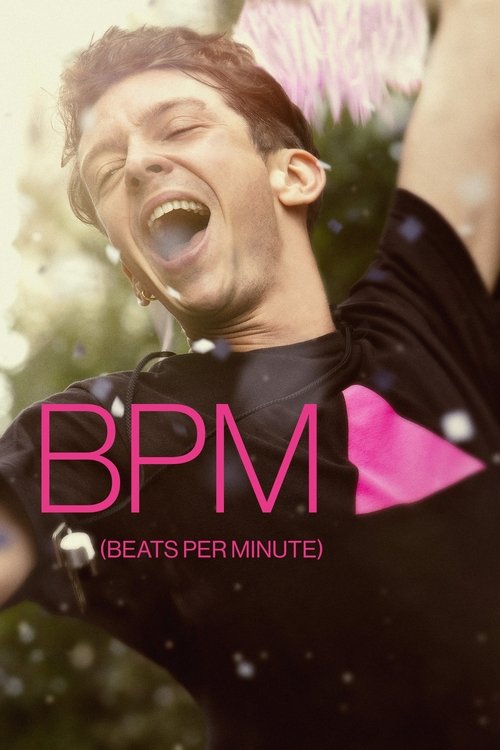
BPM (Beats per Minute)
120 battements par minute
Overview
Set in Paris during the early 1990s, the film follows the activists of ACT UP-Paris as they wage a desperate war against general indifference to the AIDS epidemic. The narrative centers on the group's heated weekly meetings (General Assemblies) where they debate strategies to force government agencies and pharmaceutical companies to release new treatments and prevention measures.
Amidst the shouts and whistles of political action, a tender romance blossoms between Nathan, a newcomer to the group who is HIV-negative, and Sean, a radical and passionate founding member whose health is rapidly deteriorating. The film oscillates between the collective energy of protests—dousing officials in fake blood and invading offices—and the intimate, heartbreaking reality of Sean's declining health, ultimately merging the political fight with the personal tragedy of loss.
Core Meaning
The personal is political, and the political is physical. Director Robin Campillo illustrates that for the marginalized, activism is not a choice but a biological necessity. The film posits that in the face of death, the act of living—dancing, loving, and debating—becomes a form of resistance. It captures the urgency of now, equating the rhythm of house music with the heartbeat of a community fighting to stay alive.
Thematic DNA
The Body as a Political Tool
The characters use their sick bodies as weapons of war. By staging "die-ins" and throwing their own ashes, they force society to look at the physical reality of the plague they are ignoring. The film emphasizes that their physical existence is their primary argument against the state.
Collective vs. Individual
The film meticulously details the democratic process of the group, showing how individual grief and anger are channeled into collective action. It balances the anonymity of the group protests with the specific, solitary experience of dying.
Life and Eros amidst Death
Despite the grim subject, the film is full of life, sex, and dancing. The club scenes serve as a release and a sacred space where the community reaffirms its vitality. Sex is portrayed not just as pleasure, but as an affirmation of life and connection in the face of a virus transmitted through it.
Silence = Death
The core motto of ACT UP. The film explores the necessity of noise—whistles, shouting, slogans, and loud music—to break the deadly silence of the government and society. Silence is equated with complicity and erasure.
Character Analysis
Sean
Nahuel Pérez Biscayart
Motivation
Survival and rage. He fights because he is dying and refuses to go quietly, fueled by anger at the time being stolen from him.
Character Arc
Starts as the fiery, radical voice of the group, demanding immediate action. As his health fails, he physically deteriorates but his spirit remains defiant. He eventually chooses assisted suicide, turning his own death into a final political statement.
Nathan
Arnaud Valois
Motivation
Love and awakening. He is drawn to the vitality of the group and specifically to Sean, finding purpose in the collective struggle.
Character Arc
Enters as a hesitant newcomer and observer. Through his love for Sean, he becomes deeply committed, eventually taking on the burden of caregiving and the emotional weight of carrying on the fight after Sean is gone.
Thibault
Antoine Reinartz
Motivation
Political efficacy. He wants to win concrete victories for the community through organized pressure rather than just chaos.
Character Arc
Represents the institutional memory and strategy of the group. He often clashes with Sean over methods, trying to balance radicalism with achievable goals.
Symbols & Motifs
Dust Particles / The Virus
The transition from the macroscopic to the microscopic. It represents the omnipresent, invisible threat of the virus and the fragility of life.
In club scenes, the camera focuses on dust motes floating in the strobe lights, which visually morph into microscopic images of the HIV virus attacking cells, linking the euphoria of the dance floor with the biological war inside their bodies.
Fake Blood
Visceral visualization of the disease and the guilt of those ignoring it. It represents the "blood on the hands" of politicians and pharma executives.
Used in protests to bombard pharmaceutical offices and government officials. It turns abstract statistics into a messy, unavoidable red reality.
The Seine as a River of Blood
A surreal manifestation of the epidemic's scale and the collective trauma of the community.
A visual metaphor where the river Seine in Paris appears to turn red, symbolizing the bloodshed and the pervasive nature of the tragedy engulfing the city.
120 BPM (The Beat)
The rhythm of house music, the racing heartbeat of fear and adrenaline, and the relentless ticking of time for the dying.
The pounding soundtrack underlies both the dance scenes and the protest marches, unifying the two aspects of the activists' lives.
Memorable Quotes
Désolé, on n'a pas le temps d'être sympas. On n'a pas le temps !
— Sean
Context:
During a raid on a pharmaceutical company, shouting at employees who are terrified by the activists' aggression.
Meaning:
Encapsulates the central conflict: the dying cannot afford the luxury of politeness or patience that society demands of them.
Silence = Mort
— ACT UP Slogan (Chanted by group)
Context:
Chanted repeatedly during die-ins and marches, serving as the film's auditory leitmotif.
Meaning:
The fundamental philosophy of the movement. Staying silent about the epidemic guarantees its continuation and their death.
Tu te rends compte que je t'ai jamais demandé ce que tu faisais dans la vie ?
— Sean (to Nathan)
Context:
An intimate moment in bed, realizing they know each other's bodies and HIV status but not their mundane biographical details.
Meaning:
highlights how the epidemic has suspended 'normal' life; their identities are defined by the struggle and their status, not their careers.
Philosophical Questions
Does the end justify the means in activism?
The film questions whether radical, disruptive, and sometimes violent protests (splattering blood, handcuffing officials) are morally justifiable when lives are at stake, contrasting them with 'polite' lobbying.
How do we grieve politically?
It explores the concept of the 'political funeral,' asking if the dead body belongs to the family for private mourning or to the community as a symbol of state negligence.
Alternative Interpretations
The Film as a Ghost Story: Some critics interpret the recurring dust motes and the spectral lighting in the club scenes as the presence of the ghosts of those lost to AIDS, dancing alongside the living.
Political vs. Erotic: There is debate over whether the sex scenes are 'breaks' from the politics or political acts themselves. Most readings lean towards the latter—suggesting that in an era of plague, reclaiming sexual pleasure is a radical act of defiance.
Cultural Impact
Historical Resurrection: The film played a major role in re-educating the French public about the AIDS crisis, a period often shrouded in shame or silence. It revived interest in the history of ACT UP and LGBTQ+ activism in Europe.
Critical Acclaim: It won the Grand Prix at the 2017 Cannes Film Festival and swept the César Awards (winning Best Film), cementing its status as a modern queer classic.
Cinematic Influence: It challenged the 'tragic victim' trope common in AIDS cinema (like Philadelphia) by focusing on agency, anger, and collective power rather than passive suffering.
Audience Reception
Praised: Audiences and critics universally lauded the film's raw energy, the authenticity of the debate scenes, and the chemistry between the leads. The refusal to melodramatize death was seen as a major strength.
Criticized: Some viewers felt the runtime (143 minutes) was too long, specifically the extended debate sequences which could feel repetitive to those uninterested in the minutiae of political organizing.
Verdict: Widely considered one of the most important LGBT films of the 21st century.
Interesting Facts
- Director Robin Campillo was a real-life member of ACT UP-Paris in the 90s.
- The scene where Nathan dresses Sean's body after death is based on Campillo's actual experience with a deceased boyfriend.
- The film was shot in just 37 days.
- The actors were not given the full script initially; the debate scenes were filmed with three cameras running simultaneously to capture spontaneous reactions.
- The English title 'BPM (Beats Per Minute)' refers to the tempo of house music popular in gay clubs of the era, typically around 120-124 bpm.
- Co-screenwriter Philippe Mangeot was also a president of ACT UP-Paris.
- The film uses no non-diegetic music (score) until the very end; all music heard is 'source' music from clubs or parades.
Easter Eggs
Smalltown Boy by Bronski Beat
The song plays a prominent role in a club scene. It is a historical anthem for gay liberation, describing a young man forced to leave his home for his sexuality, mirroring the characters' exile from mainstream society.
Historical Accuracy of Posters
The slogans and graphic designs seen in the film (like the pink triangle on a black background) are precise recreations of the actual agitprop materials used by ACT UP in the 1990s.
⚠️ Spoiler Analysis
Click to reveal detailed analysis with spoilers
Frequently Asked Questions
Explore More About This Movie
Dive deeper into specific aspects of the movie with our detailed analysis pages
Comments (0)
No comments yet. Be the first to share your thoughts!