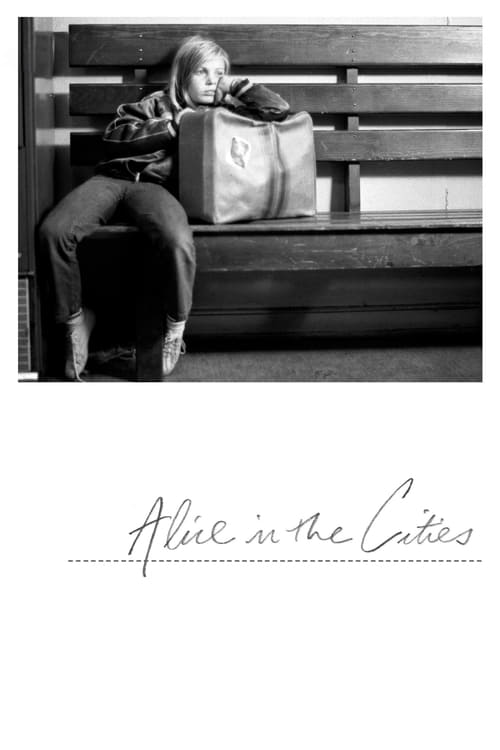
Alice in the Cities
Alice in den Städten
Overview
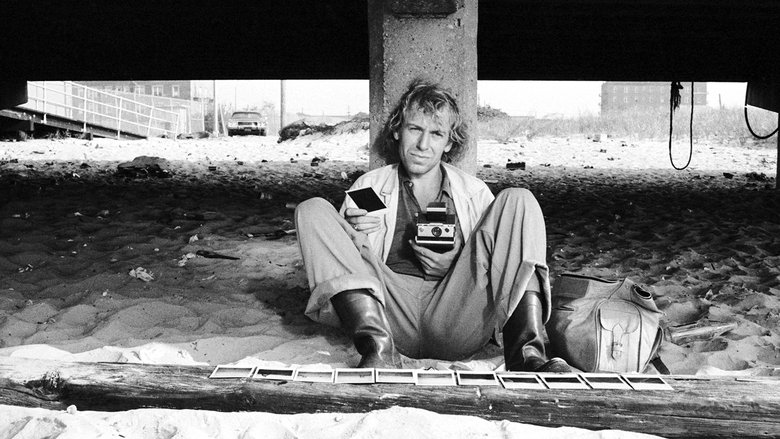
Philip Winter, a German journalist suffering from a severe case of writer's block, travels across the United States. Instead of writing his assigned article, he obsessively takes Polaroid photos, finding himself unable to connect with the reality before him. Defeated and alienated by the commercialized American landscape, he decides to return to Germany. At a New York airport, he encounters Lisa, a fellow German, and her nine-year-old daughter, Alice. Due to a flight strike, they are stranded together, but the next morning Lisa disappears to deal with a personal crisis, leaving Alice in Philip's care with a note promising to meet them in Amsterdam.
When Lisa fails to appear in Amsterdam, Philip and Alice embark on a journey to find Alice's grandmother in Germany. The only clue they have is a photograph of the grandmother's house; Alice cannot remember the address or the name of the city. Their road trip becomes a bonding experience as they travel through the industrial Ruhr region, searching for a home that may no longer exist. Through their shared displacement and the innocent, direct gaze of the child, Philip begins to break out of his existential shell and rediscover a sense of purpose and connection.
Core Meaning
Alice in the Cities is a meditation on the difficulty of seeing and the search for authentic experience in a media-saturated world. Wim Wenders uses the road movie genre to explore the post-war German identity crisis, where a cultural void is filled by American pop culture (music, movies, ads).
The film suggests that true connection and self-discovery happen not through capturing static images (the Polaroids that 'never show what you saw'), but through the shared, lived experience of movement and human interaction. Alice acts as a catalyst who forces Philip to look away from his own reflection and engage with the world directly, moving him from cynical alienation to a hopeful openness.
Thematic DNA
Alienation and Disconnection
Philip embodies modern existential alienation. He is disconnected from his work, his environment, and himself. His obsession with taking photos is a symptom of his inability to truly experience reality; he uses the camera as a shield. It is only through his involuntary guardianship of Alice that he is forced to connect with another human being.
The Image vs. Reality
A central motif is the failure of photography to capture the truth of an experience. Philip complains that his Polaroids 'never show what you saw.' The film critiques the mediation of life through images—a theme that has only become more relevant. Wenders contrasts these static, empty images with the moving, living landscape of the film itself.
Americanization of Europe
The film visually and thematically explores how American culture (rock music, advertisements, neon signs) has permeated post-war Germany. Philip travels through the US finding it empty, only to return to a Germany that looks increasingly similar. This reflects the 'colonization of the subconscious' that Wenders often discusses regarding his generation.
Movement and Transit
The characters are constantly in motion—planes, trains, cars, suspended railways. The state of being 'on the road' is presented not just as a physical journey but as a mental state. It is in these transitional spaces (hotels, stations) that the characters find a temporary home and form their bond.
Character Analysis
Philip Winter
Rüdiger Vogler
Motivation
Initially, to finish his article and survive his existential crisis; later, to help Alice find her grandmother and ensure her safety.
Character Arc
Starts as a cynical, blocked writer unable to produce anything but empty images. Through his journey with Alice, he moves from annoyance to affection, learning to care for someone else. By the end, he is able to write again, having found a story worth telling.
Alice van Dam
Yella Rottländer
Motivation
To find her grandmother and a sense of home after being left by her mother.
Character Arc
Alice remains consistent in her resilience and independence. She is not a 'cute' movie child but a complex person with her own agency. She guides Philip out of his introspection, forcing him to engage with the immediate needs of the present.
Lisa van Dam
Lisa Kreuzer
Motivation
To escape her current emotional or relationship crisis, leading her to make the desperate decision to leave Alice.
Character Arc
A peripheral but pivotal character whose personal crisis sets the plot in motion. She represents the instability and confusion of the adult world that Alice must navigate.
Symbols & Motifs
The Polaroid Camera
Symbolizes the futile attempt to possess reality and fix identity through mechanical reproduction. It represents Philip's barrier against the world.
Philip constantly snaps photos of landscapes and himself, shaking them and waiting for an image that ultimately leaves him dissatisfied. He eventually puts the camera aside as he bonds with Alice.
Jukeboxes and Rock 'n' Roll
Represents the pervasive influence of American culture, which offers both a comforting refuge and a reminder of cultural displacement.
Wenders himself appears in a cameo leaning on a jukebox. The soundtrack features Chuck Berry and Canned Heat, grounding the characters in a shared, imported cultural language.
The Photograph of the House
Represents a longing for roots and a home that may be illusory or unreachable. It is a static memory guiding a dynamic journey.
This is the only clue Alice has to her grandmother's location. Philip and Alice drive around showing it to strangers, turning the search for a specific place into a broader search for belonging.
The Wuppertal Schwebebahn (Suspension Railway)
Symbolizes a unique, suspended perspective on the world—floating above the city rather than being grounded in it.
Alice and Philip ride this distinctive train while searching for the house. It visually reinforces the theme of transit and looking at the world from a moving window.
Memorable Quotes
The pictures... they never really show what it was you saw.
— Philip Winter
Context:
Spoken by Philip as he looks at his Polaroids, disappointed that the emotional reality of the landscape is missing from the glossy print.
Meaning:
This encapsulates the film's central thesis about the inadequacy of images to capture the essence of experience. It highlights Philip's frustration with his inability to mediate reality.
I'll write an end to this story.
— Philip Winter
Context:
The final scene on the train to Munich, when Alice asks him what he will do next.
Meaning:
Signifies the breaking of his writer's block and his acceptance of his role in the narrative of his own life. He has moved from a passive observer to an active participant.
D-R-E-A-M
— Alice van Dam
Context:
Alice and Philip are playing Hangman on the plane. Alice guesses the word Philip was thinking of.
Meaning:
A moment of connection and foreshadowing. The word 'dream' contrasts with the gritty reality they are navigating, suggesting the hope that drives them.
Philosophical Questions
Can an image ever truly capture reality?
The film argues that images (Polaroids, TV, movies) acts as barriers to experience. Philip's photography alienates him from the world. The film suggests that truth is found in the duration of time and movement, not in static snapshots.
What constitutes 'home' in a globalized world?
Both characters are homeless wanderers. The film proposes that in a modern, industrialized world, 'home' is no longer a physical place (the grandmother's house is elusive), but a state of connection found in transit and in relationships with others.
Alternative Interpretations
The 'Anti-Paper Moon' Theory: While superficially similar to Paper Moon, critics argue that Wenders' film deconstructs the 'cute kid/grumpy adult' trope. Alice is not a plot device to redeem Philip, but an independent existential agent. The film is less about 'family' and more about two solitary souls finding a way to coexist.
The Post-War Void Reading: Some scholars interpret Philip's emptiness and the ruined landscapes of the Ruhr valley as a commentary on the 'black hole' of German history after WWII. The obsession with America is a way to avoid looking at the German past, and the journey back to the grandmother (the older generation) is a tentative attempt to reconnect with German roots that may no longer exist.
Cultural Impact
Alice in the Cities is a seminal work of the New German Cinema movement. It helped establish the 'road movie' as a genre for exploring existential questions rather than just counter-cultural freedom. The film marked the beginning of Wim Wenders' international recognition and defined his signature style: a focus on wandering, American landscapes seen through European eyes, and the use of rock music.
Critically, it is often cited as one of Wenders' most accessible and emotionally resonant films. It laid the groundwork for his later masterpiece, Paris, Texas (1984), which shares similar themes of lost people, vast landscapes, and the bond between an adult and a child. The film's depiction of a 'colonized' German consciousness—filling the post-war silence with American imagery—was a crucial contribution to the cultural dialogue of West Germany in the 1970s.
Audience Reception
Critical Acclaim: The film holds a very high rating on review aggregators (often 100% on Rotten Tomatoes). Critics praise its understated emotion, Robby Müller's stunning black-and-white cinematography, and the natural chemistry between Vogler and Rottländer.
Audience Reaction: Viewers often describe it as a 'gentle' and 'healing' film. While some find the pacing slow (typical of Wenders), most appreciate the meditative atmosphere. The lack of forced melodrama is frequently cited as a major strength. It is widely considered the best entry point into Wenders' filmography.
Interesting Facts
- Wim Wenders almost cancelled the film after seeing Peter Bogdanovich's 'Paper Moon' (1973), realizing the plots were strikingly similar. Samuel Fuller convinced him to make it anyway.
- This is the first film in Wenders' 'Road Movie Trilogy', followed by 'The Wrong Move' (1975) and 'Kings of the Road' (1976).
- The film was shot in 16mm black and white by legendary cinematographer Robby Müller and later blown up to 35mm, giving it a grainy, textured look.
- The script was largely improvised and shot in chronological order, allowing the relationship between the actors to develop naturally on screen.
- The character Philip Winter appears in other Wenders films, including 'The Wrong Move' and 'Kings of the Road', always played by Rüdiger Vogler.
- Wim Wenders has a cameo as a man putting money into a jukebox in a diner.
- The film features an uncredited appearance by Chuck Berry in concert footage.
- The story was partly inspired by Peter Handke's novel 'Short Letter, Long Farewell'.
Easter Eggs
Clip from 'Young Mr. Lincoln'
Philip watches John Ford's film in his hotel room. This is a direct reference to Peter Handke's novel Short Letter, Long Farewell, which also features an alienated German traveler in the US and references the same Ford film.
Yella Rottländer's Casting
Wenders cast Yella Rottländer because he had worked with her on The Scarlet Letter (1973) and felt he hadn't done justice to her character in that film. He wanted to make a film that captured her natural presence.
Can Soundtrack
The score is by the experimental German rock band Can. It is considered one of their most atmospheric works, perfectly complementing the 'inner journey' aspect of the road movie.
⚠️ Spoiler Analysis
Click to reveal detailed analysis with spoilers
Frequently Asked Questions
Explore More About This Movie
Dive deeper into specific aspects of the movie with our detailed analysis pages
Comments (0)
No comments yet. Be the first to share your thoughts!