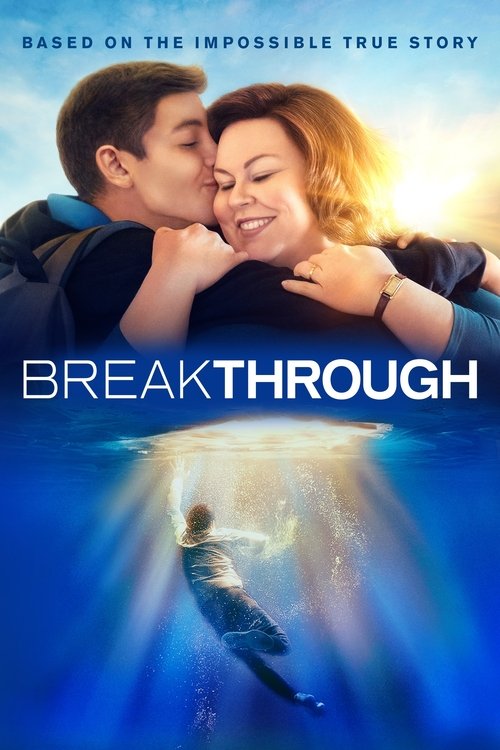
Breakthrough
"Based On The Impossible True Story"
Overview
Based on a staggering true story, Breakthrough follows the life of 14-year-old John Smith, a Guatemalan adoptee struggling with his identity in suburban Missouri. One winter day in 2015, a playful moment on a frozen lake turns into a nightmare when the ice breaks, plunging John and his friends into the freezing water. While his friends are rescued quickly, John remains submerged for 15 minutes before first responders finally pull his lifeless body from the depths.
Rushed to the hospital, medical teams perform CPR on John for nearly 45 minutes without success. Just as the lead doctor prepares to pronounce the boy dead, his mother, Joyce, is brought into the room to say her final goodbyes. Refusing to accept the grim reality, she cries out in a desperate, passionate prayer for the Holy Spirit to breathe life back into her son—and impossibly, John's heart begins to beat again.
While the initial survival is hailed as a medical anomaly, the family's battle is far from over. The film transitions into a tense, emotional journey as John remains in a critical state. It explores how Joyce's fierce, sometimes overbearing faith clashes with the realistic doubts of the medical staff, her husband, and a progressive new pastor, ultimately culminating in a story about community resilience and the power of letting go.

Core Meaning
The core message of Breakthrough transcends a simple recounting of a medical miracle; it is a profound exploration of surrender and the limitations of human control. Director Roxann Dawson highlights that while faith and prayer are central, true spiritual maturity involves letting go of one's need to orchestrate the outcome.
Through Joyce's journey, the film suggests that genuine faith is not about demanding a specific result from a higher power, but trusting that higher power implicitly, regardless of the conclusion. Furthermore, the film underlines the invaluable strength of community—showing that miracles are often collaborative efforts involving medical science, first responders, and a unified network of emotional support.
Thematic DNA
The Power of Prayer and Unyielding Faith
The film centers entirely on the transformative potential of bold, desperate prayer [1.2]. Joyce's refusal to accept the medical consensus acts as the catalyst for John's survival, framing faith as a potent, active force.
Surrender vs. Control
Joyce begins the film as a deeply controlling figure, micromanaging her family and her church environment. Her character arc requires her to understand that she cannot will her son back to health on her own terms; she must ultimately surrender his fate to God.
Community and Collective Healing
The narrative emphasizes that no one survives tragedy in a vacuum. The unification of the town, the school's prayer vigil, the dedication of the medical staff, and the persistence of Pastor Jason demonstrate that collective love is a tangible lifeline.
Purpose and Survivor's Guilt
After his miraculous recovery, John wrestles with why his life was spared when others pass away. The film navigates the heavy burden of finding meaning and purpose after being given a second chance at life.
Character Analysis
JoyceSmith
ChrissyMetz
Motivation
Driven by an all-consuming love for her adopted son and a desperate need to save his life against impossible medical odds.
Character Arc
Joycetransformsfromajudgmental, controllingmotherwhodictatesherenvironmentintoahumbledbelieverwholearnsthattruefaithrequiresrelinquishinghergripandtrustingGodcompletely, evenwiththepossibilityofloss[1.3].
John Smith
Marcel Ruiz
Motivation
To figure out his identity, prove his worth, and understand his place in a world where he previously felt abandoned.
Character Arc
John begins as a rebellious teen struggling with feelings of rejection from his birth mother. Through his near-death experience, he awakens to the profound reality of how deeply he is cherished by his adoptive parents and his community.
Pastor Jason Noble
Topher Grace
Motivation
To connect with the youth of his congregation and provide genuine, unwavering support to his flock, even when they push him away.
Character Arc
Initially viewed as an annoying, overly-hip interloper by Joyce, Jason proves his spiritual mettle and pastoral dedication by refusing to leave the family's side during their darkest hours, eventually earning Joyce's deep respect.
Brian Smith
Josh Lucas
Motivation
To protect his own heart from unbearable grief while trying to keep his family grounded in medical reality.
Character Arc
Unlike his wife, Brian is paralyzed by the grim reality of the medical monitors. He initially retreats emotionally to protect himself from the pain, but eventually finds the courage to stand strong alongside his wife and son.
Tommy Shine
Mike Colter
Motivation
To perform his duty effectively as a first responder, relying purely on logic, training, and tangible facts before the miraculous event.
Character Arc
An atheist first responder who is certain the rescue is just a body recovery. After hearing a mysterious voice guiding him to John's body, he is forced to confront the existence of a higher power and re-evaluate his worldview.
Symbols & Motifs
The Icy Lake
The lake represents the sudden, unpredictable abyss of tragedy and death [1.4]. It stands as a boundary between the warmth of life and the cold finality of the unknown.
Used in the harrowing first act, the lake swallows the boys in an instant. The visual contrast between the stark, white ice and the dark, suffocating water beneath heightens the sense of helplessness.
Breath and Breathing
Breath is utilized as a literal and spiritual symbol of life, representing the presence of the Holy Spirit.
Joyce specifically prays for the Holy Spirit to 'breathe life' into her son. The return of John's pulse and his eventual ability to breathe off the ventilator serve as the physical manifestations of this spiritual breath.
The Women's Ministry Calendar
This seemingly mundane object symbolizes Joyce's rigid need for control, traditionalism, and her resistance to outside influence or change.
Early in the film, Pastor Jason takes down the calendar to make room for his modern church initiatives. This sparks intense friction with Joyce, foreshadowing the deeper spiritual lesson she must learn about relinquishing control.
Memorable Quotes
Holy Spirit, please breathe life into my son!
— Joyce Smith
Context:
Screamed by Joyce in the emergency room over John's lifeless body, mere moments before his pulse miraculously returns after 45 minutes of failed CPR.
Meaning:
This is the thematic and narrative turning point of the film, showcasing a raw, unpolished, and desperate act of faith that defies logic and medical science [1.17].
Patient died. Mother prayed. Patient came back to life.
— Pastor Jason Noble
Context:
Spoken by Pastor Jason when reflecting on the sheer impossibility of John's sudden resuscitation to the doctors and the community.
Meaning:
A succinct, powerful summarization of the movie's core miracle, stripping away complex medical jargon to highlight the perceived divine intervention.
You have a purpose and you are loved.
— Joyce Smith
Context:
Spoken to John as an affirmation of his life's value, counteracting his feelings of abandonment and his struggles with survivor's guilt.
Meaning:
This quote directly addresses the emotional void John feels regarding his adoption. It reinforces the film's message about the intrinsic worth of every human soul.
Yesterday is not ours to recover, but tomorrow is ours to win or lose.
— Lyndon B. Johnson (via Poster)
Context:
Seen on a poster at John's school, serving as a subtle thematic framing device for his journey back to health and purpose.
Meaning:
This historical quote serves as a thematic anchor for the film, emphasizing that while the trauma of the past cannot be changed, the future is still unwritten and worth fighting for.
Philosophical Questions
Why does God intervene to save some, but not others?
The film tackles the classic theological problem of theodicy [1.3]. It directly confronts this when a teacher, who recently lost her husband despite fervent prayers, asks John why he was spared. The narrative refuses to provide a neat, comforting answer, instead lingering in the tension that divine will is inherently mysterious.
Where is the line between faith and denial?
Throughout the hospital scenes, Joyce aggressively silences any doctor or family member who speaks negatively about John's prognosis. The film asks audiences to consider whether her behavior is a manifestation of profound, unwavering faith, or a dangerous psychological denial of reality that isolates her from those trying to help.
Can science and the miraculous coexist?
By highlighting the extreme dedication, medical procedures, and expertise of the hospital staff alongside the community's prayers, the film explores whether a 'miracle' is a suspension of natural laws, or simply the perfect alignment of human scientific effort and unseen providence.
Alternative Interpretations
While the film explicitly frames John's recovery as a divine miracle spurred by the Holy Spirit, secular audiences and medical professionals offer an alternative, physiological interpretation. From a scientific perspective, John's survival is attributed to the extreme cold of the water, which rapidly lowered his core body temperature. This induced hypothermia essentially put his brain and organs into a protective state, drastically reducing their need for oxygen and preventing immediate irreversible brain damage.
Another layer of interpretation lies in the film's handling of 'survivor's guilt.' Some critics view the ending—where a teacher questions why her husband died while John was miraculously saved—as a subtle deconstruction of the 'miracle narrative'. Instead of a triumphant guarantee of divine intervention, this perspective suggests the film acknowledges the random, often cruel nature of mortality, presenting faith as a mechanism for enduring life's inexplicable outcomes rather than a magic cure.
Cultural Impact
Breakthrough arrived at a time when the faith-based film industry was transitioning from niche, low-budget productions to mainstream cinematic releases backed by major studios. As the first 20th Century Fox film distributed by Walt Disney Studios Motion Pictures, it carried significant industry weight. The involvement of high-profile producer DeVon Franklin and executive producer Stephen Curry helped bridge the gap between religious audiences and mainstream moviegoers.
Culturally, the film sparked widespread discussions about the intersection of faith and medical science. While skeptics pointed to the medical semantics and the phenomenon of cold water survivals, religious communities embraced the film as an undeniable modern-day miracle. The movie also notably strayed from the sanitized tropes of many Christian films by depicting its protagonist, Joyce, as a flawed, controlling character, bringing a necessary authenticity to the genre.
Audience Reception
Breakthrough was warmly received by general audiences, particularly within the faith-based demographic, with praise for its high production values and moving performances. Viewers specifically appreciated Chrissy Metz's emotional portrayal of a grieving mother and Topher Grace's charismatic turn as Pastor Jason. The film was lauded for its refusal to sugarcoat the messy dynamics of church life and family trauma.
Conversely, critical reception was more mixed. Mainstream film critics acknowledged the compelling nature of the true story but felt the film frequently dipped into melodramatic, Hallmark-style sentimentality. A main point of criticism was the pacing, as the movie scours the edges of the story looking for conflict while John is unconscious. However, critics agreed that the movie successfully avoided many 'preachy' pitfalls by making its characters deeply flawed and by leaving the agonizing question of unanswered prayers unresolved.
Interesting Facts
- Thefilmisbasedonthe2017book'TheImpossible'(laterretitled'Breakthrough')bythereal-lifeJoyceSmith[1.3].
- NBA superstar Stephen Curry served as an executive producer for the film, drawing a connection to the real John Smith's deep love for basketball and the Golden State Warriors.
- Despite being set in Missouri, the movie was primarily filmed in Winnipeg, Manitoba, Canada, where the cast and crew endured harsh winter conditions.
- Actor Marcel Ruiz actually laid on real ice in a t-shirt in freezing 9-degree weather to authentically capture the shock of the rescue scene.
- The real John Smith made an astounding recovery in real life, walking out of the hospital just 16 days after the accident and returning to play basketball.
- The real-life rescue worker Tommy Shine actually did believe he heard a voice telling him where to search in the dark water, which led him to reconsider his beliefs.
Easter Eggs
Stephen Curry's Executive Producer Credit
NBA star Stephen Curry helped produce the film [1.3]. This is a deliberate, heartwarming meta-reference, as the main character John Smith is a massive basketball fan whose joy is found on the court.
Lecrae's Cameo
Grammy-winning Christian hip-hop artist Lecrae appears as himself, performing at Pastor Jason's modernized church service. This highlights the pastor's efforts to reach the youth and update the church's culture, much to Joyce's initial chagrin.
⚠️ Spoiler Analysis
Click to reveal detailed analysis with spoilers
Frequently Asked Questions
Explore More About This Movie
Dive deeper into specific aspects of the movie with our detailed analysis pages
Comments (0)
No comments yet. Be the first to share your thoughts!