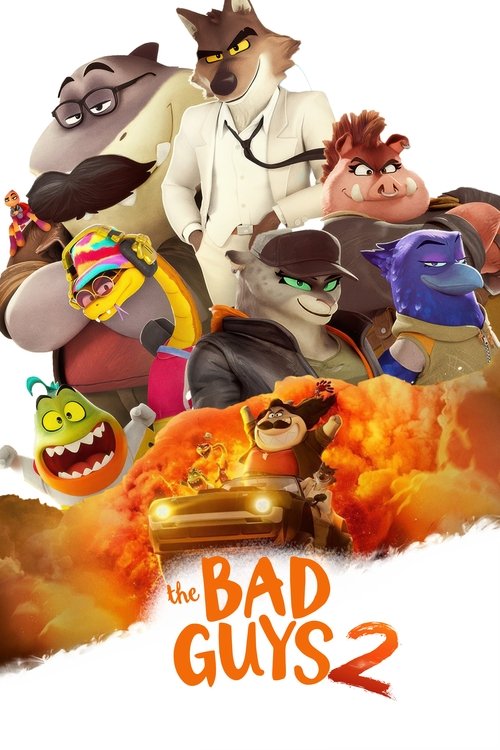
The Bad Guys 2
"Back in badness."
Overview
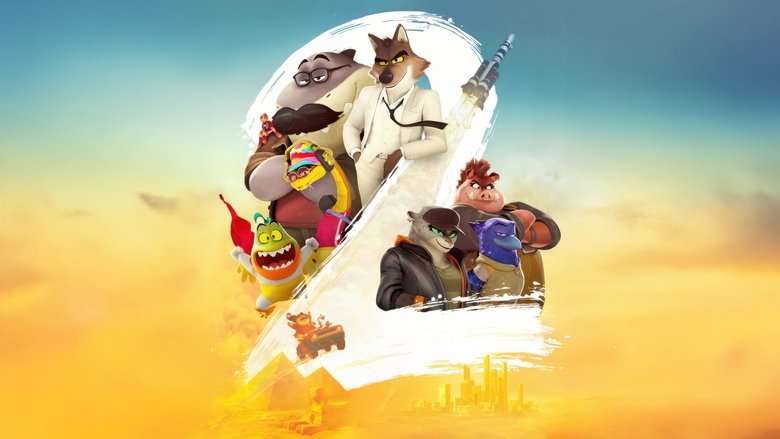
In The Bad Guys 2, the reformed crew of animal outlaws attempts to navigate life on the straight and narrow, only to find that society isn't quite ready to forgive their past. Struggling to find honest work and acceptance, Mr. Wolf and his gang are cornered into 'one last job' by a rival all-female syndicate known as The Bad Girls. This new squad, led by the cunning Kitty Kat, blackmails the group into a globe-trotting heist involving a mysterious substance known as 'MacGuffinite' and a high-stakes mission to a space station.
As the heist unfolds, loyalties are tested and the line between hero and villain blurs. The Bad Guys must use their criminal expertise for good, culminating in a chaotic finale aboard a Moon-X rocket. The film expands the universe with high-tech gadgetry and a shift from local crimes to international espionage, ultimately forcing the team to fake their own deaths to be reborn as secret agents.
Core Meaning
The film explores the fragility of redemption and the systemic barriers to change. While the first film was about choosing to be good, the sequel asks whether society will allow you to be good. It posits that true reformation requires not just personal change but also the resilience to prove oneself despite prejudice, suggesting that sometimes one must operate outside the law to ultimately uphold justice.
Thematic DNA
The struggle of recidivism
The central conflict arises from the Bad Guys' inability to reintegrate into society. Despite their genuine efforts, they face rejection and unemployment, illustrating the harsh reality that 'going straight' is often harder than the crime itself. This drives the plot as their desperation makes them vulnerable to coercion.
Identity and labels
The introduction of The Bad Girls serves as a mirror to the protagonists, challenging them to define themselves not by their species or their past labels ('Bad Guys'), but by their current actions. The film deconstructs the binary of 'Good Guy' vs 'Bad Guy' into something more fluid.
Trust and betrayal
Wolf's leadership is tested as he hides secrets from his team to protect them, mirroring the first film but with higher stakes. The dynamic with the Bad Girls introduces a complex layer of deception, where trust becomes the most valuable currency in a world of thieves.
Female empowerment and rivalry
The Bad Girls aren't just villains; they are competent, professional counterparts who challenge the boys' club of the original team. Characters like Kitty Kat and Doom provide a foil to Wolf and Snake, highlighting competence and ambition irrespective of gender.
Character Analysis
Mr. Wolf
Sam Rockwell
Motivation
To prove that he and his friends are truly 'Good Guys' and to protect Diane Foxington.
Character Arc
Wolf transitions from a leader seeking validation from society to one who accepts that doing the right thing matters more than recognition. He learns to trust his team with the truth rather than shouldering the burden alone.
Mr. Snake
Marc Maron
Motivation
Loyalty to Wolf, conflicted by his attraction to the criminal lifestyle (and Doom).
Character Arc
Snake struggles most with the 'good' life, finding a kindred spirit in the new character Doom (Susan). His arc involves resisting the temptation to backslide into crime for love and easy money.
Kitty Kat
Danielle Brooks
Motivation
To pull off the ultimate heist and outshine the legendary Bad Guys.
Character Arc
As the leader of The Bad Girls, she represents what Wolf used to be—unapologetically criminal. She serves as the primary antagonist who challenges Wolf's new morality.
Professor Marmalade
Richard Ayoade
Motivation
Revenge and returning to his home planet.
Character Arc
Returning as a chaotic force, his arc pivots from earthly criminal mastermind to cosmic threat, setting up future installments.
Symbols & Motifs
MacGuffinite
A literal manifestation of the plot device (MacGuffin) that drives characters' actions without having intrinsic meaning. It satirizes the genre's tendency to chase arbitrary objects, symbolizing the futility of greed.
Used as the primary target of the heist, a volatile substance that everyone is chasing, mocking the seriousness of traditional action movie stakes.
The Moon-X Rocket
Symbolizes escape and escalation. It represents the franchise leaving its grounded roots for 'shark-jumping' spectacle, paralleling the characters' desire to escape their earthly reputations.
The climax takes place on this rocket, physically elevating the conflict above the city that rejected them.
The Golden Limo Spaceship
Represents absurdist wealth and alien otherness. It connects Marmalade's greed with his true extraterrestrial nature.
Revealed in the mid-credits scene when Professor Marmalade's getaway vehicle transforms, hinting at his alien origins.
Memorable Quotes
Sometimes being good... means being bad.
— Mr. Wolf
Context:
Spoken during the climax when the team realizes they must use their criminal skills to save the city from the Bad Girls' plot.
Meaning:
The thematic thesis of the film. It signifies that strict adherence to rules doesn't always equal justice; sometimes one must break the rules to do what is morally right.
We panicked. Okay? I'm a panicker.
— Mr. Shark
Context:
Shark trying to explain a botched element of their plan to the Bad Girls.
Meaning:
Highlights the comedic vulnerability of the characters despite their tough exteriors.
I'm going home.
— Professor Marmalade
Context:
Spoken in the post-credits scene as his limo transforms into a spaceship.
Meaning:
A double entendre revealing his alien nature.
Philosophical Questions
Can society truly forgive past transgressions?
The film explores this by showing the Bad Guys rejected despite their best efforts. It suggests that societal forgiveness is conditional and superficial, forcing the characters to find self-worth internally rather than through external validation.
Is morality defined by action or intent?
Wolf's decision to use 'bad' methods (heists, deception) for a 'good' outcome (saving the city) challenges deontological ethics, leaning towards a utilitarian view where the ends justify the means.
Alternative Interpretations
Some critics interpret the film as a critique of performative activism. The Bad Guys try to 'look' good to be accepted, but society rejects them until they embrace their authentic skills. The ending, where they fake their deaths to work in the shadows, can be read as a cynical admission that true redemption is impossible in the public eye—one must simply exist outside the system entirely to do good.
Cultural Impact
The Bad Guys 2 solidified the franchise as a modern animation staple, praised for continuing the '2.5D' animation style that blends CGI with illustrative 2D textures. Culturally, it sparked discussions about recidivism and the justice system in family media, offering a palatable way for parents to discuss how hard it is to change one's reputation. While not as universally acclaimed as the first for its freshness, it successfully transitioned the series from a simple heist comedy to a broader action-adventure universe, influencing a wave of 'villain redemption' stories in children's media.
Audience Reception
Praised: Audiences loved the animation style, the chemistry between Sam Rockwell and Zazie Beetz, and the addition of the 'Bad Girls' which added a fresh dynamic. The action sequences, particularly the Cairo car chase and the zero-gravity finale, were highlighted as visual feasts.
Criticized: Some reviews felt the plot was overly complicated with too many twists (MacGuffinite, aliens, secret agencies). A few critics noted that the humor relied too heavily on pop-culture references compared to the character-driven comedy of the first film.
Verdict: A worthy sequel that sacrifices some narrative tightness for bigger spectacle, generally considered a hit with families but slightly inferior to the original.
Interesting Facts
- The film was released on August 1, 2025, marking the first DreamWorks animated film to be released in that month.
- The character 'Doom' (played by Natasha Lyonne) is a raven, which is a nod to Lyonne's dark and witty persona; she previously voiced a turtle in 'DC League of Super-Pets' alongside Marc Maron.
- The substance 'MacGuffinite' is a meta-joke named after the film term 'MacGuffin', coined by Alfred Hitchcock.
- In a mid-credits twist, Professor Marmalade is revealed to be an alien, a plot point pulled from the later books in Aaron Blabey's series.
- The final scene where the team wears suits and works as secret agents sets up a shift in genre from heist to spy thriller for a potential third movie.
Easter Eggs
Ms. Tarantula joining last
A reference to the book series where Mr. Tarantula joins the gang in the second book, mirroring her 'newest member' status in the film lore.
Ghost Pottery Scene reference
A joke involving a pottery wheel asks 'Who even does pottery? The cast of Ghost?!', referencing the iconic 1990 film scene.
Marmalade's alien ship
The design of Marmalade's transforming limo pays homage to retro 1950s sci-fi saucers, hinting at the genre shift towards sci-fi found in the source books.
⚠️ Spoiler Analysis
Click to reveal detailed analysis with spoilers
Frequently Asked Questions
Explore More About This Movie
Dive deeper into specific aspects of the movie with our detailed analysis pages
Comments (0)
No comments yet. Be the first to share your thoughts!