Skip to content
Caché
A sterile bourgeois sanctuary unravels into suffocating dread as static surveillance tapes force a man to confront his suppressed past, visualised like an unblinking eye staring into a darkened room.
Caché
Caché

"Hidden within."

05 October 2005 France 118 min 7.0 (1,300)

Director: Michael Haneke

Cast: Daniel Auteuil, Juliette Binoche, Annie Girardot, Bernard Le Coq, Daniel Duval

Drama Thriller Mystery Collective and Individual Guilt Colonial Amnesia and Historical Repression Surveillance, Media, and Voyeurism Bourgeois Insulation and Complicity
Budget: $8,500,000
Box Office: $16,197,824

Caché — Ending Explained

⚠️ Spoiler Analysis

The mystery begins with static footage of the Laurent home, progressing to tapes displaying Georges’s childhood farm in the French countryside. Georges identifies the rural location and recalls Majid, whose parents were farmhands murdered in the 1961 Paris police massacre. Georges' parents intended to adopt six-year-old Majid, but young Georges, terrified of sharing parental affection, framed Majid: he told his parents Majid had coughed blood (claiming tuberculosis), and coerced Majid into beheading a rooster with an axe, convincing his parents the boy was dangerously disturbed. Majid was expelled to an orphanage, irrevocably altering his life.

Led by a cassette filming a rundown suburban apartment, Georges confronts Majid, who is now impoverished and ailing. Majid denies sending any tapes. Later, Majid summons Georges back to his flat. With flat composure, Majid says, "I wanted you to be present," draws a straight razor, and slices his own throat, collapsing dead across the floor. Terrified of being implicated, Georges flees the scene without notifying authorities, goes to a cinema to hide, and lies to Anne upon returning home. Later, Majid’s adult son confronts Georges at his TV studio, insisting neither he nor his father bore malice or sent the tapes, while holding Georges to task for his cowardice.

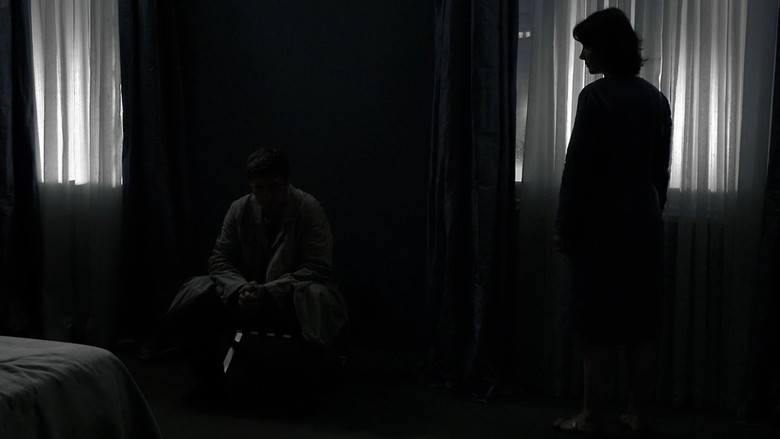
Unwilling to confront his culpability, Georges returns home, pulls down all bedroom blinds, strips in total darkness, and ingests sleeping pills to retreat into unconsciousness. The film closes with an unbroken, stationary wide shot of the exterior staircase of Pierrot’s school at dismissal. Amid a crowd of students, Majid’s son and Pierrot appear together in the bottom-left corner of the frame, conversing casually before parting ways. Haneke offers no dialogue, no narrative resolution, and no overt confirmation of their relationship, leaving the moral burden entirely on the viewer.

Alternative Interpretations

Different readings exist regarding the mystery of who recorded and sent the tapes:

  • The Conspiracy Theory (Majid’s Son & Pierrot): The final wide shot shows Majid’s son and Pierrot meeting outside Pierrot’s school in an apparently familiar conversation. Many viewers infer that the two youths orchestrated the video campaign together to dismantle the parental figures' hypocrisy. However, their dialogue is inaudible, and Pierrot earlier denied knowing Majid, leaving the complicity unproven.
  • The Meta-Cinematic Reading (Haneke / The Lens Itself): Haneke deliberately positions cameras at impossible vantage points—such as tapes showing closed interior hallways or high-angle street shots with no plausible camera mounts. In this reading, there is no diegetic culprit; the camera is the gaze of the filmmaker and the audience holding Western society accountable.
  • The Psychological / Metaphorical Reading: The tapes are not material evidence of a criminal stalker, but an allegorical return of the repressed. They function as externalizations of Georges' guilty conscience, forcing him to witness what he has systematically walled off.

Explore More About This Movie

Dive deeper into specific aspects of the movie with our detailed analysis pages

Similar Movies