Skip to content
Caché
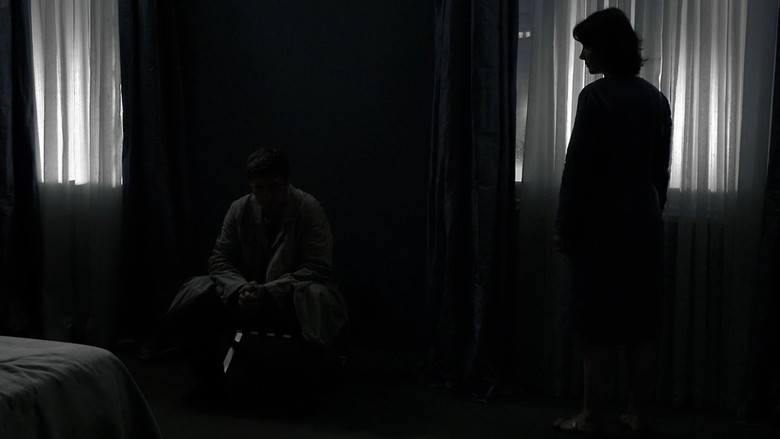
A sterile bourgeois sanctuary unravels into suffocating dread as static surveillance tapes force a man to confront his suppressed past, visualised like an unblinking eye staring into a darkened room.
Caché

Caché

"Hidden within."

05 October 2005 France 118 min 7.0 (1,300)

Director: Michael Haneke

Cast: Daniel Auteuil, Juliette Binoche, Annie Girardot, Bernard Le Coq, Daniel Duval

Drama Thriller Mystery Collective and Individual Guilt Colonial Amnesia and Historical Repression Surveillance, Media, and Voyeurism Bourgeois Insulation and Complicity
Budget: $8,500,000
Box Office: $16,197,824

Overview

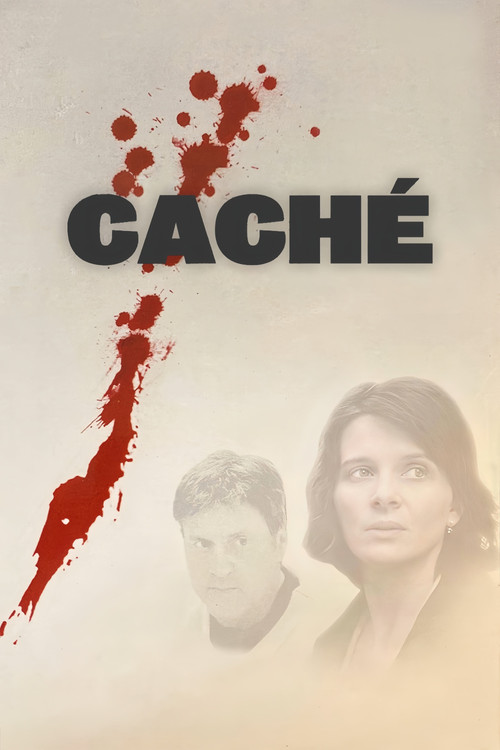
Caché (released as Hidden in English-speaking markets) centers on Georges Laurent, an intellectual television host of a highbrow literary talk show, and his wife Anne, an urbane book editor. Together with their twelve-year-old son, Pierrot, they inhabit a serene, book-lined townhome in Paris, shielded by intellectual prestige and material comfort.

Their domestic tranquility fractures when videotapes begin arriving anonymously on their doorstep. Wrapped in ordinary plastic grocery bags, each cassette contains hours of unedited, static surveillance footage focused directly on their front facade. Initially dismissed as an eccentric nuisance or an adolescent prank, the deliveries escalate into psychological warfare as subsequent packages include macabre, child-like drawings depicting violent imagery and tapes recorded outside Georges’s rural childhood home.

As the unidentified stalker's gaze narrows, Georges realizes the footage points directly toward a buried incident from his youth involving an orphaned Algerian boy named Majid. Refusing to confide honestly in his wife or the police, Georges launches an isolated, defensive quest to unmask the sender, setting off a cascade of paranoia, domestic estrangement, and moral reckoning.
Core Meaning

Michael Haneke constructed Caché as an indictment of individual and collective evasion. The film argues that personal guilt cannot be walled off behind intellectual respectability or bourgeois comforts; past injustices, when repressed rather than acknowledged and reconciled, calcify into systemic bad faith and latent aggression.

On a sociopolitical tier, the film addresses postcolonial trauma, specifically France's suppression of its historical atrocities during the Algerian War. Haneke highlights how privileged Western societies benefit from historic violence while systematically erasing its memory, maintaining an illusion of civilization while living in permanent dread of retribution. The core message posits that denial provides only a fragile, illusory peace.

Thematic DNA

Collective and Individual Guilt 35%
Colonial Amnesia and Historical Repression 25%
Surveillance, Media, and Voyeurism 20%
Bourgeois Insulation and Complicity 20%

Collective and Individual Guilt

Guilt operates as both an intimate childhood sin and a national legacy. Georges’s refusal to accept culpability for ruining Majid’s childhood mirrors France’s refusal to reckon with its colonial crimes. Haneke does not present guilt as an emotional catalyst for redemption, but rather as an irritant that drives the perpetrator into deeper hostility, self-justification, and defensiveness.

Colonial Amnesia and Historical Repression

The narrative hinges directly on the October 17, 1961 Paris massacre. By embedding an Algerian victim whose trauma was erased into the heart of an affluent French family's narrative, the film exposes how postcolonial power dynamics persist in contemporary Europe beneath an intellectual veneer of tolerance.

Surveillance, Media, and Voyeurism

Through the untraced surveillance footage, Haneke blurs the boundary between the lens of the stalker, the camera of the filmmaker, and the gaze of the audience. The theme interrogates what it means to watch passively, implicating the viewer in the invasive act of looking without intervening.

Bourgeois Insulation and Complicity

The Laurent household—surrounded by thousands of books, fine wine, and cultured dinner companions—is shown as a fortress engineered to shut out the volatile geopolitical realities of the outside world. Haneke dissects the fragile complacency of the liberal elite, demonstrating how quickly decorum collapses when privileges are scrutinized.

Character Analysis

Georges Laurent

Daniel Auteuil

Archetype: Compromised Antihero / Self-Deceiving Patriarch Key Trait: Pathological denial disguised as moral pragmatism.

Motivation

Preserving his spotless reputation, social standing, and self-conception as an innocent party.

Character Arc

Begins as an urbane, self-assured arbiter of culture; as the past re-emerges, he deteriorates into an angry, evasive coward who retreats into willful ignorance.

Anne Laurent

Juliette Binoche

Archetype: Skeptical Confidante / Fractured Ally Key Trait: Intuitive intelligence combined with bourgeois self-preservation.

Motivation

Protecting her family and regaining clarity in an environment poisoned by secrecy.

Character Arc

Shifts from a supportive partner to an alienated, suspicious spouse as Georges' persistent lies undermine their marriage.

All 4 characters and cast

Symbols & Motifs

The Surveillance Videotapes

Meaning:

Symbolize conscience, objective scrutiny, and historical memory that refuses to remain suppressed.

Context:

They arrive unannounced on the Laurent doorstep, bypass security, and disrupt manufactured narratives of innocence.

The Decapitated Rooster

Meaning:

Represents the innocent victim sacrificed to preserve Georges' domestic territory, while anticipating Majid’s violent fate.

Context:

Appears in both childhood drawings and fragmented nightmares, linked to the childhood event where Georges coerced Majid into beheading a rooster with an axe.

The Living Room Bookshelves

Meaning:

Represent the intellectual barricade behind which the Western bourgeoisie hides from base physical realities.

Context:

Floor-to-ceiling volumes frame the Laurent living room and television studio.

Closed Curtains and Drawn Blinds

Meaning:

Represent retreating from accountability and inducing artificial darkness and willful ignorance.

Context:

Recurring visually whenever Georges retreats from accountability, climaxing in the scene where he undresses, closes every blind to block sunlight, and takes sleeping pills.

The Television Broadcasts

Meaning:

Contrast systemic real-world slaughter against the insulated squabbles of the upper-middle class.

Context:

Unattended background televisions throughout the film display news footage of actual wars, suicide bombings, and postcolonial conflicts in the Middle East and Africa.

Memorable Quotes

Non, tu as menti parce que tu avais peur de devoir partager.
— Anne

Context

Spoken by Anne to Georges during their discussions regarding his past actions toward Majid.

Meaning

Strips away Georges' childhood excuse that he was merely a frightened boy and diagnoses his deep-rooted territorial greed.

Je voulais que tu sois là.
— Majid

Context

Spoken to Georges inside Majid's dilapidated apartment just before drawing a razor and slitting his own throat.

Meaning

Majid's chilling final declaration before forcing Georges to become an undeniable witness to violence.

All 4 quotes

Philosophical Questions

Can an adult be held morally culpable for a lie told in early childhood?

The film probes the boundary between juvenile jealousy and permanent moral culpability, asking whether Georges' refusal to atone as an adult transforms a child’s deception into lifelong complicity.

How does collective historical amnesia shape the psyche of the privileged?

By juxtaposing comfortable domesticity with past massacres, Caché asks whether societal tranquility is merely a fragile delusion maintained by state-sponsored forgetting.

Does the medium of recorded video capture objective truth or fabricate deceit?

The surveillance tapes are unedited and objective, yet devoid of context, generating false assumptions, suspicion, and hysteria in those who watch them.

Alternative Interpretations

Different readings exist regarding the mystery of who recorded and sent the tapes:

Full ending explanation

Cultural Impact

The film directly engages with the Paris massacre of October 17, 1961. Under orders from Paris Police Prefect Maurice Papon, French police brutally attacked an estimated 30,000 peaceful pro-FLN Algerian demonstrators, beating dozens unconscious and drowning scores in the Seine River. For nearly four decades, French state authorities enforced strict censorship, officially conceding only a handful of casualties until limited declassification in the late 1990s. Caché captured a crucial cultural moment when French society was finally forced to confront the suppressed traumas of the Algerian War.

Caché reshaped contemporary psychological thrillers and arthouse suspense, demonstrating how digital cinematography and static long-takes could generate dread without traditional musical cues or jump scares. It inspired a wave of modern surveillance and paranoia films, including works by Ruben Östlund and David Fincher, while consistently ranking in international critics' polls as one of the defining masterpieces of 21st-century cinema.

Audience Reception

Caché was overwhelmingly lauded by global film critics, holding a 90%+ approval rating on Rotten Tomatoes and an 84 on Metacritic. Critics celebrated Haneke’s formal control, Christian Berger’s crisp digital lensing, and Daniel Auteuil's calibrated portrayal of guilt and hostility.

Mainstream viewers and detractors expressed frustration with the total lack of narrative closure, arguing that the unresolved whodunit mystery leaves the audience feeling deceived or emotionally manipulated. Furthermore, Majid’s sudden, visceral suicide provoked shock and debate during its Cannes premiere, challenging viewers with graphic real-time violence.

Ultimately, it is universally regarded as Haneke’s defining masterwork and a modern classic that weaponizes the thriller genre to explore socio-political guilt.

Interesting Facts

  • Michael Haneke conceived the script specifically for Daniel Auteuil and Juliette Binoche after working with Binoche on Code Unknown (2000). Binoche accepted her role without reading the completed screenplay.
  • Shot on high-end Sony CineAlta HDW-F900 digital cameras. Haneke and cinematographer Christian Berger leveraged digital HD because its hyper-clear, un-celluloid texture allowed seamless transitions between fictional scenes and diegetic surveillance footage.
  • Haneke was drafting the script for Caché in late 2001. Following the September 11 terrorist attacks, he felt an immediate urgency to produce his post-apocalyptic film Time of the Wolf (2003) first before returning to complete Caché.
  • Premiering at the 2005 Cannes Film Festival, the film won the Prix de la mise en scène (Best Director) for Haneke, alongside the prestigious FIPRESCI International Critics Prize and Prize of the Ecumenical Jury.
  • For the graphic apartment suicide scene, Haneke kept the mechanics and timing of the special-effects throat slash secretive on set to capture raw, authentic horror in Daniel Auteuil’s immediate facial reaction.
  • In keeping with Haneke’s signature ascetic realism, Caché contains no non-diegetic musical score; every sound emanates strictly from within the filmed environment, accentuating the silence of the surveillance shots.

Easter Eggs

Rue Pirandello Address

Pierrot’s school is explicitly shown located on Rue Pirandello in Paris’s 13th arrondissement, referencing Italian playwright Luigi Pirandello (author of Six Characters in Search of an Author), whose work deconstructs theatrical illusion, surveillance, and subjective truth.

Camera Shadow in Diegetic Footage

In one of the stationary exterior tapes, careful examination reveals the silhouette of a modern cinema camera rig, subtly blurring the line between a diegetic blackmailer and the cinematic apparatus watching over the characters.

Background World News as Chorus

Television news broadcasts running on background monitors in Georges' studio and home feature reports on the Iraq War, Palestinian-Israeli tensions, and civil strife, functioning as a thematic counterpoint to the characters' domestic grievances.

Frequently Asked Questions

Explore More About This Movie

Dive deeper into specific aspects of the movie with our detailed analysis pages

Comments (0)

Leave a comment

No comments yet. Be the first to share your thoughts!

Similar Movies