
Skip to content
Caramelo
A sun-warmed Brazilian dramedy where a young chef's polished ambitions crack open under a diagnosis, and a caramel-coated stray becomes the only recipe that heals — tenderness served on São Paulo asphalt.
Caramelo

Caramelo

07 October 2025 Brazil 100 min 7.7 (297)

Director: Diego Freitas

Cast: Rafael Vitti, Amendoim, Kelzy Ecard, Arianne Botelho, Bruno Vinicius

Drama Comedy Mortality and the loss of control Unconditional companionship across species Ambition versus being alive Abandonment, rescue and who counts as disposable Family, chosen and inherited

Overview

Pedro (Rafael Vitti) has finally arrived. A gifted young cook in São Paulo, he is about to take command of the kitchen of an upscale restaurant that fuses Brazilian culinary roots with contemporary technique — the moment every knife-scarred year of his life has been pointing toward. Then an unexpected medical diagnosis arrives and rewrites the menu entirely, forcing him to consider a future he had never budgeted for.

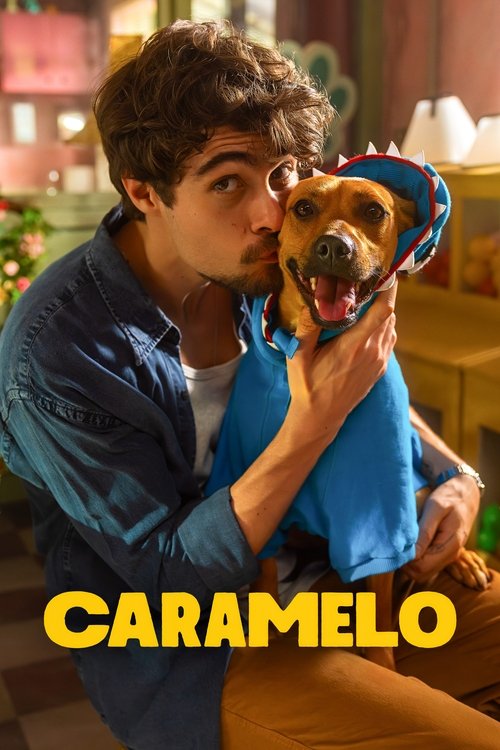
Into that collapse trots a caramel-colored mixed-breed stray (played by the rescued dog Amendoim), a scruffy opportunist with an appetite and an agenda of his own. What begins as an irritation becomes a companionship, and the companionship becomes a slow, stubborn re-education in how to be alive. Around them gather Camila (Arianne Botelho), a dog rescuer who sees both of them clearly; Neide (Kelzy Ecard), Pedro's mother, holding her fear behind her hands; and Léo (Bruno Vinicius), a fellow patient whose humor cuts sharper than any prognosis.

Directed by Diego Freitas (Beyond the Universe) and running a brisk 105 minutes, the film moves between the chrome pressure of professional kitchens, the fluorescent limbo of hospital corridors, and the loose, noisy vitality of São Paulo's streets. It is openly, unapologetically sentimental — a story about mortality told in the key of a wagging tail.


Core Meaning

Freitas — who has said the project grew out of rescuing an abandoned puppy during the pandemic — builds the film around a single reversal: the creature society treats as disposable turns out to be the one teaching a human being how to live. Pedro's whole identity is control: the plated composition, the career timeline, the mastered technique. A diagnosis dismantles control, and a stray dog, who has never had any, becomes his instructor.

The film's message is not that illness is redemptive, but that a life is not a project to be completed. Pedro's ambition had made the future the only place worth living; the dog can only live in the present tense, and drags him there. The closing movement makes this explicit — survival here is not a cure but a practice, something done daily rather than achieved once.

Underneath, there is a distinctly Brazilian argument about worth. The vira-lata caramelo, the country's beloved mongrel, is a national emblem of resilience precisely because nobody planned for it. Freitas proposes that same dignity for his human characters: value is not conferred by pedigree, prestige, or a Michelin-shaped future, but by the simple, insistent fact of being here.

Thematic DNA

Mortality and the loss of control 28%
Unconditional companionship across species 25%
Ambition versus being alive 20%
Abandonment, rescue and who counts as disposable 15%
Family, chosen and inherited 12%

Mortality and the loss of control

Pedro's cerebral glioma arrives at the exact moment of professional triumph, and the film stages illness less as physical suffering than as the collapse of a plan. His cooking is all precision and mastery; the diagnosis introduces a variable he cannot prep, portion, or plate. Through Léo, a fellow patient whose gallows humor refuses solemnity, the film insists that living with mortality is a daily negotiation rather than a single dramatic confrontation.

Unconditional companionship across species

The central relationship is transactional at first — food for proximity — and becomes something neither party names. The dog makes no demands on Pedro's future, offers no advice, and cannot be impressed by his résumé, which is precisely why the bond works: it is the only relationship in his life not contingent on his success. The film's tenderness comes from watching a man learn to be loved for nothing.

Ambition versus being alive

Pedro's kitchen is a shrine to deferred living: everything sacrificed now for a payoff later. The restaurant's fusion of Brazilian roots and modern flair mirrors his own split — the boy from a home kitchen versus the chef performing sophistication. As the film progresses, food shifts meaning, from a vehicle for status to an act of care for specific people, cooked to be eaten rather than judged.

Abandonment, rescue and who counts as disposable

Camila's work rescuing dogs supplies the film's moral vocabulary. Strays are creatures the city has decided not to see, and the film quietly aligns them with anyone rendered inconvenient — the sick, the poor, the unglamorous. Rescue runs in both directions here, and the film is careful never to let Pedro be the sole savior in the arrangement.

Family, chosen and inherited

Neide, Pedro's mother, carries the inherited family — its worry, its cooking, its unglamorous loyalty — while Camila, Léo and the dog assemble into something chosen. The film's long final movement, which leaps forward across years, argues that the family you end up with is largely the one you let in during your worst season.

Character Analysis

Pedro

Rafael Vitti

Archetype: Reluctant hero / the striver undone Key Trait: Stubborn perfectionism that curdles into pride and slowly softens into devotion

Motivation

Initially: to be recognized as excellent, to make the career-defining moment count. Eventually: to stay — for the dog, for Camila, for the ordinary unremarkable days he had previously treated as overhead.

Character Arc

Begins as a headstrong young chef at the threshold of the career he has organized his entire life around, then is knocked off that track by a cerebral glioma diagnosis. His arc moves from denial and fury through a bitter dependence on others toward a hard-won capacity to inhabit the present. By the film's long epilogue, years on, he has built a professional life, a partnership with Camila and a child — while still carrying the illness rather than having defeated it.

Caramelo

Amendoim

Archetype: Trickster and unwitting mentor Key Trait: Irrepressible, unembarrassed appetite for being alive

Motivation

Food, warmth, company, the next interesting smell — an existence entirely in the present tense, which is precisely what Pedro lacks.

Character Arc

Arrives as a mischievous street opportunist with no interest in being anyone's lesson, attaches himself to Pedro through sheer persistence, and is gradually domesticated without being diminished. His transformation is from unclaimed to belonging — and, in the process, he teaches by example rather than by sacrifice, which is the film's most important structural choice.

All 5 characters and cast

Symbols & Motifs

The caramel-colored stray (the <i>vira-lata caramelo</i>)

Meaning:

Brazil's unofficial national dog, an internet-beloved emblem of improvised survival and affection without pedigree. In the film it stands for instinctive hope and loyalty that asks no credentials — and, by extension, for the dignity of everything a society writes off.

Context:

Freitas leans openly on the mongrel's meme-era status as a folk icon, casting the dog not as a pet acquired but as a presence that simply arrives, uninvited, and refuses to be inconvenient enough to leave.

Food and the plated dish

Meaning:

Control, performance and hierarchy when cooked for judgment; love and presence when cooked for someone you know. The transformation of Pedro's cooking tracks his interior change more reliably than any dialogue.

Context:

The high-end restaurant fusing Brazilian tradition with modern technique frames his ambition, and a cameo by real-life chef Paola Carosella as a food critic personifies the external verdict he has organized his life around.

The tumor

Meaning:

Not merely a disease but a figure for every fear that cannot be scheduled away: mortality, loss of authorship over one's own story, the future going dark mid-sentence.

Context:

Crucially, the film never grants it a clean disappearance; it becomes a permanent tenant, which reframes the whole story from cure narrative to coexistence narrative.

The street versus the kitchen

Meaning:

Two philosophies of living — improvisation, appetite and the present tense against measurement, hierarchy and the deferred reward.

Context:

São Paulo's noisy, unruly streets, where the dog is entirely competent, are set against the controlled interior of the restaurant, where Pedro is. Each becomes fluent in the other's territory.

Breath

Meaning:

The film's smallest unit of life: involuntary, unearned, repeatable, and the one thing available when achievement is stripped away.

Context:

It becomes the explicit vocabulary of the ending, where breathing, feeling and living are named as the whole of what was won.

The hospital corridor

Meaning:

Suspended time — the space where plans are held in abeyance and where identity is reduced to a chart.

Context:

It is also where Léo appears, converting the film's most sterile environment into the site of its most unsentimental friendship and its bleakest jokes.

Memorable Quotes

Respirar... Sentir... Viver.
— Pedro

Context

Spoken in the film's closing movement, after a leap of roughly twelve years that shows Pedro's professional progress, his life with Camila and their daughter — a voice from the far side of the crisis, looking back.

Meaning

The film's thesis compressed into three verbs. After a story built on achievement and prognosis, Pedro names the sum of what he has gained not as a cure or a career but as the bare, repeatable acts of being alive. It reframes the entire narrative: the tumor never fully went away, so living became a practice rather than a victory.

Philosophical Questions

Is a life measured by what it achieves or by the fact that it is lived?

Pedro enters the film with an entirely instrumental relationship to his own existence: every day is a payment toward a future restaurant, a future reputation. The diagnosis voids the contract, and the film's answer arrives in its final vocabulary — breathing, feeling, living — placing worth in the bare act rather than the accomplishment. The dog, who achieves nothing, is proposed as the more competent philosopher.

Can you live well with something that will not go away?

The film's most quietly radical decision is to deny Pedro remission. Instead of the cure narrative that the genre promises, it depicts coexistence: the tumor persists, and what changes is the relationship to it, as suffering becomes motivation. The question shifts from "will he be saved?" to "what does a good life look like when rescue isn't coming?"

Who decides what a life is worth?

Strays are, by definition, creatures a society has valued at zero; Camila's rescue work is the practical refutation of that accounting. The film draws the parallel to human worth without spelling it out: Pedro's value in his own eyes is set by a critic's verdict, and he has to learn to reject that exchange rate. The caramel mongrel — worthless by pedigree, beloved by an entire country — is the living counter-argument.

What do we actually owe the beings who depend on us?

Pedro's fear is doubled: he dreads his own death and dreads what becomes of the dog after it. That second fear turns out to be the more transformative one, because obligation to another creature is what pulls him out of self-enclosure. The film suggests that being needed is not a burden added to a life but part of what makes it navigable.

Is love less real when it is unchosen and unearned?

Every human relationship in Pedro's life is conditional on something — performance, history, obligation. The dog's attachment is arbitrary: it fixes on him for no reason and cannot be lost by failure. The film treats this not as a lesser form of love but as the purest available demonstration of it, and measures the human relationships against it.

Alternative Interpretations

The reassurance reading. The most common interpretation takes the ending at face value: Pedro survives, the dog survives, a family is built, and the film is a warm-hearted affirmation that love and companionship carry us through catastrophe. Coverage of the ending emphasized exactly this relief — audiences arriving braced for a dead-dog ending find both protagonists alive.

Full ending explanation

Cultural Impact

Context. Caramelo arrived on Netflix on October 8, 2025, as part of the platform's sustained investment in Brazilian originals, and it was engineered around a piece of homegrown internet folklore. The vira-lata caramelo — the caramel-coated street mongrel — has circulated for years in Brazilian memes as a symbol of scrappy national affection and survival; Freitas took that shared cultural shorthand and built a feature around it, which gave the film instant recognition at home and an easy emotional handle abroad.

Reach. The film travelled well beyond Brazil, with coverage framing Amendoim as a Brazilian street dog who became a global Netflix phenomenon — a rare case of a local vernacular icon breaking internationally in a dog-movie register that needs no subtitling to work.

Critical reception. Reviews were warm but clear-eyed. Roger Moore's Movie Nation called it "a boy-and-his-dog tale that's as adorable as it is sentimental and predictable," while praising it as a "near perfectly executed São Paulo story of a mischievous stray, a young chef and the ways they connect when one of them gets sick." Several critics singled out the second half for its precision about love, ambition and reality. Audience scoring has been notably kinder than the critical shrug, with an IMDb rating around 7.1.

Beyond the screen. The production's own ethics became part of its cultural footprint: around 60 dogs were cast, most rescued or from shelters, and most were adopted by crew members — a fact widely reported alongside the film and effectively functioning as an adoption advocacy campaign attached to a piece of mainstream entertainment.

Audience Reception

Praised. Audiences responded far more generously than the critical consensus, pushing the IMDb score to roughly 7.1 and turning the film into an international Netflix success. The most consistently celebrated elements were Amendoim's screen presence — genuinely expressive rather than merely cute — Rafael Vitti's committed, unvain lead performance, and the specificity of the São Paulo setting. Viewers also singled out the second half as markedly stronger than the first, with reviewers noting "precise, spot on moments of understanding love, goals, dreams, and reality." The real-life rescue story behind the production, and the adoption of most of the roughly 60 cast dogs by crew members, generated enormous goodwill that spilled over into the reception of the film itself.

Criticized. The recurring complaint is predictability. Movie Nation's assessment — "as adorable as it is sentimental and predictable" — captures the dominant reservation: the beats are legible well in advance, the emotional manipulation is unhidden, and the first act leans on familiar arrogant-young-chef shorthand. Some found the crowd-pleasing register at odds with the seriousness of the illness material.

Controversial. The single most discussed question was pre-emptive: does the dog die? The volume of explainer articles devoted to this exact anxiety shows how much of the audience watched defensively, and some viewers felt the film deliberately courted that dread. The other point of debate is the epilogue's long time jump — embraced by many as earned catharsis, dismissed by others as a montage that resolves emotionally what the film hadn't dramatized.

Verdict. A frankly sentimental crowd-pleaser that knows exactly what it is doing, elevated above its formula by a remarkable canine performer, a genuinely moving lead, and an ending braver than the genre requires. Not a film that surprises, but one that delivers what it promises with real craft.

Interesting Facts

  • Director Diego Freitas has said the film grew out of a personal experience: rescuing an abandoned puppy during the COVID-19 pandemic, after which they took the idea to Netflix hoping to tell a story about how dogs transform human lives.
  • The canine star, Amendoim (Portuguese for "peanut"), was himself a rescue. Freitas told the Brazilian outlet Splash that the sick, malnourished three-month-old puppy simply showed up at the door of the production's animal trainer. "It was meant to be," the director said.
  • Amendoim was prepared for the role through months of play-based training rather than pressure-based methods.
  • Roughly 60 dogs were cast in the film, most of them from shelters or rescued from the streets — and the majority were adopted by crew members after filming.
  • Star Rafael Vitti, who already had around ten dogs at the time, kept one of the animals from the production.
  • Animal welfare on set was overseen by Brazilian trainer Luis Estrelas, with American animal trainer Mike Miliotti — whose credits include the Garfield film — brought in as a consultant.
  • Renowned chef Paola Carosella, a familiar face to Brazilian television audiences, makes a special appearance as a food critic.
  • Freitas previously directed the Netflix Brazilian feature Beyond the Universe (2022).
  • The film runs 105 minutes and premiered on Netflix on October 8, 2025.
  • Pedro's illness is specified as a cerebral glioma, a brain tumor — a choice that lets the film explore living with a condition rather than a straightforward cure narrative.

Easter Eggs

Paola Carosella as the food critic

Casting a genuinely famous Brazilian chef and television personality as the arbiter of Pedro's cooking collapses the fiction into reality: the judgment Pedro fears is delivered by someone the audience knows actually holds that power. It is both an in-joke for Brazilian viewers and a sly thematic move about the authority of external verdicts.

The <i>vira-lata caramelo</i> as protagonist

The film's entire premise is an extended reference to a living piece of Brazilian internet culture. The caramel-coated mongrel has spent years circulating in memes and social media as an affectionate national mascot; Freitas essentially promotes a folk icon to leading man, which is why the title needs no explanation for Brazilian audiences.

Amendoim's real-life rescue mirroring the plot

The dog who plays a stray taken in by a stranger was himself a sick stray who turned up at the production's door. The behind-the-scenes story and the on-screen story are the same story, which lends the film's sentimentality an unusual claim to sincerity.

The fusion-cuisine restaurant concept

A kitchen that blends Brazilian culinary roots with modern technique is also a description of Pedro's psychology — and arguably of the film itself, a locally rooted story built on a globally legible Netflix crowd-pleaser template.

Frequently Asked Questions

Explore More About This Movie

Dive deeper into specific aspects of the movie with our detailed analysis pages

Comments (0)

Leave a comment

No comments yet. Be the first to share your thoughts!

Similar Movies