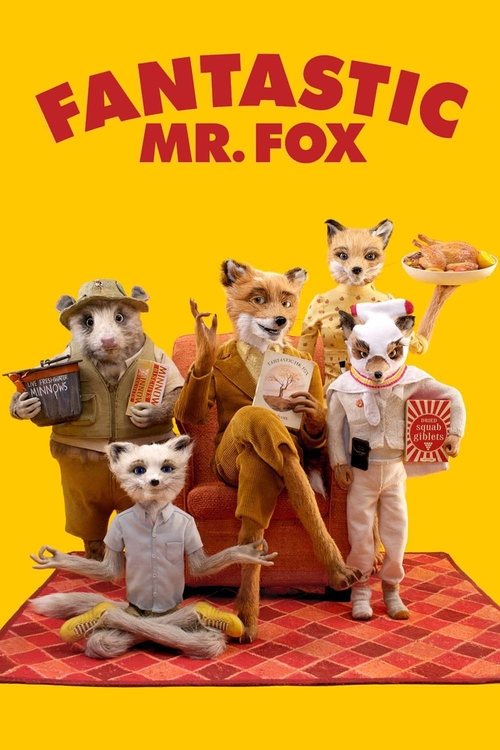
Fantastic Mr. Fox
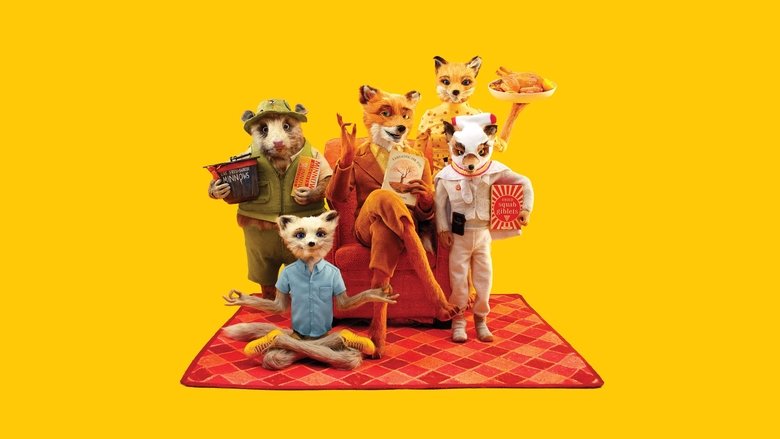
A dapper stop-motion odyssey painting a golden-hued portrait of wild instincts clashing with domesticity, where a fox’s mid-life heist becomes a breathless, underground dance of self-acceptance and survival.
Fantastic Mr. Fox

Fantastic Mr. Fox

"Dig the life fantastic!"

14 October 2009 United States of America 87 min ⭐ 7.8 (5,855)
Director: Wes Anderson
Cast: George Clooney, Robin Hurlstone, Meryl Streep, Jason Schwartzman, Eric Chase Anderson
Animation Family Comedy Adventure
Nature vs. Identity Fatherhood and Legacy Individualism vs. Community Community vs. Industrial Greed
Budget: $40,000,000
Box Office: $46,471,023

Overview

Directed by the visionary Wes Anderson, Fantastic Mr. Fox is a meticulous stop-motion adaptation of Roald Dahl's classic children's novel. The story follows the titular Mr. Fox, a former chicken thief who has spent twelve years living a quiet, "domesticated" life as a newspaper columnist to please his wife, Felicity. However, the urge to return to his wilder days proves too strong, leading him to plan one last series of daring raids on the local farms of Boggis, Bunce, and Bean.

His reckless pursuit of glory backfires, triggering a brutal retaliatory war from the farmers. Forced deep underground with his family and a community of displaced animals, Mr. Fox must pivot from self-serving vanity to selfless leadership. The narrative intertwines this high-stakes heist with the intimate emotional struggles of his son, Ash, who feels overshadowed by his seemingly perfect cousin, Kristofferson. As the human world attempts to bulldoze their existence, the animals must rely on their innate "fantastic" traits to survive in an increasingly hostile landscape.

Core Meaning

At its heart, the film explores the existential struggle of reconciling one's primal nature with social and familial responsibilities. The director suggests that "being fantastic" is not about individual prowess or the reckless pursuit of ego, but about accepting one's flaws and using unique talents for the benefit of the community. It posits that while we may try to mask our true selves with suits and sophisticated language, we remain "wild animals" at our core—a reality that should be embraced with dignity rather than suppressed by shame.

Thematic DNA

Nature vs. Identity 35%
Fatherhood and Legacy 25%
Individualism vs. Community 20%
Community vs. Industrial Greed 20%

Nature vs. Identity

The film repeatedly asks, "How can a fox be happy without a chicken in its teeth?" It explores the tension between civilized domesticity and biological instinct. Mr. Fox's mid-life crisis is rooted in his attempt to deny his nature as a predator, showing that true fulfillment comes only when one acknowledges their inherent traits while adapting them to a responsible life.

Fatherhood and Legacy

The relationship between Mr. Fox and Ash serves as a poignant look at parental expectations and the quest for approval. Ash’s feeling of inadequacy and Mr. Fox's initial failure to see his son's value highlight the difficulty of finding one's own identity when living in the shadow of a legendary parent.

Individualism vs. Community

Mr. Fox begins the film driven by a solitary desire for glory (his "master plan"). By the climax, he realizes that he cannot defeat the farmers alone. The narrative shifts from a solo heist to a collective effort, celebrating the diverse talents of all the animals—from a badger's digging to a mole's eyesight.

Community vs. Industrial Greed

The farmers Boggis, Bunce, and Bean represent the grotesque excess of capitalism. Their mechanical, industrial assault on the hill reflects a disregard for the natural world. The animals' resistance becomes an allegory for the working class or marginalized groups surviving in the face of overwhelming corporate or systemic power.

Character Analysis

Mr. Fox

George Clooney

Archetype: Antihero
Key Trait: Suave, cunning, and compulsively reckless.

Motivation

Driven by a mid-life crisis to prove he is still "fantastic" and a need to escape the "drudgery" of a respectable domestic life.

Character Arc

Evolves from a narcissistic individualist seeking a return to his glory days into a selfless leader who recognizes the damage his ego has caused to his family and community.

Mrs. Felicity Fox

Meryl Streep

Archetype: The Anchor
Key Trait: Logical, artistic, and fiercely protective.

Motivation

Motivated by the safety and emotional health of her family, specifically protecting them from Mr. Fox's dangerous impulses.

Character Arc

Remains a steady force of wisdom, moving from a position of quiet disappointment to assertive guidance, ultimately reminding her husband of the true meaning of their survival.

Ash

Jason Schwartzman

Archetype: The Misfit
Key Trait: Quirky, brooding, and resilient.

Motivation

A desperate desire to be seen as "athletic" and "fantastic" in the eyes of his father.

Character Arc

Transfers his resentment and jealousy toward his cousin into a unique sense of self-worth, eventually saving the group with his own particular, "different" set of skills.

Kristofferson Silverfox

Eric Chase Anderson

Archetype: The Catalyst
Key Trait: Zen-like, naturally gifted, and humble.

Motivation

A quiet search for belonging and stability following his father's illness.

Character Arc

Though seemingly perfect, he learns to integrate into the family unit and becomes a bridge for Ash's development through shared adversity.

Symbols & Motifs

The Wolf (Canis Lupus)

Meaning:

Symbolizes pure, untamed nature and the "wild" that Mr. Fox both fears and admires. It represents a level of freedom that the anthropomorphic animals, with their suits and jobs, can never truly attain.

Context:

Appears in a silent, powerful encounter toward the end of the film. Mr. Fox salutes the wolf, acknowledging a shared identity while finally accepting his own path in the civilized world.

The Tail

Meaning:

Represents Mr. Fox's vanity and ego. Losing it is a physical manifestation of his fall from grace and the consequences of his arrogance.

Context:

Shot off by Bean early in the film, the tail is later worn as a necktie by Bean, humiliating Mr. Fox until he finally learns that his value isn't tied to his physical "perfection."

Cider (Liquid Gold)

Meaning:

Represents dangerous temptation and the intoxicating lure of one's old habits. It is the literal and metaphorical "spirit" of the farmers that the animals covet.

Context:

The final heist takes place in Bean's cider cellar, and the cider later floods the tunnels, nearly destroying the animals—showing how indulgence can lead to ruin.

Memorable Quotes

Who am I, Kylie? Why a fox? Why not a horse, or a beetle, or a bald eagle? I'm saying this more as a... existential query, I suppose, than anything else.

— Mr. Fox

Context:

Spoken during a quiet moment of reflection with Kylie the opossum before Mr. Fox begins his raiding spree.

Meaning:

Highlights the existential crisis at the core of the film—the search for identity beyond one's biological species and social role.

I'm a wild animal.

— Mr. Fox

Context:

Used during arguments with Felicity and Badger to defend his predatory instincts.

Meaning:

A recurring justification for his behavior, used both as an excuse for irresponsibility and eventually as a declaration of authenticity.

We are all different... but there's something kind of fantastic about that, isn't there?

— Mrs. Fox

Context:

Said to Ash while they are hiding underground, comforting him about his differences.

Meaning:

The central moral of the story, advocating for the acceptance of individuality and the celebration of diversity within a community.

Philosophical Questions

Can true authenticity exist within a structured society?

The film explores whether Mr. Fox's "wildness" is a liability to be tamed or a necessary part of his soul that must be accommodated, even if it causes social friction.

Is mediocrity a form of failure or a path to peace?

Through Ash's struggle and Mr. Fox's rejection of his columnar job, the film examines the pressure to be "fantastic" and whether being "different" or "average" is a valid way to exist.

Alternative Interpretations

Some critics interpret the film as an allegory for the creative process, where Mr. Fox represents the artist struggling against the commercial pressures (the farmers) of the industry. Another reading views the film through the lens of class warfare, where the animals represent a displaced working class fighting against the encroaching industrial destruction of the elite. Additionally, the ending has been analyzed as a critique of consumerism, suggesting that while the animals survived, they are now trapped in a perpetual cycle of stealing from the very system that destroyed their natural habitat.

Cultural Impact

Fantastic Mr. Fox marked a significant moment in modern animation, proving that stop-motion could be used to explore sophisticated, adult themes within a family-friendly framework. It helped revitalize the medium, paving the way for Anderson's later work like Isle of Dogs. The film’s autumnal aesthetic and symmetrical compositions have become iconic in pop culture, frequently parodied and celebrated for their "cozy yet clinical" vibe. It is widely considered one of the best literary adaptations of the 21st century for its ability to expand a short children's story into a complex meditation on the human (and vulpine) condition.

Audience Reception

The film was a critical smash hit, lauded for its witty screenplay by Anderson and Noah Baumbach, its tactile visual charm, and the charismatic voice performances. While it had a modest box office performance initially, it has since achieved cult status. Audiences frequently praise its "rewatchability" and the way it appeals to both children (through its slapstick and animal antics) and adults (through its themes of mid-life angst and parental anxiety). The "cuss" word replacement is a particular fan-favorite element of the dialogue.

Interesting Facts

  • Wes Anderson directed the film remotely from Paris, communicating with the London-based animation team via email and a system called Dragon Stop-Motion.
  • The voice actors recorded many of their lines outdoors on a farm, in a forest, and even in an attic to achieve a more naturalistic, organic soundscape.
  • The character of Mr. Fox wears a corduroy suit made from the same fabric and by the same tailor as Wes Anderson's real-life suits.
  • CGI was used only for one specific sequence in the entire film: the flooding of the flint mine with apple cider.
  • The production required 535 puppets; there were 102 different puppets made for Mr. Fox alone across various sizes.
  • The visual style was heavily inspired by the village of Great Missenden, where Roald Dahl lived and wrote.

Easter Eggs

The Magnum P.I. Helicopter

The helicopter used by the farmers is modeled exactly after T.C.’s iconic chopper from the 1980s TV show Magnum, P.I..

Roald Dahl's Gypsy House

The interior of the Fox family's tree house is modeled after Roald Dahl’s own writing hut and his 'Gipsy House' estate.

Jarvis Cocker Cameo

The character Petey, who sings the 'Farmer Bean' song, is both voiced by and modeled after the Pulp frontman Jarvis Cocker.

⚠️ Spoiler Analysis

Click to reveal detailed analysis with spoilers

Frequently Asked Questions

Explore More About This Movie

Dive deeper into specific aspects of the movie with our detailed analysis pages

Comments (0)

Leave a comment

No comments yet. Be the first to share your thoughts!