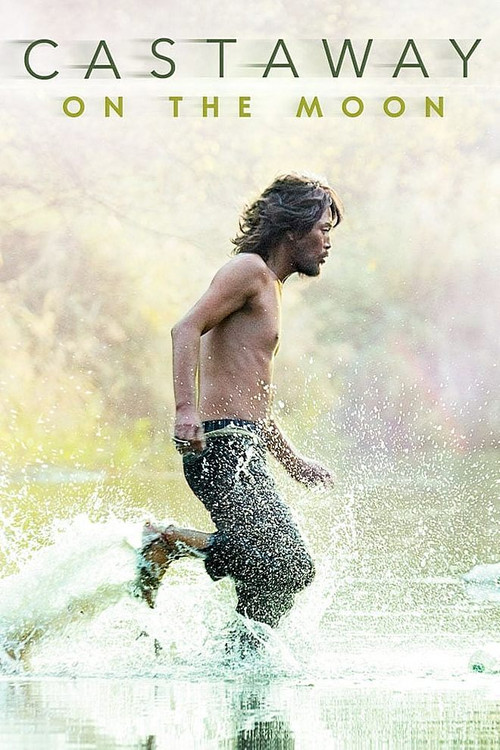
Castaway on the Moon
김씨 표류기
"Once in a life time, There comes a moment that you live in HOPE."
Overview
"Castaway on the Moon" tells the unique story of Kim Seong-geun, a man who, after a failed suicide attempt by jumping off a bridge in Seoul, finds himself washed ashore on the small, uninhabited Bamseom island in the middle of the Han River. Though surrounded by the city's skyscrapers, he is utterly isolated, unable to swim to shore. Initially despairing, he slowly adapts to his new life, finding a strange sense of freedom and purpose away from his crushing debt and societal pressures.
His solitary existence is secretly observed by Kim Jung-yeon, a young hikikomori (a severe social recluse) who hasn't left her cluttered apartment in three years. Her hobby is photographing the moon, but one day she turns her telephoto lens towards the island and discovers Seong-geun. Believing him to be an alien, she becomes fascinated by his daily struggles and triumphs. This voyeuristic observation eventually evolves into a quirky and anonymous form of communication, as she throws messages in bottles onto the island and he writes his replies in the sand, forging a profound connection between two souls adrift in their own worlds.

Core Meaning
The core meaning of "Castaway on the Moon" revolves around the idea that true connection and hope can be found in the most isolating of circumstances. Director Lee Hae-jun explores the paradox of being lonely in a crowded modern world, suggesting that emotional isolation can be more profound than physical separation. The film posits that by disconnecting from the superficial demands of consumerist society, individuals can rediscover a more authentic sense of self and purpose. It is a critique of a capitalist society that pushes people to despair over debt and failure, while celebrating the resilience of the human spirit and the simple, fundamental need for communication and mutual understanding as the ultimate source of salvation.
Thematic DNA
Isolation and Loneliness in the Modern World
The film presents two distinct forms of isolation. Kim Seong-geun is physically marooned on an island in the heart of a bustling metropolis, a stark visual metaphor for feeling alone in a crowd. Kim Jung-yeon's isolation is self-imposed; she is a hikikomori who has retreated from the world into the confines of her room, communicating only through the curated reality of social media. Both characters are profoundly lonely, shipwrecked by their failure to conform to societal standards, and the film uses their parallel lives to explore how modern urban life can alienate individuals despite constant proximity to others.
The Nature of Hope
Hope is a central and recurring theme, symbolized most powerfully by a simple packet of instant jajangmyeon (black bean noodles) seasoning. For Seong-geun, the desire to make and eat these noodles becomes his reason for living, a tangible goal that gives his life meaning and structure. His quest to cultivate corn and produce his own noodles is an act of profound hope and self-reliance. For Jung-yeon, observing Seong-geun's journey becomes her source of hope, inspiring her to break out of her own prison. The film suggests that hope isn't about waiting for rescue, but about creating purpose from the simplest of desires.
Critique of Capitalism and Consumerism
The film opens with Seong-geun's suicide attempt, a direct result of his overwhelming debt in a hyper-competitive capitalist society. His life on the island, free from financial worries and societal expectations, becomes a critique of the consumerist treadmill. He learns to find joy not in possessions, but in small, earned victories like starting a fire or harvesting a vegetable. Jung-yeon's room, filled with hoarded consumer goods, stands in stark contrast to Seong-geun's minimalist existence, highlighting how material possessions fail to cure her deep-seated loneliness.
Human Connection and Communication
Despite being physically separated and never speaking face-to-face until the very end, the two Kims build a deeply meaningful relationship. Their unconventional communication—messages in bottles and words written in sand—transcends the superficiality of Jung-yeon's online interactions. The director intentionally had them communicate in simple English words like 'HELLO' and 'HOW ARE YOU?' to signify that they are creating their own unique language, separate from the mainstream society that has excluded them. Their connection shows that genuine communication is about shared understanding and empathy, not physical presence or complex language.
Character Analysis
Kim Seong-geun
Jung Jae-young
Motivation
Initially motivated by despair and a desire to escape his life, his motivation shifts to survival. This is quickly replaced by a powerful, self-created purpose: to successfully cultivate, create, and consume a bowl of jajangmyeon. This small goal becomes the anchor for his entire existence and recovery.
Character Arc
Seong-geun begins as a hopeless and defeated man, pushed to suicide by societal and financial pressures. His accidental isolation forces him to move beyond despair towards self-reliance. He rediscovers the will to live not through a grand purpose, but through the simple goal of making noodles. He transitions from wanting to die to escape society to fiercely protecting his newfound, self-sufficient world from the intrusion of that same society. Ultimately, the connection he forms with Jung-yeon pulls him back, suggesting a future that integrates his newfound self-worth with human companionship.
Kim Jung-yeon
Jung Ryeo-won
Motivation
Her primary motivation is to escape the real world, which she finds terrifying and judgmental. Her new motivation becomes the desire to connect with the man on the island. His existence gives her a focus outside of herself and inspires her to breach her self-imposed boundaries to maintain their unique bond.
Character Arc
Jung-yeon starts as a hikikomori, living a meticulously scheduled but stagnant life within the confines of her bedroom. Her world is virtual and entirely controlled. Observing Seong-geun, her 'alien', becomes a catalyst for change. She moves from passive observation to active communication, physically leaving her apartment to deliver messages. Her journey is one of immense courage, as she overcomes her crippling social anxiety step-by-step, culminating in her desperate run through the city to find Seong-geun, fully re-engaging with the world she had abandoned.
Symbols & Motifs
Jajangmyeon (Black Bean Noodles)
The packet of jajangmyeon seasoning represents hope, purpose, and the will to live. It transforms from a simple craving into Seong-geun's entire reason for being, a tangible goal that he must work towards. It symbolizes the idea that even the smallest, most mundane desire can provide the motivation needed to survive and find happiness.
Seong-geun finds a discarded packet of jajangmyeon seasoning on the island. Having never made noodles before, he dedicates himself to cultivating his own grain to eventually fulfill his dream of eating a bowl of the noodles. This quest structures his life on the island.
The Moon
The Moon symbolizes a world of perfect, peaceful isolation. Jung-yeon's obsession with photographing it stems from her desire for a place without people, a place where one cannot feel lonely. Seong-geun, on his 'desert island' within the city, effectively becomes her 'man on the moon'—an object of fascination in a world of his own, initially as remote and unreachable as the celestial body itself.
Jung-yeon's primary hobby before discovering Seong-geun is taking pictures of the moon every night through her telephoto lens. It is during one of these sessions that she accidentally discovers him on the island, shifting her focus from the sky to the earth.
Messages in a Bottle
This classic symbol of castaways represents a hopeful, uncertain act of reaching out. It's a form of communication that relies on chance and patience, mirroring the slow, tentative, and deeply meaningful connection forming between the two characters. It is an act of faith, sending a message into the unknown with no guarantee of a response, which is precisely what both characters must do to overcome their isolation.
To communicate with Seong-geun after seeing his 'HELLO' message in the sand, Jung-yeon writes messages, puts them in wine bottles, and ventures out at night to throw them from a bridge onto the island. This is her first significant step outside her comfort zone.
Cyworld (Social Media)
Jung-yeon's curated Cyworld page symbolizes the false, superficial nature of modern digital connection. She creates a glamorous, idealized version of herself online, which stands in stark contrast to her real, isolated, and messy life. It represents the emptiness of performing for a virtual audience versus the authenticity of her connection with Seong-geun, which is anonymous and based on shared experience rather than a fabricated identity.
Jung-yeon spends a significant portion of her day maintaining her Cyworld page, posting photos of an idealized self and interacting with online 'friends'. This digital life is shown to be a hollow substitute for genuine human interaction.
Memorable Quotes
자살도 실패한 병신.
— Kim Seong-geun
Context:
This is one of the first things Seong-geun says (or thinks) after realizing his suicide attempt has failed and he is stranded on Bamseom island. He looks at the 63 Building across the river, a landmark from which a fall would be fatal, and berates himself for failing even at this final task.
Meaning:
Translated as "Stupid. Can't even die." or "Retard. You can't even die." This line, spoken by Seong-geun to himself after he wakes up on the island, encapsulates his initial state of complete self-loathing and hopelessness. It's a moment of dark, tragic comedy that establishes the depth of his despair, seeing even his failure at suicide as another personal failing.
Desire makes humans smarter.
— Kim Seong-geun
Context:
Seong-geun has a eureka moment as he contemplates the packet of black bean noodle seasoning. He understands that this newfound desire to eat this specific meal is driving him to think in new, creative ways to achieve his goal, kicking his survival instincts into high gear.
Meaning:
This realization marks a turning point for Seong-geun. After finding the jajangmyeon seasoning, he is filled with a powerful desire to eat the noodles. This simple craving sparks his ingenuity, leading him to figure out how to farm and survive. The quote suggests that purpose and intelligence are not abstract concepts but are born from fundamental, even mundane, desires.
My name is Kim Jung-yeon. What's yours?
— Kim Jung-yeon
Context:
After Seong-geun is forcibly 'rescued' from the island and is on a bus headed towards the 63 Building for another suicide attempt, a city-wide emergency drill halts all traffic. Jung-yeon, having run frantically from her apartment, manages to find and board his bus. She walks up to him and introduces herself, culminating the entire film.
Meaning:
This is the first time the two characters meet in person and speak directly. For Jung-yeon, saying her own name out loud to a stranger is the final, triumphant step in her journey of re-engaging with the world. It is an act of immense bravery that sheds the anonymity of their previous communication and her online persona, signaling her readiness for a real, present connection.
Philosophical Questions
What constitutes a meaningful life?
The film directly contrasts two paths to meaning. Modern society, with its emphasis on career, status, and wealth, drives Seong-geun to suicide. On the island, however, he finds profound meaning in the simplest of tasks: survival and the pursuit of a single, self-made meal. The film asks whether a meaningful life is defined by external achievements recognized by society or by internal, self-defined purpose, no matter how small or seemingly absurd.
Is it possible to be truly alone in a connected world?
"Castaway on the Moon" explores the paradox of loneliness in a hyper-connected, urbanized world. Seong-geun is physically alone yet visually surrounded by millions. Jung-yeon is virtually connected to many yet physically and emotionally isolated. The film questions the nature of presence and connection, suggesting that genuine connection is a rare and intentional act that transcends physical or digital proximity.
Does retreating from society lead to freedom or a different kind of prison?
Both characters retreat from society, but with different outcomes. For Jung-yeon, her room is a prison born of fear. For Seong-geun, the island initially feels like a prison but evolves into a sanctuary of freedom. The film explores this duality, suggesting that withdrawal can be a necessary step for healing and self-discovery, but that ultimate fulfillment requires a courageous return to the world, hopefully on one's own terms.
Alternative Interpretations
While the film is largely seen as a hopeful romantic comedy, some viewers and critics have offered alternative readings of its narrative and ending.
- The Ending as Hallucination: One darker interpretation posits that the ending is a fantasy in Seong-geun's mind. After the devastating typhoon destroys his entire world on the island, he is forcibly removed. This theory suggests that he either successfully commits suicide at the 63 Building or dies from despair, and the reunion with Jung-yeon is a final, imagined moment of hope.
- A Metaphor for Mental Illness: The entire film can be viewed as an extended metaphor for battling depression. Seong-geun's island is his depressive state—isolated and seemingly inescapable. His methodical process of building a life there mirrors the small, incremental steps needed to recover, with the jajangmyeon representing a reason to keep going. Jung-yeon's journey represents overcoming social anxiety. Their connection is not just romantic but therapeutic, as they essentially help each other heal and re-enter the world.
- The Island as True Paradise: An alternative reading of Seong-geun's character arc is that his 'rescue' is the true tragedy. On the island, he had found a fulfilling, self-sufficient life free from the pressures that drove him to suicide. Being forced back into the society he rejected is a violation, and the ending is not a purely happy one, but a bittersweet compromise where he must now find a way to live in a world that nearly destroyed him, albeit with a new companion.
Cultural Impact
"Castaway on the Moon" was not a major box office hit upon its release but has since gained significant recognition and a cult following internationally, celebrated for its originality, charm, and emotional depth. It stands as a prominent example of South Korean cinema's ability to blend genres—comedy, drama, and romance—in unconventional ways to tell a deeply humanistic story. The film's release in 2009 came at a time of global economic uncertainty, and its critique of debt-driven despair and consumer culture resonated with many viewers. It thoughtfully explores the modern phenomenon of social isolation, particularly the Japanese concept of hikikomori, presenting it with empathy rather than judgment. For many international viewers, it served as an accessible and heartwarming introduction to the creativity of Korean cinema beyond the more common thriller and horror genres. Its enduring popularity on streaming platforms has cemented its status as a beloved, quirky classic that offers a poignant commentary on the search for connection in a disconnected world.
Audience Reception
Audiences have overwhelmingly praised "Castaway on the Moon" for its originality, warmth, and quirky charm. Review aggregators and film forums show a very high approval rating, with viewers frequently highlighting the perfect balance of humor and pathos. The performances of the two leads, Jung Jae-young and Jung Ryeo-won, are consistently lauded for their ability to convey a wide range of emotions with minimal dialogue. The central concept of two isolated people finding each other is described as heartwarming and deeply moving. The main point of praise is its ability to be a feel-good movie without being saccharine, tackling serious issues like suicide and social anxiety with a light, hopeful touch. Criticisms are minor and infrequent, but some viewers have noted that the pacing can feel slow at times, particularly in the first act before the two characters' stories fully intertwine. However, most agree that the deliberate pacing is essential to building the atmosphere of isolation and the rewarding emotional payoff of the ending.
Interesting Facts
- To realistically portray a castaway, actor Jung Jae-young lost 7 kg (about 15 lbs) over three months, and refrained from cutting his hair or nails.
- The film was the first ever to receive official permission to shoot on Bamseom island, which is a protected nature reserve in Seoul. However, only the beach scenes could be filmed there; the forest interiors were shot in other locations.
- Actress Jung Ryeo-won, who played the hikikomori, spoke of feeling genuinely lonely during filming as most of her scenes were shot alone in her room set.
- The director, Lee Hae-jun, chose the common surname 'Kim' for both protagonists to suggest that these characters could be anyone, representing a universal experience of urban loneliness.
- The decision to have the two characters communicate in simple English was a deliberate choice by the director to show that they were creating their own private world with its own language, separate from the Korean-speaking society that had alienated them.
⚠️ Spoiler Analysis
Click to reveal detailed analysis with spoilers
Frequently Asked Questions
Explore More About This Movie
Dive deeper into specific aspects of the movie with our detailed analysis pages
Comments (0)
No comments yet. Be the first to share your thoughts!