La Familia del Barrio
Overview
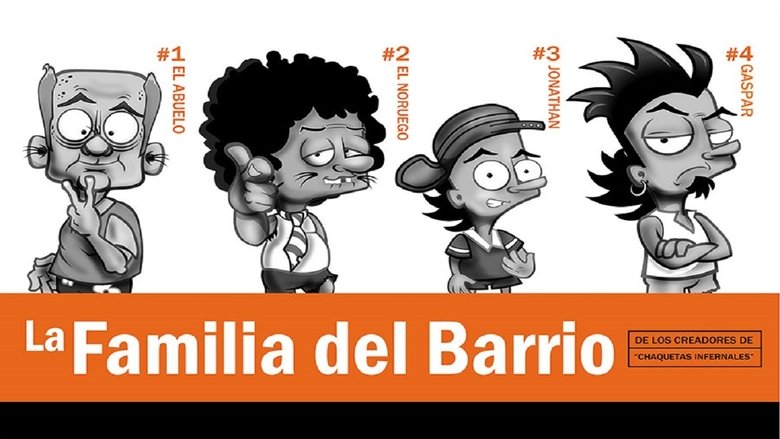
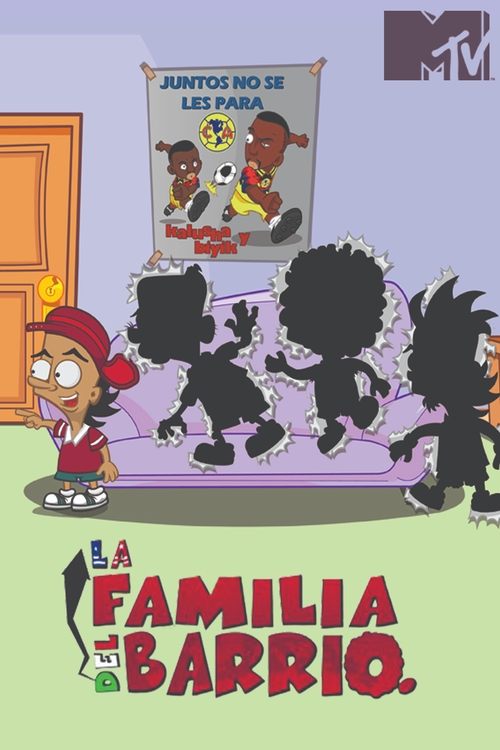
"La Familia del Barrio" is an adult animated sitcom that chronicles the surreal and dysfunctional lives of the Barrio family, residing in a fictional apartment building in Mexico City. The household is a chaotic mix of personalities: Gaspar, the relatively responsible single father trying to maintain some semblance of order; his pre-teen son Jonathan, who is often the most mature and sensible member of the family; El Abuelo (The Grandfather), a lewd, selfish, and vice-driven old man with a past as a male prostitute; and El Noruego, Gaspar's freeloading, womanizing, and irresponsible best friend who lives with them.
Across its seasons, the series eschews a strong overarching plot in favor of episodic adventures that satirize Mexican society, pop culture, politics, and daily life with a heavy dose of black humor, vulgarity, and absurdity. The family constantly finds itself in bizarre situations, from dealing with their criminal neighbor Peluzín to embarking on outlandish schemes initiated by El Abuelo or El Noruego, which Gaspar and Jonathan are inevitably dragged into. The humor is raw and unapologetic, drawing comparisons to shows like "South Park" and "Beavis and Butthead" for its willingness to tackle controversial topics and its crude animation style. The narrative consistently revolves around the family's attempts to navigate poverty, their own profound character flaws, and the absurdity of the world around them.

Core Meaning
At its core, "La Familia del Barrio" serves as a biting social satire, using a dysfunctional family as a microcosm to critique and parody the idiosyncrasies of Mexican working-class life. The creators, Teco Lebrija and Arturo Navarro, use black humor and often grotesque situations to explore themes of poverty, ignorance, corruption, and the erosion of traditional family values in modern society. Through its crude exterior, the series delivers a commentary on how people with limited opportunities navigate a chaotic world, often with absurd and self-destructive coping mechanisms. The underlying message is a raw reflection of societal flaws, suggesting that while the family's actions are outrageous, they are products of a larger, equally absurd environment. Despite the constant insults and selfish behavior, there are fleeting moments of loyalty and fraternity, suggesting a twisted, unbreakable bond that holds this chaotic unit together.
Thematic DNA
Social Satire and Critique
This is the central theme of the series. The show consistently lampoons various aspects of Mexican society, including politics, celebrity culture, social class divides, and religion. Episodes often parody real-life events, television shows (like a spoof of Laura Bozzo's talk show), and political scandals. The humor is deeply rooted in the specific cultural context of Mexico City, using slang and referencing local customs to critique the nation's struggles with corruption, bureaucracy, and social inequality. The characters themselves are archetypes of societal failings: El Noruego represents laziness and irresponsibility, while El Abuelo embodies cynicism and moral decay.
Dysfunctional Family Dynamics
The series is a case study in extreme family dysfunction. The relationships are defined by mutual insults, selfishness, and a complete lack of conventional affection. El Abuelo constantly belittles and exploits his family, Gaspar struggles to be a responsible authority figure, and El Noruego is a perpetual bad influence. Jonathan, the child, is ironically the moral compass, often highlighting the absurdity of the adults' behavior. Despite the toxic environment, they remain a cohesive unit, bound by circumstance and a strange, unspoken loyalty. This theme explores the idea of family not as an idealized institution, but as a messy, co-dependent, and often destructive force that people are stuck with.
Poverty and Lack of Opportunity
The family's financial struggles are a constant source of conflict and motivation for their ridiculous schemes. Living in a modest apartment building, with Gaspar as the sole provider, they are always on the lookout for a way to make easy money, which invariably backfires. This theme is a reflection of the economic realities for many in the lower-middle class, showcasing the desperation and questionable choices people make when faced with limited resources. The show uses humor to highlight the indignities of poverty and the almost surreal lengths the characters will go to for a small material gain.
Absurdity and Surrealism
The show's narrative logic frequently descends into the bizarre and surreal. The plots are driven by outlandish premises, such as time travel to prevent a soccer player from becoming president, dealing with ancient curses, or El Abuelo hiring an assassin to kill their neighbor. This theme separates the show from realistic sitcoms, placing it in a tradition of adult animation where the impossible is commonplace. The surrealism serves to heighten the satire, suggesting that the reality of the world they inhabit is so fundamentally flawed that it can only be accurately represented through absurdity.
Character Analysis
El Abuelo (The Grandfather)
Sergio "Teco" Lebrija
Motivation
His motivations are primal and unwavering: satisfying his immense libido, usually at the local brothel, and acquiring money through the least amount of effort possible. He is also motivated by a deep-seated cynicism and a desire to cause chaos and suffering for his own amusement, particularly for his family members. He actively sabotages any attempt at normalcy or responsibility within the household.
Character Arc
El Abuelo displays a remarkable lack of a traditional character arc; he is consistently and unapologetically selfish, lewd, and misanthropic from the beginning to the end of the series. His development is not one of growth, but of reinforcement. He remains a creature of pure id, driven by his addictions to sex and easy money. Any moments that hint at potential change or sentimentality are almost immediately undercut by an act of profound selfishness or cruelty, solidifying his role as the chaotic, unchanging anchor of the family's dysfunction.
Gaspar
Sergio "Teco" Lebrija
Motivation
Gaspar's primary motivation is to be a good father to his son, Jonathan, and to keep the family financially afloat. He desperately wants to provide a stable environment and instill good values in his son, a goal that is made virtually impossible by his housemates. His struggle is the classic sitcom conflict of order versus chaos.
Character Arc
Gaspar is the long-suffering nucleus of the family, and his arc is largely static, defined by his perpetual, and consistently failing, attempt to impose responsibility on his deeply irresponsible family. While he never stops trying to be the mature adult, the series sees him worn down over time, becoming more resigned to the chaos he cannot control. He starts as the voice of reason and slowly evolves into a man perpetually on the verge of a nervous breakdown, whose moments of assertiveness are always swallowed by the overwhelming dysfunction created by El Abuelo and El Noruego.
El Noruego
Sergio "Teco" Lebrija
Motivation
El Noruego is motivated by the avoidance of all forms of work and responsibility. His goals are simple: eat, drink, and pursue women, all on Gaspar's dime. He is driven by immediate gratification and a profound lack of foresight, which leads him to enthusiastically join any of El Abuelo's ill-advised schemes.
Character Arc
Similar to El Abuelo, El Noruego (The Norwegian) is an intentionally static character who resists growth. He is the epitome of the irresponsible, lazy, and womanizing best friend. Throughout the series, he remains unemployed, contributing nothing to the household and consistently making terrible, impulsive decisions that create problems for Gaspar. His arc is a flat line of immaturity; he learns no lessons and feels no remorse, serving as a constant source of conflict and a foil to Gaspar's attempts at a normal life.
Jonathan
Sergio "Teco" Lebrija
Motivation
Jonathan is motivated by a simple desire for a normal life and a genuine love for his father, Gaspar. He often tries to steer his father, great-grandfather, and El Noruego toward more sensible decisions, though he is rarely successful. He represents the glimmer of hope and decency in an otherwise morally bankrupt household.
Character Arc
Jonathan is the ironic heart and mind of the family. His arc is one of maintaining his sanity and moral compass amidst the depravity of his elders. He starts as a mature child and remains so, often acting as the adult in the room. His development is seen in his growing awareness and cynicism about the world his family has exposed him to. While he retains his good heart, the series shows him becoming increasingly adept at navigating and commenting on the chaos, rather than just being a passive victim of it.
Memorable Quotes
¡Cállate, pendeja!
— El Abuelo
Context:
Used constantly throughout the entire series in response to almost any statement he disagrees with or finds annoying. For example, in one scene, after a nonsensical game of charades, he yells it at El Noruego for not being able to speak.
Meaning:
This is arguably El Abuelo's most frequent and iconic catchphrase, which he directs at nearly everyone, regardless of gender. It encapsulates his misogynistic, impatient, and perpetually angry worldview. The humor comes from its constant, inappropriate, and aggressive repetition in any situation, highlighting his complete lack of a social filter.
No mames, Abuelo.
— Gaspar
Context:
Uttered in nearly every episode by Gaspar, usually after El Abuelo suggests something outrageous, reveals a horrifying story from his past, or insults someone for no reason. For instance, when El Abuelo claims to have been a male prostitute in his youth.
Meaning:
This phrase, translating roughly to "No fucking way, Grandpa" or "You've got to be kidding me, Grandpa," is Gaspar's signature expression of exasperation. It is his go-to response to the latest insane, dangerous, or depraved idea that El Abuelo has concocted. It perfectly summarizes Gaspar's role as the beleaguered straight man reacting to the madness around him.
Te presento al gran Jodini. Es Judini, güey. Sí, pero yo soy Jodini porque estoy jodido.
— El Noruego and Gaspar
Context:
In the episode "El Gran Jodini," El Noruego decides to become a magician to make money. He introduces his new persona to a skeptical Gaspar with this line, revealing his assistant is a sock puppet named "Señor Hilachas" (Mr. Threads).
Meaning:
This exchange perfectly captures El Noruego's character and the show's self-deprecating humor. By calling himself "Jodini"—a pun on "Houdini" and the Spanish word "jodido" (meaning screwed, broke, or f*cked)—he proudly embraces his status as a broke loser. It's a moment of pathetic yet strangely charming self-awareness.
Philosophical Questions
Is family defined by love and support, or merely by co-dependence and circumstance?
The series constantly challenges the traditional notion of a loving family. The Barrio household operates on a foundation of mutual exploitation, insults, and selfishness. Yet, the members are inextricably linked and function as a unit, however chaotically. The show explores whether this forced proximity and deep-seated co-dependence, devoid of conventional affection, can still be defined as "family." Do their occasional, fleeting moments of solidarity in the face of external threats give their toxic relationship a twisted sort of validity?
To what extent is an individual a product of their dysfunctional environment?
"La Familia del Barrio" presents characters who are deeply flawed. El Abuelo is depraved, and El Noruego is pathologically lazy. The series raises the question of whether these characters are inherently corrupt or if their behavior is a rational, albeit extreme, response to a life of poverty, marginalization, and lack of opportunity. Is their embrace of hedonism and irresponsibility a form of rebellion against a system that has offered them nothing, or is it simply a personal moral failing? The show uses their absurd lives to blur the line between personal choice and environmental determinism.
Alternative Interpretations
One of the primary debates surrounding "La Familia del Barrio" is whether it is a sharp piece of social commentary or simply a vulgar, low-brow comedy. One interpretation views the series as a clever satire that uses its crude animation and offensive humor as a vehicle to critique the socio-economic realities of Mexico's marginalized classes. In this reading, the characters' profound flaws and dysfunctional behavior are not just for shock value but are symptomatic of a society with systemic problems like poverty, lack of education, and corruption. The show is seen as a reflection, albeit a distorted one, of a genuine cultural milieu.
Conversely, a more critical interpretation argues that the series often mistakes vulgarity for wit. From this perspective, the show's reliance on repetitive gags, toilet humor, and excessive profanity overshadows any potential for insightful social critique. The characters are seen not as complex archetypes but as one-dimensional and predictable vehicles for offensive jokes. This view holds that the show's humor is aimed at an immature audience and that it fails to evolve beyond its initial premise, ultimately offering little more than surface-level shock without deeper substance.
Cultural Impact
"La Familia del Barrio" carved a significant niche in Mexican and Latin American animation by offering a distinctly local, unapologetically crude, and satirically sharp alternative to imported adult cartoons. Created in 2004 and gaining popularity on YouTube before its 2013 MTV debut, the show arrived at a time when adult animation in the region was still developing. It drew inspiration from American shows like "South Park" and "Beavis and Butthead" but thoroughly grounded its humor in the specific social and cultural context of Mexico City's working class.
Its influence lies in its raw portrayal of Mexican idiosyncrasies, from slang and social customs to parodies of national politics and media figures. The series became a cult hit by reflecting a reality—albeit a grotesquely exaggerated one—that was recognizable to its audience, tackling themes of poverty, corruption, and systemic dysfunction with black humor. While some critics dismissed it for its simplistic Flash animation and reliance on toilet and sexual humor, audiences connected with its honesty and irreverence. The show's success demonstrated a viable market for adult-oriented animated content made by and for a Latin American audience, paving the way for other creators. Its legacy is that of a pioneering series that, despite its rough edges, provided a powerful, humorous, and deeply cynical critique of modern Mexican life.
Audience Reception
Audience reception for "La Familia del Barrio" has been largely polarized, though it has maintained a loyal cult following since its early days on YouTube. Fans praise the show for its audacious, unfiltered humor and its satirical portrayal of Mexican culture and daily life. Many viewers find the characters relatable in their flaws and appreciate the show's willingness to tackle taboo subjects with a dark comedic lens. The specific, slang-filled dialogue and references to Mexican pop culture are frequently cited as highlights, creating a strong sense of authenticity for its target audience.
However, the series has also faced significant criticism for its crude and often simplistic animation style, which some find lazy and unappealing. A common critique is that the humor is overly reliant on profanity, sexual jokes, and toilet humor, which can become repetitive and tiresome. Some critics and viewers argue that the show lacks substance beneath its shocking exterior, with one-dimensional characters and predictable plots. Despite these criticisms, its successful transition from the internet to television networks like MTV and Comedy Central, as well as the production of a movie, confirms its significant and enduring appeal to a large segment of viewers who enjoy its brand of irreverent comedy.
Interesting Facts
- The series was created by longtime friends Sergio "Teco" Lebrija and Arturo Navarro, who have known each other since they were 11 years old.
- Before it was picked up by MTV in 2013, "La Familia del Barrio" began as a web series on YouTube, with the first episode uploaded as early as 2008.
- The creators were inspired by adult animated shows like "South Park" and initially used the software they had for coding a webpage to start animating.
- Creator Sergio "Teco" Lebrija provides the voices for nearly all of the characters in the series.
- The animation for the entire series is done in Adobe Flash, which contributes to its distinctive and intentionally crude visual style.
- When pitching the show to MTV, the creators presented a pilot called "El Gato Razurado" (The Shaved Cat), which got them hired.
- The show is set in the John F. Kennedy housing unit in the Jardín Balbuena neighborhood of Mexico City.
- A feature film based on the series, "La Familia del Barrio: La Película," was produced and released on the Vix streaming platform in 2024.
⚠️ Spoiler Analysis
Click to reveal detailed analysis with spoilers
Frequently Asked Questions
Explore More About This Movie
Dive deeper into specific aspects of the movie with our detailed analysis pages
Comments (0)
No comments yet. Be the first to share your thoughts!